If the Purchase Funnel is Dead, it’s been Replaced by … What?

For most marketing professionals over the age of 30, the purchase funnel was one of the fundamental staples of their business training.
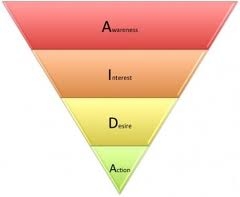
AIDA purchase funnelIn fact, the famous “AIDA” model – which stands for awareness, interest, desire and action – was first posited as far back as 1898 by Elias St. Elmo Lewis, an American sales and advertising professional and business writer.

“AIDA” was also the inspiration behind the classic purchase funnel – an orderly, simple path consumers take on the way to selecting and purchasing a product or service.

AIDA has had a good run, because for more than a century, the AIDA purchase funnel has meshed neatly with the various advertising and MarComm tactics that have come along the pike – print advertising, direct mail marketing, radio, television – and even the Internet.

While some people might contend that the advent of the Internet disrupted traditional buying processes, the greater reality is that it brought certain aspects of the buying process into sharper relief. Search engine optimization and search engine marketing stepped in to play nicely within the “interest, desire and action” steps.

Even better, Internet marketing made ineffective “soft” attitudinal metrics less important; all of a sudden, it became much easier to make educated decisions about sales and marketing programs based on hard evidence.

But with social media taking center stage, everything is now scrambled. The tidy “linear” purchase process just doesn’t reflect what’s happening now that “interactivity all over the place” is the thing.

But what exactly is the new “thing” when it comes to the purchase process? There’s a lot of discussion … lots of thinking … but not much in the way of conclusions.

Perhaps the most well-known attempt at replacing AIDA with a new model has been made by consulting firm McKinsey. In 2009, it came up with the “modern” version of the purchase funnel which it dubbed “the consumer decision journey.”

McKinsey purchase funnel
McKinsey’s new model has been described as a “purchase cycle,” a “customer journey,” and various other alternative explanations — you can take your pick.

But what exactly is that? When you look at how McKinsey attempts to graph it … it may be the proverbial “big ol’ mess.”  I’ve pictured it here so you can try and have some fun with it.

The “McKinsey Whatever” may be hard to grasp pictorially, but there’s one thing’s about it: it’s surely not linear.

There are two circles (kind of). Consumers can go around within the circles forwards or backwards. They can also go sideways between the two (sort of).

Truth be told, the “McKinsey Thingamabob” is fairly difficult to untangle. At least that’s the claim of some business observers such as Jon Bond, a marketing specialist and cofounder of branding agency Kirschenbaum Bond Senecal. He writes this:

“I’ve been in 20 meetings where the ‘McKinsey Frankenfunnel’ has come up , and not once has anyone had the courage to admit that they didn’t have a clue what to do with it.”

Bond goes on to posit that introducing this new model was a masterstroke on the part of McKinsey (wittingly or unwittingly) because it’s become a boon to its consulting business: Companies have to hire McKinsey so the consulting firm can explain it, he notes wryly.

Whether it’s the McKinsey diagram or any other one that’s been proffered recently in an attempt to illustrate the new purchasing paradigm (one being a Google model with the eyebrow-raising acronym “ACID”) – what’s clear is that the purchase process is more complex then ever before. And in that process, the number of touchpoints has also grown dramatically.

Perhaps the best thing to do is to jump out of the funnel (or box, or circles, or whatever the purchase cycle is today). Instead of focusing on impressions or touchpoints, let’s remember the big thing that interactivity has placed in the hands of purchasers: far more opportunity to see and hear what trusted influencers are saying about products, services and brands.

It’s like going back to traditional, pre-1900 word-of-mouth advertising — and putting it on steriods.

Jon Bond contends that this new riff on WOM may be the smarter way of looking at the purchase journey a customer takes today. Instead of the “old AIDA” or the “new interactivity,” he suggests focusing more on three degrees of “trust“:

  • Before trust: Even if the brand is known, it’s not yet trusted because no credible third party has validated the brand in the eyes of the buyer.
  • Trust exists: An interaction happens with a trusted influencer who recommends the brand or has positive things to say about it.
  • Advocacy: Nirvana for companies, wherein a highly satisfied customer also becomes a brand advocate, providing third-party validation and attracting additional new customers because of the resulting brand credibility.

Incidentally, the above scenario is particularly effective in the B-to-B world, where credibility and the “CYA” impulse have always played big roles in guiding business buyers to make purchase decisions they won’t regret later.

Consider it the IBM principle, writ large:  You’ve probably heard the adage that “nobody ever got fired for recommending IBM.”  Now, in the “Age of Interactivity,” that principle can apply across the board.

“Social Media Stress Syndrome”: Real or Fake?

Social Media Stress SyndromeThere’s no denying the benefits of social media in enabling people to make new friendships, reconnect with old acquaintances, and nurture existing relationships.

Facebook and other social platforms make it easier than ever to maintain “in the moment” connections with people the world over. 

Speaking for myself, my immediate relatives who live in foreign lands seem so much closer because of social media.

Plus, thanks to social media, I’ve met other relatives from several different countries for the very first time.  This would never have happened in the pre-Facebook era.

But there are downsides to social media, too – and I’ve written about them on this blog on occasion; for example, whether social media is a platform for narcissists.

Other negative consequences of social media have been noted by numerous observers of consumer online behaviors, including Canadian digital marketing company Mediative’s Senior Vice President and online marketing über-specialist Gord Hotchkiss.

Gord Hotchkiss
Gord Hotchkiss

In a recently published column by Hotchkiss headlined “The Stress of Hyper-Success,” he posits that self-regard and personal perspectives of “success” are relative.  Here’s a critical passage from what he writes:

“We can only judge it [success] by looking at others.  This creates a problem, because increasingly, we’re looking at extreme outliers as our baseline for expectations.”

Hotchkiss’ contention is that social media engenders feelings of stress in many people that would not occur otherwise.

Pinterest is a example.  A recent survey of ~7,000 U.S. mothers conducted by Today.com found that ~42% of respondents suffer from this social media-induced stress; it’s the notion that they can’t live up to the ideal suggested by the images of domestic bliss posted on the female-dominated Pinterest social network.

Facebook causes a similar reaction in many; Hotchkiss reports on a survey showing that one-third of Facebook users “feel worse” after visiting the site.

It may not be hard to figure out why, either, as visitors are often confronted with too-good-to-be-true photo galleries chronicling friends’ lavish vacations, social gatherings, over-the-top wedding ceremonies, etc.

Social Media EnvyIt’s only natural for people to focus their attention on the “extraordinary” posts of this type … and to discount the humdrum posts focusing on the mundane aspects of daily life. 

Just like in the national or local news, people tend to focus on personal news items that are exceptional – the activities that are set far apart from the average.

Wall Street Journal report Meghan McBride Kelly has come up with a pretty interesting way to address social media stress:  She quit Facebook earlier this year after a nine-year run.  McBride contends that “Aristotle wouldn’t ‘friend’ you on Facebook,” writing:

“Aristotle wrote that friendship involves a degree of love.  If we were to ask ourselves whether all of our Facebook friends were those we loved, we’d certainly answer that they’re not.  These days, we devote equal if not more time to tracking the people we have had very limited interaction with than to those whom we truly love.”

Likewise, Hotchkiss tries to head us off at the social media pass:

“Somewhere, a resetting of expectations is required before we self-destruct because of hyper-competitiveness in trying to reach an unreachable goal.  To end on a gratuitous pop culture quote, courtesy of Sheryl Crow:  ‘It’s not having what you want.  It’s wanting what you got.”

What are your thoughts about “social media stress disorder”?  Please share your observations with other readers here.

The Very Latest Trends in B-to-B Content Creation Activities …

Content Marketing, Content CreationFor anyone who’s paying attention in business, “content marketing” is all the rage right now.  That’s not surprising, considering that “content” is the common link between advertising, promotion, public relations and social media.

Each year, the Content Marketing Institute, working in conjunction with MarketingProfs and Brightcove, conducts research among B-to-B marketers to gauge the type of content marketing that is increasing in popularity.  The CMI’s most recent report, B2B Content Marketing: 2013 Benchmarks, Budgets and Trends – North America has now been issued.

This report provides results from more than 1,400 surveys collected from North American members and subscribers of MarketingProfs and the Content Marketing Institute.

I think the survey is representative of business as a whole because the respondents include a mix of company sizes – ranging from fewer than 10 employees (~39% of the survey sample) to the very largest firms having more than 1,000 employees (~5% of the sample).

Respondent titles are varied, too – encompassing advertising/MarComm functions (~37%), corporate management (~31%) plus various other functions that handle marketing and communications as part of their responsibilities.

When we compare the results of the new survey to the one that was completed last year (I blogged about that survey here), we find that in nearly every category of B-to-B content creation, there is greater participation now.  (The one exception is the use of print magazines.)

For the record, here is how B-to-B content activity breaks down today, from highest to lowest usage:

  • Social media:  ~87% of respondents are using
  • Website articles (own site):  ~83%
  • e-Newsletters:  ~78%
  • Blogs:  ~77%
  • Case studies:  ~71%
  • Videos:  ~70%
  • Website articles (other sites):  ~70%
  • In-person events:  ~69%
  • White papers:  ~61%
  • Webinars and/or webcasts:  ~59%

A number of other tactics are used by a minority of B-to-B respondents:

  • Research reports:  ~44%
  • Web microsites:  ~40%
  • Infographics:  ~38%
  • Mobile content:  ~33%
  • e-Books:  ~32%
  • Print magazines:  ~31%
  • “Virtual” conferences:  ~28%
  • Podcasts:  ~27%
  • Mobile apps:  ~26%
  • Digital magazines:  ~25%
  • Print newsletters:  ~24%
  • Annual reports:  ~20%
  • Gamification:  ~11%

So it’s clear that “a lot of people” are employing “a lot of tactics” in content creation.  But which ones do they feel are most effective?

An interesting finding of the survey measures the “confidence gap” between respondents who feel that certain content tactics are “more effective” versus “less effective.”  Taking the difference between these two percentages yields a “confidence spread.”

This evaluation shows that B-to-B marketers consider a traditional tactic — in-person events – to be the most effective one:

  • In-person events:  +34 “confidence gap” rating
  • Case studies:  +28
  • Webinars and webcasts:  +22
  • Blogs:  +16
  • e-Newsletters:  +16
  • Videos:  +16
  • Research reports:  +14
  • White papers:  +14
  • e-Books:  +10
  • Website articles (own site):  +6
  • Website articles (other sites):  +0
  • Web microsites:  +0

And where are marketers publishing content?  The survey finds that B-to-B marketers are using an average of five social media sites to distribute content, with the “usual suspects” coming in at the top of the list:

  • LinkedIn:  ~83% of respondents use for distributing content
  • Facebook:  ~80%
  • Twitter:  ~80%
  • YouTube:  ~61%
  • Google+:  ~39%
  • Pinterest:  ~26%
  • SlideShare:  ~23%
  • Vimeo:  ~12%
  • Flickr:  ~10%
  • Foursquare:  ~8%
  • Instagram:  ~7%
  • Tumblr:  ~7%

A number of these social sites didn’t even show up in last year’s results – Pinterest and Vimeo in particular, but also Tumblr, Instagram and Foursquare.

It really underscores how “fresh” things remain in the social sphere – and how marketers can’t afford to take their eye off of the ball even for an instant when it comes to the tactical considerations of content creation.

There are additional findings available from the CMI research report, which you can download here.  And feel free to comment below on any of the results that seem particularly interesting (or surprising) to you.

PR Firms at Loggerheads with Bloggerheads

PR mistakes with bloggersTime was, we could get a chuckle out of television commercials where unsuspecting consumers were surprised to find out that the restaurant coffee was really Folgers®, or the day spa’s skin moisturizer treatment for their hands was actually Palmolive® dish detergent.

There was something rather endearing about those consumer reactions – and they were uniformly positive ones as well.

But to show how far removed we are from those halcyon days, consider this recent attempt to pull a fast one on unsuspecting dinner guests at a “faux” restaurant in Midtown Manhattan: Cooked up by the Ketchum public relations unit of Omnicom Group for its client, ConAgra Foods, New York-based food bloggers and “mommy” bloggers were invited to dine at “Sotto Terra,” an underground restaurant supposedly run by Chef George Duran of TLC’s Ultimate Cake Off cable program.

But Sotto Terra, far from being the “intimate Italian restaurant” of the invitation, was nothing more than an elaborate set-up – hidden cameras and all – to get bloggers to sample ConAgra’s newest offerings in the Marie Callender’s line of frozen entrees and desserts … and presumably to extol the virtues of the cuisine.

In fact, no such restaurant even exists. Rather, it was all a staged scene in a Greenwich Village brownstone. The invitation promised a “delicious four-course meal” accompanied by Chef Duran’s “one-of-a-kind sangria” … along with a talk by famed food industry expert Phil Lempert on new taste trends in food.

The invitation also promised a “special surprise” for those who attended the dinner on one of five evenings.

The special surprise, of course, was revealing the actual provenance of the food items being served. “The twist at the end was not dissimilar to what brands like Pizza Hut and Domino’s have done in the recent past, with success,” noted Stephanie Moritz, a public relations flack at ConAgra.

The plan was to use the video footage captured at the dinners for promotional clips on ConAgra’s website and on YouTube … as well as for the bloggers who attended to generate cyber-buzz about being pleasantly surprised at the revelation.

But this is 2011, not 1981 or 1991. And bloggers are also quite different from the average consumer. Ketchum and ConAgra apparently forgot about the “90-9-1 rule” of online content: 1% create content … 9% comment on that content … and 90% simply lurk.

Not only are bloggers part of the 1%, they take their role seriously and certainly don’t appreciate being fooled. So instead of the food taking center stage, the event itself became the topic of (uniformly negative) conversation on the blogs. A few examples:

 “We discussed with the group the sad state of chemical-filled foods. And yet, you still fed me the exact thing I said I did not want to eat.” (Lon Binder, FoodMayhem Blog)

 “[I] pointed out that the reason I ate organic, fresh and good food was because my calories are very precious to me, so I want to use them wisely. Yet they were serving us a frozen meal, loaded with sodium. I’m NOT their target consumer, and they were totally off by thinking I would buy or promote their highly processed frozen goods after tricking me to taste it.” (Cindy Zhou, Chubby Chinese Girl Blog)

 “Our entire meal was a SHAM! We were unwitting participants in a bait-and-switch for Marie Callender’s new frozen three-cheese lasagna and there were cameras watching our reactions.” (Suzanne Chan, Mom Confessionals Blog)

I loved reading the PR personnel’s “spin” of the events the way they transpired: “Once we sensed it was not meeting attendees’ expectations, that’s where we stopped, we listened and we adjusted,” Stephanie Moritz remarked.

… By which she means the remaining dinner evenings were canceled.

Looking back is 20/20 hindsight, of course. But it does seem like most PR professionals could have seen this negative reaction coming from a mile away. PR agencies exist to provide not only publicity for their clients, but also counsel. Sure, the event sounds like a fun lark with a bit of a twist – and I can just picture the breathlessly animated PR brainstorming session at Ketchum that produced this idea.

But is duping bloggers and making them out to be fools the correct tactic? … Especially considering that their megaphone, augmented by the viral nature of social media, is much more effective and far-reaching than ConAgra’s corporate website ever could hope to be.

When the Public Relations Society of America was contacted by the New York Times for comment, Deborah Silverman, chairperson of the PRSA’s Board of Ethics and Professional Standards, responded by stating that the Ketchum/ConAgra PR stunt was “unfortunate” and “not quite where they should be in terms of honesty.”

Ya think?