Is AdTrap the answer to our prayers when it comes to blocking online advertising?

ad blocking deviceYou may have heard of AdTrap … or maybe you haven’t.

AdTrap is a newly developed device that intercepts online ads before they reach any devices that access a person’s Internet connection.

That basic action means that people are able to surf the web – including viewing videos – without the onslaught of online advertisements that seem to become more and more pervasive with every passing month.

The fundamental promise that the developers of AdTrap are making is a return to the “good ol’ days” of web surfing.

You know, back when most web pages you downloaded contained text and pictures – and virtually no advertising.

AdTrap’s motto is a simple and powerful one:  The Internet is yours again.”

Not surprisingly, there’s a good deal of excitement surrounding this new product.  In fact, interest has been so great that the invention attracted more than $200,000 in funding — raised in a 30-day Kickstarter campaign in early 2013.

Those funds are now being used to manufacture the first AdTrap units for shipment to “early adopter” consumers across the country.

How New an Idea Is This?

advertisingIn actuality, there have been a plethora of (often-free) software and browser plug-ins offered to consumers that can block online advertisements. 

But most of them have significant limitations because they’ve been designed to work only with specific browsers or on specific devices.

Free is good, of course.  But the developers of AdTrap are banking on the willingness of consumers to shell out $139 for their product – a rectangular box that looks a lot like a wireless router and that intercepts advertisements before they reach a laptop, tablet or mobile device.

The beauty of AdTrap is that it will work on every device connected to a person’s network.  Situated between the modem and router, it takes just a few minutes to set up.  

CNN technology correspondent Dan Simon reports that AdTrap does an effective job blocking advertising content.  But not perfectly; ads still appear on Hulu content, for example. 

But the developers of AdTrap report that they’re working on ways to block even more content going forward, including ads on Hulu.

Is this Bigger than Merely Blocking Ads?

Beyond the collective sigh of relief you’re likely hearing from those reading this blog post … what are the larger implications if AdTrap and similar devices are adopted by consumers on a large scale?

One not-so-positive implication may be that websites will no longer offer be able to offer content without charge, since so many publishers’ business models rely on advertising content to help pay most of the bills.

If advertising isn’t appearing thanks to AdTrap, people aren’t getting paid.

So let’s think about this for a minute:  It’s true that the Internet was blissfully free of wall-to-wall advertising 15 years ago compared to today. 

But cyberspace was also far less robust in terms of the quantity and quality of the informational and entertainment content available to us.

So yes … having a device to block 80% or more of the ads served to us is a very attractive proposition.  But if it means that some of our favorite sites move to pay-walls as a result, it might be that making a $139 investment in an AdTrap device isn’t such a “no-brainer” choice in the final analysis.

What do you think of this development — pro or con?  Please share your thoughts with other readers here.

“Public pronouncements” versus “private predilections”: What we say isn’t always what we actually believe.

Public versus private thinkingThere’s an intriguing new research report out from Young & Rubicam that lays bare the contradictions of what people say they like and want … and what they secretly think.

The findings are outlined in a new research study Y&R has dubbed Secrets & Lies … and it’s based on research conducted in September 2013 among adults over age 18 in the United States, Brazil and China.

The bottom line?  The Y&R research finds that many people hold views that are diametrically opposed to what they reveal to others publicly.

That kind of a result would be difficult to measure using traditional survey research.  So Y&R chose to meld the conventional survey approach with a second methodology known as “Implicit Association Testing.”

IAT helps reveal sub-conscious or unconscious motivations that lie outside of our standard awareness.

So, what contradictions and correlations did the research uncover? 

Let’s start with the study’s global findings.  When asked to rank-order a group of 16 “values,” here’s a listing of the top five values as cited by the survey respondents in all three countries:

  • #1.  Finding meaning in life
  • #2.  Choosing my own path
  • #3.  Helpfulness
  • #4.  Environmentalism
  • #5.  Success

Now … compare that to the “Top 5” list that was revealed with these same respondents were evaluated using implicit association:

  • #1.  Sexual fulfillment
  • #2.  Respect for tradition
  • #3.  Maintaining security
  • #4.  Environmentalism
  • #5.  Building wealth

Wow.

We  see just one value appearing on both lists … and there are some pretty big differences in the values that reside on each of them.

Did American respondents differ from their counterparts in China and Brazil?  Like the global results, the values were quite different between conscious responses and implicit association. 

U.S. respondents named helpfulness as their highest-ranked value, followed by choosing my own path and finding meaning in life.

But what did the implicit association testing reveal among these same American respondents?

Far from being at the top of the list, “helpfulness” came in dead last:  16th place out of 16 values rated.  Instead, the top three “subconscious” values are actually these:

  • #1.  Maintaining security
  • #2.  Sexual fulfillment
  • #3.  Honoring tradition

As the Y&R study pointedly opines, America’s top conscious values sound like political correctness reminiscent of the Oprah Show … whereas our unconscious values sound more like a return to the Eisenhower era.

These seeming disconnects between “public pronouncements” and “private predilections” manifest themselves in brand image as well.

As it turns out, consumers say they like the “popular kids” on the branding block a lot more than they actually do subconsciously.

Here’s a list of top brands researched and how they come out in conscious rating versus IAT evaluation:

  • Alignment between public and secret likes:  Amazon, Target, Whole Foods
  • Alignment between public and secret dislikes:  AT&T, K-Mart, Playboy
  • Liked less in secret:  Google, Microsoft, Starbucks
  • Liked more in secret:  Exxon, Facebook, National Inquirer

When I scan this list, it’s pretty evident what’s going on.  Certain brands are popular whipping boys in the “popular media” and on certain cable news channels, where one rarely hears positive word uttered about them. 

Not surprisingly, it’s precisely those brands that get a “public thumbs-down” from the respondents.

But in secret — away from the klieg lights and the admonitions of the culture’s PC denizens — it’s quite a different ballgame.

Of course, no one would want their brand to be in AT&T’s or K-Mart’s unenviable position – because that’s where people dislike those companies publicly as well as in their private thoughts!

Here’s a Big Book on Big Data

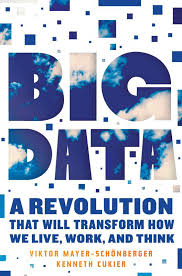
Big Data: A Revolution that will Transform how we Live, Work and Think by Mayer-Schonberger and Cukier“Big data” is definitely one of the more commonly heard business buzz terms these days.

But beyond the general impression that “big data” represents the ability to collect and analyze lots and lots of information in some efficient manner, most people have a difficult time explaining with any specificity what the term really means.

Moreover, for some people “big data” isn’t very far removed from “big brother” – and for that reason, there’s some real ambivalence about the concept.  Consider these recent “man on the street” comments about big data found online:

  • “Big data:  Now they can crawl all the way up your *ss.”
  • “The scary thing about big data is knowing [that] Big Brother can know every single thing you do – and realizing your life is too unimportant for Big Brother to even bother.”
  • “Big data is what you get after you take a big laxative.”

But now we have a recently-published book that attempts to demystify the concept.  It’s titled Big Data:  A Revolution that will Transform How We Live, Work and Think, and it’s authored by two leading business specialists – Viktor Mayer-Schönberger, a professor of internet governance and regulation at Oxford University and Kenneth Cukier, a data editor at The Economist magazine.

The book explores the potential for creating, mining and analyzing massive information sets while also pointing out the potential pitfalls and dangers, which the authors characterize as the “dark side of big data.”

The book also exposes the limitations of “sampling” as we’ve come understand it and work with it over the past decades.

Authors Viktor Mayer-Schonberger (l) and Kenneth Cukier (r).

Cukier and Mayer note that sampling works is fine for basic questions, but is far less reliable or useful for more “granular” evaluation of behavioral intent.  That’s where “big data” comes into play big-time.

The authors are quick to note that advancements in data collection tend to come along, shake things up, and then quickly become routine.

Mayer calls this “datafication,” and describes how it works in practice:

“At first, we think it is impossible to render something in data form.  Then somebody comes up with a nifty and cost-efficient idea to do so, and we are amazed by the applications that this will enable – and then we come to accept it as the ‘new normal.’  A few years ago, this happened with geo-location, and before it was with web browsing data gleaned through ‘cookies.’  It is a sign of the continuing progress of datafication.”

Causality is another aspect that may be changing how we go about treating the data we collect.

According to Cukier and Mayer, making the most of big data means “shedding some of the obsession for causality in exchange for simple correlations: not knowing why but only what.”

So then, we may have less instances when we come up with a hypothesis and then test it … but rather just use the data to determine what is important and act on whatever information is revealed in the process.

Retail DisplayOne example of this practice that’s cited in the book is how Wal-Mart determined that Kellogg’s® Pop-Tarts® should be positioned at the front of the store in selected regions of the country during hurricane season to stimulate product sales.

It wasn’t something anyone had thought about in advance and then decided to verify; it was something the retailer discovered by mining product purchase data and simply “connecting the dots.”

Author Mayer explains further:

“There is a value in having conveniently placed Pop-Tarts, and it isn’t just that Wal-Mart is making more money.  It is also that shoppers find faster what they are likely looking for.  Sometimes ‘big data’ gets badly mischaracterized as just a tool to create more targeted advertising … but UPS uses ‘big data’ to save millions of gallons of fuel – and thus improve both its bottom line and the environment.”

One area of concern covered by the authors is the potential for using “big data predictions” to single out people based on their propensity to commit certain behaviors, rather than after-the-fact.  In other words, to treat all sorts of conditions or possibilities in the same manner we treat sex offender lists today.

Author Kenneth Cukier believes that the implications of a practice like this – focusing on the use of data as much as the collection of the data – is “sadly missing from the debate.”

This book fills a yawning gap in the business literature.  And for that, we should give Dr. Mayer-Schönberger and Mr. Cukier fair dues.  If any readers have become acquainted with the book and would care to weigh in with observations, please share your thoughts here.

Evil eye? Google’s vision for the future.

pay-per-gaze creepy disturbingTo understand where Google is heading next in the world of advertising, consider this:  The company has just been granted a patent on its “pay-per-gaze” eye-tracking system.

You might wonder what that might be.

Pay-per-gaze is an ad system that utilizes Google Glass for tracking the ads that consumers see online and elsewhere.  The gaze-tracking capability comes from another Google innovation:  a head-mounted tracking device that communicates with a server.

According to the patent documentation, the tracking devices includes eyeglasses with side-arms that engage the ears of the user … a nose bridge that engages the nose of the user … and lenses through which the user views the external scenes wherein the scene images are captured in real-time.

And it need not be limited to tracking online advertising, either; pay-per-gaze functionality could potentially extend to billboards, magazines, newspapers and other printed media, Google notes.

But the idea is even more revolutionary than that:  Not only does it aim to measure how long an individual looks at an ad, but also how “emotionally invested” the consumer is by virtue of measuring pupil dilation.

So the tracking system not only will show how long someone looks at an ad, but also will measure the emotional response.  The patent also covers a provision for “latent pre-searching” which would display search results over a user’s field of vision using Google Glass or another wearable computer.

If all of this seems like “Big Brotherism” at its worst … you may well be correct.  But Google is doing its best to downplay such sinister connotations.  It’s emphasizing that users can opt out of “pay-per-gaze” tracking, and that all data will be anonymized.

But let’s get this straight:  The world’s biggest search engine was just granted a patent for the most “sticky” form of advertising possible – ads that literally flash in front of someone’s eyes.

And when we add in aspects like measuring pupil dilation, it won’t be long before Google will be able to determine how good eats, or good looks, are affecting our emotional response.

One wonders how much farther we can go with measuring advertising engagement and buying intent. 

Then again, we already have an answer, of sorts.  As early as 2000, experiments with electromagnetic brainwaves have shown that people can literally “think” instructions and thereby cause an action.

Imagine combining Google’s pay-per-gaze and pay-per-emotion with electromagnetic brainwave tracking.  Add in a credit card number, and there’s no telling what could happen just with a fleeting thought or two!

If all of this sounds creepy and disturbing … get used to it.  With the likes of Google and the NSA at the helm, “creepy and disturbing” may well become the “new normal” for society.

Consumers Still Finding Weaknesses in Brands’ Web Presence

Temkin Group logoThe most recently published Temkin Web Experience Ratings of more than 200 companies across 19 industries reveals continuing widespread disappointment with the quality of the “web experience.”

The Temkin Web Experience Ratings are compiled annually by Temkin Group, a Newton, MA-based customer experience research and consulting firm.  The ratings are based on consumer feedback when asked to rate their satisfaction when interacting with each company’s website.

Temkin ratings are established for companies garnering responses from 100 or more of the ~10,000 randomly selected participants in an online survey conducted by the research firm in January 2013.

Rankings are calculated via a “net satisfaction” score based on a 7-point rating scale from “completely satisfied” to “completely dissatisfied” by taking the percentage of consumers selecting the two highest ratings and subtracting the percentage who selected the bottom three ratings.

Just 6% of the brands earned strong or very strong “net” trust ratings, while ten times as many (~63%) were given weak or very weak scores.

And there’s this, too:  Not much improvement is happening.  More than half of the ~150 companies that were included in both the 2012 and 2013 Temkin evaluations earned lower scores this year than last.

Managing partner Bruce Temkin summarized it succinctly:  “The web is a key channel, but online experiences aren’t very good – and are heading in the wrong direction.”

The latest Temkin ratings give Amazon the top-rank position with a 77% overall rating score.  Other companies ranked near the top include Advantage Rent A Car, U.S. Bank and QVC.

At the other end of the scale, MSN, EarthLink and Cablevision earned the lowest ratings – MSN worst of all.

Indeed, the following industries had composite company ratings that ended up in the “very weak” column:

  • Airlines
  • Health plans
  • Internet service providers
  • TV service providers
  • Wireless carriers

Do any of these industries seem like ones that shouldn’t be on this list?

I didn’t think so, either.

Which ones are the industries that score best in the Temkin analysis?  By order of rank, they are as follows:

  • Banks
  • Investment firms
  • Retailers
  • Credit card issuers
  • Hotel chains

Come to think of it, I haven’t encountered problems online with companies or bands in any of these five industries.

It’s also interesting to consider which companies have improved the most over time.  When comparing year-over-year results for the ~150 companies that were included in both the 2012 and 2013 studies, eight of them showed double-digit improvements in their scores:

  • Blue Shield of California
  • Citibank
  • Humana
  • Old Navy
  • Safeway
  • Toyota
  • TriCare
  • U.S. Bank

On the other hand, a much bigger contingent of 21 companies saw their ratings decline by at least 10 points; the six firms that dropped by 15 points of more were these:

  • Bright House Networks
  • Cablevision
  • MSN
  • ShopRite
  • Southwest Airlines
  • United Airlines

You can view the scores (and trends) for all 200+ companies by clicking here to download the full report.

If you notice any rankings that seem surprising – or that don’t comport with your own online experiences – please share your thoughts and perspectives below.

Craigslist: The $5 billion juggernaut that crippled an industry.

Craigslist logoIt’s common knowledge that the business model for newspapers started going awry in a major way with the decline in newspaper classified advertising.

Craigslist played a huge role in that development, as the online classifieds site went about methodically entering one urban market after another across the United States.

And now we have quantification of just how impactful Craigslist’s role was.  It comes in the form of a May 2013 study authored by Robert Seamans of New York University’s Stern School of Business and Feng Zhu of the University of Southern California.

Titled Responses to Entry in Multi-Sided Markets:  The Impact of Craigslist on Local Newspapers, the study explored the dynamics at play over the period 2000-2007, focusing on newspapers’ degree of reliance on classifieds at the time of Craigslist’s entry into their markets.

What the researchers found was that those newspapers that relied heavily on classified ads for revenue experienced more than a 20% decline in classified advertising rates following Craigslist’s entry into their markets.

But that isn’t all:  The outmigration of classified advertising to Craigslist was accompanied by other negative trend lines — an increase of subscription prices (up 3%+) and lowering circulation figures (down nearly 5%).

Even newspaper display advertising rates fell by approximately 3%.

Were these developments “cause” or “effect”?  The study’s authors posit that fewer classified ads may have diminished the incentive for people to purchase the newspapers.  Also, display advertising rates tend to track circulation figures, so once the “decline cycle” started, it was bound to continue.

The study concludes that by offering buyers and sellers a free classified ad alternative to paid listings in newspapers, Craigslist saved users approximately $5 billion over the seven-year period.

Those dollars came right out of the hides of the newspapers, of course … and changed the print newspaper industry for good.

But here’s the thing:  The experience of the newspaper industry has relevance beyond just them.  “The boundaries between media industries are blurred and advertisers are able to reach consumers through a variety of platforms such as TV, the Internet and mobile devices,” the authors write.

The unmistakable message to others in the media is this:  It could happen to you, too.

A full summary of the Seamans/Zhu report can be found here.

Social Marketers Behaving Badly …

Social marketers behaving badlyEx-Cong. and New York City mayoral candidate Anthony Weiner hasn’t been the only one misbehaving on social media.

Chipotle Mexican Grill also gets a time-out to sit in the corner for its social media hi-jinks. 

It turns out that a supposed hacking of Chipotle’s Twitter account in mid-July was nothing more than a ploy to grab attention and gain more Twitter followers.

For those who haven’t heard, Chipotle’s Twitter stream appeared to have been hacked as a series of bizarre and nonsensical tweets were posted over the span of several hours – until the company claimed to have solved the problem.

As it turned out … the whole thing was completely manufactured – all of those crazy tweets published by the company itself.

A few days later, a Chipotle spokesperson came clean, admitting that the whole episode was actually a carefully orchestrated effort to gain more Twitter followers, in concert with the company’s 20th anniversary.

Did it work?  Evidently yes … because Chipotle had ~4,000 more Twitter followers at the end of the campaign than it did at the beginning.

But some marketing professionals were critical of the ploy.  Here are a few representative comments:

  • Chipotle is a brand about honesty and authenticity; faking a hack if off-brand.”  (Rick Liebling, Y&R Creative Culturalist)
  • “Most of these stunts … strike me as being pretty lazy.  It’s like making your CEO do a press conference drunk and then apologizing for it once he sobers up.”  (Ian Schafer, Deep Focus CEO)
  • Chipotle’s pico de gallo was more ‘weak sauce’ than ‘muy caliente.’”  (Saya Weissman, Digiday Editor)

On second thought, perhaps it’s not such a good idea to “mess with the market” when upside is a few additional social media contacts (that probably won’t stick around), and the downside is brand irritation or even humiliation.

After all, Chipotle’s net gain in Twitter followers represented an uptick of just 1.7%

That seems a bit paltry considering the potential blowback and reputation risk.

Andrew Mason’s Next Act: Groupon’s ex-CEO Releases a Music Album

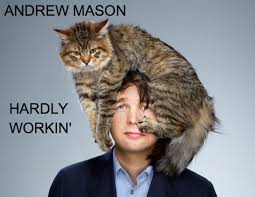
Andrew Mason - Hardly Workin' music album
Groupon’s ex-CEO Andrew Mason is releasing a music album titled — appropriately enough — “Hardly Workin’.”

I’ve blogged before about the tribulations of Groupon and its “daily deal” couponing business.

The company has found it incredibly difficult to develop a sustaining business model, what with increased competition and the propensity for vendors to cease their participation after one or two deals due to disappointing program results.

With Groupon taking 50% of every deal plus a credit-card handling fee, far too many vendors found that they couldn’t make money on “daily deal” promotions, and often, “repeat business” from the ultra-price-savvy consumers who tend to participate in such schemes never materialized

Groupon founder and former CEO Andrew Mason was hardly the typical head of a dotcom business.  His business background was rather thin, despite having started a Saturday morning bagel delivery service in suburban Pittsburgh when he was just 15 years old.

Instead, Mason graduated from Northwestern University in 2003 with a degree in music, signaling where his interests truly lie.  After having worked at several Chicago-area tech companies, Mason managed to snag some seed money from Chicago entrepreneur Eric Lefkofsky, and Groupon was born in 2008.

By 2010, Groupon was the latest star in the constellation of online businesses, with annual revenues of ~$800 million.  In December of that year, Groupon was offered $6 billion to sell to Google, but Mason and his company board foolishly declined the offer.

But within two years, Groupon’s fortunes had turned dramatically for the worse.  Herb Greenberg of CNBC named Mason the “Worst CEO of the Year” in 2012, writing:

“Mason’s goofball antics, which can come off more like a big kid than company leader, almost make a mockery of corporate leadership – especially for a company with a market value of more than $3 billion.  It would be excusable, even endearing, if the company were doing well … but it’s not.”

After one too many missed quarterly goals, Groupon’s board of directors ousted Mason on February 28, 2013.  On the day of his dismissal, Mason wrote to his employees:

“After four and a half intense and wonderful years as CEO of Groupon, I’ve decided that I’d like to spend more time with my family.  Just kidding – I was fired today.  If you’re wondering why … you haven’t been paying attention.”

But now Mason is back – just not in the same way.  This time, it’s as a musician.  The former punk band keyboardist (and also husband of pop singer Jenny Gillespie) is releasing an album titled “Hardly Workin’” that contains seven songs.  It was produced by Don Gehman, who has also worked with R.E.M. and John Mellencamp, among others.

Here’s what Mason has to say about his latest project:

“I managed over 12,000 people at Groupon, most under the age of 25.  One thing that surprised me was that many would arrive at orientation with minimal understanding of basic business wisdom.”

This album pulls some of the most important learnings from my years at the helm of one of the fastest-growing businesses in history, and packages them as music.  Executives, mid-level management and front-line employees are all sure to find valuable takeaways.”

*  *  *  *  *

“If you’re seeking business wisdom, you don’t need no MBA — look no further than the beauty that surrounds us every day …”

*  *  *  *  *

With lyrics like these, one wonders if Andrew Mason isn’t talking so much about 12,000 employees, but instead about himself!

The $25 Tweet

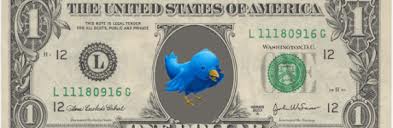
Value of a tweetA marketing analytics firm is claiming that the average tweet on branded Twitter sites is worth a little over $25.

Yep, you read that correctly; $25.62, to be precise.

The revenue estimate comes to us courtesy of SumAll, a data visualization and analytics firm.  It reached that conclusion after reviewing more than 900 of its customers’ social media program efforts.  SumAll published its findings last week in an infographic.

To those who might look at the ~$25 figure and scoff (that may be most readers), it should be noted that once the total number of people who see an individual tweet is taken into consideration, the amount of revenue gained per impression is only about one half of one penny, on average.

To put this into context, $0.005 revenue-per-impression is lower than most other marketing tools and about on par for AdWords revenues-per-impression.

The imputed revenue from tweets amounts to about 1%-2% in incremental revenues, according to SumAll’s study group.

Not surprisingly, this announcement was met with questions … and some skepticism.  Asked to explain further how SumAll came up with its results, a SumAll spokesperson replied on the company’s blog:

“… Our data comes from our own user base of over 30,000 people.  We anonymize the data first and then aggregate all the data to derive new, interesting insights from a broad population.  For this infographic, we collected data from all users who have a Twitter stream and commerce stream, and conducted some calculations to derive the value of each tweet.”

There, that should clear up matters nicely, right?

As if pre-anticipating the muffled sniggers or raised eyebrows in reaction to this “non-response response,” the blog response continued:

“This is obviously a little overgeneralized, but I hope that [it] clears some things up.”

Uh-huh.  Or as radio NPR talk show host Diane Rehm might say, “All right and we’ll leave it at that.”

The experience of our clients hasn’t approached what SumAll is reporting … but I’m interested in hearing what kind of results other companies may have experienced using Twitter as a social marketing platform.  Any particularly positive stories (or negative ones) to report?  Please share you observations here.