Charting Social Media’s “Maturity Continuum”

Social Media lineupAs social media has crept more and more into the fabric of life for so many people, it’s only natural that social scientists and marketers are thinking about the wider implications.

One of these thinkers is someone whose viewpoints I respect a good deal.  Social media and online/search über-strategist Gord Hotchkiss has come up with a way of looking at social media vehicles that he dubs the “Maturity Continuum.”

According to Hotchkiss, the Maturity Continuum is made up of four levels of increasing social media “stickiness” — meaning how relevant and important the social platforms are to people’s daily lives and routines.

Specifically, these four levels are:

The Fad Phase — This is when people start using a social media platform because it’s the bright shiny thing … and “everyone else” in their circle is doing so, too.  This dynamic is commonly found among early adopters — you know, the folks who try out new things because … they’re new.

Gord Hotchkiss
Gord Hotchkiss

Of course, early adopters don’t necessarily stick around.  A new social platform has to have some sort of “there there” – to deliver some measure of functional benefit – or else it won’t keep fad users around for long.

Also important at this early stage is the aspect of uniqueness and novelty — which is always important among this group of people who tend to be higher on the ego and narcissism scale.

Making a Statement — If a social platform makes it through the pure novelty gauntlet, it continues to be used because it makes a statement about the user.  In the case of social media, it’s often as much about the technology as it is the functionality.

Thinking about a platform like FourSquare, here you have social tool that’s probably at this level of maturity.  With FourSquare, there may be a few utilitarian reasons for using it — getting vouchers or other “free stuff” from restaurants and bars — but it’s probably a lot more about “making that statement.”

A Useful Tool — At this point on the Maturity Continuum, here’s where a social platform breaks into a more practical realm.  Going beyond the novelty and ego aspects, users find that the platform is a highly beneficial tool from a functionality standpoint — perhaps better than any other one out there for facilitating certain activities.

Thinking about a social platform like LinkedIn in this context, it’s easy to see how that particular one has done so well.

A Platform of Choice — This is the highest level of social media maturity, where users engage — and continue to engage — with a social platform because they have become so familiar with it.

At this level, it becomes quite a challenge to dislodge a social platform, even if “newer, better” choices come along.  Once social habits have become established and a large critical mass of users is established, it can be very difficult to change the behavior.

Facebook is “Exhibit A” in this regard:  Despite near-weekly reports of issues and controversies about the platform, people continue to hang in there with it.

Thinking about other social platforms like Instagram, YouTube, Twitter, SnapChat and Pinterest, it’s interesting to speculate on where they currently fall on the “maturity meter.”

I’d venture to say that YouTube has made it to the highest level … SnapChat is still residing in the early “fad” stage … while Pinterest and Instagram are transitioning between “making a statement” and being “a useful tool.”

Where Twitter resides … is anyone’s guess.  I for one am still wondering just how Twitter fits into the greater scheme of social — and how truly “consequential” it is in the fabric of most people’s social lives.

What are your perspectives on the Maturity Continuum in social media?  If you have opinions one way or the other about the long-term staying power of certain platforms, please share them with other readers here.

Tough Nut: Shoehorning Social Media Practices into an Existing Corporate Culture

managing social mediaIn late May 2014, Business Insider published an article about the processes by which corporations and their brands plan and manage their social media efforts.

It elicited derision and snorts of laughter in response.

Why?  For starters, the story sported this irreverent headline:  “We Got a Look Inside the 45-day Planning Process that Goes Into Creating a Single Corporate Tweet.”

And inside the article, it was revealed that it took the four-person agency team that handles the social media program for the Président Cheese brand 45 days to take a single tweet from conception to published reality.

For the record, here is the tweet as it finally appeared on Twitter:

President Cheese tweet

On the one hand, it seems patently ridiculous that a single tweet should take so long to germinate, come to fruition and be published.  At that pace, the Président Cheese brand is going to be left in the dust.

[To add further insult, the social media accounts in question had only ~100 Twitter followers and ~220 Facebook likes at the time.]

But let’s look more closely.  The tweet is recommending serving camembert cheese at room temperature for better flavor, rather than straight out of the refrigerator.

It’s a mild enough suggestion … but it has potential negative implications concerning food safety — or at least the perception of such.

When one is a brand sold nationally, such considerations aren’t merely theoretical; a simple tweet can be turned into a cudgel to beat over the head of the brand in the case of a lawsuit over food sanitation.

Considered in those terms, it no longer seems quite so strange that it took the MarComm agency so many days to go from ideation through the review-and-approval process to get to publication.

And the four agency people involved?  They’re the team assigned to the brand’s social media account, and the full group’s involvement was a single meeting to discuss the upcoming month’s social media topics.

It turns out that “planned” topics represent about one-third of the Président Cheese activity on social media platforms; the rest of the postings are done on the fly, responding to customer chatter, answering questions or weighing in on other comments, and responding to food trend news or other developments that tie in with the world of food, hospitality and entertaining.

So, like so many other factors in the business world and in life, the 45-day tweet isn’t a black-and-white issue of failure; it’s shades of gray.

Now that we’ve seen both sides of the coin, I think it’s still legitimate to question the length of time and the amount of energy required to post a single tweet.

Several ways to correct this come to mind.  One is for brands to stay away from any topics that might expose them to the risk of public relations problems or potential legal repercussions.

But in a world where brands are competing against an endless crowd of other social posters … that seems like a pretty sure ticket to irrelevance and social media oblivion.

At the same time, any MarComm agency or in-house social media department needs to adhere to some practical standards of vetting so that some ill-conceived post doesn’t blow up in the company’s face.

The sweet spot — or at least the proper balance between interest, efficiency and prudence — would be creating a streamlined client approval process involving only one or two people (plus backups) who are sufficiently attuned to the brand’s market position and the best ways to advance it and protect it.

Oh, and the team assigned to the responsibility needs to be available 24/7 for vetting purposes (hence the need for backup personnel who are at-the-ready).

It may be a pesky responsibility, but in the “always-on” world of marketing today, it’s really the only way to go if one wishes to participate on the interactive playing field.

The alternative is a tweet that takes weeks to be published … and I doubt anyone is ever going to be satisfied with that.

Living Life in Pictures

PhotographyYou know the old adage:  A picture is worth a thousand words.

Well, with the plethora of images being uploaded these days … we’re talking billions and billions of images and words.

Recently, Yahoo estimated that the number of images uploaded to the web is nearing 900 billion, which translates to nearly 125 photos for every person on the planet.

Facebook reports that it’s seeing more than 6 billion photos uploaded each month, on average.

And Instagram?  It’s reporting that nearly 28,000 photos are uploaded every minute.

Clearly, we love our photos.  And since digital technology makes it so easy to take good-quality photos and post them instantly, it seems people can’t get enough of doing so.

It’s an interesting twist — in a sense, taking us back to the cavemen days and illustrations on the walls.

Over the centuries, words and language have made it faster and easier to communicate, even as drawing, painting or developing photos using analog (film) technology was difficult and/or time-consuming.

In more recent times, Polaroid® photos gave us a more “instant” experience with images … but sharing them was no easlier than before.  (Plus, let’s be honest:  Most Polaroid shots were pretty lame in the quality department.)

Now that digital photography is as effortless as it is … it seems everyone is rushing back to pictures.

We’re even seeing it in the world of books.  Take Amity Shlaes’ book The Forgotten Man, about the Great Depression.  It came out in conventional form in 2008.

The Forgotten Man (Graphic Edition)But now, it’s being released in a picture book version:  The entire book has been re-imagined as an elaborate comic book, replete with illustrations by veteran graphic artist Paul Rivoche.

And based on the early indications, it looks like the new graphic version is going to outsell the original.

Is all of this some kind of regression to an earlier stage — a return to a sort of “collective adolescence writ large”?

I think not.  It’s more a function of “doing what’s possible.”

I think human beings have always gravitated to pictorial portrayals — which explains the immediate embrace of movies and television when those innovations came on the scene.

So when photography becomes so easy to produce and to share, it’s only natural that we’re going to have billions and billions of images swirling around as a result.

And why not?  Life’s all the richer because of it.

Time spent online daily: 2.5 hours and growing.

Lots of time spent onlineIf you’re wondering what happened to all of the community volunteer activities people used to do – not to mention the popularity of participating in group social or recreational activities like softball or bowling leagues … you might look at the time Americans are spending online as one possible explanation.

The evidence comes in the form of research the Interactive Advertising Bureau did when they contracted with GfK Research to conduct an extensive online survey as part of a larger behavioral analysis of American adults.

Fielded in late 2013 with participation from ~5,000 adults between the ages of 18 and 65, the IAB/GfK survey revealed that Americans are spending an average of 2.5 hours of every day online.

Add that on to the average ~5 hours per day spent watching TV – a figure that’s hardly budged in years – and it’s little wonder that the Jaycees, Shriners’ and other service organizations are finding it more difficult to recruit new members … or that “old faithful” group social and recreational activities are in danger of becoming less relevant.

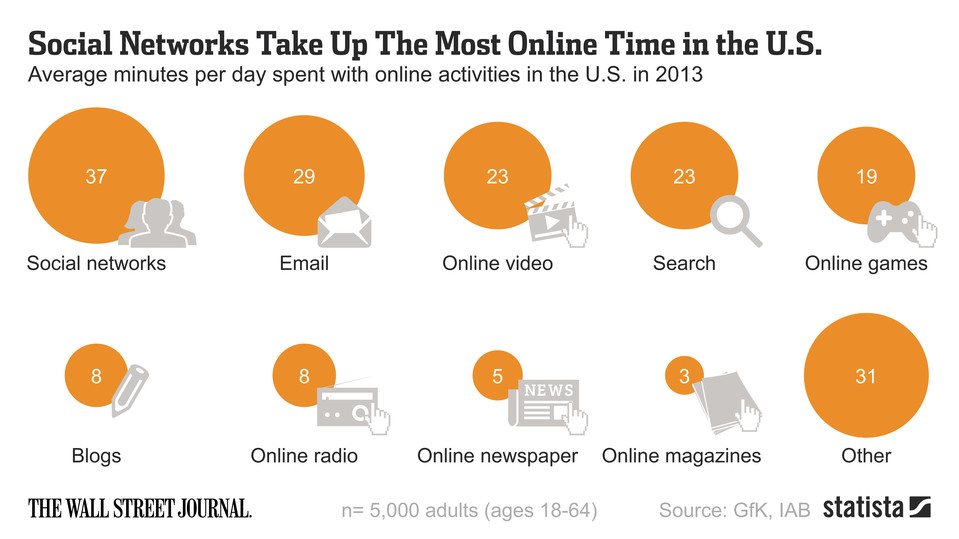
The IAB/GfK survey also revealed which types of online activities are engaged in the most.  The chart below, created by Statista from the IAB/GfK report’s data and published in The Wall Street Journal, gives us the lowdown:

Online Time (average per day)


I wasn’t surprised to discover that social networks chew up the most online minutes per day.  Online video viewing and search time seem about as expected, too.  And who doesn’t enjoy a nice game of Spider Solitaire or Internet Spades to wind down after a long day?

But at ~30 minutes per day, the e-mail average seems on the high side.  People must really be struggling with managing personal inboxes stuffed with marketing e-mails.  (But if work-related e-mails are part of the equation, the half-hour figure seems more expected.)

Comparing these results to similar research done in prior years, the most recent survey charts an increase in online video watching; it’s doubled over the past four years.

Other activities that are on the rise include online gaming, and listening to online radio.

Adding it all up, total time spent online is continuing its inexorable rise thanks to mobile connectivity and the “always-on” digital environment in which Americans now live.

Perhaps the way to stem reduced interest in group social activities and volunteerism lies in giving people free reign to “multitask” even as they participate in the local bowling league or Ruritan Club meetings …

What are your thoughts on the time people are spending online – and if it’s crowding out other forms of daily activities?  Please share your thoughts with other readers here.

Companies Continue to Increase their Investment in Social Media

InvestmentSocial media may have its share of nettlesome issues … but that doesn’t mean companies aren’t spending more effort and energy on these platforms.

To illustrate, a new online survey of ~1,060 business owners, senior management personnel and social strategists that was conducted in April 2014 by Social Media Marketing University finds that a clear majority of companies are investing more time and/or dollar resources on social media as compared to a year ago.

And three-fourths feel that this investment is worth it.

Here are some of the SMMU survey’s key findings:

  • ~74% of companies are devoting more time to social media.
  • ~54% are spending more dollars on social media.
  • Nearly 70% are managing four or more social profiles.

The most significant expenditures for social media programs fall into these four categories:

  • Compensation of in-house staff: ~37% of all social media program expenditures
  • Social media advertising: ~18% of program expenditures
  • Compensation of external staff: ~10% of expenditures
  • Content development: ~7% of expenditures

According to the SMMU survey, smaller businesses – those with fewer than 50 employees – face the biggest challenge in terms of the increased time and cost commitments to social media.

As SMMU Principal John Souza puts it:

“Because many small businesses don’t have the skill-set or the staff to properly manage social media, they are outsourcing their social, or spending an excessive amount of time on tasks as they learn social by trial-and-error.”

Not surprisingly, having some focused training on the “how-to” of social media can make a pretty big difference in the effectiveness of the people charged with planning and carrying out a company’s social media program.

The question is how many businesses actually feel the need for such training, seeing as how some of the recent press about social platforms hasn’t been all that positive.

The answer, based on my own personal interaction with numerous small and medium-sized firms is … not very many of them.

LinkedIn: The “Other” Social Network Makes its Move

linkedinWe may be reading quite a few news reports these days about Facebook and Twitter facing a plateau in usage … but LinkedIn’s fortunes continue to be on the upswing (financial losses notwithstanding).

In late April, the social network reported that it now has more than 300 million active members throughout the world, which is up more than 35% since the beginning of the year.

Too, the gender gap in membership is narrowing, albeit more slowly:  Today, ~44% of LinkedIn members are women, up from ~39% in 2009.

Even more impressive for a network that has the lofty goal of “creating economic opportunity for every one of the 3.3 billion people in the global workforce,” is the fact that two-thirds of LinkedIn’s active members are located outside the United States.

This is underscored by the top three countries represented  in LinkedIn’s membership, which are the U.S. (#1), India (#2) and Brazil (#3).

worldwide membersLinkedIn’s latest international push is into China, where it seeks to add more than 140 million Chinese professionals to its membership rolls.

Mobile Movement

The increased use of “smart” mobile units has affected the ways users interact with LinkedIn as well; mobile traffic is expected to overtake desktop access later this year.

[In fact, that’s already happened in markets like the United Kingdom, Singapore and Sweden.]

Here are a few “factoids” that illustrate how significant mobile has become for LinkedIn operating as the world’s mobile employment bazaar:

  • Average number of LinkedIn profiles viewed daily via mobile devices:  ~15 million
  • Average number of job position openings viewed daily via mobile:  ~1.5 million
  • Average number of job applications submitted daily via mobile:  ~44,000

Despite these healthy usage figures, a continuing challenge for LinkedIn is the degree to which it has been able to “monetize” its membership.  Among U.S. members, the average revenue-per-user is hovering around $11.30.

That’s much better than the ~$3.75 average revenue-per-user amount for members overseas.  But it’s still well below the revenue-per-member figures being charted by Facebook, which helps explain LinkedIn’s continuing revenue and profit challenges.

Still, when you consider that LinkedIn is becoming the de facto “Help Wanted” public square for the professional world, it’s hard to criticize its business model as the “go-to resource” for human resources professionals involved in personnel recruitment.

And now that the platform has a an active membership north of 300 million people, it’s hard seeing how that dynamic is going to change going forward; LinkedIn really is in the catbird seat when it comes to recruitment.

Speaking personally, I’m glad LinkedIn is resisting going the route of Facebook and Twitter in their evolving “all advertising, all the time” revenue models.  If LinkedIn can continue to derive a large chunk of its revenue stream from recruitment solutions instead of relying on display advertising or sponsored posts that are too often distracting or irritating, so much the better for us.

Twitter: The social platform that’s less important today than it was yesterday.

Twitter losing lusterTwitter hasn’t mattered to very many people for a very long time.

Of course, for some it hasn’t mattered even from its inception. But when we start reading about Twitter’s most avid users and how they’ve begun to drift away from using the social platform like they’ve done in the past … you know that more than just the atmospherics are changing.

A case in point about this evolution is an article that was published in late April by The Atlantic titled “A Eulogy for Twitter.

The article’s authors, Adrienne LaFrance and Robinson Meyer, begin their piece by writing:

“We’ve been trying to figure out the moment Twitter turned, retracing tweets to see whether there was something specific that soured the platform.  

“Something is wrong on Twitter. And people are noticing. Or at least, the kind of people we hang around with on Twitter are noticing … audience-obsessed, curious, newsy … The thing is, its users are less active than they once were. Twitter says these changes reflect a more streamlined experience, but we have a different theory: Twitter is entering its twilight.”

Those are strong words. But the authors back up their assertions by noting that while people may still be using Twitter, many of them are no longer “hanging out” there. And that’s because there’s less “there there” to sustain once highly-engaged Twitter users.

The perceptions of Twitter’s value have been changing because of three key precepts which are now being proven out as “fictions,” according to LaFrance and Meyer.

What are those “fictions”?

  • The belief that other people in the “Twitterverse” are actually paying attention — or at least that a decent portion of one’s followers are seeing the tweets. 
  • The belief that competent and compelling tweeting will increase a person’s Twitter follower base. 
  • The confidence of knowing that there is a useful potential audience beyond current followers, so that the time and energy spent on the platform will pay dividends. 

None of these premises has turned out to be correct in the long-haul. Instead, the following stark realities fly in the face of all the hope (or hype):

  • Twitter is positively stuffed with “spam” accounts. In fact, the median number of followers for a Twitter account is … exactly one. Even if a few of those accounts are actually “legit,” of what value are they to anyone? 
  • Twitter’s year-over-year growth rate has fallen significantly since 2011.

And here’s another clear indication of how Twitter has morphed into something quite different from its original character. Today, Twitter is more likely to be merely a place to promote content published someplace else in cyberspace, simply providing quick links over to that content.

Whereas in the past, journalists and celebs and others were posting statements and opinions — and replying to or retweeting the posts of others — now it’s more likely to be canned promotion and little more.

… Which sets up a downward spiral, because followers aren’t seeing anything particularly new or interesting that they’re not already encountering elsewhere. So interest wanes … leading to reduced participation … leading to even less consideration of Twitter’s “worth” as a social platform.

This phenomenon of “professionalized accounts” means little more than being a bulletin board of scheduled tweets and broadcast links, resulting in collective yawns all over the place.

Of course, there’s one aspect of Twitter than continues its joyride unabated: hate speech and profanity. But that’s the sort of content many people would just as soon avoid encountering.

LaFrance and Meyer conclude that the world may have “outgrown” Twitter. They’re not happy by that turn of events, writing:

“For a platform that was once so special, it would be sad and a little condescending to conclude that Twitter is simply something we’ve outgrown. After all, the platform has always been shaped by the people who congregate there. So if it’s no longer any fun, surely we’re at least partly to blame.”

The authors go on to note:

“Twitter has done for social publishing what AOL did for e-mail. But nobody has AOL accounts anymore … [Today,] Twitter feels closed off — choked — in a way that makes us want to explore somewhere else for a while.”

It may not be time for Twitter’s eulogy. But there are many who don’t see much of a second act for the social platform, either.

By the way … where are those “somewhere elses” in social media that LaFrance and Meyer allude to? Try Snapchat, Instagram … even LinkedIn.  That’s where the interesting action is happening these days.

What do B-to-B buyers really want in a website?

Hint:  Forget social media.

btob web surfingAs online communications continues to evolve, B-to-B marketers have more options than ever to interface with prospects and suspects.

In fact, it’s pretty easy to get distracted by the latest “shiny objects” in marketing … and we sometimes see a lack of focus — and “prioritization all over the map” — as a result.

With company websites serving as the “hub” of marketing communications, it’s only natural to try to align the information provided to prospective customers with what they’re seeking.

A recent survey of several hundred B-to-B companies conducted by DH Communications and KoMarketing Associates sought to determine what business-to-business buyers are doing once they land on a vendor website. Which elements on the site increase a vendor’s credibility … and at the other end of the scale, what causes visitors to leave?

The results of this survey confirm what many have suspected. In a nutshell:

  • Buyers come to a vendor’s website with one thought foremost in mind: to qualify the company in order to begin the process of moving towards a purchase.

And this:

  • Buyers believe the vendor qualification process should be simple and straightforward, and they don’t have time to deal with it any other way.

This mission manifests itself in the following typical behaviors when landing on a website:

  1. The first place visitors go is straight to the products and services pages.
  2. They want to see technical information … and published pricing information, too.
  3. They look for testimonials or case examples to see how others have solved their problems using the products or services.
  4. If they don’t already know the company, they check out the “about us” pages to gauge its credibility as a supplier – but only after they’ve determined that its products or services are aligned with their needs.
  5. They have little interest in social media – and hence mostly ignore those elements.

Website Must-Haves

The survey asked respondents which informational content elements are “must-haves” for a B-to-B website. It found that these elements are of greatest importance:

  • Contact information: ~68% consider a “must-have”
  • Pricing information: ~43%
  • Technical information: ~38%
  • Case studies/white papers/articles: ~38%
  • Shipping information: ~37%

The first item on the list above may seem like a given. But it turns out that many websites don’t offer visitors the most preferred methods of contact: an e-mail address (~81% want this option) and/or a phone number (~57% want this).

What about “Contact Us” forms? It turns out that quite a few visitors don’t like them at all. It makes sense to offer them … but also to provide other contact options. Otherwise, some visitors will leave the site without any further engagement — or so they claim.

Axing the Distractions

Because most visitors come to vendor websites to gather information and research products in preparation for making a buying decision, things that detract from those objectives are viewed as an interruption and a distraction.

Some elements are so irritating, they’ll compel visitors to leave the website altogether.  What are those? Video and/or audio clips that play automatically, animated web designs and other visual hijinks, plus pop-up messages are the worst offenders.

Basically, anything that interrupts the visitor’s train of thought reduces the vendor’s credibility and helps the push the company further down the buyer’s list of prioritized vendors.

What’s Missing from Vendor Websites

The survey also asked respondents to cite what they feel is lacking on many vendor sites. Their responses to this question could be considered an indictment of B-to-B websites the world over!

  • Case studies/white papers/articles: ~54% say these are most lacking on websites
  • Pricing information: ~50%
  • Product reviews: ~42%
  • Technical support details: ~42%
  • Testimonials/client list: ~31%

Social Media?

To consider the social media attitudes revealed in this survey of B-to-B buyers is to wonder what all the fuss has been about over the past five years. In citing how impactful social media is on the buying process … it’s clear that the impact isn’t great at all:

  • Social media isn’t a factor: ~37%
  • Neutral feelings about social media: ~26%
  • Social media is a factor, but not a “deal-breaker”: ~30%
  • Social media is a big factor: ~6%

The takeaway?  If B-to-B web content managers spent less time on social media and more time on pricing information, case study testimonials and robust technical data, it would be a more valuable use of their energies.

I’ve summarized some of the key survey results above – but there are more research findings available in a 32-page report summary just published by KoMarketing Associates. You can download it here.

Fast Fade: Unpaid brand posts on Facebook are getting rarer by the day.

Lower ReachIt was just a matter of time.

Once Facebook ramped up its advertising program in order to monetize its platform and mollify its investors, unpaid posts by companies and brands were sure to be the collateral damage.

Sure enough, the recent monthly stats show that the “organic reach” of unpaid content published on company and brand pages on Facebook has been cut in half from where it was just a short time ago.

To illustrate, look at these stark figures gathered in an analysis by Ogilvy of 100+ country-level brand pages measuring the average reach of unpaid posts:

  • October 2013: 12.2%
  • November 2013: 11.6%
  • December 2013: 8.8%
  • January 2014: 7.7%
  • February 2014: 6.2%

What these stats show is that within the span of less than six months, the average reach of unpaid brand posts dropped by nearly 50%

To go even further, an anonymous source familiar with Facebook’s long-term strategy is claiming that its new algorithm could ultimately reduce the reach of organic posts to 2% or less.

Actually, the reason for the squeeze is more than just Facebook’s desire to increase advertising revenue.

Here’s a dynamic that’s also significant:  A Pew Research study conducted in mid-2013 found that the typical adult American Facebook user has around 340 friends.

That average is up nearly 50% from approximately 230 friends in 2010.

Of course, more friends mean more status updates eligible for feeds … and Facebook’s not going to display them all to everyone — even if it wanted to.

Also, Facebook users “like” an average of 40 company, brand, group or celebrity pages each, according to a 2013 analysis done by Socialbakers, a social media analytics firm.  That translates into an average of ~1,440 updates every month.

Compare those figures to five years ago, when the average number of page “likes” was fewer than five … yielding fewer than 25 monthly updates on average.

Clearly, there’s no way Facebook is going to to be able to display all of these updates to followers.  So … the content is squeezed some more.

The final nail in the coffin is the rise in “promoted” posts – the ones that brands pay dollars to promote. It’s only natural that Facebook is going to give those posts priority treatment.

Thus, the hat-trick combination of more friends, more likes and more promoted posts is what’s causing “organic” brand posts to go the way of the dodo bird.

In retrospect, it was only a matter of time before a major social platform like Facebook would seek to monetize its program in a big way.

In some respects, it’s amazing that the free ride lasted as long as it actually did …

The Continuing Ambivalence about Twitter

Or is it more a division of the house?

ambivalenceOf all of the social media platforms that have taken root, the one that seems to cause the most divided opinions among the marketing and communication specialists I know is Twitter.

… And these are the folks who have been diligent about “following the script” for crafting tweets that are interesting, informative, and get noticed.

Each social platform has its strong and weak attributes, of course … but I hear far more mixed views about Twitter than I do about Pinterest, Facebook and LinkedIn.

This is amply illustrated in a recent discussion that was started on LinkedIn’s B2B Marketing Group, of which I’m a member.

Joel Harrison, Editor-in-Chief of B2BMarketing.net, posed this question to the group’s members:

“If Twitter ceased to exist tomorrow, would we all be better off?”

This rather provocative query elicited a range of reactions pro and con – which was to be expected.

However, I was a little surprised that the comments were weighted roughly two-thirds negative about Twitter versus positive.

Remember, this is a discussion group made up of marketing professionals — people you’d expect to be keen on pretty much any established social platform that has an extensive following for marketing purposes.

… Which, even if you discount the ~30% of accounts that “fake, faux and farcical” – still makes Twitter qualify as one of the leading social media platforms.

But consider these comments about Twitter posted by members of the B2B Marketing Group on LinkedIn:

“16 characters solve this dilemma: ‘Don’t take part.’”

 “I once read a tweet that said, ‘This is the generation that had nothing to say, and said it.’ Sums it up pretty well.”

 “My target audiences … have not mentioned that they prefer to communicate on that channel, so until that happens, there isn’t much going on.”

 “I like the old BBC mission: ‘Entertain, inform and educate.’ If you don’t do any of that, I ain’t following.”

 “Useful as an additional channel for customer service and sharing experiences – if the customer wants it.”

 “It depends on the industry and the target audience.”

 “As a marketer, it’s useful.  On a personal level, it annoys the hell out of me.”

These statements don’t sound like a ringing endorsement of the platform, do they?

Of course, they were posted on a business-to-business discussion board, so presumably people were commenting based on their B-to-B perspective; consumer marketing opinions are likely somewhat different.

What are your opinions about Twitter? Based on your own experience, how important and how effective has Twitter been to your marketing efforts?  Is it a critical component … or is it just one more ornament on the MarComm tree? Please share your comments for the benefit of other readers.