The past few months have seen people like Mark Zuckerberg doing mental acrobatics attempting to explain how social media platforms like Facebook intend to control the spate of “fake news” and “hate speech” posts, comments and tweets that are so often the currency of interactive “discourse” online.
And now the First Amendment Center of the Freedom Forum Institute is weighing in with the results of a survey in which ~1,000 Americans were asked for their opinions about the challenges of monitoring and controlling what gets published for the world to see.
The survey, which has been conducted annually since 1997, gives us insights into Americans’ current attitudes about censoring objectionable content balanced against free speech rights.
Asked whether social medial companies should remove certain types of content from their pages in certain circumstances, sizable majorities agreed that companies should do so in the following cases:
Social media companies should remove false information: ~83% agree
Social media companies should remove hate speech: ~72% agree
Social media companies should remove personal attacks: ~68% agree
At the same time, however, when asked whether the government should require social media sites to monitor and remove objectionable content, those opinions were decidedly mixed:
Strongly agree with having government involved in these activities: ~27%
Somewhat agree: ~21%
Somewhat disagree: ~20%
Strongly disagree: ~29%
Don’t know/not sure: ~3%
So the key takeaway is that Americans dislike objectionable content and think that the social platforms should take on the responsibility for monitoring and removing such content. But many don’t want the government doing the honors.
A mixed result for sure — and one in which governmental authorities could well be d*mned if they do and d*mned if they don’t.
More information about the survey findings can be accessed here.
As a MarComm specialist and head of a marketing firm for several decades, I’ve worked with my share of marketing tactics — the tried-and-true ones as well as the “next new things.”
Along those lines, working with numerous B-to-B companies in their attempts to turn social media and blogging into significant sources of new business, the track records have been more often ones of failure than of success.
I think the issue boils down to something pretty fundamental: Unlike consumer products, where customers can fall deeply “in love” with particular brands, or at the very least develop feelings of brand affinity, in the world of business products and services, the brand dynamics are seldom “emotional.”
The reality is, business buyers are looking for products and services that will solve their problems and also provide all-important CYA peace of mind. Few B-to-B buyers are truly “excited” about these purchases, and they aren’t personally “invested” in the brands in question, either.
Instead, they’re looking for solutions that work. Ones that deliver on a checklist of criteria, and ones that don’t risk unpleasant developments down the road.
In such a world, the notion that buyers are waiting around to read and interact with the next blog article or social media post that’s published by a supplier is fanciful at best.
News flash: The target audience doesn’t care about things like that. Business buyers don’t have time in their busy schedules to read the posts. The few times they will is when they need to satisfy a business need and are looking for information to help them make an informed buying decision.
But of course, it’s precisely then when content needs to be easily findable on the web. Brands that have published deeper and more relevant content than their competitors are going to be the ones that show up on search engine results pages (SERPs), because those are the websites search engines reward with higher rankings based on the perceived “relevance” of the web pages in question.
This view of B-to-B audience dynamics isn’t just my personal one; survey research of B-to-B buyers reveals similar attitudes. For instance, market research and communication firm KoMarketing publishes an annual B2B Web Usability Report, and the findings they uncover are consistent:
Most B-to-B buyers don’t think a blog adds much to a supplier’s credibility as a company.
As for social media activity, three-fourths of buyers find such platforms irrelevant to their interests and concerns.
So, what is it that buyers are seeking?
It’s more “actionable” data such as sales contact information (who to call), a list of customers a supplier serves (addressing the credibility factor), plus customer testimonials, case studies and similar reports that help buyers “see” themselves in the experiences of other customers.
That’s pretty much it.
Which brings us back to blog posts in the B-to-B realm. Informative articles that center on customer testimonials and before/after case studies provide the best of everything: content that buyers will actually find useful, along with the “relevance” and “robust activity” that search bots are seeking in making their quasi-mysterious calculations on how high to rank a particular web page on SERP pages.
It dovetails with my typical advice to business clients:
Don’t publish blog posts because you expect people to read them like they would a newsfeed. Publish them for relevance and visibility when your prospect is actually seeking out information and insights — which could be months or even years after you publish the post.
Make sure each blog article addresses “problem –> solution” topics centered on the challenges your customers are most likely to face.
Twitter or Facebook? Unless your marketing people have plenty of time on their hands and nothing much better to do, don’t bother with these social platforms at all — because the payoff is so mediocre.
What about you? Are your B-to-B marketing experiences different? If so, please share your perspectives in the comment section for the benefit of other readers.
Over the past month or so, the drumbeat of ominous news about Facebook and how its user data have been used (or misused) by the social platform and customers such as Cambridge Analytica has been never-ending.
To hear the hyperventilating of reporters, you might think that Facebook was teetering on the brink of an implosion or similar corporate catastrophe as a result of all the nasty revelation.
Well … maybe not so much.
Securities firm Raymond James has surveyed a sample of ~500 Internet users in the wake of the Cambridge Analytica “user abuse” allegations in an effort to determine just how concerned people are about the news, and how it might be impacting on Facebook usage.
It comes as no surprise at all that a clear majority of those surveyed have concerns about Facebook’s use of their personal data. To wit:
Very concerned about Facebook’s use of personal data: ~44%
Somewhat concerned: ~40%
Not concerned: ~15%
But when asked how they may be changing their use of the social platform as a result of knowing about Facebook’s treatment of their personal data, it turns out that only ~8% of the survey respondents have stopped using (or plan to stop using) the platform.
On the other hand, a solid half of the survey respondents report no changes at all in their use of Facebook – now or in the future.
For those in the “mushy middle,” the majority of them plan to use the social platform “somewhat less” rather than “significantly less” than before.
So, what we’re witnessing is unmistakably heightened user concerns generated by a flurry of news reports that lead to … very little.
In fact, in a report that accompanies the survey findings, Raymond James’ analysts go even further, predicting that user concerns will likely ease as the news cycle slows on this topic.
Considering how strongly Facebook has integrated itself into many people’s daily lives, that prognosis comes as little surprise to me.
But what about you? Have you made changes in your usage of the social platform? Have you noticed changes made by your friends on Facebook? Feel free to share your perspectives with other readers.
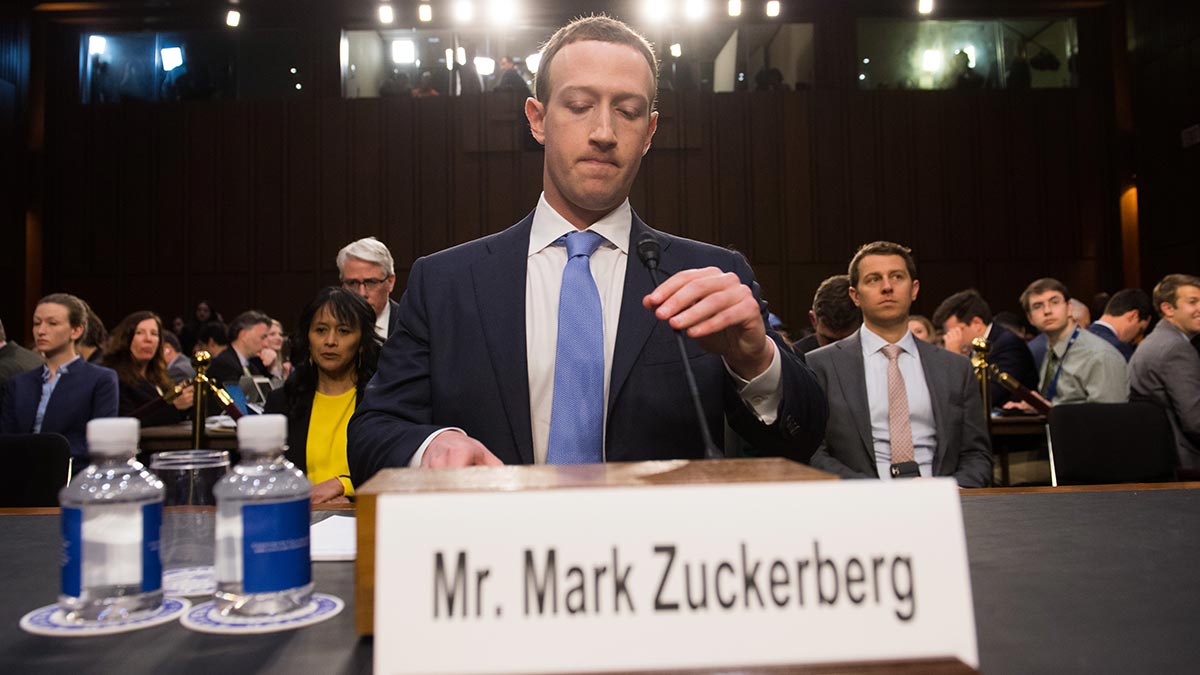
Lawmakers’ cringeworthy questioning of Facebook’s Mark Zuckerberg calls into question the government’s ability to regulate social media.
Facebook CEO Mark Zuckerberg on Capitol Hill, April 2018. (Saul Loeb/AFP/Getty Images)
With the testimony on Capitol Hill last week by Facebook CEO Mark Zuckerberg, there’s heightened concern about the negative side effects of social media platforms. But in listening to lawmakers questioning Zuckerberg, it became painfully obvious that our Federal legislators have next to no understanding of the role of advertising in social media – or even how social media works in its most basic form.
Younger staff members may have written the questions for their legislative bosses, but it was clear that the lawmakers were ill-equipped to handle Zuckerberg’s alternatively pat, platitudinous and evasive responses and to come back with meaningful follow-up questions.
Even the younger senators and congresspeople didn’t acquit themselves well.
It made me think of something else, too. The questioners – and nearly everyone else, it seems – are missing this fundamental point about social media: Facebook and other social media platforms aren’t much different from old-fashioned print media, commercial radio and TV/cable in that that they all generate the vast bulk of their earnings from advertising.
It’s true that in addition to advertising revenues, print publications usually charge subscribers for paper copies of their publications. In the past, this was because 1) they could … but 2) also to help defray the cost of paper, ink, printing and physical distribution of their product to news outlets or directly to homes.
Commercial radio and TV haven’t had those costs, but neither did they have a practical way of charging their audiences for broadcasts – at least not until cable and satellite came along – and so they made their product available to their audiences at no charge.
The big difference between social media platforms and traditional media is that social platforms can do something that the marketers of old could only dream about: target their advertising based on personally identifiable demographics.
Think about it: Not so many years ago, the only demographics available to marketers came from census publications, which by law cannot reveal any personally identifiable information. Moreover, the U.S. census is taken only every ten years, so the data ages pretty quickly.
Beyond census information, advertisers using print media could rely on audit reports from ABC and BPA. If it was a business-to-business publication, some demographic data was available based on subscriber-provided information (freely provided in exchange for receiving those magazines free of charge). But in the case of consumer publications, the audit information wouldn’t give an advertiser anything beyond the number of copies printed and sold, and (sometimes) a geographic breakdown of where mail subscribers lived.
Advertisers using radio or TV media had to rely on researchers like Nielsen — but that research surveyed only a small sample of the audience.
What this meant was that the only way advertisers could “move the needle” in a market was to spend scads of cash on broadcasting their messages to the largest possible audience. As a connecting mechanism, this is hugely inefficient.
The value proposition that Zuckerberg’s Facebook and other social media platforms provide is the ability to connect advertisers with more people for less spend, due to these platforms’ abilities to use personally identifiable demographics for targeting the advertisements.
Want to find people who enjoy doing DIY projects but who live just in areas where your company has local distribution of your products? Through Facebook, you can narrow-cast your reach by targeting consumers involved with particular activities and interests in addition to geography, age, gender, or whatever other characteristics you might wish to use as filters.
That’s massively more efficient and effective than relying on something like median household income within a zip code or census tract. It also means that your message will be more targeted — and hence more relevant — to the people who see it.
All of this is immensely more efficient for advertisers, which is why social media advertising (in addition to search advertising on Google) has taken off while other forms of advertising have plateaued or declined.
But there’s a downside: Social media is being manipulated (“abused” might be the better term) by “black hats” – people who couldn’t do such things in the past using census information or Nielsen ratings or magazine audit statements.
Here’s another reality: Facebook and other social media platforms have been so fixated on their value proposition that they failed to conceive of — or plan for — the behavior inspired by the evil side of humanity or those who feel no guilt about taking advantage of security vulnerabilities for financial or political gain.
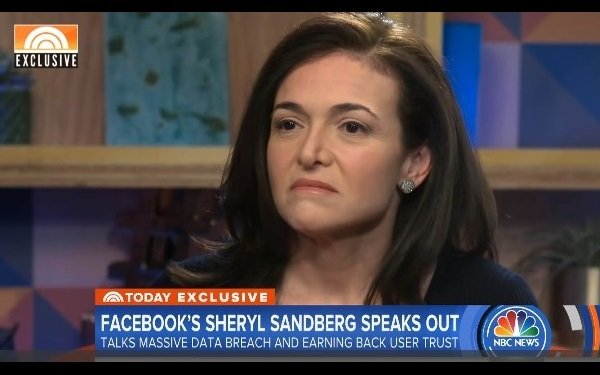
Facebook COO Sheryl Sandberg interviewed on the Today Show, April 2018.
Now that that reality has begun to sink in, it’ll be interesting to see how Mark Zuckerberg and Sheryl Sandberg of Facebook — not to mention other social media business leaders — respond to the threat.
They’ll need to do something — and it’ll have to be something more compelling than CEO Zuckerberg’s constant refrain at the Capitol Hill hearings (“I’ll have my team look into that.”) or COO Sandberg’s litany (“I’m glad you asked that question, because it’s an important one.”) on her parade of TV/cable interviews. The share price of these companies’ stock will continue to pummeled until investors understand what changes are going to be made that will actually achieve concrete results.
Amazon Spark: Less like a sizzle … more like a fizzle.
It’s now been more than nine months since Amazon launched its social media platform Spark … and so far, it’s hardly sizzled.
In fact, it’s made barely a ripple in the market.
There are plenty of people who contend that the last thing the world needs is yet another social network. But others would like to see new alternatives to the recently beleaguered Facebook platform.
As for its trajectory, it looks as if Spark is following the former rather than the latter path. The question is, “Why?”
Very likely, the answer lies in Spark’s questionable underlying raison d’etre. Essentially, Spark is a social feed of photos and other images. That makes it similar to Instagram … sort of.
One difference between the two platforms is that Spark is open to exclusively to Amazon Prime members. That limits the potential number of Spark users pretty severely, right from the get-go. [It’s true that non-members can view Spark feeds — but they can’t post their own content. And what’s a social platform if you cannot interact with it? It isn’t one.]
Another difference with Instagram may be even more of a fundamental problem. The rationale for Spark is to focus on products that Amazon sells. Spark is directly “shoppable,” which differentiates it from Instagram and other social networks. It also makes it less like a true social network and more like a garden-variety e-commerce site.
In other words, rather than being an interesting and engaging social platform, Spark is boring. Informative – but boring.
It isn’t that Amazon/Spark allows brands themselves to post content there; posting privileges are granted only to people it dubs “enthusiasts” or “onsite associates.” Brands must seek out “regular people” [sic] who are members of Amazon Prime to post content on their behalf about their products.
And I’m sure that’s happening – along with varying levels and forms of compensation flowing to these supposed “enthusiasts” in return for the product plugs. But can anyone imagine less compelling content than what results from this kind of commercialized “AstroTurfing”? No wonder people are ignoring this social media platform.
Andrew Sandoval, a group director for media planning agency The Media Kitchen, summarizes Spark’s predicament by noting that lifestyle-focused people tend congregate on Instagram — a place that shows people living their lives through products. By contrast, “Amazon Spark is mostly just talking about your products, which is the hard-sell. Ultimately, the e-commerce social experience is a little too far from the social experience,” Sandoval opines.
Have you interfaced with Spark since its July 2017 launch? If so, do you see redeeming qualities about the platform that the rest of us might be missing? Please share your comments with other readers.
Unless you’ve been living under a rock, it’s pretty obvious that the advertising marketplace in America has changed radically in the past few years.
In short order, we’ve seen the largest concentration of digital advertising converge on just two players: Google and Facebook. In fact, according to digital advertising research firm eMarketer, those two firms alone are attracting two-thirds of all digital ad dollars in the United States.
But this development isn’t all that surprising. The vast bulk of Google’s ad market share results from its search engine marketing platform (paid search). As for Facebook, it dominates digital display advertising not just in America, but in many other countries all over the world as well.
And both companies are the “big kahuna” players in the mobile advertising sector, too.
What’s interesting is that, despite the shortcomings that many people recognize in both types of digital advertising – banner blindness and often ill-targeted paid search results — healthy growth in both forms of advertising continues apace.
Google’s ad revenue growth has average around 20% for more than 30 straight quarters. Its growth in the third quarter of 2017 is right on pace at 22%.
For Facebook, the growth dynamics are particularly lucrative; its year-over-year ad revenue growth is pushing 50%.
Mobile ad revenues are growing even faster; they accounted for “only” $9 billion in revenues for Facebook in just the third quarter. And just as paid search advertising revenues represent more than 90% of Google’s total company revenues, mobile advertising accounts for nearly 90% of Facebook’s overall revenues.
With so much advertising activity, one might wonder from where it’s emanating.
One answer to that question is that the “universe” of advertisers is exponentially higher than we’ve ever encountered before. With low barriers to entry and “anyone can do it” ad development tools, “Jane and John Doe” are far more likely to be advertisers in today’s world of digital marketing than was ever contemplated just a few decades ago.
To wit: Facebook estimates that its social platform has more than 6 million active advertisers participating on it at any given moment in time. That’s the equivalent of 2% of the entire population of America.
There are a growing number of reasons why more marketers these days are referring to the largest social media platform as “Fakebook.”
Back last year, it came to light that Facebook’s video view volumes were being significantly overstated – and the outcry was big enough that the famously tightly controlled social platform finally agreed to submit its metrics reporting to outside oversight.
To be sure, that decision was “helped along” by certain big brands threatening to significantly cut back their Facebook advertising or cease it altogether.
Now comes another interesting wrinkle. According to Facebook’s statistics, the social network claims it can reach millions of Americans across several important age demographics, as follows:
18-24 year-olds: ~41 million people
25-34 year-olds: ~60 million people
35-49 year-olds: ~61 million people
There’s one slight problem with these stats: U.S. Census Bureau data indicates that the total number of people living in the United States falling in the 18-49 age grouping is 137 million.
That’s a substantially lower figure than the 162 million people counted by Facebook – 25 million (18%) smaller, to be precise.
What could be the reason(s) for the overcount? As reported by Business Insider journalist Alex Heath, a Facebook spokesperson has attributed the “over-counting” to foreign tourists engaging with Facebook’s platform while they’re in the United States.
That seems like a pretty lame explanation – particularly since U.S. tourism outside the country is a reciprocal activity that likely cancels out foreign tourism.
There’s also the fact that there are multiple Facebook accounts maintained by some people. But it stretches credulity to think that multiple accounts explain more than a small portion of the differential.
Facebook rightly points out that its audience reach stats are designed to estimate how many people in a given geographic area are eligible to see an ad that a business might choose to run, and that this projected reach has no bearing on the actual delivery and billing of ads in a campaign.
In other words, the advertising would be reaching “real” people in any case.
Still, such discrepancies aren’t good to have in an environment where many marketers already believe that social media advertising promises more than it actually delivers. After all, “reality check” information like this is just a click away in cyberspace …
For some time now, we’ve been hearing the contention made that social media causes people to become angry or depressed.
One aspect of this phenomenon, the argument goes, is the “politicization” of social media — most recently exhibited in the 2016 U.S. presidential election.
Another aspect is the notion that since so many people engage in never-ending “happy talk” on social media — presenting their activities and their lives as a constant stream of oh-so-fabulous experiences — it’s only natural that those who encounter those social posts invariably become depressed when comparing them to their own dreary lives that come up wanting.
But much of this line of thought has been mere conjecture, awaiting analysis by social scientists.
One other question I’ve had in my mind is one of causation: Even if you believe that social media contributes to feelings of depression and/or anger, is using social media what makes people feel depressed … or are people who are prone to depression or anger the very people who are more likely to use social media in the first place?
Recently, we’ve begun to see some research work that is pointing to the causation — and the finding that social media does actually contribute to negative mental health for some users of social media.
The researchers — Drs. Holly Shakya and Nicholas Christakis — studied the relationships between Facebook activity over time with self-reported measures such as physical health, mental health and overall life satisfaction. There were other, more objective measures that were part of the analysis as well, such as weight and BMI information.
The study detected a correlation between increased Facebook activity and negative impacts on the well-being of the research subjects. ore specifically, certain users who practiced the following social media behaviors more often (within one standard deviation) …
Liking social posts
Following links on Facebook
Updating their own social status frequently
… showed a decrease of 5% to 8% of a standard deviation in their emotional well-being.
As it turns out, the same correlation also applied when tracking people who migrated from light to moderate Facebook usage; these individuals were prone to suffer negative mental health impacts similar to the subjects who gravitated from moderate to heavy Facebook usage.
The Shakya/Christakis study presented several hypotheses seeking to explain the findings, including:
Social media usage comes at the expense of “real world,” face-to-face interactions.
Social media usage undermines self-esteem by triggering users to compare their own lives with the carefully constructed pictures presented by their social media contacts.
But what about that? It could be argued that heavy social media users are spending a good deal more time engaged in an activity which by definition is a pretty sedentary one. Might the decreased physical activity of heavy social media users have a negative impact on mental health and well-being, too?
We won’t know anything much more definitive until the Shakya/Christakis study can be replicated in another longitudinal research study. However, it’s often quite difficult to replicate such findings in subsequent research, where results can be affected by how the questions are asked, how random the sample really is, and so forth.
I’m sure there are many social scientists who are itching to settle these fundamental questions about social media, but we might be waiting a bit longer; these research endeavors aren’t as tidy a process as one might think.
These days, brands often get caught up in a social media whirlwind whenever they might stumble. Whatever fallout there is can be magnified exponentially thanks to the reach of social platforms like Twitter, Facebook and Instagram.
When a “brand fail” becomes a topic of conversation in the media echo chamber, it can seem almost as though the wheels are coming off completely. But is that really the case?
Consider the past few weeks, during which time two airlines (United and American) and one consumer product (Pepsi) have come under fire in the social media sphere (and in other media as well) for alleged bad behavior.
In the case of United and American, it’s about the manhandling of air travelers and whether air carriers are contributing to the stress – and the potential dangers – of flying.
In the case of Pepsi, it’s about airing an allegedly controversial ad featuring Kendall Jenner at a nondescript urban protest, and whether the ad trivializes the virtues of protest movements in cities and on college campuses.
What exactly have we seen in these cases? There’s been the predictable flurry of activity on social media, communicating strong opinions and even outrage.
United Airlines was mentioned nearly 3 million times on Twitter, Facebook and Instagram just on April 10th and 11th. Reaction on social media over the Pepsi ad was similarly damning, if not at the same level of activity.
And now the outrage has started for American Airlines over the “strollergate” incident this past weekend.
But when you consider what the purpose of a brand actually is – to sell products and services to customers – what’s really happening to brand reputation?
A good proxy is the share price of the brands in question. United Airlines’ share price took a major hit the week the “draggergate” news and cellphone videos were broadcast, but it’s been climbing back ever since. Today, United’s share price looks nearly the same as before the passenger incident came to light.
In the case of Pepsi, company shares are up more than 7% so far in 2017, making it a notably robust performer in the market. Moreover, a recent Morning Consult poll found that over 50% of the survey respondents had a more favorable opinion of the Pepsi brand as a result of the Kendall Jenner commercial.
That is correct: The Pepsi commercial was viewed positively by far more people than the ones who complained (loudly) about it on social media.
What these developments show is that while a PR crisis isn’t a good thing for a brand’s reputation, social fervor doesn’t necessarily equate with brand desertion or other negative changes in consumer behavior.
Instead, it seems that the kind of “brand fails” causing the most lasting damage are ones that strike at the heart of consumers’ own individual self-interest.
Chipotle is a good example, wherein the fundamental fear of getting sick from eating Chipotle’s food has kept many people away from the chain restaurant’s stores for more than a year now.
One can certainly understand how fears about being dragged off of airplanes might influence a decision to select some other air carrier besides United – although it’s equally easy to understand how price-shopping in an elastic market like air travel could actually result in more people flying United rather than less, if the airline adjusts its fares to be more the more economical choice.
My sense is, that’s happening already.
And in the case of Pepsi, the Jenner ad is the biggest nothing-burger to come down the pike in a good while. The outrage squad is likely made up of people who didn’t drink Pepsi products to begin with.
Still, as an open forum, social media is important for brands to embrace to speak directly to customers, as well as to learn more about what consumers want and need through their social likes, dislikes and desires.
But the notion of #BrandFails? As often as not, it’s #MuchAdoAboutNothing.
With each passing day, we see more evidence that Twitter has become the social media platform that’s in the biggest trouble today.
The news is replete with articles about how some people are signing off from Twitter, having “had it” with the politicization of the platform. (To be fair, that’s a knock on Facebook as well these days.)
Then there are reports of how Twitter has stumbled in its efforts to monetize the platform, with advertising strategies that have failed to generate the kind of growth to match the company’s optimistic forecasts. That bit of bad news has hurt Twitter’s share price pretty significantly.
And now, courtesy of a new analysis published by researchers at Indiana University and the University of Southern California, comes word that Twitter is delivering misleading analytics on audience “true engagement” with tweets. The information is contained in a peer-reviewed article titled Online Human-Bot Interactions: Detection, Estimation and Characterization.
That sort of news can’t be good for a platform that is struggling to elevate its user base in the face of growing competition.
But it’s even more troubling for marketers who rely on Twitter’s engagement data to determine the effectiveness of their campaigns. How can they evaluate social media marketing performance if the engagement data is artificially inflated?
Fifteen percent of all accounts may seem like a rather small proportion, but in the case of Twitter that represents nearly 50 million accounts.
To add insult to injury, the report notes that even the 15% figure is likely too low, because more sophisticated and complex bots could have appeared as a “humans” in the researchers’ analytical model, even if they aren’t.
There’s actually an upside to social media bots – examples being automatic alerts of natural disasters or customer service responses. But there’s also growing evidence of nefarious applications abounding.
Here’s one that’s unsurprising even if irritating: bots that emulate human behavior to manufacture “faux” grassroots political support. But what about the delivery of dangerous or inciting propaganda thanks to bot “armies”? That’s more alarming.
The latest Twitter-bot news is more confirmation of the deep challenges faced by this particular social media platform. What’s next, I wonder?

 The past few months have seen people like Mark Zuckerberg doing mental acrobatics attempting to explain how social media platforms like Facebook intend to control the spate of “fake news” and “hate speech” posts, comments and tweets that are so often the currency of interactive “discourse” online.
 The survey, which has been conducted annually since 1997, gives us insights into Americans’ current attitudes about censoring objectionable content balanced against free speech rights.







 Nones Notes