Remembering Elinor Smith: Aviatrix Extraordinaire (1911-2010)

Elinor Smith in the 1920sThis past month, one of the world’s pioneering women of flight, Elinor Regina Patricia Ward Smith, passed away at age 98.

Known as “The Flying Flapper,” Ms. Smith was the last of aviation’s early pioneers. While her name may not be well known beyond the circle of aviation aficionados today, it could be argued that her career was more accomplished than Amelia Earhart’s (except, of course, in the “high drama” department).

Elinor Smith had her share of interesting and noteworthy feats that were followed by a fascinated public during the early years of aviation, when she flew in the company of such personages as Charles Lindbergh and Jimmy Doolittle as well as other aviatrixes like Earhart, Evelyn ‘Bobbi’ Trout and Frances Lowe ‘Pancho’ Barnes.

Smith first flew in an aircraft in 1917 at the age of six and later recounted that she immediately caught the aviation “bug.” By age ten, she had learned to operate the control panel of a Curtiss Jenny aircraft – helped along by blocks attached to the rudder pedals to accommodate her short legs.

Having completed her first solo flight by age 15, Smith was licensed at 16 – the youngest U.S.-government licensed pilot on record – by none other than Orville Wright. The following year (1928) she came close to losing that license by performing an air stunt around the city of New York that involved flying over and under four bridges spanning the East River.

Smith was to recall later that this feat of flight was done basically on a dare. She piloted her Waco 10 biplane beneath the Williamsburg, Manhattan and Queensboro bridges – dodging several ships along the way. She completed her performance by flying sideways beneath the Brooklyn Bridge and capping things off by twice circling the Statue of Liberty.

Not surprisingly, all of a sudden Elinor Smith was big news in the media. The mayor of New York intervened on her behalf with the U.S. Commerce Department, who controlled pilot licensing in those days, so that the new celebrity was back in the air flying a mere 15 days after her daredevil stunt.

Smith would go on to mark numerous other feats of accomplishment in early aviation – charting records of flying higher, faster and longer than others had done previously. In 1930, she was voted the “best woman pilot in America” in a poll of licensed pilots … when she was not yet 20 years old!

Another interesting honor was being the first woman ever to appear on a Wheaties® cereal box (1934).

Since careers in the military were closed to women in those days, Smith instead landed positions as test pilot with the Fairchild and Bellanca organizations. She was married in 1933, and retired from aviation a few years later to concentrate on her marriage and raising four children. In later years, following the death of her husband in 1956, she would return to test-piloting jet aircraft.

As testament to the capabilities of this remarkable woman, as late as 2000 the nearly 90-year-old Smith flew NASA’s Space Shuttle flight simulator, becoming the oldest pilot to succeed in a simulated shuttle landing. And the following year, she was to pilot an experimental C33 Raytheon AGATE aircraft … proving that the skills she honed at the very beginning of the aviation era had not dimmed over the years.

Elinor Smith now joins that august company of aviation pioneers who have lived extraordinarily long lives, including Jimmy Doolittle (96) and Bobbi Trout (97). Wouldn’t it be nice to imagine that she is busily piloting people about the heavens now!


Newspapers Turn on Each Other

Dinosaurs in Disney's FantasiaLast week, the Associated Press reported that U.S. newspaper advertising revenues declined dramatically in 2009, bringing ad receipts to the lowest level recorded in nearly 25 years.

In fact, newspaper publishers’ total advertising revenues last year came in below $28 billion, down $10 billion from 2008. According to the Newspaper Association of America, annual ad revenues have now fallen by nearly $22 billion – a whopping 44% — since 2006.

And now, amid this toxic environment comes word that The Wall Street Journal has declared an all-out war on The New York Times for local advertising. In mid-April, the Journal — up to now focused almost exclusively on national and international news — is set to introduce a New York-focused section as part of its paper. Outside observers believe this will put as much as ~20% of the New York Times’ retail advertising revenues at risk.

And this isn’t a minor foray on the part of the WSJ, either. It will be spending upwards of $15 million to produce the new 12-page section which will cover local business, real estate, sports and cultural events. The financial outlay includes salaries for ~35 editorial writers – surely one of the few instances of new editor jobs actually becoming available.

The WSJ action couldn’t come at a worse time for the Times, which has experienced sharper ad revenue declines than the industry average. It’s responding by launching a major trade marketing campaign of its own, touting its audience strength with female readers and “high culture” afficionados.

But just how effective this countermove will be is debatable, as recent moves by the paper haven’t exactly telegraphed a continuing commitment to the local news scene. In the last few years alone, the Times has consolidated weekly sections covering specific regions of the New York metro area (Long Island, Westchester, Northern New Jersey), as well as axing its stand-alone “City” and “Metro” sections.

Over the coming months, it’ll be interesting to see how effective the WSJ is with its new local-focused section – whether or not it’ll land a major blow on its rival.

Either way, the vision of two venerable newspapers engaged in a Herculean struggle, fighting over an ever-shrinking advertising pie is isn’t exactly a pretty sight.

It reminds me of the famous scenes in the Disney movie Fantasia of the huge dinosaurs furiously going after one other – even as the world’s changing ecosystem is rendering the entire species extinct.

Joel Kotkin: America’s Best Years Are Still Ahead

The Next Hundred Million: America in 2050 by Joel KotkinIn the study of demographics – a field that has had its share of doomsayers over the years – the irrepressible Joel Kotkin has been a continuing voice of optimism. The Distinguished Presidential Fellow in Urban Futures at Chapman University and an authority on economic, political and social trends as well as demographics, Kotkin has also been one to defend suburbia as one of the key ingredients of successful urban development.

It’s been interesting to watch how these views have played out in relation to the predilection of many in the American elite to denigrate anything pertaining to the suburban lifestyle. In their characterization, “suburbia” is synonymous with faceless neighborhoods punctuated by numbingly similar commercial strip developments featuring cookie-cutter national chain stores and restaurants. The only difference between suburban Los Angeles and suburban Chicago is the palm trees.

The suburban mindset has also been maligned by many as being obsessed with material pursuits and economic upward mobility … and possessing little if any thinking that’s “progressive.”

As an example of this side of the debate, the publication of Richard Florida’s book The Rise of the Creative Class – with its claims that metropolitan areas with high concentrations of high-tech employees, artists, musicians and gay people correlate to a higher level of economic development – articulates a theory that has been far better received by the news media and other members of the American intelligentsia.

Now, along comes Kotkin’s newest book … and with it his latest intriguing predictions. In The Next Hundred Million: America in 2050, Kotkin argues that the coming 40 years will witness a resurgent America, even as the population swells by another 100 million souls. Comparing the birth rates of America to all other developed nations, along with the continued in-migration of people from other countries – particular Asian and Latin American – Kotkin contends that no other country anywhere will enjoy such ethnic diversity. And to Kotkin, youth and diversity equate with strength.

By contrast, Kotkin maintains that “most of the developed countries in both Europe and Asia will become veritable old-age homes.” Many of these nations, with their generous social safety nets, will face huge pension obligations without having younger workers to help shoulder the costs.

Kotkin’s bottom-line prediction is that Europe and Asia will decline even as America thrives. And not just economically but also culturally: “The most affluent, culturally rich and successful nation in human history.”

Kotkin also believes that the large new numbers of Americans will flock to – where else – the suburbs, which he characterizes as “the best, most practical choice for raising their families and enjoying the benefits of community.”

No doubt, there will be those who question Mr. Kotkin’s conclusions and predictions. What about the rise of China? How will illegal versus legal immigration affect social and economic trends? How about the widening gulf between the earning power of “technocrats” and the rest of the population? Not to mention the collapse of the family unit which has rendered so much of the fabric of “inner-urban” America dysfunctional at best … hopeless at worst?

Either way, this book is very interesting and helps us reappraise some of the “big trends” in social demography. The theories of Richard Florida’s “creative class” ring decidedly less compelling today, barely six or seven years on. It’s time now to consider Joel Kotkin’s interesting theories — with the same critical eye, of course.

Jack LaLanne at 95: Fit for the Ages

Gov. Arnold Schwarzenegger congratulates Jack LaLanne on his 95th birthday (September 2009).
Woods. McGwire. Vick. Harding. Rodriguez. In the world of sports and fitness, it seems that every other day someone is falling from grace. “Larger than life” seems inevitably to be followed by “all too human.”

But we have at least one sports hero who has forged a career refreshingly clear of controversy … and who has done so for nearly a century.

When Jack LaLanne opened the world’s first modern “fitness club” in Oakland, CA in 1935 at the age of 21, no one could have predicted that he’d still be a fixture in the world of sports some 75 years later.

“I can’t die. It would ruin my image!” he’s quoted as saying. But LaLanne certainly doesn’t have to worry about his image. At 95 years old, he remains one of America’s greatest proponents of health and fitness, communicating his message of exercise and good nutrition to all who will listen.

And unlike the hype surrounding so many other sports celebrities, LaLanne practices what he preaches: He works out at least two hours each day, concentrating on stretch and pull exercises plus swimming.

The story of Jack LaLanne was not always fitness and health, however. Like Charles Atlas, another bodybuilding and fitness pioneer, LaLanne hardly grew up as the picture of strength. But it was a teen-age encounter with nutrition pioneer Paul Bragg that inspired LaLanne to dramatically change his daily routine by joining the local YMCA in the San Francisco Bay area, becoming involved in bodybuilding and high school sports, and focusing on healthy eating.

It wasn’t long before LaLanne was experimenting with new weight training equipment of his own design, attracting a steady stream of policemen, firefighters and neighborhood toughs to his family’s backyard – which would lead to opening his first fitness center just a few years later.

The list of “firsts” in Jack LaLanne’s career in fitness is certainly impressive:

 The first host of a nationally syndicated television exercise show (1951).

 The first person to open a coed health club (eventually to become the 200-unit European Health Spa chain, later sold to Bally). At age 41, swimming the entire length of San Francisco’s Golden Gate Bridge underwater, with 140 lbs. of equipment – a world record.

 At age 42, becoming the world-record holder for pushups (1,033 in 23 minutes).

 The first person to promote weight training for women and older adults.

 The first sports personality to endorse vitamins and exercise equipment on the TV airwaves.

(Coincidentally, LaLanne was also one of the first sports celebrities to warn against the dangers of smoking – long before medical science would come to the same conclusion.)

The Jack LaLanne Show would continue on television for 35 years. But the then 71-year-old host was certainly not ready to retire. Instead, he’s remained active as an author, spokesperson and motivational speaker on health and fitness in the 25 years since.

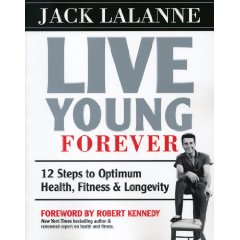
Moving easily between the world of sports and entertainment, Jack LaLanne has been awarded a lifetime achievement award from the President’s Council on Physical Fitness & Sports (1996) … along with getting his star on the Hollywood Walk of Fame (2002). And at age 95, LaLanne isn’t showing any signs of slowing down. In fact, his eleventh book on fitness, Live Young Forever, was published just last year.

“Dying is easy. Living, you’ve got to work at,” LaLanne is fond of saying. By the looks of it, Jack LaLanne has certainly followed his own medicine – and it’s worked out beautifully for him.

The End of Privacy

An article by technology author Steve Lohr published last week in The New York Times caught my eye. Titled “How Privacy Vanishes Online,” it explores how conventional notions of “privacy” have become obsolete over the past several years as more people engage in cyber/social interaction and web e-commerce.

What’s happening is that seemingly innocuous bits of information are being collected, “read” and reassembled by computers to build a person’s identity without requiring direct access to the information.

In effect, technology has provided the tools whereby massive amounts of information can be collected and crunched to establish patterns and discern all sorts of “private” information.

The proliferation of activity on social networking sites such as Flickr, Facebook and LinkedIn is making it easier than ever to assemble profiles that are uncanny in their accuracy.

Pulling together disparate bits of information helps computers establish a “social signature” for an individual, which can then be used to determine any number of characteristics such as marital status, relationship status, names and ages of children, shopping habits, brand preferences, personal hobbies and other interests, favorite causes (controversial or not), charitable contributions, legal citations, and so on.

One of the more controversial experiments was conducted by MIT researchers last year, dubbed “Project Gaydar.” In a review of ~4,000 Facebook profiles, computers were able to use the information to predict male sexual preference with nearly 80% accuracy – even when no explicit declaration of sexual orientation was made on the profiles.

Others, however, have pointed to positive benefits of data mining and how it can benefit consumers. For instance, chain grocery stores can utilize data collected about product purchases made by people who use store loyalty cards, enabling the chains to provide shoppers relevant, valuable coupon offers for future visits.

Last year, media company Netflix awarded a substantial prize to a team of computer specialists who were able to develop software capabilities to analyze the movie rental behavior of ~500,000 Netflix subscribers … and significantly improve the predictive accuracy of product recommendations made to them.

To some, the Netflix program is hardly controversial. To others, it smacks of the “big brother” snooping that occurred in an earlier time during the Supreme Court confirmation hearings for Robert Bork and Clarence Thomas, when over-zealous Senate staffers got their hands on movie store rental records to determine what kind of fare was being watched by the nominees and their families.

Indeed, last week Netflix announced that it will not be moving forward with a subsequent similar initiative. (In all likelihood, this decision was influenced by pending private litigation more than any sort of altruism.)

Perhaps the most startling development on the privacy front comes courtesy of Carnegie Mellon University, where two researchers have run an experiment wherein they have been able to correctly predict the Social Security numbers for nearly 10% of everyone born between 1989 and 2003 – almost 5 million people.

How did they do it? They started by accessing publicly available information from various sources including social networking sites to collect two critical pieces of information: birthdate, plus city or state of birth. This enabled the researchers to determine the first three digits of each Social Security number, which then provided the baseline for running repeat cycles of statistical correlation and inference to “crack” the Social Security Administration’s proprietary number assignment system.

So as it turns out, it’s not enough anymore merely to be concerned about what you might have revealed in cyberspace on a self-indulgent MySpace page or in an ill-advised newsgroup post.

Social Security numbers … passwords … account numbers … financial data. Today, they’re all fair game.

U.S. consumers: More comfortable than ever making online purchases.

Online purchasingHave U.S. consumers finally gotten over their skittishness about making purchases over the Internet? A newly released study from Javelin Strategy & Research suggests that they have.

The 2010-2014 Online Retail Payments Forecast report draws its findings from data collected online in November 2009 from a randomly selected panel of nearly 3,300 U.S. consumers representing a representative cross-sample by age, gender and income levels.

Based on the Javelin sample, nearly two-thirds of American consumers are now either “comfortable” or “very comfortable” with shopping online.

On the other end of the scale, ~22% of U.S. consumers continue to be wary of online purchasing; these people haven’t made an online purchase within the past year … or in some cases, never.

These figures suggest that the consumer comfort level with making online purchases is as high as it’s ever been. And how are consumers making their online payments? The Javelin study reports that among those respondents reporting online activities, the five most popular payment methods are:

 Major credit card: 70%
 Major debit card: 55%
 Online payment service such as PayPal®: 51%
 Gift card (good at one specific merchant): 41%
 Store-branded credit card (good at one specific merchant): 27%

Even with more than half of consumers using a debit card for online purchases, the total dollar volume of online sales attributable to debit cards is less than 30%. Javelin forecasts debit card share to continue climbing in the short-term, however, due to tighter consumer credit standards now in force.

Bottom line, the Javelin report suggests that despite the periodic horror stories that have been published about credit card information and other financial data being captured or mined off the Internet, the convenience and price/selection benefits of online shopping are winning the day with consumers. Not surprising at all, really.

Your declining retirement savings: It’s all relative.

EBRI's Annual Retirement Confidence Survey
The EBRI's 2010 Retirement Confidence Survey reveals severe challenges faced by many American workers.
As difficult as the last two years have been on your finances, you’ve probably saved a lot more for retirement than your fellow workers.

How is that possible? Because it’s all relative. The Employee Benefit Research Institute’s most recent annual survey of U.S. workers and their retirement savings reveals that the percentage of workers having fewer than $10,000 in savings stands at 43%. That’s up from 39% in 2009.

Even more ominous, the percentage of workers who reported they have less than $1,000 in savings is 27% — significantly more than the 20% reported in 2009.

The EBRI’s definition of retirement savings excludes the value of primary homes and defined-benefit pension plans. Still, these are startling figures, showing that large numbers of Americans have little if anything in the way of a savings safety net.

It’s true that some people have plowed their savings into the purchase of a home. But these “house poor” individuals are often among the first who face mortgage foreclosures upon the loss of a job, because they have so few cash resources upon which to fall back.

If there is a glimmer of good news in these dreary statistics, it’s that more people are awakening to the reality of their finances. Gone is the notion that Social Security will pay enough for a decent retirement lifestyle. Indeed, less than 20% of respondents expressed confidence in their ability to save enough for a comfortable retirement. That’s the second lowest reading ever recorded in the 20-year history of the EBRI’s annual survey.

Only ~45% of workers with some form of savings have more than $25,000 stashed away … and people know that $25,000 is not nearly enough for retirement, Social Security payments being what they are. Consequently, in the 2010 EBRI survey, one in four workers report that they’ve decided to postpone their retirements (that’s up from ~15% saying so in the 2009 EBRI research).

For its survey, the Employee Benefit Research Institute queried ~1,150 U.S. workers (age 25 and older) plus retirees, making it one of the most comprehensive field studies on the topic of U.S. retirement savings. There’s a wealth of additional statistics and insights available here.

Let’s Revisit the Yugo!

Yugo advertisementThose of us “of a certain age” remember well when the Yugo car was introduced to America with great fanfare. In 1985, the prospect of purchasing a small vehicle with an even smaller price tag (~$3,990) was irresistible to many – even with the high gasoline prices and gas lines of the 1970s looking more distant in the rearview mirror. For those on a budget, who could resist the allure of buying a new car for $99 down and a $99 monthly payment?

Here’s a startling statistic that bears this out: When the Yugo was introduced in the summer of 1985, more than 1,000 of them were sold in one day. In fact, the Yugo was to be the fastest-selling first-year European import ever sold into the U.S. – a record that stands yet today.

But in just a few short years, the Yugo would go from being a star to being a dud … from being the “it” car to being the butt of jokes.

How could this happen? The answers are found in a just-released book “The Yugo: The Rise and Fall of the Worst Car in History,” written by Jason Vuic (ISBN-13: 978-0809098910). This pithy, irreverent volume takes readers on a merry romp through its 250+ pages … and things never have time to become dull.

One of the earliest signs that the Yugo might not be all it was cracked up to be came when its American investors decided to drive a Yugo car across the country. What better way to test the product? In retrospect, they should have heeded the clear warning signs: the new car broke down not once … not twice … but three times during its ~3,000 mile journey.

Undeterred, they plowed ahead, forming a national dealer network and trumpeting the Yugo as a fresh, affordable European car that came with a small price tag and a big attitude.

But the reviews were scathing from the get-go. The car broke down during a road test by Motor Trend, leading the magazine to conclude that the vehicle was “hard to recommend at any price.” Some customers reported that their new Yugos came off the dealer lot with rust spots already showing in the trunk. That plus noisy brakes … rough-riding clutch … and a few other deficiencies not normally experienced until any other car is years old.

Predictably, it didn’t take long for the magic to wear off. By the time of Saturday Night Live’s famous parody of the Yugo – its fake TV ad for the Adobe clay car (at $179 apiece) – Yugo dealers across America were already closing their doors.

Actually, what’s most surprising to read is that the Yugo actually continued to be manufactured in Europe as late as 2008.

In retrospect, I suppose the Yugo wasn’t a complete waste of time. It helped us realize – once again – that despite the enduring appeal of a low-cost alternative, there’s no substitute for producing a quality product.

It’s also given us 25 years of great jokes.

The Residential Real Estate Market: Still in the Dumper

Home Foreclosures
U.S. home foreclosures set a record in 2009 ... and are on their way to being even higher in 2010.
When it comes to the U.S. residential real estate market, the latest statistics and forecasts don’t bode well at all for the industry. Recently released stats on foreclosure rates reveal that 2009 was the worst year on record. And unfortunately, 2010 is looking like it’ll shatter the record yet again.

According to RealtyTrac, a firm that monitors real estate and foreclosure data, more than 2.8 million properties in America received a foreclosure notice during the past year. That’s 21% more than in 2008 and a whopping 120% higher than what was reported in 2007.

Moreover, one in every 45 households received at least one filing last year – nearly four times higher than 2006. These ugly numbers were racked up in spite of robust foreclosure prevention programs, without which the figures doubtless would have been significantly higher.

Unfortunately, the scenario doesn’t appear any better for 2010. Unless and until lenders are able to get principal balance reductions, high default rates are going to continue. In fact, RealtyTrac projects that a new record of 3 million or more properties will get a filing this year.

Where are we seeing the biggest problems? Well … in Michigan, to nobody’s surprise. But also in Nevada, Arizona and Florida. Until recently, those were states blessed with dramatic – even outsized – population and job growth, along with commensurately growing political power.

But as outlined in a recent article by Michael Barone, in an interesting twist of fate, these states are now experiencing net out-migration, while erstwhile laggard states in the Northeast and Midwest are now showing net in-migration.

It’ll likely take years to sort out the scrambled residential real estate market we have today – a situation sparked by a housing crisis for which many in government and the private sector are responsible … but which has also caught far too many innocent people in its clutches. Hopefully, the lessons learned will not be soon forgotten.

Improving the Prognosis for Patient Safety in Hospitals

"Josie's Story" Book"Safe Patients, Smart Hospitals" BookThere’s a newly published book just out on the issue of patient safety in U.S. hospitals that’s quite an interesting read. The book is titled Safe Patients, Smart Hospitals (Hudson Street Press, ISBN-13: 978-1594630644), written by Peter Pronovost, Ph.D, M.D., a professor at Johns Hopkins University School of Medicine, and Eric Vohr, former assistant director of media relations at Johns Hopkins University School of Medicine and an instructor of technical writing at the school. Dr. Pronovost is also Medicaid director for the Johns Hopkins Center for Innovation in Quality Patient Care. (The book is also available in a Kindle edition.)

Instead of presenting us with a dry tome like so many other books on healthcare issues, this volume starts out with a true-life medical case where procedures and protocol at a top-notch healthcare institution were not enough to save the life of a patient.

The example the authors use to introduce us to the issue of patient safety is Josie King, an 18-month old girl who was the victim of accidental scalding by hot water and who was admitted to Johns Hopkins Hospital with second-degree burns. Unfortunately, the little developed a bacterial infection from a central line catheter while in the hospital, which was then improperly treated, leading to her death.

Living not far from Baltimore area, I recall this story as being big news in the local media market back in 2001 when the case occurred. Numerous stories were broadcast along with concerns raised as to how such events could have happened at one of America’s most prestigious healthcare institutions. (The child’s mother, Sorrel King, also wrote a book about the incident – Josie’s Story – published last year.)

Both Dr. Pronovost and Mr. Vohr are intimately familiar with the Josie King tragedy because of their first-hand knowledge of the events at the time. In fact, Dr. Pronovost used the experience to develop a simple set of usage guidelines for central line catheters – reducing a ~120-page thicket of inconsistent, confusing procedures and guidelines down to a five-step checklist. When a test program across 50 intensive-care units in Michigan hospitals used the five-step checklist in lieu of the traditional guidelines, there was a dramatic reduction in the incidence of catheter line infections to near zero, along with saving an estimated 2,000 lives.

In their book, Messrs. Pronovost and Vohr are basically issuing a “call to action” for taking a similar approach to a myriad of other surgical and related procedures at hospitals. But the book also pinpoints significant hurdles the authors believe are standing in the way of action. These range from having a lack of uniform standards from one hospital to another … a propensity for doctors and other medical staff to stick to existing behaviors and protocols even if they have shortcomings … the sometimes insufficient lines of communications between physicians and nurses … and, not least, the unwillingness of some surgeons, as the prima donnas of their hospitals, to taking direction, advice or orders from other medical staff members.

In my line of work, I have the opportunity to interact with healthcare organizations ranging from smaller community hospitals to large regional “destination” health centers. From my experience, I tend to agree with the authors that different hospitals have different protocols, different priorities, and different cultures, which could certainly lead to different patient outcomes in some cases.

Nevertheless, I have never seen a case of wanton disregard for patient safety. From what I’ve observed, I think any problems that might arise would more likely come from the large volume of patients being cared for, along with the constantly evolving technologies and procedures. It’s really too bad that medical staff members aren’t blessed with a 36-hour day, because so many seem to put forth a 36-hour effort within a 24-hour day … day in and day out.

Perhaps for this reason as much as any other, it is interesting – and welcome – to read of practicals way to improve patient safety through using steps such as ones outlined by Dr. Pronovost and Mr. Vohr in their book. For anyone interested or involved in the healthcare industry, it’s a volume definitely a worth reading.