Where do people spend their time online?

How much time to people spend online ... and doing what?With the ever-growing options for where people spend their time when online, what’s the latest in terms of their online behaviors?

That’s the question The Buntin Group, a MarComm and branding agency, and Survey Sampling International (SSI) were trying to answer when they conducted a survey of American web users in May 2013. 

The survey was conducted among adults who use at least two tech platforms (including e-mail, text or social) to connect with others during a given week.

What the survey found is that Americans are spending more time than ever online – about 23 hours per week on average.  That’s nearly a full day out of a seven-day week.

Drilling down further, the survey found that e-mail communications continues to be the most prevalent online activity, but it’s followed closely by Facebook:

  • Average time per week spent on e-mail communications:  7.8 hours
  • Average time spent on Facebook:  6.8 hours
  • Average time spent on YouTube:  5.0 hours
  • Average time on Google+:  4.3 hours
  • Average time on Twitter:  4.2 hours

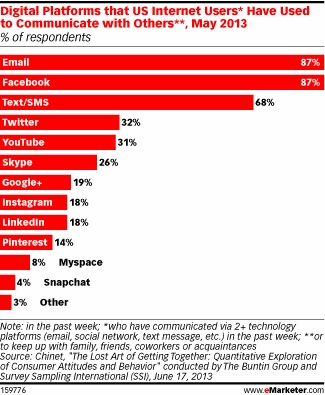
In keeping with these findings, the survey also found that e-mail and Facebook are where most respondents log in most often to communicate with others:

Social Platforms used by Internet Users

But here’s another interesting finding from the survey:  From time to time, even the most digitally connected people find themselves fatigued by all of their online activity.

In fact, nearly 55% of the survey respondents reported that they had “walked away from technology at least occasionally” in the past year to gain more in-person time.

An even larger ~62% reported that they plan to reduce their “tech socializing time” in the upcoming year and instead focus on more face-to-face interaction.

Speaking personally, e-mail and YouTube are indispensable to me.  Facebook is a “nice to have” platform when it comes to keeping up with friends and family — and I usually check in once a day.  But I have gone as long as two weeks without logging on and haven’t felt worse for it. 

I spend far less time on Twitter than the survey average … and I don’t even have a Google+ account (nor do I have any plans to set one up).

What about you?  Based on your experience, does 23 hours of online activity weekly seem excessive – or close to the mark? 

Do you take “online vacations” periodically?  And which online activities are most important and valuable to you?  Please share your thoughts here.

College Kids and their “Gadget Goodies”

I’ve received a few interesting comments from readers about my recent blog post about so-called “digital dementia.”  One reader and business colleague of mine, Syed Tahir Rasul, had this to say:

“In the 1990s, we were taught that playing computer games would even sharpen our mental skills.  But now this enormous increase in gadgets, [even] in the hands of five-year olds … is certainly alarming.  This is causing some sort of disorder for sure.  But then again, we can’t live without these gadgets now!”

College students and their electronic gadgetsThis got me to wondering:  I have two twenty-something daughters who are most definitely “wired” up one side and down the other.  But is this behavior the norm or the exception?

I found some answers in the form of results from a new online survey of ~1,525 college students aged 18 to 34 conducted by market research firm Crux Research for re:fuel, a branding and media company.  To be included in the survey, each respondent had to be taking at least one course on a physical campus.

With ~22 million U.S. college students expected to be enrolled for the 2013/14 college year, one would imagine the behaviors of this large group would track fairly closely with the overall behaviors of this age cohort.

What the re:fuel research shows is that the average American college student possesses seven devices in their technology “arsenal” (that’s up from six a year earlier).  So it’s definitely a “gadget grab-bag” with these kids.

Laptops and smartphones lead the pack in popularity:

  • Laptop computer:  ~85% of American college students own one
  • Smartphone:  ~69%
  • Video gaming console:  ~68%
  • MP3 player:  ~67%
  • Printer:  ~62%
  • Digital camera:  ~61%
  • Flat-screen TV:  ~60%

—————————————————

  • Desktop computer:  ~48%
  • Tablet computer:  ~36%
  • Handheld gaming system:  ~35%
  • Feature phone:  ~33%
  • Camcorder/video recorder:  ~25%
  • E-reader:  ~21%
  • Tivo/DVR:  ~18%

The “break” we observe between ownership rates of 60%+ and below 50% is as much a function of changing tastes in digital equipment as anything else.  “Old fashioned” feature phones are biting the dust as more college kids trade up to smartphones.  In fact, the survey reveals that more than 30% of the respondents say they intend to purchase a new smartphone in the coming year.

[Considering the ownership rates that already exist, quite a few students will be trading up not from a feature phone, but from another smartphone.]

Who uses camcorders anymore, when so many smartphones take just as good-quality pictures?

Desktop computers?  Why even bother?

There’s a good deal more information contained in the re:fuel college study — covering not only technology ownership but also student spending, online behaviors, media consumption habits, and engagement on social platforms.  You can review report highlights here.

If you have college-age kids … or if you’ve been a student yourself recently, I’m interested to hear your perspective on these trends.  Please share your thoughts.

The $25 Tweet

Value of a tweetA marketing analytics firm is claiming that the average tweet on branded Twitter sites is worth a little over $25.

Yep, you read that correctly; $25.62, to be precise.

The revenue estimate comes to us courtesy of SumAll, a data visualization and analytics firm.  It reached that conclusion after reviewing more than 900 of its customers’ social media program efforts.  SumAll published its findings last week in an infographic.

To those who might look at the ~$25 figure and scoff (that may be most readers), it should be noted that once the total number of people who see an individual tweet is taken into consideration, the amount of revenue gained per impression is only about one half of one penny, on average.

To put this into context, $0.005 revenue-per-impression is lower than most other marketing tools and about on par for AdWords revenues-per-impression.

The imputed revenue from tweets amounts to about 1%-2% in incremental revenues, according to SumAll’s study group.

Not surprisingly, this announcement was met with questions … and some skepticism.  Asked to explain further how SumAll came up with its results, a SumAll spokesperson replied on the company’s blog:

“… Our data comes from our own user base of over 30,000 people.  We anonymize the data first and then aggregate all the data to derive new, interesting insights from a broad population.  For this infographic, we collected data from all users who have a Twitter stream and commerce stream, and conducted some calculations to derive the value of each tweet.”

There, that should clear up matters nicely, right?

As if pre-anticipating the muffled sniggers or raised eyebrows in reaction to this “non-response response,” the blog response continued:

“This is obviously a little overgeneralized, but I hope that [it] clears some things up.”

Uh-huh.  Or as radio NPR talk show host Diane Rehm might say, “All right and we’ll leave it at that.”

The experience of our clients hasn’t approached what SumAll is reporting … but I’m interested in hearing what kind of results other companies may have experienced using Twitter as a social marketing platform.  Any particularly positive stories (or negative ones) to report?  Please share you observations here.

If the Purchase Funnel is Dead, it’s been Replaced by … What?

For most marketing professionals over the age of 30, the purchase funnel was one of the fundamental staples of their business training.

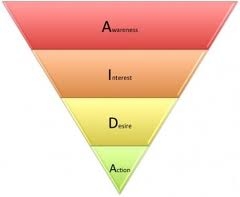
AIDA purchase funnelIn fact, the famous “AIDA” model – which stands for awareness, interest, desire and action – was first posited as far back as 1898 by Elias St. Elmo Lewis, an American sales and advertising professional and business writer.

“AIDA” was also the inspiration behind the classic purchase funnel – an orderly, simple path consumers take on the way to selecting and purchasing a product or service.

AIDA has had a good run, because for more than a century, the AIDA purchase funnel has meshed neatly with the various advertising and MarComm tactics that have come along the pike – print advertising, direct mail marketing, radio, television – and even the Internet.

While some people might contend that the advent of the Internet disrupted traditional buying processes, the greater reality is that it brought certain aspects of the buying process into sharper relief. Search engine optimization and search engine marketing stepped in to play nicely within the “interest, desire and action” steps.

Even better, Internet marketing made ineffective “soft” attitudinal metrics less important; all of a sudden, it became much easier to make educated decisions about sales and marketing programs based on hard evidence.

But with social media taking center stage, everything is now scrambled. The tidy “linear” purchase process just doesn’t reflect what’s happening now that “interactivity all over the place” is the thing.

But what exactly is the new “thing” when it comes to the purchase process? There’s a lot of discussion … lots of thinking … but not much in the way of conclusions.

Perhaps the most well-known attempt at replacing AIDA with a new model has been made by consulting firm McKinsey. In 2009, it came up with the “modern” version of the purchase funnel which it dubbed “the consumer decision journey.”

McKinsey purchase funnel
McKinsey’s new model has been described as a “purchase cycle,” a “customer journey,” and various other alternative explanations — you can take your pick.

But what exactly is that? When you look at how McKinsey attempts to graph it … it may be the proverbial “big ol’ mess.”  I’ve pictured it here so you can try and have some fun with it.

The “McKinsey Whatever” may be hard to grasp pictorially, but there’s one thing’s about it: it’s surely not linear.

There are two circles (kind of). Consumers can go around within the circles forwards or backwards. They can also go sideways between the two (sort of).

Truth be told, the “McKinsey Thingamabob” is fairly difficult to untangle. At least that’s the claim of some business observers such as Jon Bond, a marketing specialist and cofounder of branding agency Kirschenbaum Bond Senecal. He writes this:

“I’ve been in 20 meetings where the ‘McKinsey Frankenfunnel’ has come up , and not once has anyone had the courage to admit that they didn’t have a clue what to do with it.”

Bond goes on to posit that introducing this new model was a masterstroke on the part of McKinsey (wittingly or unwittingly) because it’s become a boon to its consulting business: Companies have to hire McKinsey so the consulting firm can explain it, he notes wryly.

Whether it’s the McKinsey diagram or any other one that’s been proffered recently in an attempt to illustrate the new purchasing paradigm (one being a Google model with the eyebrow-raising acronym “ACID”) – what’s clear is that the purchase process is more complex then ever before. And in that process, the number of touchpoints has also grown dramatically.

Perhaps the best thing to do is to jump out of the funnel (or box, or circles, or whatever the purchase cycle is today). Instead of focusing on impressions or touchpoints, let’s remember the big thing that interactivity has placed in the hands of purchasers: far more opportunity to see and hear what trusted influencers are saying about products, services and brands.

It’s like going back to traditional, pre-1900 word-of-mouth advertising — and putting it on steriods.

Jon Bond contends that this new riff on WOM may be the smarter way of looking at the purchase journey a customer takes today. Instead of the “old AIDA” or the “new interactivity,” he suggests focusing more on three degrees of “trust“:

  • Before trust: Even if the brand is known, it’s not yet trusted because no credible third party has validated the brand in the eyes of the buyer.
  • Trust exists: An interaction happens with a trusted influencer who recommends the brand or has positive things to say about it.
  • Advocacy: Nirvana for companies, wherein a highly satisfied customer also becomes a brand advocate, providing third-party validation and attracting additional new customers because of the resulting brand credibility.

Incidentally, the above scenario is particularly effective in the B-to-B world, where credibility and the “CYA” impulse have always played big roles in guiding business buyers to make purchase decisions they won’t regret later.

Consider it the IBM principle, writ large:  You’ve probably heard the adage that “nobody ever got fired for recommending IBM.”  Now, in the “Age of Interactivity,” that principle can apply across the board.

The Very Latest Trends in B-to-B Content Creation Activities …

Content Marketing, Content CreationFor anyone who’s paying attention in business, “content marketing” is all the rage right now.  That’s not surprising, considering that “content” is the common link between advertising, promotion, public relations and social media.

Each year, the Content Marketing Institute, working in conjunction with MarketingProfs and Brightcove, conducts research among B-to-B marketers to gauge the type of content marketing that is increasing in popularity.  The CMI’s most recent report, B2B Content Marketing: 2013 Benchmarks, Budgets and Trends – North America has now been issued.

This report provides results from more than 1,400 surveys collected from North American members and subscribers of MarketingProfs and the Content Marketing Institute.

I think the survey is representative of business as a whole because the respondents include a mix of company sizes – ranging from fewer than 10 employees (~39% of the survey sample) to the very largest firms having more than 1,000 employees (~5% of the sample).

Respondent titles are varied, too – encompassing advertising/MarComm functions (~37%), corporate management (~31%) plus various other functions that handle marketing and communications as part of their responsibilities.

When we compare the results of the new survey to the one that was completed last year (I blogged about that survey here), we find that in nearly every category of B-to-B content creation, there is greater participation now.  (The one exception is the use of print magazines.)

For the record, here is how B-to-B content activity breaks down today, from highest to lowest usage:

  • Social media:  ~87% of respondents are using
  • Website articles (own site):  ~83%
  • e-Newsletters:  ~78%
  • Blogs:  ~77%
  • Case studies:  ~71%
  • Videos:  ~70%
  • Website articles (other sites):  ~70%
  • In-person events:  ~69%
  • White papers:  ~61%
  • Webinars and/or webcasts:  ~59%

A number of other tactics are used by a minority of B-to-B respondents:

  • Research reports:  ~44%
  • Web microsites:  ~40%
  • Infographics:  ~38%
  • Mobile content:  ~33%
  • e-Books:  ~32%
  • Print magazines:  ~31%
  • “Virtual” conferences:  ~28%
  • Podcasts:  ~27%
  • Mobile apps:  ~26%
  • Digital magazines:  ~25%
  • Print newsletters:  ~24%
  • Annual reports:  ~20%
  • Gamification:  ~11%

So it’s clear that “a lot of people” are employing “a lot of tactics” in content creation.  But which ones do they feel are most effective?

An interesting finding of the survey measures the “confidence gap” between respondents who feel that certain content tactics are “more effective” versus “less effective.”  Taking the difference between these two percentages yields a “confidence spread.”

This evaluation shows that B-to-B marketers consider a traditional tactic — in-person events – to be the most effective one:

  • In-person events:  +34 “confidence gap” rating
  • Case studies:  +28
  • Webinars and webcasts:  +22
  • Blogs:  +16
  • e-Newsletters:  +16
  • Videos:  +16
  • Research reports:  +14
  • White papers:  +14
  • e-Books:  +10
  • Website articles (own site):  +6
  • Website articles (other sites):  +0
  • Web microsites:  +0

And where are marketers publishing content?  The survey finds that B-to-B marketers are using an average of five social media sites to distribute content, with the “usual suspects” coming in at the top of the list:

  • LinkedIn:  ~83% of respondents use for distributing content
  • Facebook:  ~80%
  • Twitter:  ~80%
  • YouTube:  ~61%
  • Google+:  ~39%
  • Pinterest:  ~26%
  • SlideShare:  ~23%
  • Vimeo:  ~12%
  • Flickr:  ~10%
  • Foursquare:  ~8%
  • Instagram:  ~7%
  • Tumblr:  ~7%

A number of these social sites didn’t even show up in last year’s results – Pinterest and Vimeo in particular, but also Tumblr, Instagram and Foursquare.

It really underscores how “fresh” things remain in the social sphere – and how marketers can’t afford to take their eye off of the ball even for an instant when it comes to the tactical considerations of content creation.

There are additional findings available from the CMI research report, which you can download here.  And feel free to comment below on any of the results that seem particularly interesting (or surprising) to you.

What’s happening with marketing analytics right now?

MarketingSherpa logoWith so many promotional tactics available to marketers these days, figuring out how to measure the success of each may be just as challenging as choosing which ones to employ to begin with

That’s the reasoning behind the release of research firm MarketingSherpa’s first-ever marketing analytics research report

MarketingSherpa was seeking insights as to how marketers track metrics for a whole host of channels like PPC advertising, SEO initiatives, social media, display advertising, e-mail marketing and content marketing, among others.

2013 Marketing Analytics Benchmark Report from MarketingSherpaThe results compiled by MarketingSherpa are based on research and data collected during 2012 from more than 1,100 marketing professionals across a full range of industries worldwide. 

The research covers a wide variety of marketing analytics tools and practices, along with challenges and budget constraints faced by marketers in the course of carrying out their responsibilities.

The 2013 Marketing Analytics Benchmark Report is big – to the tune of ~325 presentation slides and 425+ data charts plus commentary – and rather costly as well. 

But it may be just the ticket for marketers who are looking for the latest insights on how to tackle measurement in today’s “smorgasbord” marketing landscape.

One set of data points that I find particularly interesting is in identifying the marketing metrics that companies routinely track.  The MarketingSherpa research has found that that e-mail open rates and clickthrough rates continue to be the most prevalent forms of measurement:

  • Open rate:  ~78% routinely track this metric
  • Clickthrough rate:  ~73%

Several other metrics are tracked by about half (or more) of the respondents:

  • Unsubscribe rate:  ~65% routinely track
  • Deliverability rate:  ~55%
  • Conversion rate:  ~54%
  • Clicks-per-link in e-mail:  ~49%
  • List size:  ~48%

On the other hand, several other metrics are being tracked by a distinct minority of companies:

  • ROI:  ~28% routinely track
  • Complaint rate:  ~25%
  • Social sharing rate:  ~21%

On one hand, seeing ROI tracking so far down the list is disappointing … until we remind ourselves that accurate ROI measurement is a function of having good data on 5 or 10 other factors.  If any one of them is off by a significant degree, it affects the veracity of the ROI conclusions.

Yet another example where “talk” is most definitely “cheap.”

But for more insights on measurement factors and other marketing topics, you can order and download the full report and see for yourself.

Experian Takes the Pulse of Hispanics in the United States

Hispanic Market Report from ExperianIt’s no secret that the share of the American population identifying itself as Hispanic or Latino is growing.

The latest evidence of this is a report just released by Experian Marketing Services. It shows that ~16% of Americans age 6 and older fall into this category.

That’s an increase of two percentage points in just six years.

But here’s an even more eyebrow-raising statistic: Among Americans aged 6 to 34, nearly one in four are Hispanic or Latino.

What this means is that the geographic zones of the country usually associated with Hispanic population – California and the Southwest, Central and South Florida, Chicagoland, and New York City/Northern New Jersey – will surely expand to encompass other geographic clusters as well.

Experian’s research also shows that Hispanic households account for approximately 10% of all discretionary spending in the U.S.

But in select metropolitan areas, the share of spending by Hispanic households is greater — sometimes substantially so:

  • San Antonio Metro Area: ~60% Hispanic share of all HH discretionary spending
  • Miami: ~37%
  • Los Angeles: ~33%
  • Houston: ~17%
  • San Francisco: ~14%
  • Chicago: ~12%
  • New York: ~12%
  • Dallas: ~11%

While the country now has many second- and third-generation Hispanic individuals and families, the Experian research finds that even with these consumers, emotional ties to the Spanish language carry over to companies that advertise their brands in Spanish.

Not surprisingly, more than half of Spanish-dominant Hispanics agreed that when they hear a company advertise in Spanish, “it makes me feel like they respect my heritage and want my business.”

But among English-dominant Hispanics, ~30% feel the same way as well. And similar percentages feel a much greater sense of loyalty to such companies.

There’s another interesting takeaway from the Experian research, too. Hispanic consumers tend to be more optimistic about their personal financial situation – and that of America as a whole – than their non-Hispanic counterparts.

This sense of greater optimism has been a common thread among all Experian surveys of this type, where the research has shown a persistent positive margin with Hispanics of about five index points over the rest of the survey sample.

That level of optimism is refreshing to see!

Optify Measures Social Media Activity in the B-to-B Market

Optify logoThis is my fourth and final post about the findings of Optify’s recently published business-to-business online marketing analysis.  The focus of this post is on what Optify found about social media usage.  (You can read my other posts on B-to-B web traffic and advertising here, here and here.)

Optify, which is a developer of digital marketing software for B-to-B marketing professionals, analyzes web behaviors and releases a report each year.  This annual “benchmark” report is particularly important in that the findings are reported from actual web activity, not from surveys.

The key takeaway findings on the social media front are these:

  • Despite all of the continuing hype, social media remains a very small fraction of traffic and leads to B-to-B websites.  In fact, social media has contributed to less than 5% of B-to-B web traffic and leads.
  • Facebook drives the more than half of the social media-generated web traffic to B-to-B websites, versus about one-third from Twitter and most of the remaining traffic from LinkedIn.
  • Visitors who arrive at B-to-B sites from LinkedIn are more likely to view more pages per visit (~2.5 page views on average) than visitors who come from Facebook (~1.9 page views) or Twitter (~1.5 page views).
  • Despite generating more traffic Facebook drives fewer actual B-to-B leads than either Twitter or LinkedIn.
  • At this time, Twitter appears to be the most lucrative social media source for leads, with a higher-than-average conversion rate of ~2.1% (defined as a visitor taking an action such as submitting a form).

Because of this last data point, Optify posits that companies should not shy away from considering social media‘s potential as a source for leads as opposed to being just an  awareness tool.

I’m sure Optify’s figures don’t lie.  But I for one remain unconvinced about social media’s lead generation potential in the B-to-B realm.

More B-to-B Web Behavior Findings from Optify

Optify logoThis is my second post on the very interesting findings from Optify’s analysis of the behavior of visitors to business-to-business websites during 2012.

[Refer to my earlier post for a quick overview of salient “top-line” results.]

As part of its analysis, Optify uncovered some interesting factors pertaining to “organic” web searches, which represent ~41% of all visits to B-to-B websites.  Here’s what stands out in particular:

  • Forget all of the talk about Bing/Yahoo taking a bite out of Google on the search front. Optify found that Google is responsible for nearly 90% of all organic search activity in the B-to-B realm, making it the #1 referring source of traffic – and it isn’t even close.  (Bing’s coming in at a whopping ~6% of the search traffic.)
  • Organic search visits from Bing do show slightly better engagement rates in the form of more page views per visit, as well as better conversion rates (e.g., filling out a form). But with such low referring traffic to begin with, it’s fair to say that Google was — and remains — the cat’s meow when it comes to organic search.
  • “Branded” searches – ones that include the name of the company – account for nearly one-third of all visits from organic search. Plus, they show the highest engagement levels as well: ~3.7 page views per visit on average.

Optify notes a few clouds on the horizon when it comes to evaluating the success of a company’s organic search program. Ever since Google introduced its “blocked search data” securred socket layer (SSL) option (https://google.com), the incidence of blocked referring keyword data has increased rapidly:

  • Block referring keyword data now represents over 40% of all search queries.
  • Non-branded keywords that are known (and thus available for analysis) have dropped to just 35% of all organic searches.

Here’s the bad news:  As blocked keyword searches continue to grow in popularity – and who wouldn’t choose this option when it’s so easy and readily available – it’s creating a veritable “data oblivion” confronting marketers in their attempts to analyze and improve their SEO performance.

In a subsequent blog post, I’ll summarize key findings from Optify pertaining to paid search (SEM) and social media in the B-to-B realm.