Growth hits the skids in two key industry segments.

economic doldrumsAs further proof that the worldwide economy is sputtering in a pretty major way, here come two reports on stalling growth in two key industry segments: hospitality and mobile communications.

Technology research and advisory firm Gartner, Inc. has announced that it is revising its 2012 mobile growth projections downwards.

In fact, Gartner is reporting that worldwide sales of mobile phones actually declined nearly 3% during the second quarter of the year.  That’s a rude awakening for a market segment that’s been nearly impervious to downward economic pressures up to this time.

And on the hospitality front, industry research firm Hospitality Resource Group (HRG) is reporting that worldwide hotel rates during the first half of 2012 are essentially flat, following a significant rise charted throughout all of 2011.

While a smattering markets scattered around the world (Moscow, Mexico City, Dubai, San Francisco) have charted hotel rate increases in the 10%+ range, there were far more urban areas that experienced rate declines, led that dramatic drops in the following markets:

  • Bangalore, India: -30%
  • Barcelona, Spain: -26%
  • Munich, Germany: -20%
  • Bombay (Mumbai), India: -18%
  • Istanbul, Turkey: -16%

It may be comforting to hear the reassuring words of select politicians in Europe, Asia and North America as they reiterate that recovery is just around the corner.

But the facts on the ground are delivering an unmistakable message that’s far different – the commercial equivalent of a skunk at the garden party:  The economic doldrums aren’t going away anytime soon.

Arthur Brooks Presents the “Moral Case” for the Free Enterprise System

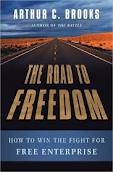
The Road to Freedom by Arthur C. BrooksThose of us in the business world who experience first-hand the positive attributes of the free enterprise system while also seeing certain failings, usually find it much easier to defend the concept of free enterprise from the perspective of “facts, data and efficiency”: Things work better under a capitalist system because the profit motive and competition combine to reward both effort and results.

Of course, that sort of defense makes it pretty easy for others to accuse capitalism of being an essentially heartless, unfair system that promotes winners and losers … where more typically “the rich get richer and the poor get poorer.”

The lame response to that contention is often something like what Sir Winston Churchill once said about democracy: “It’s the worst system – except for all the others.”

Now along comes a book that presents a moral case for free enterprise: The Road to Freedom: How to Win the Fight for Free Enterprise, by Arthur C. Brooks. Published just last month, I think it’s the freshest, most modern exposition of ideas on the topic since Friedrich Hayek in the 1950s.

Dr. Brooks bases his moral defense of the free enterprise system on the ideals of earned success, equality of opportunity, charity, and basic fairness. Of these, I find the “fairness” argument for capitalism to be the most interesting and useful aspect in that it takes an argument normally used against capitalism and turns it back on its accusers.

Brooks does a very good job presenting the case of how the free market, while not perfect, is the fairest system for the largest number of people – including the poor. One of the ways that he illustrates his points is by citing “happiness” research exercises that have been conducted with groups of people over the past 10-20 years in many different countries all over the world. These studies show the power of the idea of “earned success” and the fact that it has near-universal human appeal over the alternative of “learned helplessness” of less free economic structures.

It’s refreshing to read a book on economic matters that doesn’t fall into the realm of a polemic, and that eschews doctrinaire philosophy and partisan labels. Instead, Brooks emphasizes that government has a role in protecting the population from corporate cronyism and monopoly power, even while defending free enterprise as the fairer and more moral system.

To top it off, the book is written in an easy-to-approach conversational tone with liberal doses of humor. How often can you say that about a book on economics?

For anyone else who has read Dr. Brooks’ book, let’s hear your reactions. Do you have a different take?

Jobless Americans and Gallows Humor …

Jobless AmericansThere’s a funny-yet-sobering ditty bounding about cyberspace that chronicles a day in the life of an unemployed American looking for work.

Whether it’s the alarm clock, the coffee pot, clothing, appliances, the car and the gasoline it takes to run it, everything with which this person interfaces during the course of the day comes from overseas – especially China or some other East Asian country.

For those of you who haven’t encountered this satirical little piece yet, you can read it here.

Dana Bales, an industry colleague of mine who is a managing partner at Dayton, OH-based NEO Marketing Communications, reacted to this joke by noting a few key points about China. He writes:

I’m a free trade advocate. I absolutely support NAFTA. But for the life of me, I don’t get our trade relationship with China. Let me get this straight:

 China imposes trade barriers to many of our goods and services.

 China allows its industries to pollute with impunity, keeping its costs for manufactured goods lower while adding to atmospheric and oceanic pollution.

 China allows its citizens and companies to rip off non-Chinese patents.

 Although experts may disagree on the degree of impact, China manipulates its currency to benefit its own export goods.

 China actively supports efforts to hack into U.S. corporate and defense systems, stealing untold billions of dollars’ worth of technology.

 China uses American dollars to subsidize its own industries.

Food for thought, indeed – even if you don’t agree with every single one of Bales’ statements.

It would be nice, too, if our government and trade officials could focus on coming up with some workable solutions to these issues. I think we’d all be happier if we could relegate this sort of gallows humor to the literary trash can!

The Consequences of Alabama’s New Immigration Law: Welcome to Economics 101

Alabama's tough new immigration law (2011)Since the passing of Alabama’s tough new immigration law several months ago, two major things have happened:

1. Many immigrant workers have left the workforce.

2. Employers – especially agricultural operations – have found it nearly impossible to replace the lost workers.

In retrospect, neither development seems particularly surprising. Many immigrant workers, whether they’re here in the United States legally or not, fear the heavy hand of government and will opt to find a more inviting environment than the one in Alabama today. For now at least, that environment is better in nearly all of the other 49 states.

And while the jobs no longer being done by immigrants may now be sought by American citizens – after all, the ~9.9% unemployment rate in Alabama is higher than the overall U.S. rate – the appetite for doing many of these jobs dissipates quickly when people are confronted by the reality of what is required to perform them.

Alicia Caldwell, an Associated Press reporter, spoke last week with some Alabama farmers to find out what has happened since Americans were hired to replace immigrant workers.

“Most show up late, work slower than seasoned farm hands and are ready to call it a day after lunch or by mid-afternoon. Some quit after a single day,” Caldwell reported in her AP article published last week.

As a result, farmers are opting to leave crops in the field rather than harvesting them.

What we have here is a classic Economics 101 lesson. If workers aren’t willing to do the jobs at a labor cost that will enable the products to be sold at a competitive price, the crops won’t be brought to market.

If agricultural operations in the whole world faced the same situation as Alabama farmers, it’s possible that a new labor/price equilibrium could be established. But not only is Alabama competing against other states where immigrant labor continues to be used, it’s also competing against other countries that produce the same crops.

The result? No one is winning. Not the farmers … not the immigrant workers … nor the unemployed Americans who have decided that ramaining unemployed is preferable to working a difficult or unpleasant job.

The Alabama state government is attempting to support the transition away from immigrant workers. A program started recently seeks to pair Alabamians interested in jobs with the state’s farming operations that need replacement labor.

So far, the results of this effort haven’t been encouraging, with only ~260 people registering interest in temporary agricultural jobs.

Out in the field, reporter Caldwell has found ample anecdotal evidence that underscores the disconnect between the “theory” versus “practical reality” of unemployed Americans taking advantage of these new job opportunities:

Tomato farmer Wayne Smith said he has never been able to keep a staff of American workers in his 25 years of farming.

“People in Alabama are not going to do this,” said Smith, who grows about 75 acres of tomatoes in the northeast part of the state. “They’d work one day and then just wouldn’t show up again.”

At this farm, field workers get $2 for every 25-pound box of tomatoes they fill. Skilled pickers can make anywhere from $200 to $300 a day, he said. Unskilled workers make much less.

A crew of four Hispanics can earn about $150 each by picking 250-300 boxes of tomatoes in a day, said Jerry Spencer of Grow Alabama, which purchases and sells locally owned produce. A crew of 25 Americans recently picked 200 boxes – giving them each $24 for the day.

Years ago, an old Russian emigré professor of Slavic history and literature at Vanderbilt University advised us students, “As you grow older and wiser, you’ll come to realize that the great issues of the day can’t be debated in black and white. Because the two sides aren’t black and white; they’re really shades of gray.”

Those words could well be applied to the immigration debate and its socioeconomic consequences. Certainly, one “black and white” issue that should be banished from the discussion is the notion that if all of the jobs done by illegal immigrants were to become available to Americans, our unemployment problem would be magically solved.

Getting the Message on Retirement Savings

401(k) plan balances are actually increasing.
401(k) plan contributions -- and balances -- are back on the increase.
Have Americans finally gotten the message about saving for retirement? Judging from the most recent published stats on 401(k) savings, it would seem so.

Last month, it was reported that 401(k) retirement savings have hit a 12-year high, with an increase of ~3.5% in contributions being charted during the first quarter of 2011.

What about average account balances? Today, those stand at about $75,000. That’s still woefully inadequate considering what (little) people can expect to receive from Social Security as they reach retirement age. But it’s a darn sight better than the ~$41,000 average 401(k) plan balance that existed in 2002.

Of course, averages can be misleading, since the figures can be skewed by some very hefty balances held by a very few highly compensated workers at the top of the heap. In fact, more than 55% of workers have less than $25,000 in their 401(k) plans.

On top of that, nearly one in four plan participants has outstanding loans against their plans.

Clearly, the recession has had a big impact on contribution behavior – even as workers have become more sensitized than ever about the inability of Social Security to cover their retirement needs.

Making 401(k) contributions are not an option for the unemployed, of course, but there are many other workers who were forced to reduce their contributions to cover for losses of family income because of a spouse losing his or her employment.

And some have had to borrow against their plan assets in the more serious circumstances. Those loans are actually up by double digits.

Still, it’s heartening to see the latest numbers … as it appears that “awareness” is now being translated into “action.” Would that we could rely on our local and national politicians to do the same thing …

For U.S. Households, the $534,000 Elephant in the Room

It doesn’t matter where you may be on the political spectrum, the most recent financial figures about the U.S. economy and our financial obligations have to be stunning in their import.

It turns out that the federal government’s financial condition has deteriorated much more rapidly and significantly than is commonly understood – far more than the ~1.5 trillion in new debt that was incurred to finance the budget deficit.

Instead, USA Today is reporting that the government took on some $5.3 trillion in new financial obligations during 2010. Not surprisingly, a big chunk of these unmet obligations fell under Medicare and Social Security.

Adding these new obligations to the existing ones translates into a record of nearly $62 trillion in financial promises not paid for.

And if that particular number isn’t striking enough, perhaps putting it this way will get your attention: It translates into ~$534,000 in unfunded obligations for each individual household in the United States.

In addition to $534,000 being a breathtaking number in and of itself, it represents more than five times what Americans have borrowed for everything else (mortgages, car loans, college loans, etc.).

Now there’s certainly a big difference between the government and the private sector, of course. Corporations would be required to account for these new liabilities when they are taken on – and thereby report big losses to their shareholders. But unlike businesses, Congress can conveniently stave off recording these commitments until it’s ready to write the check. “See no evil … hear no evil …”

And here’s another big difference between the federal government and everyone else: the ability to “manufacture” greenbacks to pay for debt obligations. Whether we call it euphemistically “quantitative easing” or more bluntly “printing money,” that’s a solution that comes dangerously close to the famous quip attributed to H. L. Mencken: “For every problem, there’s a solution that is simple, elegant, and wrong.”

Sheila Weinberg, founder of the Chicago-based Institute for Truth in Accounting advocacy organization, raises another key point: “The [federal] debt only tells us what the government owes to the public. It doesn’t take into account what’s owed to seniors, veterans and retired employees. Without accurate accounting, we can’t make good decisions.” She has a good point.

The blind leading the deaf: It certainly doesn’t portend well for the future. But there’s always the hope that if we can somehow create robust future annual economic performance in the 4-5% range, we’ll grow our way out of the problem.

We’ll have to see about that.

The Fortunes of the Fortune 500

Global Business:  28% of the 500 largest multinational companies are U.S.-based.Time was when the United States accounted for the largest contingent of the Fortune 500 global companies. Not so anymore. According to stats reported recently by international business expert Ted Fishman in USA Today, only about one-fourth of the 500 largest global enterprises are based in the U.S.

And those that remain on the list aren’t behaving particularly “American,” either. This group of ~140 companies has eliminated nearly 3 American million jobs since 2000.

Is that a consequence of the recent global recession? Hardly … the same companies added ~2.4 million jobs overseas during the same period.

The particulars behind each company’s employment choices are varied, of course. But certain factors seem to come up often in the analysis, including:

 Gaining closer geographic proximity to the world’s fastest-growing economies such as India, China and other Far Eastern countries.

 The availability of workforces that are “cheaper” to hire and require fewer employee benefits.

 A relatively unattractive U.S. corporate tax rate compared to other countries – hard to believe, but America’s 35% top corporate rate is eclipsed only by Japan’s (39.5%).Going forward, it would be nice if America’s largest corporate entities could be more sensitive to the need for additional investment here at home. Then again, it would be equally gratifying if government adopted policies of lower tax rates and easing regulations to make business growth and job creation in America easier.

The truth is, both parties will continue to pursue their own self-motivated interests, which is only natural.

The problem is, it’s a lopsided game. With a big wide world out there, the multinationals have a host of options at their disposal … and thus hold the winning cards. Tax laws and new regulations can be put on the books time and again, but the multinational crowd continues to float above it all, seemingly unaffected by anything – at least not to any great extent.

Meanwhile, U.S. small business gets hammered.

China overtakes Japan … and who’s surprised?

Chinese + Japanese FlagsThe somewhat breathless headlines earlier this week reporting that China had nudged past Japan to become the world’s second largest economy behind the United States, didn’t particularly grab me.

In fact, it seems almost anticlimactic that Japan has finally been overtaken. Hasn’t Japan’s economy been in the doldrums for years?

In some sense, it seems like Japan has hardly mattered now for the better part of 20 years. By contrast, economies like those in Brazil, India and the Far Eastern countries have been the ones shining brightly and getting most of the business coverage.

Actually, I’m old enough to remember a time, back in the 1980s, when the rise of Japan’s economy was of huge concern to American and European manufacturing and banking organizations. “Japan, Inc.” was a continuing topic in the pages of BusinessWeek and Fortune magazines. Japanese managerial styles and its participatory worker groups were the focus of many a management seminar and how-to business book.

What happened? During the 1980s, Japan’s economic miracle turned into a massive real estate bubble before imploding in the early 1990s. What came next was a “lost decade” – a stagnant economy from which the country has never really recovered.

And today, demographics and other factors are catching up with the country. Things like low population growth (and an aging population to boot), weak domestic demand for goods, slow growth in exports, a strong currency and even deflationary pricing forces … these are the characteristics most observers assign to the Japanese economy.

Some economic miracle, huh?

Meanwhile, China keeps chugging away, charting 10%+ annual growth rates even as the average Chinese citizen continues to earn just one-tenth of what American and Japanese workers make.

But if we look a little more closely at Japan’s experience, there may be lessons for us here in the U.S. In fact, some characteristics are uncanny in their similarity. More ominously, some economists believe that China is on course to overtake the U.S. and become the world’s biggest economy inside of ten years.

That seems startling on the face of it. But when you consider the symbiotic relationship between the U.S. and Chinese economies – we’re China’s largest export customer and they hold a ton of our dollars – it becomes easier realize just how much our two countries need one another.

“Accidental allies,” it turns out.

The Residential Real Estate Market: Still in the Dumper

Home Foreclosures
U.S. home foreclosures set a record in 2009 ... and are on their way to being even higher in 2010.
When it comes to the U.S. residential real estate market, the latest statistics and forecasts don’t bode well at all for the industry. Recently released stats on foreclosure rates reveal that 2009 was the worst year on record. And unfortunately, 2010 is looking like it’ll shatter the record yet again.

According to RealtyTrac, a firm that monitors real estate and foreclosure data, more than 2.8 million properties in America received a foreclosure notice during the past year. That’s 21% more than in 2008 and a whopping 120% higher than what was reported in 2007.

Moreover, one in every 45 households received at least one filing last year – nearly four times higher than 2006. These ugly numbers were racked up in spite of robust foreclosure prevention programs, without which the figures doubtless would have been significantly higher.

Unfortunately, the scenario doesn’t appear any better for 2010. Unless and until lenders are able to get principal balance reductions, high default rates are going to continue. In fact, RealtyTrac projects that a new record of 3 million or more properties will get a filing this year.

Where are we seeing the biggest problems? Well … in Michigan, to nobody’s surprise. But also in Nevada, Arizona and Florida. Until recently, those were states blessed with dramatic – even outsized – population and job growth, along with commensurately growing political power.

But as outlined in a recent article by Michael Barone, in an interesting twist of fate, these states are now experiencing net out-migration, while erstwhile laggard states in the Northeast and Midwest are now showing net in-migration.

It’ll likely take years to sort out the scrambled residential real estate market we have today – a situation sparked by a housing crisis for which many in government and the private sector are responsible … but which has also caught far too many innocent people in its clutches. Hopefully, the lessons learned will not be soon forgotten.

Mathematicians and the Meltdown

I can’t wait for the release of The Quants, a new book by Wall Street Journal reporter Scott Patterson about the role of so-called “quant funds” in the financial near-meltdown in September 2008, to be published on February 2. The weekend edition of The Wall Street Journal printed excerpts from the book, a powerful indictment of the mathematicians and computer whizzes who “nearly destroyed Wall Street.”

According to Patterson, “quants” was a name given to “traders and financial engineers who used brain-twisting math and super-powered computers to pluck billions in fleeting dollars out of the market.” In a major departure from traditional trading – evaluating individual companies’ management, performance and competitive positions – the quants used mathematical formulae to wager on which stocks will rise or fall.

Because of breakthroughs in the application of mathematics to financial markets – some of them so novel so as to have won their discoverers Nobel Prize awards — quant funds had quickly come to dominate Wall Street, with most of them piling up profits day after day. (To the senior brass at the investment houses, who likely knew little if anything about how these funds operated except that they made a lot of money, a hands-off policy seemed just the thing.)

And just as in so many other fields, technology elevated the “nerds” to the position of “stars” – with commensurately stratospheric compensation.

Unfortunately, in September 2008 the quant funds could not anticipate the effect of the collapse of the housing market bubble. In fact, this development turned the mathematical formulae of the quant funds on their head: What should have declined, rising … and what should be going up, dropping.

Patterson’s book promises to go into the details of just how things spun out of control, as seen through the eyes of key Wall Street managers such as the piano-playing, songwriting Peter Muller, founder of Morgan Stanley’s Process Driven Trading (PDT) quant fund, and Cliff Asness, formerly of Goldman Sachs and leader of the Applied Quantitative Research (AGR) quant fund.

In addition to presenting all the facts and all the drama, I’m hoping that Patterson will offer a few observations on how we can avoid a debacle like this from happening again in the future.

Another key question is whether any of the proposed regulations being debated in Congress will address the practices of quant funds – or is it all too complicated for anyone to figure out?

If that’s so, it’s pretty scary.