Getting Bunky with Retail Marketing

digital circularsAre the days of the lowly printed sales circular numbered?

Judging from the flurry of newfangled activity by key retail marketers, it would seem so.

This past week, CVS Pharmacy announced a complete makeover of its weekly circular.  The new digital version, dubbed myWeekly Ad, incorporates customized promotions focused on the products that are deemed of greatest interest to individual consumers.

The personalized sale items are determined from scanning the trove of customer buying behavior information housed in CVS’s ExtraCare Rewards database, which now numbers more than 70 million active users.

The myWeekly Ad circular determines which items to feature based on the products that each targeted consumer buys most frequently, along with showcasing deals on other products in related categories that may also be of interest based on the purchase history of each customer.

CVS’s digital circular provides other user-friendly options as well:

  • Consumers can scan the savings and rewards currently available to them, and print coupons or digitally send special offers to their card before visiting a CVS store. 
  • Shopping lists can be created, shared and sent to mobile devices. 
  • Shoppers can view their own purchase history showing all products bought at CVS previously going back 18 months.

And CVS is hardly alone in digitizing its MarComm materials.  Thanks to the continuing evolution of rewards cards and the voluminous customer data they can collect, new personalized circular announcements are coming with regularity now.

Here are some of the latest new developments:

  • Shoplocal is a Gannett-owned print and digital circular publisher.  It has gotten together with personalized video firm Eyeview to create a new digital ad promo piece known as V-circular.  This vehicle allows retailers and major brands to target customers on a local level based on geographic, demographic and behavioral data – along with factoring in “real-time” conditions like the weather.
  • National coupon clearinghouse Valpak has introduced a novel “augmented reality” feature for its digital circulars.  Simply pointing a smartphone toward the horizon will enable shoppers to see which nearby businesses are offering coupons.
  • Direct mail media and marketing services firm Valassis has unveiled Geo-Commerce Retail Zone, a new ad-targeting capability that applies transaction and behavior data from consumers to local store trading areas, enabling targeted advertising to be delivered cross-platform.

No one questions the fact that more and more information on individual consumers is being collected, archived and applied on an individualized basis.  Anonymity is fast becoming a quaint notion of the past.

Of course, this couldn’t happen without the cooperation and willing engagement of consumers. 

Considering the benefits – special discounts and even freebies on goods and services – is it any wonder that these programs have been able to grow in size and comprehensiveness over time?

What are your thoughts about the tradeoffs?  Feel free to add your thoughts to the discussion.

Is AdTrap the answer to our prayers when it comes to blocking online advertising?

ad blocking deviceYou may have heard of AdTrap … or maybe you haven’t.

AdTrap is a newly developed device that intercepts online ads before they reach any devices that access a person’s Internet connection.

That basic action means that people are able to surf the web – including viewing videos – without the onslaught of online advertisements that seem to become more and more pervasive with every passing month.

The fundamental promise that the developers of AdTrap are making is a return to the “good ol’ days” of web surfing.

You know, back when most web pages you downloaded contained text and pictures – and virtually no advertising.

AdTrap’s motto is a simple and powerful one:  The Internet is yours again.”

Not surprisingly, there’s a good deal of excitement surrounding this new product.  In fact, interest has been so great that the invention attracted more than $200,000 in funding — raised in a 30-day Kickstarter campaign in early 2013.

Those funds are now being used to manufacture the first AdTrap units for shipment to “early adopter” consumers across the country.

How New an Idea Is This?

advertisingIn actuality, there have been a plethora of (often-free) software and browser plug-ins offered to consumers that can block online advertisements. 

But most of them have significant limitations because they’ve been designed to work only with specific browsers or on specific devices.

Free is good, of course.  But the developers of AdTrap are banking on the willingness of consumers to shell out $139 for their product – a rectangular box that looks a lot like a wireless router and that intercepts advertisements before they reach a laptop, tablet or mobile device.

The beauty of AdTrap is that it will work on every device connected to a person’s network.  Situated between the modem and router, it takes just a few minutes to set up.  

CNN technology correspondent Dan Simon reports that AdTrap does an effective job blocking advertising content.  But not perfectly; ads still appear on Hulu content, for example. 

But the developers of AdTrap report that they’re working on ways to block even more content going forward, including ads on Hulu.

Is this Bigger than Merely Blocking Ads?

Beyond the collective sigh of relief you’re likely hearing from those reading this blog post … what are the larger implications if AdTrap and similar devices are adopted by consumers on a large scale?

One not-so-positive implication may be that websites will no longer offer be able to offer content without charge, since so many publishers’ business models rely on advertising content to help pay most of the bills.

If advertising isn’t appearing thanks to AdTrap, people aren’t getting paid.

So let’s think about this for a minute:  It’s true that the Internet was blissfully free of wall-to-wall advertising 15 years ago compared to today. 

But cyberspace was also far less robust in terms of the quantity and quality of the informational and entertainment content available to us.

So yes … having a device to block 80% or more of the ads served to us is a very attractive proposition.  But if it means that some of our favorite sites move to pay-walls as a result, it might be that making a $139 investment in an AdTrap device isn’t such a “no-brainer” choice in the final analysis.

What do you think of this development — pro or con?  Please share your thoughts with other readers here.

Evil eye? Google’s vision for the future.

pay-per-gaze creepy disturbingTo understand where Google is heading next in the world of advertising, consider this:  The company has just been granted a patent on its “pay-per-gaze” eye-tracking system.

You might wonder what that might be.

Pay-per-gaze is an ad system that utilizes Google Glass for tracking the ads that consumers see online and elsewhere.  The gaze-tracking capability comes from another Google innovation:  a head-mounted tracking device that communicates with a server.

According to the patent documentation, the tracking devices includes eyeglasses with side-arms that engage the ears of the user … a nose bridge that engages the nose of the user … and lenses through which the user views the external scenes wherein the scene images are captured in real-time.

And it need not be limited to tracking online advertising, either; pay-per-gaze functionality could potentially extend to billboards, magazines, newspapers and other printed media, Google notes.

But the idea is even more revolutionary than that:  Not only does it aim to measure how long an individual looks at an ad, but also how “emotionally invested” the consumer is by virtue of measuring pupil dilation.

So the tracking system not only will show how long someone looks at an ad, but also will measure the emotional response.  The patent also covers a provision for “latent pre-searching” which would display search results over a user’s field of vision using Google Glass or another wearable computer.

If all of this seems like “Big Brotherism” at its worst … you may well be correct.  But Google is doing its best to downplay such sinister connotations.  It’s emphasizing that users can opt out of “pay-per-gaze” tracking, and that all data will be anonymized.

But let’s get this straight:  The world’s biggest search engine was just granted a patent for the most “sticky” form of advertising possible – ads that literally flash in front of someone’s eyes.

And when we add in aspects like measuring pupil dilation, it won’t be long before Google will be able to determine how good eats, or good looks, are affecting our emotional response.

One wonders how much farther we can go with measuring advertising engagement and buying intent. 

Then again, we already have an answer, of sorts.  As early as 2000, experiments with electromagnetic brainwaves have shown that people can literally “think” instructions and thereby cause an action.

Imagine combining Google’s pay-per-gaze and pay-per-emotion with electromagnetic brainwave tracking.  Add in a credit card number, and there’s no telling what could happen just with a fleeting thought or two!

If all of this sounds creepy and disturbing … get used to it.  With the likes of Google and the NSA at the helm, “creepy and disturbing” may well become the “new normal” for society.

Consumers Still Finding Weaknesses in Brands’ Web Presence

Temkin Group logoThe most recently published Temkin Web Experience Ratings of more than 200 companies across 19 industries reveals continuing widespread disappointment with the quality of the “web experience.”

The Temkin Web Experience Ratings are compiled annually by Temkin Group, a Newton, MA-based customer experience research and consulting firm.  The ratings are based on consumer feedback when asked to rate their satisfaction when interacting with each company’s website.

Temkin ratings are established for companies garnering responses from 100 or more of the ~10,000 randomly selected participants in an online survey conducted by the research firm in January 2013.

Rankings are calculated via a “net satisfaction” score based on a 7-point rating scale from “completely satisfied” to “completely dissatisfied” by taking the percentage of consumers selecting the two highest ratings and subtracting the percentage who selected the bottom three ratings.

Just 6% of the brands earned strong or very strong “net” trust ratings, while ten times as many (~63%) were given weak or very weak scores.

And there’s this, too:  Not much improvement is happening.  More than half of the ~150 companies that were included in both the 2012 and 2013 Temkin evaluations earned lower scores this year than last.

Managing partner Bruce Temkin summarized it succinctly:  “The web is a key channel, but online experiences aren’t very good – and are heading in the wrong direction.”

The latest Temkin ratings give Amazon the top-rank position with a 77% overall rating score.  Other companies ranked near the top include Advantage Rent A Car, U.S. Bank and QVC.

At the other end of the scale, MSN, EarthLink and Cablevision earned the lowest ratings – MSN worst of all.

Indeed, the following industries had composite company ratings that ended up in the “very weak” column:

  • Airlines
  • Health plans
  • Internet service providers
  • TV service providers
  • Wireless carriers

Do any of these industries seem like ones that shouldn’t be on this list?

I didn’t think so, either.

Which ones are the industries that score best in the Temkin analysis?  By order of rank, they are as follows:

  • Banks
  • Investment firms
  • Retailers
  • Credit card issuers
  • Hotel chains

Come to think of it, I haven’t encountered problems online with companies or bands in any of these five industries.

It’s also interesting to consider which companies have improved the most over time.  When comparing year-over-year results for the ~150 companies that were included in both the 2012 and 2013 studies, eight of them showed double-digit improvements in their scores:

  • Blue Shield of California
  • Citibank
  • Humana
  • Old Navy
  • Safeway
  • Toyota
  • TriCare
  • U.S. Bank

On the other hand, a much bigger contingent of 21 companies saw their ratings decline by at least 10 points; the six firms that dropped by 15 points of more were these:

  • Bright House Networks
  • Cablevision
  • MSN
  • ShopRite
  • Southwest Airlines
  • United Airlines

You can view the scores (and trends) for all 200+ companies by clicking here to download the full report.

If you notice any rankings that seem surprising – or that don’t comport with your own online experiences – please share your thoughts and perspectives below.

Craigslist: The $5 billion juggernaut that crippled an industry.

Craigslist logoIt’s common knowledge that the business model for newspapers started going awry in a major way with the decline in newspaper classified advertising.

Craigslist played a huge role in that development, as the online classifieds site went about methodically entering one urban market after another across the United States.

And now we have quantification of just how impactful Craigslist’s role was.  It comes in the form of a May 2013 study authored by Robert Seamans of New York University’s Stern School of Business and Feng Zhu of the University of Southern California.

Titled Responses to Entry in Multi-Sided Markets:  The Impact of Craigslist on Local Newspapers, the study explored the dynamics at play over the period 2000-2007, focusing on newspapers’ degree of reliance on classifieds at the time of Craigslist’s entry into their markets.

What the researchers found was that those newspapers that relied heavily on classified ads for revenue experienced more than a 20% decline in classified advertising rates following Craigslist’s entry into their markets.

But that isn’t all:  The outmigration of classified advertising to Craigslist was accompanied by other negative trend lines — an increase of subscription prices (up 3%+) and lowering circulation figures (down nearly 5%).

Even newspaper display advertising rates fell by approximately 3%.

Were these developments “cause” or “effect”?  The study’s authors posit that fewer classified ads may have diminished the incentive for people to purchase the newspapers.  Also, display advertising rates tend to track circulation figures, so once the “decline cycle” started, it was bound to continue.

The study concludes that by offering buyers and sellers a free classified ad alternative to paid listings in newspapers, Craigslist saved users approximately $5 billion over the seven-year period.

Those dollars came right out of the hides of the newspapers, of course … and changed the print newspaper industry for good.

But here’s the thing:  The experience of the newspaper industry has relevance beyond just them.  “The boundaries between media industries are blurred and advertisers are able to reach consumers through a variety of platforms such as TV, the Internet and mobile devices,” the authors write.

The unmistakable message to others in the media is this:  It could happen to you, too.

A full summary of the Seamans/Zhu report can be found here.

If the Purchase Funnel is Dead, it’s been Replaced by … What?

For most marketing professionals over the age of 30, the purchase funnel was one of the fundamental staples of their business training.

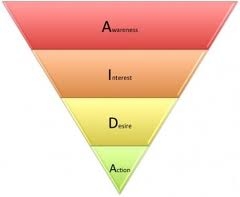
AIDA purchase funnelIn fact, the famous “AIDA” model – which stands for awareness, interest, desire and action – was first posited as far back as 1898 by Elias St. Elmo Lewis, an American sales and advertising professional and business writer.

“AIDA” was also the inspiration behind the classic purchase funnel – an orderly, simple path consumers take on the way to selecting and purchasing a product or service.

AIDA has had a good run, because for more than a century, the AIDA purchase funnel has meshed neatly with the various advertising and MarComm tactics that have come along the pike – print advertising, direct mail marketing, radio, television – and even the Internet.

While some people might contend that the advent of the Internet disrupted traditional buying processes, the greater reality is that it brought certain aspects of the buying process into sharper relief. Search engine optimization and search engine marketing stepped in to play nicely within the “interest, desire and action” steps.

Even better, Internet marketing made ineffective “soft” attitudinal metrics less important; all of a sudden, it became much easier to make educated decisions about sales and marketing programs based on hard evidence.

But with social media taking center stage, everything is now scrambled. The tidy “linear” purchase process just doesn’t reflect what’s happening now that “interactivity all over the place” is the thing.

But what exactly is the new “thing” when it comes to the purchase process? There’s a lot of discussion … lots of thinking … but not much in the way of conclusions.

Perhaps the most well-known attempt at replacing AIDA with a new model has been made by consulting firm McKinsey. In 2009, it came up with the “modern” version of the purchase funnel which it dubbed “the consumer decision journey.”

McKinsey purchase funnel
McKinsey’s new model has been described as a “purchase cycle,” a “customer journey,” and various other alternative explanations — you can take your pick.

But what exactly is that? When you look at how McKinsey attempts to graph it … it may be the proverbial “big ol’ mess.”  I’ve pictured it here so you can try and have some fun with it.

The “McKinsey Whatever” may be hard to grasp pictorially, but there’s one thing’s about it: it’s surely not linear.

There are two circles (kind of). Consumers can go around within the circles forwards or backwards. They can also go sideways between the two (sort of).

Truth be told, the “McKinsey Thingamabob” is fairly difficult to untangle. At least that’s the claim of some business observers such as Jon Bond, a marketing specialist and cofounder of branding agency Kirschenbaum Bond Senecal. He writes this:

“I’ve been in 20 meetings where the ‘McKinsey Frankenfunnel’ has come up , and not once has anyone had the courage to admit that they didn’t have a clue what to do with it.”

Bond goes on to posit that introducing this new model was a masterstroke on the part of McKinsey (wittingly or unwittingly) because it’s become a boon to its consulting business: Companies have to hire McKinsey so the consulting firm can explain it, he notes wryly.

Whether it’s the McKinsey diagram or any other one that’s been proffered recently in an attempt to illustrate the new purchasing paradigm (one being a Google model with the eyebrow-raising acronym “ACID”) – what’s clear is that the purchase process is more complex then ever before. And in that process, the number of touchpoints has also grown dramatically.

Perhaps the best thing to do is to jump out of the funnel (or box, or circles, or whatever the purchase cycle is today). Instead of focusing on impressions or touchpoints, let’s remember the big thing that interactivity has placed in the hands of purchasers: far more opportunity to see and hear what trusted influencers are saying about products, services and brands.

It’s like going back to traditional, pre-1900 word-of-mouth advertising — and putting it on steriods.

Jon Bond contends that this new riff on WOM may be the smarter way of looking at the purchase journey a customer takes today. Instead of the “old AIDA” or the “new interactivity,” he suggests focusing more on three degrees of “trust“:

  • Before trust: Even if the brand is known, it’s not yet trusted because no credible third party has validated the brand in the eyes of the buyer.
  • Trust exists: An interaction happens with a trusted influencer who recommends the brand or has positive things to say about it.
  • Advocacy: Nirvana for companies, wherein a highly satisfied customer also becomes a brand advocate, providing third-party validation and attracting additional new customers because of the resulting brand credibility.

Incidentally, the above scenario is particularly effective in the B-to-B world, where credibility and the “CYA” impulse have always played big roles in guiding business buyers to make purchase decisions they won’t regret later.

Consider it the IBM principle, writ large:  You’ve probably heard the adage that “nobody ever got fired for recommending IBM.”  Now, in the “Age of Interactivity,” that principle can apply across the board.

The Very Latest Trends in B-to-B Content Creation Activities …

Content Marketing, Content CreationFor anyone who’s paying attention in business, “content marketing” is all the rage right now.  That’s not surprising, considering that “content” is the common link between advertising, promotion, public relations and social media.

Each year, the Content Marketing Institute, working in conjunction with MarketingProfs and Brightcove, conducts research among B-to-B marketers to gauge the type of content marketing that is increasing in popularity.  The CMI’s most recent report, B2B Content Marketing: 2013 Benchmarks, Budgets and Trends – North America has now been issued.

This report provides results from more than 1,400 surveys collected from North American members and subscribers of MarketingProfs and the Content Marketing Institute.

I think the survey is representative of business as a whole because the respondents include a mix of company sizes – ranging from fewer than 10 employees (~39% of the survey sample) to the very largest firms having more than 1,000 employees (~5% of the sample).

Respondent titles are varied, too – encompassing advertising/MarComm functions (~37%), corporate management (~31%) plus various other functions that handle marketing and communications as part of their responsibilities.

When we compare the results of the new survey to the one that was completed last year (I blogged about that survey here), we find that in nearly every category of B-to-B content creation, there is greater participation now.  (The one exception is the use of print magazines.)

For the record, here is how B-to-B content activity breaks down today, from highest to lowest usage:

  • Social media:  ~87% of respondents are using
  • Website articles (own site):  ~83%
  • e-Newsletters:  ~78%
  • Blogs:  ~77%
  • Case studies:  ~71%
  • Videos:  ~70%
  • Website articles (other sites):  ~70%
  • In-person events:  ~69%
  • White papers:  ~61%
  • Webinars and/or webcasts:  ~59%

A number of other tactics are used by a minority of B-to-B respondents:

  • Research reports:  ~44%
  • Web microsites:  ~40%
  • Infographics:  ~38%
  • Mobile content:  ~33%
  • e-Books:  ~32%
  • Print magazines:  ~31%
  • “Virtual” conferences:  ~28%
  • Podcasts:  ~27%
  • Mobile apps:  ~26%
  • Digital magazines:  ~25%
  • Print newsletters:  ~24%
  • Annual reports:  ~20%
  • Gamification:  ~11%

So it’s clear that “a lot of people” are employing “a lot of tactics” in content creation.  But which ones do they feel are most effective?

An interesting finding of the survey measures the “confidence gap” between respondents who feel that certain content tactics are “more effective” versus “less effective.”  Taking the difference between these two percentages yields a “confidence spread.”

This evaluation shows that B-to-B marketers consider a traditional tactic — in-person events – to be the most effective one:

  • In-person events:  +34 “confidence gap” rating
  • Case studies:  +28
  • Webinars and webcasts:  +22
  • Blogs:  +16
  • e-Newsletters:  +16
  • Videos:  +16
  • Research reports:  +14
  • White papers:  +14
  • e-Books:  +10
  • Website articles (own site):  +6
  • Website articles (other sites):  +0
  • Web microsites:  +0

And where are marketers publishing content?  The survey finds that B-to-B marketers are using an average of five social media sites to distribute content, with the “usual suspects” coming in at the top of the list:

  • LinkedIn:  ~83% of respondents use for distributing content
  • Facebook:  ~80%
  • Twitter:  ~80%
  • YouTube:  ~61%
  • Google+:  ~39%
  • Pinterest:  ~26%
  • SlideShare:  ~23%
  • Vimeo:  ~12%
  • Flickr:  ~10%
  • Foursquare:  ~8%
  • Instagram:  ~7%
  • Tumblr:  ~7%

A number of these social sites didn’t even show up in last year’s results – Pinterest and Vimeo in particular, but also Tumblr, Instagram and Foursquare.

It really underscores how “fresh” things remain in the social sphere – and how marketers can’t afford to take their eye off of the ball even for an instant when it comes to the tactical considerations of content creation.

There are additional findings available from the CMI research report, which you can download here.  And feel free to comment below on any of the results that seem particularly interesting (or surprising) to you.

Optify takes the pulse of B-to-B paid search programs.

Optify logoI’ve been highlighting the key findings of Optify’s annual benchmark report charting the state of B-to-B online marketing. You can read my earlier posts on major findings from Optify’s most recent benchmarking here and here.

In this post, I focus on the paid search activities of business-to-business firms.

Interestingly, Optify finds that pay-per-click programs have been undertaken by fewer firms in 2012 compared to the previous year.

And the decline isn’t tiny, either:  Some 13% fewer companies ran paid search programs in 2012 compared to 2011, based on the aggregate data Optify studied from 600+ small and medium-sized B-to-B websites.

However, those companies who did elect to run pay-per-click advertising programs in 2012 achieved decent results for their efforts.

The median company included in the Optify evaluation attracted nearly 550 visits per month via paid search, with a conversion rate just shy of 2%, or ~45 leads per month.

[For purposes of the Optify analysis, a lead is defined as the visitor taking an action such as filling out a query form.]

Leads from paid search programs represented an important segment of all leads, too – between 10% and 15% each month.

The above figures represent the median statistics compiled by Optify. It also published results for the lower 25th percentile of B-to-B firms in its study. Among these, the results aren’t nearly so robust: only around ~60 visits per month from paid search that translated into 6 leads.

Since the Optify report covers only statistics generated from visitor and lead tracking activity, it doesn’t attempt to explain the reasons behind the decrease in the proportion of B-to-B firms that are engaged in paid search programs.

But I think one plausible explanation is the steadily rising cost of clicks. They broke the $2 barrier a long time ago and see no signs of letting up. For some companies, those kinds of costs are a bridge too far.

I’ll address one final topic from the Optify report in a subsequent blog post: B-to-B social media activities. Stay tuned to see if your preconceptions about engagement levels with social media are confirmed – or not!

The Confluence of “Mature Marketing” and B-to-B MarComm

Conference attendees, mature marketing and B-to-B buyersIn recent years, a seemingly endless stream MarComm literature has been published focusing on how to communicate effectively with different target groups. 
Whether it’s seniors … baby boomers … Gen-X or Gen-Yers … minority populations … B-to-B or technical audiences, marketers have all sorts of helpful advice coming in from all sides.

The more I’ve been reading this material, the more I’m seeing confluence rather than divergence. 

For example, there’s a high degree of commonality between marketing to “mature” consumers and B-to-B audiences.  The overlap is huge, actually.

Consider these aspects of crafting strong MarComm messages that make good sense for both B-to-B and mature audiences:

  • Sticking to the facts about products or services.  Both audiences tend to make judgments and decisions based on “information and intelligence” rather than “emotions or peer pressure.”
  • Providing lots of content.  “More is more” with these audiences, which tend to be far more voracious in their reading habits and appreciate the availability of copious information.
  • Avoiding “hype” in MarComm messages.  These audiences have “seen it all” and aren’t easily bamboozled.
  • Avoiding “talking down” to these audiences.  They are experienced people (and experience is the best educator); they have good instincts, too.
  • Designing communications so that these audiences will stick around and absorb what marketers have to say.  This means avoiding small type, garish colors and gratuitous design elements … not to mention the slow-loading graphics or animated visual hi-jinks that pepper too many websites.

None of this is to contend that emotions don’t play a role in driving purchase decisions.  But the reasoning processes that mature audiences and B-to-B buyers use to filter and evaluate MarComm messages are far more consequential than any “creative” aspects of the message platform could possibly deliver.

It would be nice if more marketers would remember this when crafting campaigns that target the “thinking” audiences out there.

Persistent Myth: The Ten Most Persuasive Words in the English Language

Advertising word cloud - persuadable wordsIt’s something many of us in MarComm have heard about and read about for years now: Which words are the most persuasive ones in the English language?

In fact, it’s been the topic of entire news articles since the 1960s.

The words in question sound just about as relevant today as they must have back when the first “definitive” list was published:

  • Discover
  • Easy
  • Guarantee
  • Health
  • Love
  • Money
  • New
  • Proven
  • Results
  • You

It’s a solid list … and it certainly seems like these words would be among the most persuasive ones in our language.

It’s also plausible that some sort of formal “research” would have been conducted to come up with the list in the first place.

But that doesn’t appear to be the case at all.  In fact, it seems more likely that the list was dreamed up on the back of a napkin by an advertising copywriter looking for an interesting new copy “angle.”

Allegedly, the first appearance of the English language’s  most persuasive words was in a trade publication called “Marketing Magazine.” But no evidence exists that such a publication ever really existed.

Instead, it appears that several businesses decided to publish a list of persuasive words as a way of promoting their own products and services.  Attributing the list of words to a third-party (fictitious) publication with an authentic-sounding name gave their promotional messages an added flavor of credibility.

The list appeared first in a New York Times advertisement in 1961, and it was picked up several months later for an ad run in the Washington Post by Levitt & Sons, a real estate developer (of Levittown fame) that was promoting its new Maryland-based Belair at Bowie development at the time.

Both ads touted the elusive “Marketing Magazine” as the source for the list of most persuadable words.

And then the group of words began to morph, as “lists” of this kind are wont to do. More “experts” got into the game … more words were switched out or added … and more sources were cited as being the wellspring of the research: Duke University; the University of California; Yale University’s Psychology Department (!).

But who really cares about the provenance of the list? As it turns out, these “persuade” terms are among the most popular ones that advertising copywriters have used for years.  And for the most part, the terms retain their power to persuade, 50 years on.

For the record, other words that have made it onto the list at various times include:

  • Amazing
  • Announcing
  • Bargain
  • Compare
  • Easy
  • Free
  • Happiness
  • Hurry
  • Improvement
  • Introducing
  • Miraculous
  • Now
  • Offer
  • Quick
  • Remarkable
  • Revolutionary
  • Safety
  • Sensational
  • Suddenly

Regardless of which words actually belong on a “Top Ten” list as opposed to being the runners-up, there’s one thing you can say about all of them: They’re oldies but goodies. 

And this, too:  Plus ça change, plus c’est la même chose.  (The more things change, the more they stay the same.)