The building at 1 Times Square in New York City is nearly 100% vacant.
One Times Square Building (2010).
But if you’re the owner of the building, why should you even care?
That’s because the building takes in a reported near-$25 million per year in advertising revenues – thanks to the digital signage on the building being rented to top brands like Anheuser-Busch, Dunkin’ Donuts and Sony (among others).
Media, Sports & Entertainment Marketing Officer Blaise D’Sylva of Anheuser-Busch keeps it pithy:
“There’s a statement we make in being there – and we think the placement we’ve got is outstanding.”
Of course, there’s more to it than simply “making a statement.” According to the Times Square Alliance, each year more than 100 million pedestrians pass through Times Square.
Moreover, foot traffic volume is running ~90% higher compared to 1996.
I’m quite sure these traffic volumes are central to any go/no-go advertising decisions being made by the big brands.
Where the night is as bright as day: Times Square advertising.
The Wall Street Journal reports that billboard signage in Times Square is actually the priciest outdoor advertising in the world.
Considering its location at the intersection of “high traffic” and “high trend,” marketers think it’s an investment worth making — and the rates they’re willing to pay proves the point.
The percentage is somewhat higher for men (~23%) than it is for women (~17%).
Why do people post reviews or comments on products and services they haven’t tried? Here’s what the survey respondents reported:
“Just felt like it”: ~32% gave this reason
“Didn’t like the idea of the product”: ~22%
“Didn’t like the manufacturer”: ~19%
These stats might suggest that there are more “negative” reviews being posted online than what reflects the actual experience with the product or service.
But the YouGov survey also found that far more people leave good reviews than bad ones:
~57% have left a mixed review
~54% have left a good review
Only ~21% have ever left a bad review
What drives someone to leave a bad review? The #1 reason is obvious … but the #2 reason might surprise you. And the #3 reason is just mercenary:
~88% want to warn others about a disappointing product or service
~23% believe that venting their frustrations will leave them feeling less angry
~21% are hoping to get a refund or some other monetary consideration from the company in question
The veracity of online reviews is important because the vast majority of adult consumers check them before deciding to purchase a product or service.
This YouGov survey is no different: It found that ~79% consult reviews at least sometimes … and ~26% reported that they “always” check reviews before buying a product or service.
The YouGov report comes hard on the heels of a Virginia lawsuit wherein a carpet cleaning service charged online review website Yelp with publishing negative reviews posted by people who had never been customers of the store. The cleaning service claimed that the negative reviews had hurt its business.
It may just be that posting a “faux” review has now become a little riskier.
People may think twice now before engaging in their little mischief. I’m sure most of them can think of a lot better things to do than to be hauled into court for an alleged infraction like that — or at the very least, having their name brought into the legal proceedings.
Boston Consulting Group recently conducted a survey of American consumers to see how their spending habits and approach to brands differs by age group.
The results give us a quantifiable measure of the differences in outlook between three major age groups: Millennials (age 18 to 34), Gen-Xers(age 35 to 49), and Baby Boomers and older consumers(age 50 and up).
The survey findings led BCG researchers to declare that Millennials’ perspectives are characterized by a “reciprocity principle.” By this, they mean that these younger consumers expect “mutual relationships” with companies and their brands.
This isn’t so very surprising considering the ability of the Internet and social media platforms to provide an easy platform for airing their opinions.
A positive brand experience may prompt consumers to take favorable “public” action on behalf of the brand.
A disappointing experience most assuredly will prompt vocal criticism via product or service reviews, social media, blog posts, and leaving comments.
And the juicier the commentary, the more likely it is to go viral.
The BCG survey found that younger consumers are far more prone to participate in the world of “reciprocity.”
The differences were pretty dramatic when asking respondents in the different age groups whether they agreed with certain statements:
“Brands identify who I am, and my values.”
Millennials: ~44% agree
Gen-Xers: ~38%
Boomers and older: ~33%
“People seek me for knowledge and brand opinion.”
Millennials: ~51% agree
Gen-Xers: ~42%
Boomers and older: ~34%
“I’m willing to share my brand preferences online or on social media.”
Millennials: ~55% agree
Gen-Xers: ~43%
Boomers and older: ~28%
Evaluating the survey findings, the BCG report posits that Millennials are “the leading indicators of large-scale changes in consumer behavior.”
Rather dramatically, BCG also concludes that this particular generational transition is “ushering in the end of consumer marketing as we have long known it,” and that the linear framework companies have used for decades to manage brand image and engagement is headed out the window.
“… Marketers must embrace the reality that marketing is an ecosystem of multidirectional engagement rather than a process that is controlled and pushed by the company,” the BCG report states.
My personal view is that the Boston Consulting Group’s conclusions are probably on-target … but the question is the degree.
I don’t think many major brands are going to simply cede control of their marketing and messaging to the cyberspace or the social cloud. They’ve worked too long and too hard on their brand image and identity to give up that easily.
This year a single 30-second ad spot during the Super Bowl TV broadcast will cost a cool $4 million.
And that’s just for the placement alone — not the dollars that go into producing the ad.
The high cost of advertising is directly related to Super Bowl viewership, of course, which is predicted to be north of 100 million people this year.
Still, $4 million is a really hefty sum, even for major brand advertisers. Just how big is underscored in some comparative figures put together by Jack Marshall, a reporter at marketing e-zine Digiday.
Digiday’s Jack Marshall
In lieu of spending $4 million on a single ad spot, here’s how Marshall reported that the promotional money could be spent in alternative ways:
14 billion Facebook Ad Impressions – According to digital marketing software firm Kenshoo, right-hand column “marketplace” ads on Facebook averaged 27 cents per thousand impressions during 2013. This means that for $4 million, an advertiser could run a Facebook marketplace ad every second of every day for the next 469 years.
3 billion Banner Ad Impressions – In 2013, average online display ad CPMs were running just shy of $1.30, looking globally. Applying that figure to the U.S. market translates into 3 billion display ad impressions for your $4 million spend.
160 million Sponsored Content Views – The typical charge is ~$25 to distribute sponsored content to 1,000 readers. At that rate, $4 million would give you 160 million impressions (provided a publisher could actually deliver that many!).
10.8 million Paid Search Clicks – With an overall average cost-per-click of 37 cents in 2013, $4 million would cover just shy of 11 million clicks. That may be one-tenth the size of the Super Bowl viewing audience … but at least your audience would be actually searching for your product or service instead of heading to the kitchen for more corn chips and queso dip.
These are just some of the comparative figures outlined by Jack Marshall in his article. You can read the others here.
Every few years or so, we start hearing a pithy (and sometimes obnoxious) new buzz term in marketing communications.
The most recent entry into the lexicon is SoLoMo – a cutesy amalgam of three terms: Social Media, Location, and Mobile Devices.
SoLoMo purports to convey the convergence of these three elements into a powerful new driver for marketing: sparking audience engagement and brand usage via the use of social media, and targeting consumers via their mobile devices when they are locationally proximate.
Beyond the inevitable “wink-wink, nudge-nudge” aspects of this term and the “oh-so relevant” connotation it has for those who choose to name-drop it in casual conversation, another drawback I see is the term’s emphasis on tactics rather than on the true meaning of today’s always-connected customers and the potential this offers for relationship-building.
Right now, there are more than a few company and brand marketers who are trying to figure out the best way to have their customers do all sorts of things that will benefit a product’s acceptance and position in the market — things like checking in to a physical location, then taking a mobile picture and uploading it to an Instagram or Facebook page.
Here’s what’s actually going on with consumers today:
They have more digital connections available to them than ever before.
Because of the pervasiveness of interactivity, consumers expect information to be available to them at any time – and on any device.
The good news is that marketers can establish just these sorts of connections with consumers, simply by using the very same social platforms. The bigger challenge is making those connections meaningful and relevant. That’s where effectiveness so often falls by the roadside.
Social media is an “ism” to many marketers … whereas to regular people, they hardly think of it that way. For them, it’s just another way to engage in their relationships with friends, acquaintances, industry colleagues, fellow hobbyist … and favorite brands. Other than the digital aspect of the communication, there’s really very little difference from the connections people have established and maintained for years the old-fashioned way.
Location is much more than simply where someone happens to be. It’s the context of understanding when — and what — the person is doing at or near that location. Knowing that makes for a more relevant – and potentially profitable — interactions.
Today’s focus on Mobile everything has become almost as myopic as marketers’ tunnel-focus on desktops was a few years back. Today, we’re dealing with consumers who are perpetually connected. As for which device, it simply depends on what’s handy at the moment – desktops, laptops, tablets, smartphones. So, strategies and tactics that focus on one or two of these to the exclusion of the others will fall short of the mark.
While we can give an acknowledging nod to the SoLoMo buzz term, the key is to recognize that it’s actually about today’s perpetually connected consumers — and all of the expectations that come along with that.
In other words, marketers need to be people-focused … but tactics-agnostic.
Anyone who’s had an e-mail account for any length of time likely faces ever-increasing inbox volumes.
And trying to keep those groaning inboxes in check can be a never-ending task. Now a recent report gives us clues as to what e-mails are being purged most frequently by recipients.
It’s been released by Unroll.Me, a service that scans users’ e-mail accounts for all of the lists to which they are subscribed — knowingly or not. It then gives people the opportunity to unsubscribe, or to consolidate groups of e-mails into a single regular update.
It turns out, many people are unwittingly “subscribed” to receive e-mails from vendors based on something as benign as making a single online purchase. So Unroll.Me finds a substantial incidence of people taking unsubscribe actions when given the chance.
Unroll.Me’s report claims that it prevented more than 1 billion e-mails, offers and updates from reaching inboxes last year via its service.
Of particular interest than the overall volume is the list of e-marketers that have been dissed the most by customers.
Leading the list is 1-800-Flowers. A whopping ~53% of Unroll.Me users had those e-mails stopped during 2013.
[A personal note about 1-800-Flowers: Over the past five years, our family has used this service to order flowers twice a year (Christmas and birthday) to exactly one person. For those twice-a-year transactions, I estimate conservatively that we receive more than 200 e-mail solicitations each year — most with breathless offers promising deep discounts on orders. Do those offers make us more inclined to purchase from them? Hardly.]
According ton Unroll.Me, other e-marketers that experienced high unsubscribe rates in 2013 include:
Ticketweb: ~48% unsubscribe rate
ProFlowers: ~45%
Expedia: ~45%
Active.com: ~45%
Oriental Trading: ~44%
At the other end of the scale are companies and services that remain subscribed to by two-thirds or more of those who received their e-mails.
This “Star Gallery” is made up of Facebook, Google+, Twitter and LinkedIn. What these e-mailers share in common is that they are social platforms, with engagement and interest levels higher because of the topics involved (friends, acquaintances, contacts and shared interests).
In other words, it’s the people they know, not the things companies want to sell them.
One of the complaints marketers have had about mobile advertising is that the engagement levels are so pitifully low.
But is this really so surprising? … seeing as how clickthrough rates on online banner ads have been in the dumper for years now – well before the explosion of tablet and smartphone usage.
Helpfully, a research study conducted by Praveen Kopalle, a Dartmouth marketing professor, gives us insights as to why mobile ad engagement is so low. Here are the reasons cited most often in that survey:
Mobile screens are too small – 72% of respondents cited this as a reason why they steer clear of mobile ads.
Too busy for ads – 70% claimed they don’t have time for ads when they’re on-the-go.
Can’t return easily to the content originally being viewed – 69% found this aspect irritating enough to avoid taking action on an ad.
Ads take too long to load – 53% cited this factor, which is clearly dependent on the type of mobile device or service available.
Not in the mood for ads – 42% identified this as a factor (some things never change).
Other findings in Dr. Kopalle’s survey underscore the fact that mobile advertising needs cut to the chase, because mobile device owners are generally not in “browse” mode while using them. Consider these contrasting findings between mobile device users and people using desktop or laptop computers:
The typical mobile consumer is on his or her smartphone or tablet eight times a day for approximately 15 minutes per session.
Desktop and laptops users are more likely to be engaged only once or twice per day – but spend around two hours per session.
Moreover, when mobile devices users are performing information-seeking tasks, nearly half of them reported that ads “do not register” with them.
The takeaway message for marketers: In addition to targeting ads to the right audiences, the advertising messages themselves better be super-compelling, because mobile users won’t be paying attention for very long – if at all.
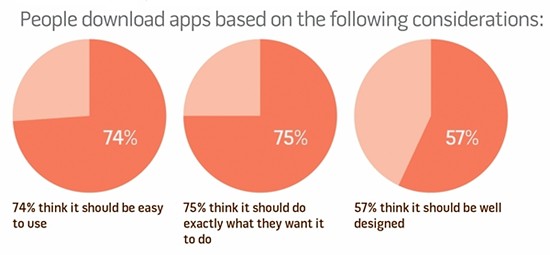
Here’s an interesting statistic offered up by marketing consultant Rich Meyer: Three-fourths of mobile apps are deleted within three weeks of being downloaded by their users.
How can the attrition rate be so high?
According to Meyer, it’s because people decide they don’t really have a need for the apps … or they find them too difficult to use and master.
I suspect the percentage may also be so high because marketers fail to query their target audiences prior to developing apps to determine now much of a need it will be satisfying.
… Or to put it another way, to avoid falling into the trap of developing a cure for something that isn’t a disease.
Sources: MarketingProfs; Harris Interactive and EffectiveUI field survey, 2010.
Meyer believes part of the dynamic at work is a knee-jerk “bias for action” as the marketing playing field shifts endlessly.
“It’s called ‘do it’ because everyone else is doing it, and it results in not only bad marketing, but in turned off consumers and customers,” he maintains.
Questions as simple as “What would you like to see in a mobile app?” … or testing an app concept with a sample of potential users before spending the effort and energy to produce it would be good places to start.
Marketers can use the research findings to adjust the proposed design of an app — or to trash it altogether and come up with an alternative one that actually meets a need.
If more companies did this, perhaps the 75% deletion rate for mobile apps would cease to be so flat-out dismal.
Over the past several years, I’ve begun to hear increasing rumblings about how e-mail is a now-mature communications method that’ll eventually go the way of the FAX machine.
But I’m not at all sure I believe that. I think it’s more likely that e-mail’s future will look … a lot like it does today.
No doubt, texting and direct messaging have cut into some of the bread-and-butter aspects of e-mail communications. But what about e-mail marketing? Could we see a similar phenomenon happening?
Recently, I read the comments of e-communications specialist Loren McDonald on this very topic. McDonald, who is vice president of industry relations at digital marketing technology firm Silverpop, makes an important point concerning the “building blocks” that have to be in place before e-mail marketing will be seriously threatened by alternative MarComm means.
McDonald speaks about the challenge of an “addressable audience” when it comes to alternative channels: “Regardless of a competing channel’s popularity, marketers must be able to deliver a comparable or replacement message to an individual. This is where many channels fall short,” he contends.
Loren McDonald
McDonald notes that most marketers possess vastly more permission-based e-mail addresses than they do mobile phone numbers with permission to text. It’s the same story when comparing e-mail addresses to the percentage of their database that have liked their company’s Facebook page.
And there’s more: For mobile apps, what portion of the typical company’s database has downloaded it and authorized notifications? The inevitable response: How low can you go?
McDonald’s point is that for these alternative channels to gain true significance, they need to achieve a certain critical mass in terms of adoption rates – thereby allowing marketers to reach their customers and prospects in a comparable manner as they can via e-mail (as well as at a comparable cost).
Looking into his own crystal ball, McDonald feels fairly confident making three predictions concerning the future of e-mail marketing:
He predicts that content-focused newsletters will remain relevant and popular, particularly for B-to-B companies and publishers. That’s because marketers can push multiple newsletter articles within a single marketing touch, while publishers can attract ads and sponsorships for their e-newsletters (i.e. they’re moneymakers for them).
For broadcast/promotional messages, most consumers will continue to prefer e-mail delivery. “Will mobile app users [really] want their smartphones to ping them all day long whenever a message arrives — and then have to click attain to view it?”, he asks rhetorically.
Transactional and triggered messages will be e-mail’s primary challengers in McDonald’s view – especially for bulletin-type messages such as breaking news headlines, weather alerts, flight delay announcements, “flash” promotions and sales, and order confirmations linked to in-app landing pages.
And even on this third prediction, McDonald doesn’t see the transition happening all that quickly.
I find myself in general agreement with Loren McDonald’s prognostications. Do you have some differing views? If so, please share them with other readers here.
Marketing can be many things. But marketing without originality isn’t much of anything.
That’s why there’s a desire among marketers to avoid clichés and buzz terminology in sales and marketing content whenever possible.
Still, it’s easy to fall into the cliché trap – and it happens to the best of us.
This is particularly true when the “next new thing” in business comes along every few months and people grasp for shorthand ways to communicate those concepts.
[There: Perhaps “next new thing” qualifies as a marketing cliché itself!]
Brian Morrissey
Recently, communications specialist and editor-in-chief of vertical media company Digiday, Brian Morrissey, came up with a list of 25 marketing clichés which he feels should be avoided if at all possible.
I’ve gone through Morrissey’s list and have selected ten that I think are particularly baneful – especially in the world of B-to-B marketing. See if you agree:
Putting the customer at the center. Isn’t it obvious that companies and brands would be committed to this? And if not … where was the customer located before?
Having an “authentic” conversation with customers. Inauthenticity isn’t cool. Inauthenticity is also what we’ve been trying to avoid for years – or should have been. There’s really no news in this statement, is there?
We fail fast. Perhaps it comes from reading too many issues of Fast Company … but what companies do you know that want to slowly jettison a failed strategy?
Blue-sky thinking. The “sky’s the limit” when it comes to “out-of-the-box thinking.” Ugh.
Nab the low-hanging fruit. This cliché has been around so long, there can’t be any low-hanging fruit left!
Dipping our toe in the water. Trying to put a positive spin on a lack of depth or heft isn’t fooling anyone.
Open the kimono. Any buzz phrase that conjures mental imageries of a flasher can’t be what we want to communicate.
Curated experiences. A fancy way of admitting that content isn’t ours. Besides, the term “curator” hardly sounds contemporary. Instead, it connotes images of museums, galleries and other places that deal with the dusty past.
Surprising and delighting our customers. Morrissey contends that this whopper makes brands come off like clowns … and that clowns are silly, scary or creepy – take your pick.
Tentpole idea. Continuing with the clown analogy, no doubt … but whether it’s a circus or a tent revival, the mental imagery this elicits isn’t particularly apropos.
… And these are just ten terms on Morrissey’s list of 25 marketing clichés.
What about you? Do you have any buzz phrases that you find particularly annoying – perhaps “thought leadership” or maybe “exceeding our customers’ expectations”?
Please share your nominations with other readers here.













 Nones Notes