Couponing Practices: Tradition Trumps Technology

couponingWith big changes happening every day in the way that consumers are interacting with brands and products, a big question is how quickly they’re changing their habits when it comes to the use of coupons.

Perhaps surprisingly, the results of a new 2014 Simmons National Consumer Study conducted by Experian show that “traditional” couponing activities remain far and away the most prevalent consumer activity.

First of all, the proportion of U.S. households that uses coupons of any sort is right around three-fourths (~74% according to the recent Simmons survey).

And we all know the single biggest reason why people use coupons:  to save money.  That rationale dwarfed any other among the survey respondents:

  • I use coupons to save money: ~64% of respondents mentioned
  • I use coupons to try new products: ~23%
  • Coupons incent me to try new stores: ~7%

But then the data points begin to deviate from where marketers may think their consumers’ minds are at (or where they might wish them to be).

Consider how many of the following popular couponing practices are distinctly “old school”:

  • I use coupons from in-store/on-shelf coupon machines: ~55% of respondents cited
  • I take advantage of rebates on products: ~50%
  • I use free-standing inserts from newspapers: ~46%
  • I use on-package coupons: ~37%

coupons on smartphoneCompare that to the far-lower engagement levels with “new school” couponing practices:

  • I use coupons delivered by Internet or e-mail: ~30% of respondents cited
  • I use my smartphone to redeem coupons at the store: ~17%
  • I have used a smartphone coupon app in the last 30 days: ~9%

These results show that if companies decide to embrace coupons as part of their marketing effort, they’ll need to pay as much attention (if not more) to traditional couponing methods than to newer practices.

Old habits die hard … at least in this arena.

Print magazine startups: Hope springs eternal.

print publicationsI’ve blogged before about the number of print magazine launches versus closures in the age of the Internet.

Now the latest report from media database clearinghouse Oxbridge Communications shows that when it comes to this most traditional form of media … hope springs eternal.

In fact, Oxbridge is reporting that in the first half of this year, new magazine start-ups outstripped those that ceased publication – and by a substantial margin.

The Oxbridge database, which includes U.S. and Canadian publications, shows that 93 magazines were launched in the first half of 2014, versus just 30 that were shuttered.

True, this represents a lower number of start-ups than is the historical average … but it’s also a lower number of closures.

What specialty audiences are being targeted by these new pubs?

In the continuation of an existing trend, there’s growth in new “regional interest” magazines such as 12th & Broad (aimed at the creative community in the Nashville metro area) and San Francisco Cottages & Gardens.

Food and drink is another category of growing interest, with publications like Barbecue America and Craft Beer & Brewing hitting the streets for the first time.

And why not?  Despite ever-changing consumer tastes and interests, all of us continue to share at least one fundamental trait:  We eat!

But on a cautionary note, the smaller list of magazine closures do include two vaunted “historic” titles:  Jet (Johnson Publishing) and Ladies’ Home Journal (Meredith).

These closures underscore the point that the magazine industry shakeup continues – and who knows what other famous titles might cease publication during the second half of the year.

As for the biggest reason behind the magazine closures … isn’t it obvious?  It’s decreased advertising revenue.

Continuing a trend that’s been happening for the better part of a decade now, Publishers Information Bureau reports that total magazine ad pages declined another 4% in the First Quarter of 2014 as compared to the same quarter of last year.

For the record, that’s 28,567 ad pages for all U.S. and Canadian publications.

While that figure may seem like a healthy total, it’s not enough to sustain the total number of publications out there.

The harsh reality is that print journalism remains dramatically more expensive than digital production.  Unless a magazine can obtain enough subscribers to justify its ad rates, the only other way it can survive is to cover its costs via a “no-advertising” business model.

The vast majority of subscribers will never pay the full cost to produce a print publication.  And with more free information resources than ever available to them online, many people aren’t particularly inclined to commit to even a subsidized subscription rate.

Indeed, the wealth of free information means it’s more difficult these days even to get qualified business readers to subscribe to free B-to-B pubs that target their own industry or markets.

What changing dynamics would portend a shift in the downward trajectory?  It would be nice to anticipate a bottoming-out followed by a turnaround.

Unfortunately, if the past five years have demonstrated anything, it’s that there may be no “natural bottom” when it comes to diminishing advertising revenues in the print magazine business.

Tough Nut: Shoehorning Social Media Practices into an Existing Corporate Culture

managing social mediaIn late May 2014, Business Insider published an article about the processes by which corporations and their brands plan and manage their social media efforts.

It elicited derision and snorts of laughter in response.

Why?  For starters, the story sported this irreverent headline:  “We Got a Look Inside the 45-day Planning Process that Goes Into Creating a Single Corporate Tweet.”

And inside the article, it was revealed that it took the four-person agency team that handles the social media program for the Président Cheese brand 45 days to take a single tweet from conception to published reality.

For the record, here is the tweet as it finally appeared on Twitter:

President Cheese tweet

On the one hand, it seems patently ridiculous that a single tweet should take so long to germinate, come to fruition and be published.  At that pace, the Président Cheese brand is going to be left in the dust.

[To add further insult, the social media accounts in question had only ~100 Twitter followers and ~220 Facebook likes at the time.]

But let’s look more closely.  The tweet is recommending serving camembert cheese at room temperature for better flavor, rather than straight out of the refrigerator.

It’s a mild enough suggestion … but it has potential negative implications concerning food safety — or at least the perception of such.

When one is a brand sold nationally, such considerations aren’t merely theoretical; a simple tweet can be turned into a cudgel to beat over the head of the brand in the case of a lawsuit over food sanitation.

Considered in those terms, it no longer seems quite so strange that it took the MarComm agency so many days to go from ideation through the review-and-approval process to get to publication.

And the four agency people involved?  They’re the team assigned to the brand’s social media account, and the full group’s involvement was a single meeting to discuss the upcoming month’s social media topics.

It turns out that “planned” topics represent about one-third of the Président Cheese activity on social media platforms; the rest of the postings are done on the fly, responding to customer chatter, answering questions or weighing in on other comments, and responding to food trend news or other developments that tie in with the world of food, hospitality and entertaining.

So, like so many other factors in the business world and in life, the 45-day tweet isn’t a black-and-white issue of failure; it’s shades of gray.

Now that we’ve seen both sides of the coin, I think it’s still legitimate to question the length of time and the amount of energy required to post a single tweet.

Several ways to correct this come to mind.  One is for brands to stay away from any topics that might expose them to the risk of public relations problems or potential legal repercussions.

But in a world where brands are competing against an endless crowd of other social posters … that seems like a pretty sure ticket to irrelevance and social media oblivion.

At the same time, any MarComm agency or in-house social media department needs to adhere to some practical standards of vetting so that some ill-conceived post doesn’t blow up in the company’s face.

The sweet spot — or at least the proper balance between interest, efficiency and prudence — would be creating a streamlined client approval process involving only one or two people (plus backups) who are sufficiently attuned to the brand’s market position and the best ways to advance it and protect it.

Oh, and the team assigned to the responsibility needs to be available 24/7 for vetting purposes (hence the need for backup personnel who are at-the-ready).

It may be a pesky responsibility, but in the “always-on” world of marketing today, it’s really the only way to go if one wishes to participate on the interactive playing field.

The alternative is a tweet that takes weeks to be published … and I doubt anyone is ever going to be satisfied with that.

Companies Continue to Increase their Investment in Social Media

InvestmentSocial media may have its share of nettlesome issues … but that doesn’t mean companies aren’t spending more effort and energy on these platforms.

To illustrate, a new online survey of ~1,060 business owners, senior management personnel and social strategists that was conducted in April 2014 by Social Media Marketing University finds that a clear majority of companies are investing more time and/or dollar resources on social media as compared to a year ago.

And three-fourths feel that this investment is worth it.

Here are some of the SMMU survey’s key findings:

  • ~74% of companies are devoting more time to social media.
  • ~54% are spending more dollars on social media.
  • Nearly 70% are managing four or more social profiles.

The most significant expenditures for social media programs fall into these four categories:

  • Compensation of in-house staff: ~37% of all social media program expenditures
  • Social media advertising: ~18% of program expenditures
  • Compensation of external staff: ~10% of expenditures
  • Content development: ~7% of expenditures

According to the SMMU survey, smaller businesses – those with fewer than 50 employees – face the biggest challenge in terms of the increased time and cost commitments to social media.

As SMMU Principal John Souza puts it:

“Because many small businesses don’t have the skill-set or the staff to properly manage social media, they are outsourcing their social, or spending an excessive amount of time on tasks as they learn social by trial-and-error.”

Not surprisingly, having some focused training on the “how-to” of social media can make a pretty big difference in the effectiveness of the people charged with planning and carrying out a company’s social media program.

The question is how many businesses actually feel the need for such training, seeing as how some of the recent press about social platforms hasn’t been all that positive.

The answer, based on my own personal interaction with numerous small and medium-sized firms is … not very many of them.

Boomers and Millennials: Destined always to be different … or on the same trajectory?

NeuroWhen it comes to advertising, it turns out that the Baby Boomer generation sees things quite a bit differently than the Millennial generation.

In fact, based on neuromarketing research conducted last year by Nielsen NeuroFocus, generational differences account for some interesting neurological contrasts between Boomer and Millennial brains.

The research results also point to how companies might find it wise to tweak the design and presentation of their advertising based on the age levels of their audiences.

Consider these distinct differences found by Nielsen NeuroFocus in its research:

Brain Function: The Boomer Brain likes repetition. Boomers also tend to believe that information that is “familiar” is true. On the other hand, the Millennial brain is more stimulated by dynamic elements such as rich media, animation, and lighting that cuts through their “perception threshold.”

Distractions: Boomer brains are more easily distracted, whereas Millennials are adept at dealing with “bleeding-over” communications such as those found in dynamic banner ads and in contemporary magazine layouts.

Attention Spans: Boomers have a broader attention span and are open to processing more information, whereas Millennials prefer at-the-ready, multi-sensory communications. (And “impatience” is their middle name.)

Colors: In advertising, contrasts gain the attention of Boomers in advertising. With Millennials, it’s more the intensity of the color palette overall rather than contrasts within it that does the trick.

Humor: The Boomer generation prefers lighthearted, clever humor in advertising messages – positive and not mean-spirited. Boomers also like relatable characters that aren’t much younger than themselves. Millennials tend to prefer offbeat, sarcastic or slapstick humor – basically, the kind of humor that many Boomers find offputting or even offensive. Making special effects and other visual hi-jinks part of the shtick attracts the attention and interest of Millennials, too.

It turns out, there’s some real science behind these findings, too. Nielsen NeuroFocus reports that when people are in their mid-50s, distraction suppression mechanisms tend to weaken. Even as early as the mid-40s there are dramatic declines in neurotransmitter levels – particularly serotonin and dopamine.

How does that manifest itself in situations where we see “Boomers behaving badly?” Dopamine declines can lead to thrill-seeking behaviors to compensate. And a drop in serotonin levels can lead to the feeling that “something is missing” – thereby leading to classic midlife crisis behaviors affecting a person’s professional life and personal relationships.

… And as we know, that often doesn’t end up particularly well.

But here’s the more central takeaway from the research: Boomer-Millennial differences don’t turn out to be so much a function of differing world views; it’s more a function of the aging process itself.

So look for the Millennials to begin responding more like Boomers in the coming years.

Online Marketplaces: The Brightest Stars in the e-Commerce Galaxy?

online commerceGiven a choice between buying a branded product from Amazon and a similarly priced one from an e-commerce store on the brand’s own website, which purchase option do most people choose?

In most cases, people opt for Amazon.

And why wouldn’t they? Online marketplaces like Amazon devote the vast bulk of their energies to removing the obstacles to purchasing products and improving the overall buyer experience.

The e-commerce stores on most company or brand websites don’t get nearly the same degree of laser-focused attention.

So it comes as little surprise that as online e-commerce continues to evolve, marketplaces like Amazon, eBay and Grainger are outpacing general e-commerce websites in terms of their growth and popularity.

Let’s face it, compared to most standard e-commerce sites, e-marketplace sites do a superior job dealing with the four major customer drivers:  selection, value, convenience and user confidence.

It shows in the growth statistics. Looking back over the past decade, Amazon’s yearly growth has averaged around 32%.  Compare those stats to standard sites … and there isn’t much of a comparison.

If anything, the future looks even brighter for marketplaces. With the increased adoption of mobile devices for online shopping, dedicated mobile apps from marketplaces like eBay and Amazon are making buying by phone easier and more convenient than ever.

Their mobile apps iron out the “payment kinks and concerns” that have bothered some mobile purchasers. These apps solve the potential security problem of having to input payment or address/shipping information into the phone when the purchase is made.

The rise of online marketplaces isn’t limited to just Amazon and eBay, either. Numerous other robust e-commerce marketplaces in both the B-to-C and B-to-B realm are thriving, too – not just in the United States but in the developing world also.

The global aspect is quite important, actually. Marketplace e-commerce may represent only about one-third of total online sales in the U.S. … but in China, such marketplaces are capturing closer to 80% of the online business.

It helps that these marketplaces offer many PayPal-like payment options. This solves the problems of payment when fewer people overseas use credit cards for purchases. (In China, less than 5% of online customers pay via credit card.)

These developments don’t presage the end of “conventional” e-commerce sites, of course. But they do suggest that companies should seriously consider online marketplaces as a prime channel for getting their products into the hands of end-users.

After all, it’s only natural that customers are going to take the “path of least resistance” – making the buying process as effortless as possible.

Online marketplaces have that game down to a science. No one does it better.

Fast Fade: Unpaid brand posts on Facebook are getting rarer by the day.

Lower ReachIt was just a matter of time.

Once Facebook ramped up its advertising program in order to monetize its platform and mollify its investors, unpaid posts by companies and brands were sure to be the collateral damage.

Sure enough, the recent monthly stats show that the “organic reach” of unpaid content published on company and brand pages on Facebook has been cut in half from where it was just a short time ago.

To illustrate, look at these stark figures gathered in an analysis by Ogilvy of 100+ country-level brand pages measuring the average reach of unpaid posts:

  • October 2013: 12.2%
  • November 2013: 11.6%
  • December 2013: 8.8%
  • January 2014: 7.7%
  • February 2014: 6.2%

What these stats show is that within the span of less than six months, the average reach of unpaid brand posts dropped by nearly 50%

To go even further, an anonymous source familiar with Facebook’s long-term strategy is claiming that its new algorithm could ultimately reduce the reach of organic posts to 2% or less.

Actually, the reason for the squeeze is more than just Facebook’s desire to increase advertising revenue.

Here’s a dynamic that’s also significant:  A Pew Research study conducted in mid-2013 found that the typical adult American Facebook user has around 340 friends.

That average is up nearly 50% from approximately 230 friends in 2010.

Of course, more friends mean more status updates eligible for feeds … and Facebook’s not going to display them all to everyone — even if it wanted to.

Also, Facebook users “like” an average of 40 company, brand, group or celebrity pages each, according to a 2013 analysis done by Socialbakers, a social media analytics firm.  That translates into an average of ~1,440 updates every month.

Compare those figures to five years ago, when the average number of page “likes” was fewer than five … yielding fewer than 25 monthly updates on average.

Clearly, there’s no way Facebook is going to to be able to display all of these updates to followers.  So … the content is squeezed some more.

The final nail in the coffin is the rise in “promoted” posts – the ones that brands pay dollars to promote. It’s only natural that Facebook is going to give those posts priority treatment.

Thus, the hat-trick combination of more friends, more likes and more promoted posts is what’s causing “organic” brand posts to go the way of the dodo bird.

In retrospect, it was only a matter of time before a major social platform like Facebook would seek to monetize its program in a big way.

In some respects, it’s amazing that the free ride lasted as long as it actually did …

Advertising and MarComm: So often ineffective … yet so often necessary.

Ineffective MarketingIn a column published in late 2013 titled “Why Does Most Marketing Stink?”, Forbes BrandVoice writer Michael Brenner (who is also a marketing executive at SAP) reminds us how the marketplace is tuning out the advertising and marketing messages being pitched to it.

We’ve heard these stats before, but it’s sobering to think of them in the aggregate.  Here are the figures that Brenner reported:

  • On any given day, consumers encounter more than 5,000 marketing messages (which is up significantly from approximately 2,000 messages only a few years ago).
  • ~85% of consumers skip TV ads that appear on their screen.
  • ~45% of direct mail goes straight to the trash without ever being opened.
  • Two-thirds of American adults have placed themselves on the “Do Not Call” Registry to avoid telemarketing pitches.
  • Nine out of ten e-mails are never opened.
  • 99.5% of e-mails receive no clicks.
  • 0.1% (or fewer) of banner ads receive clicks.
  • Eye-tracking studies show that most people have near-complete “banner blindness” when visiting web pages.

Seeing these stats presented all in one place is almost enough to make one swear off of advertising for good!

Except for one thing:  Some sort of promotion is essential for the success of nearly every enterprise.  It’s hard to think of any company or organization that has been successful without engaging in advertising or promotion of some kind, at some point in its evolution.

Of course, the hottest new approach in a MarComm field hungry for more effective strategies and tactics is “content marketing.”

But how new is that concept, exactly?

After all, let’s remember that advertising guru David Ogilvy preached that very gospel for decades, exhorting companies to concentrate on the content of their advertising, not its form.

Michael Brenner suggests that companies “publish content that informs and entertains customers through a content strategy that holistically considers audience content and channel needs.”

… Which is a fancy way of saying that companies need to think beyond the obvious traditional marketing channels.

Plus, they should focus on creating content that provides insights and answers, not the standard feature/benefit information about their products or services.

Let’s see how successful companies can be in leading with content marketing.  Surely, the results couldn’t be worse than the grim MarComm stats quoted in the Forbes BrandVoice column.

The [dis]connect between content “quality” and online advertising.

Jack Marshall
Digiday’s Jack Marshall

I really appreciate the work of Jack Marshall, a reporter at marketing e-zine Digiday, who is helping to expose and explain the “brave new world” of online display advertising and how it has evolved into something that’s rife with problems.

ad exchangesConsider a recent column of Marshall’s titled “Is this the worst site on the Internet?”

In it, he notes that for “legitimate” online publishers that rely on advertising as their revenue model, that model is becoming a more daunting proposition with each passing day.

And a big reason is the emergence of other websites that are “gaming” the online system – not to mention the ad tech middlemen that are their willing accomplices.

Essentially, what’s happening is that ad dollars are being siphoned away from websites that provide professionally produced content and are going to sites that are explicitly constructed to serve up as many ad impressions as possible.

These sites contain little or no original content.

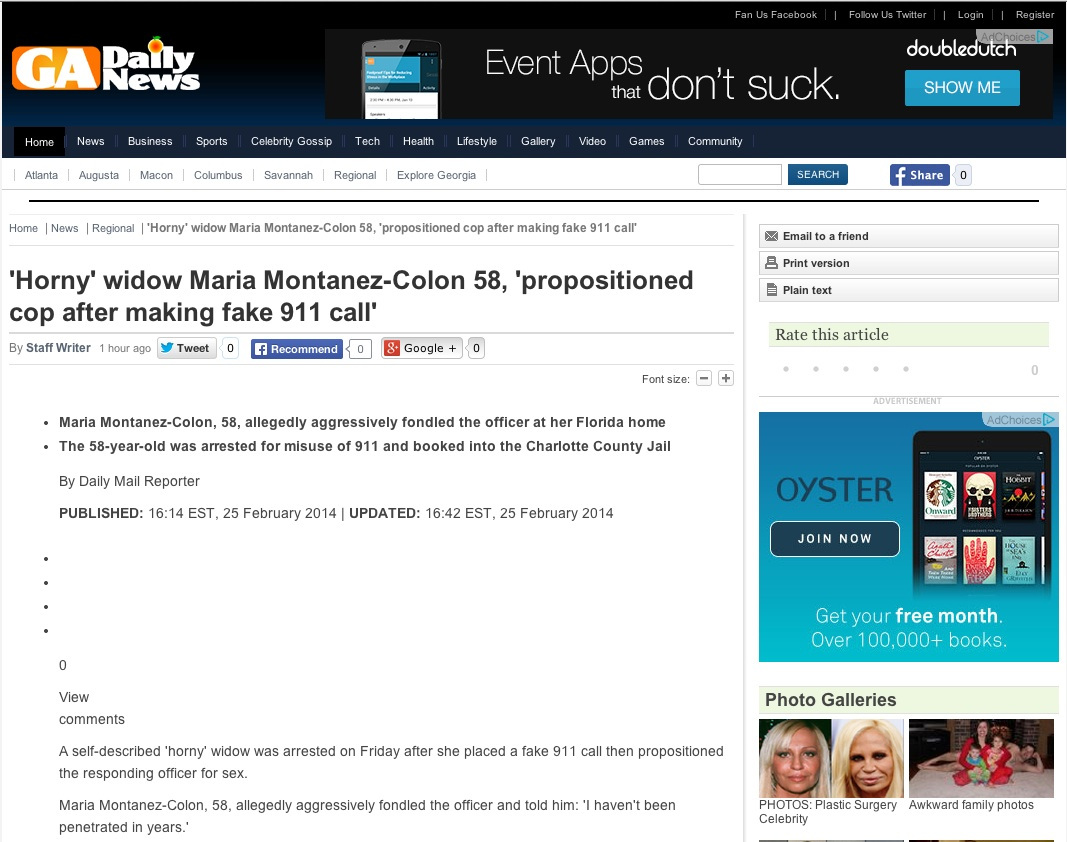
Marshall’s “Exhibit A” is Georgia Daily News, a website which purports to cover “news, traffic, sports, politics, entertainment, gossip and local events in Atlanta.”

As Marshall contends, “What it actually features is content ‘curated’ from elsewhere on the web, and some it has simply stolen from other major news sites” such as the Daily Mail.

Sizable chunks of the website’s content have nothing to do with Atlanta.

GADailyNews home pageConsidering the type of general news site it purports to be, GADailyNews.com doesn’t attract very much traffic at all.  And why would it? — since it contains precious little information of value or interest to anyone who is actually “seeking news about Atlanta.”

But it sure does generate a lot of ad impressions.  According to Marshall, each article page on the site features seven display ad units – all of which refresh every 20 seconds or so.

In the two-minute span of time it took him to read an article about Katy Perry and John Mayer (content copied from an Australian news site), Marshall was served more than 40 ad impressions.

Marshall continues:

“One page has served me nearly 500 ads in just 20 minutes – and I couldn’t stop refreshing them even if I wanted to.”

[And these ads aren’t for B-list advertisers, either.  They’re for brands like American Airlines, Hilton Hotels, Charles Schwaab and others.]

What’s happening here, of course, is that websites and ad tech middlemen have figured out that the algorithms of even the “quality” ad vendors like Google, AdRoll, and Bizo can be gamed pretty easily to serve ads on a low-quality site like Georgia Daily News, which is owned by a single-person entity called Integrated News Media Corporation.

It’s hardly the type of media vehicle that big-brand advertisers would normally wish to use for advertising.  But thanks to the vagaries and complexity of the ad exchange landscape, they are.

For every Georgia Daily News site, there are hundreds of others like it that cobble together seemingly valuable content with a passably convincing set of audience characteristics.

Put it together, and it adds up to problems on two levels.

First, advertisers are paying for impressions that are near-worthless.

Second, since there are finite ad dollars available, legitimate online publishers are losing out on those funds, which are far more important to their well-being than they are for sites that don’t engage in any true journalism at all.

As Jack Marshall concludes:

“Thanks to fraudulent traffic, dubious sites and middlemen with low quality standards, life is only getting harder for those publishers with expensive content teams to support.”