“Don’t Tread On Me”: Employees have strong feelings about employers gaining access to their social media profiles.

Social media privacyRecent news reports that some companies are asking their current employees or prospective new hires to grant them access to their private social media profiles haven’t set well with many people.

It seems that while people don’t mind publishing their personal information for friends and families to see, they’re not keen at all on employers having access as well.

This is borne out in the latest American Pulse survey from BIGinsight, a consumer information portal. In that survey, which queried nearly 3,600 American adults over the age of 18, respondents were asked how they would react to a request by an employer to hand over personal social media passwords, thereby gaining access to their profiles.

Approximately one in five of the survey respondents reported that they are not engaged in social media.  But among the remainder, most would resist the employer’s request … even to the extent of quitting their job:

  • Would quit a job or withdraw an employment application: ~52%
  • Would delete social media pages to prevent them from being seen: ~21%
  • Would go ahead and provide social media passwords to the employer: ~14%
  • Would edit social media profiles first … then provide passwords: ~13%

Based on the opinions of the respondents, it’s not at all surprising that the survey also found that ~85% think that when employers asking for access to social media profiles, it’s an invasion of privacy.  And only about 11% of respondents would be “comfortable” sharing their social media profiles with a potential employer.

There does seem to be a bit of altruism at work, because the preponderance of survey respondents (~72%) claim that they have “nothing to hide” on their social sites.

No doubt, Americans’ views about online privacy are borne out of the “live free or die … don’t tread on me” tradition of individualism in this country.  We love our ability to express ourselves … but spare us the KGB/Stasi routine!

Radio audiences: “Stickier” than you might think.

Radio audiences:  Stickier than you might realize.It’s a pretty common belief that when commercial breaks come on the radio, the audience scatters to the four winds.

And that view isn’t just held by laymen … those in the broadcast industry itself tend to believe that.

A study conducted by Arbitron, Media Monitors and Coleman Insights, released about six months ago, discovered that ad agency personnel believe that the typical radio audience is one-third lower during commercial breaks than during the lead-in.

Among radio industry personnel, those feelings are only slightlycloser to reality; they believe that the radio audience is about one-fourth lower during commercial breaks than during the lead-in.

In fact, a parallel study conducted by the same researchers found that these industry perceptions are way wide of the mark. Their evaluation, which covered nearly 18 million commercial breaks and ~62 million minutes of ads airing over a 12-month span on ~865 radio stations, revealed these interesting findings:

  • The average radio station aired 2.6 commercial breaks comprising nearly 9.0 minutes of advertising per hour.
  • The average break was ~3.5 minutes in duration.
  • On average, more than 93% of the lead-in audience stuck with the station during commercial breaks.
  • Longer spot breaks (4 to 6 minutes) still delivered ~90% of the lead-in radio audience.

These figures are significantly higher than the perception of industry observers. But one perception did turn out to comport with reality – the fact that older radio listeners are more apt to stay listening through the commercials than are younger listeners (~98% versus ~90%).

The study also determined that listening behaviors don’t differ at all between the different seasons of the year. But the audience for music stations is somewhat more prone to “wander off the reservation” compared to listeners of radio stations with spoken-word formats:  Fully 99% of the news-format radio audience stays on the station during commercials, while only ~88% of music format station listeners have the patience to stick around through the advertising.

The bottom line on the study’s findings is that radio is delivering audiences for commercials at levels that far exceed advertisers’ expectations.

So, the radio industry’s job is two-fold: Change the erroneous perceptions about audience levels … and also convince advertisers that the audience is actually listening and learning during the advertising breaks, not tuning out. 

This last bit may well be a lot harder to accomplish!

You can read more findings from the radio audience research here.

What does e-mail engagement mean to consumers? Getting a discount.

e-mail engagement is all about providing discounts to customersIf you suspect that most people opt in to receive commercial e-mails so that they can receive discounts on the products want … you’re absolutely right.

The latest proof of this is in a survey of ~1,000 consumers conducted earlier this year by BlueHornet, a San Diego-based e-mail marketing services company.

That survey found that the percentage of consumers signing up to receive commercial e-mails in order to receive discounts is a whopping 95%.

So while marketers may want to believe that “engagement” with consumers is all about brand affinity and excitement … all that is much less important to them than simply getting a good deal on the product or service.

There will always be a desire for companies to nurture personalized, relevant conversations with customers via their e-mail communications.

After all, a highly engaged customer base that sees a brand as tops in its field … perhaps leader in innovation and technology … and above all, a brand that makes a true difference in the customer’s personal or business life.

All of these objectives represent Holy Grail of marketing. By all means, marketers can and should strive for this level of brand engagement – however hard to attain it may be.

But to make it a whole lot easier easier, offer a coupon or discount as well.  Preferably big.

Wikipedia vs. the Church of Scientology

Wikipedia vs. ScientologyI’ve blogged before about Wikipedia phenomenon and how it’s completely taken over the realm of encyclopedic knowledge in the span of only a decade.

One of the central tenets of Wikipedia is that it’s an open and inclusive environment where anyone can post an article or edit article entries.  But it’s also a self-policing environment where “the wisdom of crowds” ensures that inaccurate or spurious information is quickly removed and replaced with corrected entries.

With such a free and open environment, it comes as no surprise that certain topics can engender passionate debate and create some highly interesting “fireworks.”

Once such example is the Wikipedia entry on Charles Bennison, the embattled Episcopal Bishop of Pennsylvania whose social and financial controversies have been wide-ranging. For months on end, dueling article entries made by Wikipedia posters and countered by the Bishop’s own partisans made for a morbidly fascinating tit-for-tat spectacle.

Or consider Wikipedia’s article entry on President Barack Obama, which at times has undergone literally minute-by-minute edits frantically posted by dueling editors during high-profile episodes such as the birth certificate controversy — a kind of editorial ping-pong match.

But never has Wikipedia stepped in as an organization and done what it did this past week: It has actually banned the Church of Scientology from editing any articles appearing on Wikipedia that are associated with the religion.

This unprecedented action was reportedly taken in response to “repeated and deceptive editing” of Wikipedia articles related to Scientology and its beliefs.

And according to the news reports, the vote wasn’t even close; Wikipedia’s arbitration council voted 10-1 to ban users coming from any and all IP addresses owned by the Church of Scientology and its associates, along banning with certain individuals by name.

The Scientology case has been under review by Wikipedia since last December. It centers on more than 400 articles about the religious organization and its members. These articles have been the source of fierce “edit wars” pitting organized Church of Scientology editors against the religion’s detractors.

As a measure of how heated this issue has been for Wikipedia, this was actually the fourth arbitration case concerning the Church of Scientology occurring within the past four years.

To the casual observer, the whole Church of Scientology issue is a tempest in a teapot that could be summed up by the title of William Shakespeare’s famous play, Much Ado about Nothing.

But the fervor in which Scientology’s promoters and its critics have battled each other tooth and nail over the content of the Wikipedia article entries proves the rule once again that politics and religion are among the most passionate subjects in the world.

But the Scientology fracas also makes another point: Wikipedia is now the most important information repository in the world. Otherwise, why would there be such a fuss?

So the stakes are high … and tempers are high.

Here’s a prediction: Despite the unprecedented ban by Wikipedia’s arbitration council, the Scientology “edit wars” are far from over.  These folks are relentless.

A Newspaper Startup in 2012 … Is this Madness?

European Daily, preview editionOver the past decade or more, seemingly all the business trends on the newspaper front have been negative. So to read that a new transnational newspaper is being planned for a Fall 2012 launch comes as a pretty big surprise.

Yes, you heard that right:  The European Daily plans to hit the streets in a few months’ time. In the meantime, the budding newspaper already has a website up and running.

The European Daily is the brainchild of three young entrepreneurs from Sweden and Germany. “We are a publication that partly targets a more senior audience who, to a great extent, still prefers print, as well as a traveling audience who wants to read their news on a flight or at their hotel,” says Johan Malmsten, one of the three founders.

Does this sort of thinking sound like a recipe for success in 2012?

At first blush, it seems like a pipe dream. Two huge roadblocks appear to be standing in the way of success. First, the market dynamics have been ugly for traditional newspapers … their traditional business model swept away by the Internet and changing ways that consumers access the news.

Add to this the mounting political and economic crisis in Europe, which could result in the European Union’s breakup, rather than any sort of renewed consolidation.  Is this the right time to be introducing a media property that’s “pan-European” in its character?

Mr. Malmsten discounts these threats. Instead he asserts, “Some people have praised us on our perfect timing, given the vivid current debate about Europe and the fact that a European news source and a common public sphere have never been as much in demand.”

“Europe is a daily reality for millions of Europeans, and that won’t change. We see giving these people a news source and a daily point of reference as our mission,” he adds.

Looking at the newspaper’s launch plans, it’s pretty clear the investors are fully committed to their mission. A staff of 30 is being constructed for the paper — about half of them focused on content.  The editorial team will be based in Amsterdam in Holland.

A “preview” edition of the European Daily was printed last year and ~40,000 copies were distributed in key urban centers like Paris, London, Berlin and Brussels. Reportedly, the reception was highly positive.

But I have doubts whether a completely new newspaper title can be launched successfully – especially one that’s based on a conventional print-centric product with a digital adjunct. It seems like we’ve seen this movie before:  This very formula has been tried and found wanting – even among established newspaper brands.

It will be interesting to look back in about two or three years and see if this endeavor adds up to much – or instead has gone by the wayside.

Anyone care to weigh in with odds on the front end?

Washington Mutual’s Big Gamble that Backfired

The Lost Bank, Washington Mutual's CollapseDo we need another book about bank failures? In the case of Seattle-based, Washington Mutual, I think so. After all, it represents the largest bank failure in U.S. history.

A new book has just been published about WaMu: The Lost Bank, by Kirsten Grind. Ms. Grind is a reporter for The Wall Street Journal and a former writer for the Washington State’s Puget Sound Business Journal. Having reported about WaMu for years, she brings a trove of knowledge and context to a story that goes well beyond the proceedings from Capitol Hill hearings.

In fact, one of the major reasons to read this book is the peek behind the curtain it provides … so that we can begin to understand “why” things happened, not just “what” happened.

Washington Mutual represents an ugly off-note in the oh-so-harmonious corporate world of Seattle — home to vaunted progressive organizations such as Starbucks, Boeing and Microsoft. And for decades, the financial institution was just another regional banking entity, making safe loans and turning in a decent financial performance at the end of each year.

What happened?

The trajectory of WaMu’s brief, dramatic ascent into the stratosphere – and subsequent disastrous plunge – was set when the institution, no longer the closely held institution it had once been, gambled on growth by acquiring Long Beach Mortgage in 1999. Unlike WaMu, LBM was a leading participant in the sub-prime mortgage lending market, with a national presence.

Ms. Grind notes that some of the impetus for acquiring Long Beach Mortgage came from a desire to be in accord with Congressional aims to expand home mortgage lending to people who had traditionally not been able to participate in the housing market due to low incomes, poor credit, or a lack of credit history.

Herein begins yet another example of the old adage: “The road to hell is paved with good intentions.”

And in fact, it wasn’t long before WaMu started expanding its loan offerings to include adjustable rate mortgages and other “innovations” designed to increase loans and commensurate deposits.

It was all too easy. Then the greed set in. As long as home values continued to climb, WaMu found it could continue to originate mortgage loans, collect fees, sell the loans, and continue to grow its lending business, deposits and earnings.

The bank set aggressive goals to become one of the nation’s top two or three mortgage lenders, even as it came to possess a 2,000+ branch network.

But by 2007, barely eight years after the run-up began, the bank’s own officers began to realize major problems with the sub-prime division, leading to its collapse barely a years later and the fire-sale takeover of its assets by J.P. Morgan.

The legacy of WaMu’s bad lending practices has been bedeviling J.P. Morgan ever since. After initially marking down WaMu’s portfolio of mortgage loans by some $31 billion, J.P. Morgan has had to set aside an additional ~$6 billion because of further deterioration of the portfolio.  The fallout from WaMu’s collapse will continue to reverberate in the coming years.

The Lost Bank is a good read even for people who aren’t well-versed in the financial side of business. Unlike other books I’ve encountered on banking topics that seem to be “long on tedium,” this one definitely keeps your interest from first page to last.

I find this book on par with two others that brought their corporate subjects to light in a similarly real way – and also well-worth reading:

  • Liars Poker by Michael Lewis (about Salomon Brothers and the Wall Street investment crisis of the late 1980s)

Feel free to share your own thoughts about these three books. Do you recommend them to others as well?

Does Gartner’s “Hype Cycle” Chart Apply to Social Media?

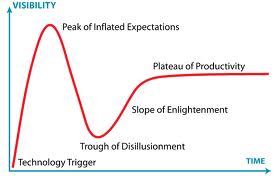
Hype Cycle Chart (Gartner, Inc.)That’s what author and digital marketing specialist Jeff Molander seems to think. In fact, it’s the topic of an article he wrote recently in Target Marketing magazine titled “What Game Changer? Moving past the Social Media Revolution that Never Was.”

As can be seen in the diagram at right, the Gartner “Hype Cycle” model begins with a technology trigger that generates a groundswell of interest and expectations, which is then followed by a crash when the early expectations fail to pan out.

Things do move forward again – much more slowly – as the sober reflection on early disappointments helps temper expectations to more realistic levels, characterized by Gartner as a “plateau of productivity.”

It is Mr. Molander’s contention that the characterization of social media as a “game-changing” phenomenon has been so overstated and sensationalized, most companies today are probably working against their own best interests in how they’re dealing with it.  Which is to say, not using it properly as a selling tool.

Here’s how Mr. Molander puts it: “The difference between fooling around with social media and selling with it relies on the use of time-tested direct response practices – not new tools and techniques.”

Those basic practices include:

  • Solving customers’ problems
  • Provoke customer responses that connect to the sales funnel
  • Discovering customers’ needs as they evolve … then using this knowledge to improve the response rate

The companies that are successful in selling goods and services via social media are promoting interactions in ways that answer questions and solve problems.

Of course, there is absolutely nothing new or novel about this: “Solving customer challenges” has always been an effective way to cultivate AIDA (awareness, interest, desire and action).

It also continues to be the best way to move customers toward making a purchase.

What social media can do is make the process easier to accomplish, due to social’s interactive nature. Approached in the proper way – and done with regularity – facilitating digital Q&A interactions will help leverage and drive sales.

I think Mr. Molander’s point of view is correct. Using social media as a platform for sales isn’t about some kind of “secret formula” for content creation or figuring out the ideal time to publish a Twitter tweet or blog post. It’s about using the “new” platforms to facilitate “old” sales concepts.

You know – the ones that work.

Arthur Brooks Presents the “Moral Case” for the Free Enterprise System

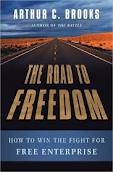
The Road to Freedom by Arthur C. BrooksThose of us in the business world who experience first-hand the positive attributes of the free enterprise system while also seeing certain failings, usually find it much easier to defend the concept of free enterprise from the perspective of “facts, data and efficiency”: Things work better under a capitalist system because the profit motive and competition combine to reward both effort and results.

Of course, that sort of defense makes it pretty easy for others to accuse capitalism of being an essentially heartless, unfair system that promotes winners and losers … where more typically “the rich get richer and the poor get poorer.”

The lame response to that contention is often something like what Sir Winston Churchill once said about democracy: “It’s the worst system – except for all the others.”

Now along comes a book that presents a moral case for free enterprise: The Road to Freedom: How to Win the Fight for Free Enterprise, by Arthur C. Brooks. Published just last month, I think it’s the freshest, most modern exposition of ideas on the topic since Friedrich Hayek in the 1950s.

Dr. Brooks bases his moral defense of the free enterprise system on the ideals of earned success, equality of opportunity, charity, and basic fairness. Of these, I find the “fairness” argument for capitalism to be the most interesting and useful aspect in that it takes an argument normally used against capitalism and turns it back on its accusers.

Brooks does a very good job presenting the case of how the free market, while not perfect, is the fairest system for the largest number of people – including the poor. One of the ways that he illustrates his points is by citing “happiness” research exercises that have been conducted with groups of people over the past 10-20 years in many different countries all over the world. These studies show the power of the idea of “earned success” and the fact that it has near-universal human appeal over the alternative of “learned helplessness” of less free economic structures.

It’s refreshing to read a book on economic matters that doesn’t fall into the realm of a polemic, and that eschews doctrinaire philosophy and partisan labels. Instead, Brooks emphasizes that government has a role in protecting the population from corporate cronyism and monopoly power, even while defending free enterprise as the fairer and more moral system.

To top it off, the book is written in an easy-to-approach conversational tone with liberal doses of humor. How often can you say that about a book on economics?

For anyone else who has read Dr. Brooks’ book, let’s hear your reactions. Do you have a different take?

Reasons Why the Facebook IPO Bombed

Facebook IPO failureShare prices of Facebook stock have been distinctly underwhelming since the first day of trading — to the tune of ~30% off its original offer price. And everyone seems to have an explanation as to why.

I’m partial to a list of reasons put out by Dan Janal, president of PRLeadPlus.com and author of the business book Reporters Are Looking for You.

Mr. Janal has come up with a dozen reasons for the Facebook IPO failure. The ones that struck me as most compelling are these:

  • The public is not as dumb as Wall Street thinks. Chalk it up to too many other dot.com “can’t miss” opportunities that whiffed big-time.
  • Who has excess money to throw around? Small investors are struggling with underwater mortgages and mountainous debt … so how do they have extra funds to throw at an IPO? Get real. (And the institutional investors stayed away because they were clearly “in the know” about how unrealistic Facebook’s IPO share pricing really was.)
  • Who goes on Facebook to actually buy things? Precious few, that’s who. And if buyers aren’t on Facebook … then advertisers won’t be there either. And with that, there goes a big part of Facebook’s business rationale down the toilet. (GM backed out of its Facebook advertising program – very publicly – just days before the IPO. That timing suggests they were trying to tell the market something!)
  • Friends aren’t really “friends.” Indeed, many Facebook friends are more like acquaintances, which is a lot less compelling when it comes to word-of-mouth influencing. (LinkedIn connections are far more “honest” in terms of being “all about business.”) When Facebook contends that friend networks will influence more buyers, investors look at their own friend networks … and they don’t buy the hype.
  • There’s a huge gulf between Facebook “friendships” and actual “engagement.” And if friends don’t engage, a big piece of what makes the Facebook power matrix potentially so potent falls away.

Mr. Janal maintains that the characteristics that make the Facebook platform what it is aren’t the same ones that’ll launch “a million new millionaires.”

Sure, the early investors who acquired stock options early in the game came out big winners. But precious little of that largesse turns out to be in the cards for the rest of the investors.

Bombs away.

Revenge of the Nerds: Microsoft will make “Do Not Track” the Default Setting for IE 10.

Do Not TrackIs it just me, or has Microsoft seemed to be the quiet wallflower in recent months? Meanwhile, Facebook and Google have been getting all the attention – good and bad.

But now, here comes this announcement: Microsoft will make the “do not track” feature in the next version of its Internet Explorer browser the “default” option when it ships.

This move poses a threat to the efforts of online advertising giants – including arch-rival Google – to track browsing behaviors and serve up relevant advertising – you know, the high-priced kind.

Could it be that Microsoft is doing a Monty Python “I fart in your general direction” number on Google? And how does this move affect the evolving privacy standards in the online realm?

It should be remembered that the “do not track” feature doesn’t actually block tracking cookies. But it does send a message to every website visited, stating the preference not to track.

It’s a request, not a command, but more sites are now honoring the request. Including, importantly, Twitter … which announced in May that it would embrace the emerging privacy standard.

The Federal Trade Commission also backs the new privacy standard, even as the agency has become more hostile to the online advertising industry’s tracking practices. In fact, the FTC has been threatening to advocate for privacy legislation.

Indeed, online advertisers are now walking a fine line in all of this. Ostensibly, they’re supporting privacy policies … but the ones they’re advocating aren’t too onerous on their ability to collect behavioral data.

What’s most concerning to advertisers is the possibility that they may eventually need to change the way they build profiles of users in order to sell premium-priced targeted ads.  That’s a nightmare scenario they’re attempting to avoid at all costs.

In this environment, how much of a threat is Microsoft’s move? Potentially big, since it’s likely that ~25% or more of web users will upgrade to the IE 10 product over time – with all of them having the “do not track” feature “on” by default.

Microsoft claims that it’s making the change “to better protect user privacy.” That seems logical on its face – and in keeping with Microsoft’s recent moves to incorporate privacy technologies in its browser products.

But one has to wonder if it’s also one of those “nyah” moments directed squarely at Google.

Because as we all know, there’s absolutely no love lost between these two behemoths.