The Bad News Just Keeps Coming at JCPenney

JCP logo (JCPenney)
The name change from JCPenney to JCP was just one of many miscues made over the past 18 months during the tenure of CEO Ron Johnson — one of the most spectacular failures in recent retailing history.

The folks at JCPenney (JCP) just can’t seem to catch a break.

It turns out that the resignation of the company’s CEO in the wake of disastrous sales and profitability results caused by an ill-fated change in retail strategy was just the biggest clanger in a string of bad news.

Not only did the company’s sales plunge by $4.5 billion to around $13 billion, employment fell to only 116,000 workers — a huge drop from more than150,000 just a year earlier.

A centerpiece of the failed CEO’s retail strategy — opening boutique “stores within a store” — has been under constant fire, not least in the courts, where Macy’s has sued to prevent Martha Stewart-branded merchandise from being sold at JCPenney (citing a pre-existing exclusive sales agreement).

But there’s more.

We also have a report from STELLAService, an independent research company that gathers information on how well the nation’s Top 25 retailers are doing when it comes to delivering merchandise ordered online.

STELLAService has found that Staples, Zappos and Office Depot deliver merchandise the fastest.

And it’s fast all right:  these retailers achieve an average delivery time of one day.

On the other hand, who scored dead last? JCPenney. Its online division was the slowest of the 25 retailers, clocking in at an average delivery time of nine days.

That’s pretty miserable.

Is JCPenney filling the role that Montgomery Wards once played in U.S. retailing? Squeezed by big box discount stores on the one hand, and on the other by department store brands like Macys and Nordstroms the public considers far more exciting, JCPenney is trapped by its its own brand history.

No amount of “polishing the apple” in the mode of Apple’s fabulously successful retail branding can change the simple fact that the JCPenney brand name speaks to an older, middle-class demographic and psychographic audience.

Just-sacked CEO Ron Johnson has now experienced this brand reality first-hand.

One wonders how he could have missed it in the first place. Did his prior positions directing retail strategy at “go-go” brands Apple and Target blind him to the facts on the ground?

Can anyone who rubs elbows with real middle-class shoppers — even tangentially — seriously have thought that dropping store discount coupons would do anything other than turn off loyal customers?

There’s a reason coupon flyers continue to be so popular in the Sunday newspapers … and it has everything to do with millions upon millions of middle class and older consumers.

But unfortunately, JCPenney’s woes go much deeper than mere brand identity. Things appear to be seriously amiss on the operational side as well.

Any top retailer that can’t manage to deliver merchandise faster than an average of nine days deserves to have consumers snap their pocketbooks shut in response.

The next 18 months will tell us a good deal about where JCPenney is headed. Will the retailer end up regaining its brand strength … or will it die a slow death and ultimately be swept into the dustbin of retail history?

To me, the latter scenario seems more likely.  What makes it a particular shame is that the company has made so many unforced errors along the way.  Its own people, strategies and tactics have contributed as much as anything to its current plight.

Optify takes the pulse of B-to-B paid search programs.

Optify logoI’ve been highlighting the key findings of Optify’s annual benchmark report charting the state of B-to-B online marketing. You can read my earlier posts on major findings from Optify’s most recent benchmarking here and here.

In this post, I focus on the paid search activities of business-to-business firms.

Interestingly, Optify finds that pay-per-click programs have been undertaken by fewer firms in 2012 compared to the previous year.

And the decline isn’t tiny, either:  Some 13% fewer companies ran paid search programs in 2012 compared to 2011, based on the aggregate data Optify studied from 600+ small and medium-sized B-to-B websites.

However, those companies who did elect to run pay-per-click advertising programs in 2012 achieved decent results for their efforts.

The median company included in the Optify evaluation attracted nearly 550 visits per month via paid search, with a conversion rate just shy of 2%, or ~45 leads per month.

[For purposes of the Optify analysis, a lead is defined as the visitor taking an action such as filling out a query form.]

Leads from paid search programs represented an important segment of all leads, too – between 10% and 15% each month.

The above figures represent the median statistics compiled by Optify. It also published results for the lower 25th percentile of B-to-B firms in its study. Among these, the results aren’t nearly so robust: only around ~60 visits per month from paid search that translated into 6 leads.

Since the Optify report covers only statistics generated from visitor and lead tracking activity, it doesn’t attempt to explain the reasons behind the decrease in the proportion of B-to-B firms that are engaged in paid search programs.

But I think one plausible explanation is the steadily rising cost of clicks. They broke the $2 barrier a long time ago and see no signs of letting up. For some companies, those kinds of costs are a bridge too far.

I’ll address one final topic from the Optify report in a subsequent blog post: B-to-B social media activities. Stay tuned to see if your preconceptions about engagement levels with social media are confirmed – or not!

Is Social Media a Platform for Narcissists?

Narcissism on social mediaOver time, I’ve been seeing more articles and blog posts cropping up that broach the topic of social media and narcissism.  Here’s just one of the latest examples.

The issue boils down to this:

  • Do social media platforms cause people to become narcissistic?
  • Or is social media merely a conduit by which people who already possess narcissistic tendencies get to indulge in “self-referential behavior” on steroids?

One could probably start at the very beginning:  Is Mark Zuckerberg a narcissist?”    (Don’t answer that question!)

My own view is somewhat conflicted.  I see evidence of some people who cheerfully relish the bullhorn – and attention – that social media appears to give them.

But social media can be deceiving in that a “personal environment” can be built that seems like the whole world is watching and listening – but in reality it’s just a constructed edifice more akin to a Potemkin village.

How many people are actually reading anyone’s Twitter posts?    (Don’t answer that question!)

But I can also see clear evidence of some of the more “Type B” people I know who have made quite an impact on social media by virtue of some very impressive contributions – written information, videos, photography, etc.

In those cases, social media has been a way to extend influence well beyond a small circle of friends or colleagues – and far more than could ever be possible before.

How about you?  What are your thoughts on this topic and what have you observed?  Please share them here if you’re so inclined.

(Don’t worry, we won’t accuse you of narcissism!)

More B-to-B Web Behavior Findings from Optify

Optify logoThis is my second post on the very interesting findings from Optify’s analysis of the behavior of visitors to business-to-business websites during 2012.

[Refer to my earlier post for a quick overview of salient “top-line” results.]

As part of its analysis, Optify uncovered some interesting factors pertaining to “organic” web searches, which represent ~41% of all visits to B-to-B websites.  Here’s what stands out in particular:

  • Forget all of the talk about Bing/Yahoo taking a bite out of Google on the search front. Optify found that Google is responsible for nearly 90% of all organic search activity in the B-to-B realm, making it the #1 referring source of traffic – and it isn’t even close.  (Bing’s coming in at a whopping ~6% of the search traffic.)
  • Organic search visits from Bing do show slightly better engagement rates in the form of more page views per visit, as well as better conversion rates (e.g., filling out a form). But with such low referring traffic to begin with, it’s fair to say that Google was — and remains — the cat’s meow when it comes to organic search.
  • “Branded” searches – ones that include the name of the company – account for nearly one-third of all visits from organic search. Plus, they show the highest engagement levels as well: ~3.7 page views per visit on average.

Optify notes a few clouds on the horizon when it comes to evaluating the success of a company’s organic search program. Ever since Google introduced its “blocked search data” securred socket layer (SSL) option (https://google.com), the incidence of blocked referring keyword data has increased rapidly:

  • Block referring keyword data now represents over 40% of all search queries.
  • Non-branded keywords that are known (and thus available for analysis) have dropped to just 35% of all organic searches.

Here’s the bad news:  As blocked keyword searches continue to grow in popularity – and who wouldn’t choose this option when it’s so easy and readily available – it’s creating a veritable “data oblivion” confronting marketers in their attempts to analyze and improve their SEO performance.

In a subsequent blog post, I’ll summarize key findings from Optify pertaining to paid search (SEM) and social media in the B-to-B realm.

Optify Measures the Current State of B-to-B Online Marketing

Optify logoEach year Optify, a developer of digital marketing software for business-to-business marketing professionals, analyzes web behaviors to develop a “benchmark” report on B-to-B marketing.

The annual Optify benchmark report is interesting in that the findings are developed not from surveys, but from actual web activity. 

Optify’s most recent report, released in early 2013, was produced using data gleaned from more than 62 million web visits, ~215 million page views and ~350,000 leads from more than 600 small and medium-sized websites of B-to-B firms.

Optify used its proprietary visitor and lead tracking technology to collect and aggregate the data.  U.S.-based B-to-B sites that garnered between 100 to 100,000 monthly visits were included in the research.

There are many interesting findings – enough to chew on so that I will cover them in several blog posts.  In all likelihood, some of the findings will confirm your perceptions … while others may be a tad surprising.

Web Traffic

As in business-to-consumer web marketing, there is cyclicality in web traffic in the B-to-B world.  But according to Optify, it’s almost the polar opposite:

  • Higher traffic:  January through March + September and October
  • Lower traffic:  Summer months + end of year

Source of Web Traffic

Optify found that the overwhelming amount of B-to-B web traffic comes from two main sources — organic search and direct traffic.  Other sources – particularly social media – are a good deal more peripheral:

  • Organic search:  ~41% of web traffic
  • Direct traffic:  ~40%
  • Referral links:  ~12%
  • Paid search:  ~5%
  • Social media:  ~2%

Lead Conversion Rate

Optify defines the “conversion rate” as the percent of web visitors who submitted a query or filled out some other type of form during a single visit.  Using this definition, Optify found that the average conversion rate was around 1.6%. 

But the best sources for lead conversions differ from the most prevalent sources of web traffic:

  • E-mail source:  ~2.9% conversion rate
  • Other referral links:  ~2.0%
  • Paid search:  ~2.0%
  • Direct traffic:  ~1.7%
  • Organic search:  ~1.5%
  • Social media:  ~1.2%

Page Views per Web Visit

Optify found that the average visitor viewed three pages on the website during their visit.

… But Big Variations

Optify found a good deal of variability in web activity.  To illustrate this, it has published findings broken out by medians and for percentile groups as follows:

  • Median visits per month per website:  1,784
  • 75th percentile of websites:  4,477
  • 25th percentile of websites:  339
  • Median page views per website visit (monthly average):  3.03
  • 75th percentile median page views:  4.04
  • 25th percentile media page views:  1.80
  • Median lead conversion rate (monthly average):  1.6%
  • 75th percentile median conversion rate:  3.3%
  • 25th percentile median conversion rate:  0.5%

There’s much more in the Optify report that’s worth reviewing … which I’ll share ina follow-up blog post.

Teens’ Rites of Passage: Technology Trumps Transportation

Technology, not cars with teens.
Technology, not cars, are where it’s at with teens today.

Thirty years ago, the rite of passage going from being a kid to adulthood had to include having your own automobile.

Not so today.

In fact, the percentage of young adults who even have their driver’s license has declined considerably:  In the early 1980s, nearly half of 16-year-olds in America had a driver’s license. By 2010, that percentage had dropped to just ~28%.

What happened between then and now? A number of things, but the biggest may be the rise of consumer electronics and social media.

Recall what an automobile could provide a young adult in the 1980s: access to all of the kid-popular activities of the day: shopping, music, movies, getting together with friends, and so forth.

Today, teens can access pretty much all of that right at their fingertips via the Internet or a smartphone.

You want clothes? Order them online.

Music? Download it to your smartphone.

Communicate with friends? Just Skype or text away.

Meanwhile, between more sophisticated, costly auto maintenance and the high price of gasoline, owning a car has only become more expensive.

Auto insurance premiums for teens? Outta sight.

Plus, it’s just more of a hassle to get a license today. Driver education classes are disappearing from many a public school classroom, the casualty of budget cuts. Stricter state laws make it much more difficult and time-consuming to rack up the necessary behind-the-wheel training hours prior to taking driving tests.

The result is fewer kids getting licensed during their teen years.

In 1983, nearly 70% of 17-year-old Americans had drivers licenses … a figure that dropped to just ~46% by 2010.

Even for 18-year-olds, the percentage holding drivers licenses declined from ~80% in 1983 to only about 60% in 2010.

A recent survey conducted by Zipcar found that millennials (people age 18 to 34) would rather shop online than in stores. No car needed for that.

And when presented the choice between giving up their phone or their tablet computer or their car … two thirds of the Zipcar survey respondents would forego the car.

This is a veritable sea change in attitudes about wheels.

In fact, one could conclude that the very things that cars once represented – the “vehicle” that enabled you to “do what you want, see who you want and be what you want” – is what actually describes the digital and social media world today.

Meanwhile … the car is now just a way to get to your part-time job. Ugh.

HR managers’ views of new college grad hires: Curmudgeonly … or canaries in the coal mine?

Lack of professionalism among new hiresAs those of us in the world of business begin to add years (or decades) to our tenure, it becomes easier than ever to look at the younger crop of workers coming onstream and see traits that don’t align with our worldview about what is acceptable, “SFW” behavior.

Perhaps we’re too set in our ways. Maybe we’re not being flexible enough or making a sufficient effort to keep an open mind about proper office professionalism and etiquette.

But maybe we’re not offbase after all:  A new survey of HR professionals suggests that others have also noticed — and they’re not very forgiving, either.

In fact, this survey of ~400 human resources managers, which was conducted by the Center for Professional Excellence at York College, found that opinions of recent college graduates in the workforce have grown more negative over the past five years.  (The survey is conducted annually.)

When asked about their experiences in recruiting and hiring recent college graduates, these HR managers were pretty unsparing in their criticism. Here are some of the opinions the survey uncovered:

  • More than one-third of HR respondents felt that the level of professionalism among new college-educated employees has worsened over the past five years.
  • Nearly half believe that the work ethic of new employees is worse today than before.
  • More than half of the respondents feel that new workers come into the workforce with an unrealistic air of entitlement.

What are some of the specific areas where HR managers see new hires failing to measure up? These were the most prevalent mentions in the York survey:

  • Appropriate appearance and dress
  • Punctuality and workplace attendance
  • Attentiveness
  • Staying on-task through to completion of assignments
  • Honesty

And that’s not all.

The human resources professionals in this survey reported that younger employees “appear arrogant” during the hiring process and once they come on the job.

Moreover, these HR professionals contend that new employees aren’t taking proper cues from older, more established workers in the office, but instead from their peers and friends.

A manifestation of this is the predilection to text co-workers rather than to communicate via e-mail messages, or through personal conversations and interfaces.

The basic problem with the attitudes of new company hires was pointed out by Deborah Ricker, director of the Center for Professional Excellence: “Acceptable behavior among peers is not necessarily acceptable among coworkers and superiors.”

Amen to that.

[Click here if you’re interested in downloading a full summary of the 2013 Professionalism in the Workplace survey results.]

Most of us can probably think of one or two examples of employees who personify many of the issues brought up by the HR managers in the York survey.

One example that comes to my mind from our own office’s experience was a young worker who decided she needed to take short naps during her lunch periods.

Nothing really wrong with that, except … she did so by lying down on the floor next to her desk — which was directly behind another worker’s cubicle. Imagine trying to do your work while having someone snoozing (snoring) at your feet!

If you have similar anecdotes about some of the younger hires in your office, feel free to leave a comment. It’ll be good for a chuckle or two – even if there’s an underlying context that’s way sober.

College aspirations: Talk versus action.

College participation ratesPollsters like to point out that people will sometimes voice an opinion about an activity, a product or a political candidate — but what they say doesn’t match the reality.

If that’s the case, it makes the recent revelation that ~42% of ~500 Austrians surveyed in a Market Institut poll believe that Adolf Hitler’s rule “wasn’t all bad” even more scary than it sounds at first blush.

Bringing things back closer to home, a report issued in August 2012 by the National Center for Education Statistics states that ~96% of female high school seniors want to go to college … and that among male seniors, it’s only a tad lower at ~90%.

But here’s the actual reality: The U.S. Census Bureau reports that fewer than 60% of 18-24 year olds are actually enrolled in college or have earned their higher education degree.

Enrolling in college doesn’t necessarily mean graduating, either. Only one-third of 25-34 year olds held a college degree as of 2011 (36% of women and 28% of men).

Why aren’t kids going to college even though the vast majority of high school seniors say they want to attend? There are the predictable reasons:

  • Can’t afford college tuition
  • Entered the workplace instead
  • Didn’t graduate from high school (~16% of 18-24 year olds haven’t actually earned their high school diplomas)

But perhaps we’re beginning to see bit of a shift in thinking, too.

Most parents – and many school systems as well – hold up college prep as the primary objective of high school curricula and learning-related activities. But some may be looking at the less-than-lucrative job prospects of graduating college seniors and realizing that the traditional four-year college course of study isn’t the clear ticket to a gainful career that it once was.

Online learning, distance learning, technical training and hands-on mentoring are other post secondary education options that may looking more viable to some — particularly males.

In fact, fewer than 50% of males are enrolling in four-year educational institutions following high school, while for females, it’s closer to 75%. 

It’ll be interesting to see how all of this plays out over the coming decade.  Perhaps then we’ll have the benefit of 20/20 hindsight to see if these trends were a potent of bad things society … or not.

Remembering Roy Brown, designer of the star-crossed Edsel, one of the biggest flops in automotive history.

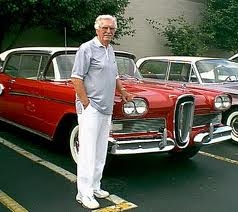
Roy Brown, designer of the Ford Edsel
Roy Brown, Jr., designer of the Edsel.

I remember my father, who had a 45+ year career in industrial/commercial sales and marketing, having an interesting artifact hanging on the wall of his office: a hubcap from a 1958 Ford Edsel sedan.

It was an interesting prop because it represents one of the biggest marketing flops in American automotive history … and underscores what can happen when product development efforts ignore what market research is telling them.

Recently, Roy Brown, Jr., one of the key players in the Edsel fiasco, passed away at the age of 96. As the lead designer on the product, Mr. Brown bore the brunt of blame for the “glorious failure” that was the Edsel.

Of course, that rap isn’t entirely fair; introducing a new motor car is a team effort that involves a host of people. And in the case of the Edsel, the design of the vehicle was only one of several key failures.

Consider just how many ways the Edsel ran afoul of good product development practices:

  • The car was developed based on out-of-date consumer research. The late 1950s was the beginning of changing consumer tastes in car designs:  moving away from exuberant fins and outlandish colors and towards a more refined style. By the time the Edsel became available at dealerships, consumer tastes had shifted and the country was in a recession.
  • The design of the car was controversial. Its most memorable design feature was its “horse collar” grille, unfortunately referred to by some as a toilet seat. It was different from any other car on the market — but the notoriety wasn’t positive. Some wags joked that the car’s front resemble “an Oldsmobile sucking a lemon,” while others were even less charitable, noting that the grille design was suggestive of a giant vulva.
  • Despite undertaking a highly publicized naming effort for the vehicle that ultimately reached more than 6,000 possibilities being considered, Ford rejected all of these suggestions and chose to name the car after the lone son of company’s founder. The “Edsel” – a clunker of a car name if ever there was one – did nothing to endear the buying public to the brand, seeming more like corporate nepotism taken to the extreme.

Ford predicted great things for the Edsel. The company launched a glitzy ad campaign for the automobile in 1957, touting it as a revolutionary “car of the future” and projecting first-year unit sales of more than 200,000 vehicles.

Instead, when it debuted in Ford showrooms in 1958 carrying a list price between $2,300 and $3,800, consumers were distinctly underwhelmed.

But even with disastrous first-year sales, Ford limped along with the Edsel until finally killing the brand in 1960. In all, only ~100,000 Edsels had been sold over three model years.

The total cost of the Edsel boondoggle to Ford was ~$350 million, which translates into nearly $2.8 billion in today’s dollars.

Roy Brown was the man held most responsible for the failure of the Edsel. But ever the optimist, the designer didn’t let this become the end of his career. In fact, Brown bounced back to work on successful new introductions such as the Ford Falcon and Mercury Comet. These turned out to be everything the Edsel wasn’t.

Mr. Brown didn’t disown his star-crossed child, either. In fact, he drove his own Edsel car (a stunning fire-engine red model) nearly to the end of his life — no doubt happy to know that in later years, mint-condition and restored Edsel cars were selling for upwards of $100,000 apiece. And there are highly active Edsel car clubs with members located throughout the United States and Canada.

So, maybe it’s not such a bad legacy in the end.

BlackBerry in 2013 … like Studebaker in 1965?

1965 Studebaker Commander station wagon
The end of the road: The 1965 Studebaker Commander station wagon.

BlackBerry has announced that it will finally introduce its new Z10 touchscreen smartphone model in the United States next week, in conjunction with its AT&T program.

That’s about a month after sales of the Z10 began in the United Kingdom, Canada and several other countries.

Does this signify a comeback of sorts for BlackBerry?

If it does, it will be a dramatic reversal of fortune, as the company has been on a steady downward trajectory ever since the release of the first Apple iPhone in 2007.

But speaking as the owner of a BlackBerry device, I have to admit that the company has seemed to be hopefully behind the curve for quite a few years now. And this latest, last-ditch effort is coming up against stiff competition, such as Samsung’s new Galaxy smartphone which is debuting at the very same time.

BlackBerry’s recently installed CEO, Thorsten Heins, has stated publicly that the company has to regain some of its market share in the U.S. in order to be successful.

But the news on this front doesn’t look promising at all, as corporate accounts — long the company’s bread-and-butter busines– appear to be falling away.

In February, The Home Depot reported that it was replacing all of its company-issued BlackBerry devices with iPhones.

And just last week, Yahoo announced that it will be phasing out its app for BlackBerry devices as of April 1st (yep, you got that right: April Fool’s Day).

Also, as of last September Yahoo no longer offers BlackBerry smartphone options to its own employees – just as with The Home Depot.

Rather than endorsements, these seem more like ringing indictments.

For those of us who love our BlackBerry keyboards, the company is promising that a keyboard version of the new smartphone (the Q10) will be available in the United States by this summer.

The question is, will it be too late by then?

We’ll know that answer soon.