What are the latest trends in the popularity of different marketing communications channel tactics?

The DMA’s 2015 Response Rate Report provides answers.
marketing channelsPeriodically, the Direct Marketing Association conducts field research to take the pulse of marketers and the various channels they’re employing to support their marketing campaigns.

In the DMA’s most recent survey, conducted online this past December and January, marketers were asked which one of seven channels they utilize in their campaigns.  The seven choices listed were the following:

  • Direct mail marketing
  • E-mail marketing
  • Mobile marketing
  • Online display advertising
  • Paid search advertising
  • Social media advertising
  • Telemarketing

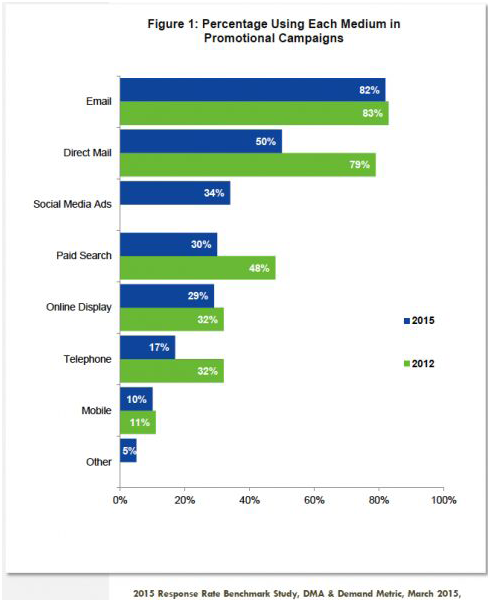
The results of the survey show that e-mail marketing remains King of the Hill when it comes to its popularity as a MarComm channel, with more than four in five marketers including the tactic as part of their promotional campaigns:

  • E-mail: ~82% use as a medium in promotional campaigns
  • Direct mail: ~50% use
  • Social media advertising:  ~34% use
  • Paid search: ~30% use
  • Online display advertising:  ~29% use
  • Telemarketing: ~17% use
  • Mobile marketing: ~10% use

Clearly, the research findings show that marketers are using multiple channels in their campaigns:  Two-thirds of the survey respondents use more than one channel, and around 45% of them reported that they’re using three or more channels in their promotional campaigns.

Social media advertising is a new entrant on the list in the DMA research.  It wasn’t even included in the DMA’s 2012 survey, yet today appears to be an important part of the channel mix.

On the other hand, mobile marketing remains a channel that isn’t being utilized by very many marketers — at least not yet.  In a similar survey conducted by the DMA in 2012, its adoption rate was similar to what the 2015 survey has found.

The graph below compares 2015 and 2012 survey results.  Aside from the lack of movement with mobile marketing, another interesting trend is the significant decline in the utilization of direct mail marketing.  Back in 2012, it rivaled e-mail marketing in popularity.  Today, only half of the marketers surveyed continue to use it as a marketing channel.

And a third big trend is the utter collapse of telemarketing as a popular MarComm channel — likely happening under the twin weight of high costs and massive phone message filtering.
DMA chart

In terms of future anticipated usage, the DMA research found that marketers are, in fact, warming to mobile marketing.  It and social media advertising are the two channels that have the best prospects for new adoption, based on the future intentions reported by these respondents.

The 2015 DMA report is available for purchase here.

World brands: Who’s up … Who’s down?

brand finance logoEach year, the brand valuation consulting firm Brand Finance produces a report on the strength of the world’s Top 500 brands.

It’s an interesting study in that Brand Finance calculates the values of brands using the so-called “royalty relief” approach – calculating a royalty rate that would be charged for the use of the brand name if it weren’t already owned by the company.

In the 2015 report, just issued, Apple remains the world’s most valuable brand based on this criterion.  The Top 10 listing of world brands is as follows:

brand finance global 500 2015#1  Apple

#2  Samsung

#3  Google

#4  Microsoft

#5  Verizon

#6  AT&T

#7  Amazon

#8  GE

#9  China Mobile

#10 Walmart

Of these, all but China Mobile were in the Top 10 listing in Brand Finance’s 2014 rankings.  Of the others, all maintained their rank except for AT&T and Amazon, which rose, and GE and Walmart, which fell.

The most valuable brands differ by region, however.  In fact, Apple is tops only in North America:

Most valuable brand in North America:  Apple

… in Europe:  BMW

… in Asia/Pacific:  Samsung

… in the Middle East:  Emirates Air

… in Africa:  MTN (M-Cell)

… in South America:  Banco Bradesco

As for which brand’s value is growing the fastest, top honors goes to … Twitter?

That is correct:  According to Brand Finance, Twitter’s value has mushroomed from $1.5 billion in early 2014 to nearly $4.5 billion now.

Other social platform firms that have experienced big growth are Facebook (up nearly 150%) and the Chinese-based Baidu (up over 160%).

What about in non-tech or social media sectors?  There, Chipotle racked up the biggest growth in brand value:  nearly 125%.  At the other end of the scale, the McDonald’s brand has lost about $4 billion in value over the past year.

Most Powerful Brands 

In addition to its brand value analysis, Brand Finance also publishes a ranking of most powerful brands based on its “brand strength index” (BSI).  This index focuses on factors more easily influenced by marketing and brand management activities — namely, marketing investment and brand equity/goodwill.

In this analysis, Brand Finance comes up with a very different set of “top brands” – led by Lego:

Lego logo#1  Lego:  BSI = 93.4

#2  PWC (PricewaterhouseCoopers):  91.8

#3  Red Bull:  91.1

#4 (tie)  McKinsey:  90.1

#4 (tie)  Unilever:  90.1

#6 (tie)  Burberry:  89.7

#6 (tie)  L’Oréal:  89.7

#6 (tie)  Rolex:  89.7

#9 (tie)  Coca-Cola:  89.6

#9 (tie)  Ferrari:  89.6

#9 (tie)  Nike:  89.6

#12 (tie) Walt Disney:  89.5

According to Brand Finance, Lego’s brand power stems from it being a “creative, hands-on toy that encourages creativity in kids and nostalgia in their parents, resulting in a strong cross-generational appeal.”  Lego also has a big consumer marketing presence, thanks to its brand activities in film, TV and comics.

Last year’s top brand was Ferrari, which has now slipped in the rankings.  Brand Finance cited the brand’s 1990s-era “sheen of glory” as wearing a bit thin 20 years on.

For more details on these brands and other aspects of the 2015 evaluation, you can review Brand Finance’s 2015 report here.

Do any of the results come as a surprise to you?  Please share your observations with other readers as to why certain specific brands are coming on strong while others may be fading.

Online user reviews: People trust their own motives for posting … but not others’.

user reviewsOne of the most important uses of the web today is for people to seek out user reviews of products and services before they buy.

Research shows that people place a high value on these user reviews, and they are more likely to influence purchase decisions than brand advertising and other forms of promotion.

The famous 90-9-1 rule — of every 100 people, 1 creates content, 9 respond to created content and 90 simply are just lurkers — may no longer be accurate.  But even if the rule still holds, that still means quite a few people are engaging in the practice of posting customer reviews and comments.

For most people who post reviews, their reasons for doing so are positive, if the results from a recent YouGov survey of U.S. consumers are any guide.  The research was conducted in November 2014 among American respondents age 18 or older.

When asked why they post consumer reviews online, the survey respondents cited the following reasons:

  • To help other people make better purchase decisions: ~62% cited as a reason why they post
  • It’s polite to leave feedback: ~35% of respondents cited
  • It’s a way to share a positive experience: ~27%
  • To make sure good vendors get more business: ~25%
  • To warn others about a bad experience: ~13%
  • To expose bad vendors: ~12%

Interestingly, the older the age of reviewers, the more likely it is that they upload reviews for the reasons listed above:  Respondents age 55 or older cited all but one of the six reasons in greater percentages than the average for all age groups.

What about the flip side of the equation?  Do those who post feel that others are posting reviews for the same reason?

thumbs up and downThat’s where the picture gets a bit murkier.  It appears that those who post do so for positive reasons … but they don’t necessarily think others are posting for similarly positive purposes.

In fact, about two-thirds of the survey respondents felt that some reviews are written by people who haven’t actually purchased the product or service.

A large portion — 80% — think that businesses write positive online review about themselves.

And nearly 70% believe that businesses post negative feedback about competitors’ products.

So it’s interesting:  People see themselves participating in online ratings and reviews for the right reasons, yet they suspect that other posters may not be playing fairly — or maybe even gaming the system.

It’s an indication that while user reviews are welcomed in practice, there are also nagging doubts about the veracity of what people are reading.

Still, surveys find that many consumers cast those doubts to the side, and continue to read user reviews and be influenced by them.

Misusing Marketing Research: There’s a Saying for That

How to Lie with Statistics by Darrell Huff (1954)
How to Lie with Statistics, Darrell Huff’s business classic, first published in 1954.

Personally, I have respect for marketing research as a discipline.  I think most business decisions are better when they’re backed by the power of marketing research.

Still, I recognize that research can also be used in misleading or otherwise improper ways.

Even worse, research results can be contorted to justify business decisions that have been predetermined.  All too often, “How can we produce results that justify our position?” is the impetus behind a research initiative.

It’s that “dirty little secret” of research that was brought to light decades ago in Darrell Huff’s business classic, How to Lie with Statistics.  First published in 1954, this book been published in countless editions and remains in print even today, 60 years later.

Quirk's Marketing Research ReviewRecently, Dan Quirk of Quirk’s Marketing Research Review, the American research industry’s leading practicum publication, asked subscribers to share their favorite research-related quotes — ones that point to the folly that can be part of the discipline at times.

Some of the reader contributions are great — and they certainly point to the downsides of the research field.  Consider these bon mots:

“Science is built of facts the way a house is built of bricks … but an accumulation of facts is no more science than a pile of bricks is a house.”  (attributed to Henri Poincaré)

“Don’t let the facts get in the way of the truth.”

“When research walks on the field, judgment does not walk off.”  (attributed to Richard Kampe)

“Don’t theorize before one has data:  One begins to twist facts to suit theories, instead of theories to suit facts.”  (attributed to Sir Arthur Conan Doyle)

“Precise forecasts masquerade as accurate ones.”  (attributed to Nate Silver)

“If you torture a data set long enough … it will confess.”

“There are three kinds of lies: lies, damned lies, and statistics.”  (attributed to Mark Twain)

“Statistics can be misleading; the average human has one breast and one testicle.”

“A little nonsense now and then is relished by the wisest men. (attributed to Roald Dahl)

And this one, which ties everything up in a neat little bow:  “No research is better than bad research.”

If you have other memorable research quotes to add to the list, please share them with other readers here.  It’ll be good for a chuckle at least!