Advertising and MarComm: So often ineffective … yet so often necessary.

Ineffective MarketingIn a column published in late 2013 titled “Why Does Most Marketing Stink?”, Forbes BrandVoice writer Michael Brenner (who is also a marketing executive at SAP) reminds us how the marketplace is tuning out the advertising and marketing messages being pitched to it.

We’ve heard these stats before, but it’s sobering to think of them in the aggregate.  Here are the figures that Brenner reported:

  • On any given day, consumers encounter more than 5,000 marketing messages (which is up significantly from approximately 2,000 messages only a few years ago).
  • ~85% of consumers skip TV ads that appear on their screen.
  • ~45% of direct mail goes straight to the trash without ever being opened.
  • Two-thirds of American adults have placed themselves on the “Do Not Call” Registry to avoid telemarketing pitches.
  • Nine out of ten e-mails are never opened.
  • 99.5% of e-mails receive no clicks.
  • 0.1% (or fewer) of banner ads receive clicks.
  • Eye-tracking studies show that most people have near-complete “banner blindness” when visiting web pages.

Seeing these stats presented all in one place is almost enough to make one swear off of advertising for good!

Except for one thing:  Some sort of promotion is essential for the success of nearly every enterprise.  It’s hard to think of any company or organization that has been successful without engaging in advertising or promotion of some kind, at some point in its evolution.

Of course, the hottest new approach in a MarComm field hungry for more effective strategies and tactics is “content marketing.”

But how new is that concept, exactly?

After all, let’s remember that advertising guru David Ogilvy preached that very gospel for decades, exhorting companies to concentrate on the content of their advertising, not its form.

Michael Brenner suggests that companies “publish content that informs and entertains customers through a content strategy that holistically considers audience content and channel needs.”

… Which is a fancy way of saying that companies need to think beyond the obvious traditional marketing channels.

Plus, they should focus on creating content that provides insights and answers, not the standard feature/benefit information about their products or services.

Let’s see how successful companies can be in leading with content marketing.  Surely, the results couldn’t be worse than the grim MarComm stats quoted in the Forbes BrandVoice column.

Social Branding: Reality-Check Time

social brandingWith all of the attention marketers have been paying to social media, it’s always helpful to look and re-look at information that gives us clues as to how customers are actually interfacing with brands in the social sphere.

Statistics published in a just-released report titled Digital Brand Interactions Survey, based on research conducted by web content management company Kentico Software, gives us a reality check on just how [non-]essential social media actually is in the greater branding picture.

The Kentico research queried approximately 300 American consumers age 18 or older via an online survey administered in February 2014.  Let’s start with the most basic finding:  the degree to which consumers “like” or “follow” brands on social networks such as Twitter, Facebook and Instagram:

  • No brands followed on social media:  ~40%
  • 1 to 10 brands followed:  ~39%
  • 11 to 20 brands followed:  ~7%
  • 21 to 30 brands followed:  ~6%

Considering how many different brands the typical consumer encounters in his or her daily life (dozens? … hundreds?), following ten or fewer brands on social media represents only a very small proportion of them.

Yet that’s exactly where four in five consumers are when it comes to social branding.

So … how do companies get into that rarefied group of brands that are, in fact, followed by consumers?  Here’s what the Kentico survey discovered:

  • Already interested in the brand and wanted to stay informed:  ~40%
  • Followed on social media to receive special offers:  ~39%
  • Followed because of a recommendation from a friend or family member:  ~12%
  • Didn’t really know the brand before, but wanted to learn more about it:  ~8%

These results suggest that the notion that social branding is an easy way to attract new customers may be flawed.  Instead, social branding is better-suited to deepening brand engagement with existing customers.

Money talks as well (discounts or other special offers) – and be sure to offer them often.

kentico logoIn another piece of evidence that points to social branding’s relatively weak ability to drive incremental sales … Kentico found that ~72% of its survey respondents “never” or “hardly ever” purchase a product after hearing about it on a social network.

An equal percentage of respondents have “never” or “hardly ever” had brand encounters online that altered their already-existing perception of those brands.

So it would seem that much of the “heat” generated by social branding may be adding up to very little “light.”

On the other hand, there is also some good news for brands in the social realm:  The incidence of people “unliking” or “unfollowing” brands is quite low:  Only about 5% of the survey respondents reported such actions.

When that does happen, it’s often because a brand has been publishing too many social posts – or the content of the posts themselves is uninteresting.

The biggest takeaway notion from the Kentico research is to remind us to maintain a degree of skepticism about the impact of social branding – and to understand that in most cases, social media activities are going to remain the “ornaments” on the marketing tree rather than be the “tree” itself.

In fact, that’s probably the case even more now — as consumers become bombarded with ever-more marketing messages from ever-more brands with every passing day.

The [dis]connect between content “quality” and online advertising.

Jack Marshall
Digiday’s Jack Marshall

I really appreciate the work of Jack Marshall, a reporter at marketing e-zine Digiday, who is helping to expose and explain the “brave new world” of online display advertising and how it has evolved into something that’s rife with problems.

ad exchangesConsider a recent column of Marshall’s titled “Is this the worst site on the Internet?”

In it, he notes that for “legitimate” online publishers that rely on advertising as their revenue model, that model is becoming a more daunting proposition with each passing day.

And a big reason is the emergence of other websites that are “gaming” the online system – not to mention the ad tech middlemen that are their willing accomplices.

Essentially, what’s happening is that ad dollars are being siphoned away from websites that provide professionally produced content and are going to sites that are explicitly constructed to serve up as many ad impressions as possible.

These sites contain little or no original content.

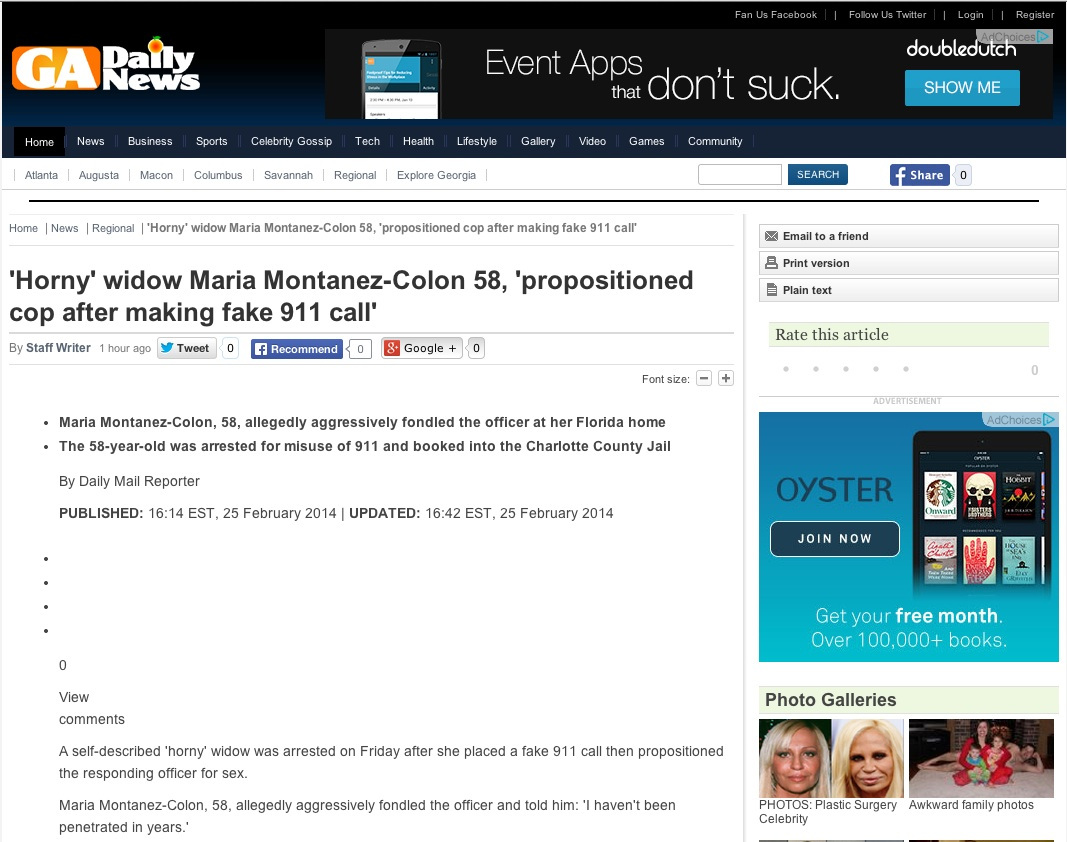
Marshall’s “Exhibit A” is Georgia Daily News, a website which purports to cover “news, traffic, sports, politics, entertainment, gossip and local events in Atlanta.”

As Marshall contends, “What it actually features is content ‘curated’ from elsewhere on the web, and some it has simply stolen from other major news sites” such as the Daily Mail.

Sizable chunks of the website’s content have nothing to do with Atlanta.

GADailyNews home pageConsidering the type of general news site it purports to be, GADailyNews.com doesn’t attract very much traffic at all.  And why would it? — since it contains precious little information of value or interest to anyone who is actually “seeking news about Atlanta.”

But it sure does generate a lot of ad impressions.  According to Marshall, each article page on the site features seven display ad units – all of which refresh every 20 seconds or so.

In the two-minute span of time it took him to read an article about Katy Perry and John Mayer (content copied from an Australian news site), Marshall was served more than 40 ad impressions.

Marshall continues:

“One page has served me nearly 500 ads in just 20 minutes – and I couldn’t stop refreshing them even if I wanted to.”

[And these ads aren’t for B-list advertisers, either.  They’re for brands like American Airlines, Hilton Hotels, Charles Schwaab and others.]

What’s happening here, of course, is that websites and ad tech middlemen have figured out that the algorithms of even the “quality” ad vendors like Google, AdRoll, and Bizo can be gamed pretty easily to serve ads on a low-quality site like Georgia Daily News, which is owned by a single-person entity called Integrated News Media Corporation.

It’s hardly the type of media vehicle that big-brand advertisers would normally wish to use for advertising.  But thanks to the vagaries and complexity of the ad exchange landscape, they are.

For every Georgia Daily News site, there are hundreds of others like it that cobble together seemingly valuable content with a passably convincing set of audience characteristics.

Put it together, and it adds up to problems on two levels.

First, advertisers are paying for impressions that are near-worthless.

Second, since there are finite ad dollars available, legitimate online publishers are losing out on those funds, which are far more important to their well-being than they are for sites that don’t engage in any true journalism at all.

As Jack Marshall concludes:

“Thanks to fraudulent traffic, dubious sites and middlemen with low quality standards, life is only getting harder for those publishers with expensive content teams to support.”

It had to happen: Google Glass begets facial recognition apps.

Google Glass wearerWell, that didn’t take long:  Now that Google Glass devices have started to be worn by more than just the first few early adopters, a new facial recognition app has promptly been developed.

It’s an app that enables users to snap a photo of someone, and then search the Internet for more information about the image – essentially, to identify the person by name.

Of course, Google has always maintained that such activities are an inappropriate use of Google Glass devices.  But that hasn’t stopped an outside app developer from doing just that.

The app is called NameTag, and it was introduced in late 2013 by a developer group known as FacialNetwork.  In December, the developer uploaded a video showing how NameTag works.  You can view it on YouTube here — and note that it’s quite controversial with more “dislikes” than “likes” from voters; how often does that happen?

Basically, the Google Glass wearer snaps a picture and the app runs the photo through a database containing ~2.5 million facial images.  If a match is found, it returns that finding along with the name and profile associated with the facial match (e.g., occupation, personal interests and relationship status).

According to the developers, NameTag can detect an image match even from behind obstructions like glasses and a hat.

What does FacialNetwork see as the benefit of its new NameTag app?  The developer touts the potential for dating and relationship-building.  On its website, the following scenario is presented:

“Jane has lots of different social media profiles and loves to meet new people.  By using NameTag, she can link all her social networks to her face and share her information, and meet new people in an instant.”

Personal privacy concernsRight. 

… And I’m sure “Jane” doesn’t worry one bit about the “creepiness” factor of someone learning her name and her personal information before she’s even aware of it …

As if pre-anticipating all of the hackles, NameTag quickly goes on to explain that people can choose whether to have their name and profile information displayed to others.

As entrepreneur and NameTag’s co-creator Kevin Tussy notes, “It’s not about invading anyone’s privacy; it’s about connecting people that [sic] want to be connected … We will even allow users to have one profile that is seen during business hours, and another that is only seen in social situations.”

If all of this sounds like it’ll be a tad more difficult to carry out in real life than it sounds like in theory – that you’re not fully comfortable “assuming” an app like this will actually offer the proper degree of safeguarding – I’m sure you’re not alone in your concerns.

In fact, some people aren’t waiting around to see what “might” happen, but are moving now to take preemptive action.  Certain congresspeople are in on the action.  And consumer advocacy group Public Citizen notes that Google Glass users in certain states could potentially face criminal prosecution in addition to civil penalties for recording people without their knowledge or consent.

Up to now, no one has faced such legal action – but that could be because the technology remains so new that few people are actually using Google Glass devices at this point.

The question is this:  Are people giving their “implicit consent” to be recorded just by talking with someone who’s wearing the device?  (The devices are fairly distinctive looking, after all.)

The answer may lie in whether the person even knows what Google Glass devices are.  One person speaking to another automatically means they know they’re being recorded seems to assume too much – at least at this relatively early stage in the product adoption cycle.

Things remain murky at this point because we’re still in an emerging phase in the application of the technology.  But one thing that seems clear is that we haven’t yet seen the beginning of what promises to be an airing of “dueling rights” in this area of the law.

For those who may already be using Google Glass (I’m not one, by the way), here’s your chance to share your perspectives with other readers here.

HubSpot’s Marketing Predictions: Hits and Misses

soothsayingOne of the things I like about SaaS inbound marketing firm HubSpot is the steady stream articles and white papers the company publishes on varied facets of marketing and communications. 

They’re often quite meaty and beneficial as informational resources.

Moreover, HubSpot isn’t afraid to go out on a limb and render a pretty strong “point of view” about various factors and trends in the fast-evolving marketing world.

The risk is that some of those perspectives can end up being “off” – or looking even a bit silly – in retrospect. 

But more often than not, HubSpot’s trendspotting is on the money.

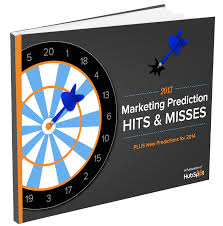
Marketing Prediction Hits & Misses (HubSpot)Here’s a case in point:  HubSpot’s team of analysts made a number of marketing predictions for the year 2013.  Recently, it revisited those predictions to judge whether they’d turned out to be on the mark or not.

These are HubSpot’s 2013 marketing predictions that it feels were on target: 

  • Content and social will matter even more for search engine optimization.
  • Stop-and-start campaigns will fade, and real-time will be ‘in.’
  • E-mail will live on.
  • Inbound marketing will spread enterprise-wide.

At the same time, four other marketing predictions for 2013 didn’t pan out so well, as underscored by HubSpot’s own cheeky editorial commentary about them:

  • Mobile or bust … “Not so hot.”
  • Marketing becomes accountable for revenue generation … “Meh.”
  • ‘Big data’ becomes real for businesses … “Nope.”
  • Print is dead … “Not even close.”

HubSpot’s post-mortem discussion points on these “misses” are interesting.  Quoting from its report:

  • Mobile or bust:  “Customers pay attention to multiple screens … and smart marketers capture attention by adding value wherever a consumer pays attention  … we need to be prepared, not by targeting just [mobile] but by embracing them all according to our specific customers and data.”
  • Marketing becomes accountable for revenue generation:  “The biggest challenge … has been proving ROI.       Even more frustrating … has been the lack of sales and marketing alignment in many companies.  Tracking can also get tricky, thanks to trying to reach fragmented digital audiences against so many channels … As much as lots of us really want this prediction to be a hit, it’s still largely aspirational.”
  • ‘Big data’ becomes real:  “Big data remains mainly a buzzword to many companies and markets — and continues to be more of a prediction than a reality …”
  • Print is dead:  “Saying ‘print is dead’ has lost pretty much all of its roots in reality … nor will it die in the next few years.”

Ever intrepid, HubSpot isn’t shying aware from new forecasts for 2014.  Looking forward, what do its analysts predict for this year?

  • Podcasting will continue to grow substantially.
  • Marketing departments will become more like engineering departments.
  • Social listening tools will gain context and get smarter.
  • The economy will become highly collaborative.
  • Marketers will become more holistic and less channel-focused.

And one more HubSpot prediction that’s a particular favorite of mine:

We’ll check back again a year from now to see how well HubSpot’s prognosticators fared this time around.

What types of word terms perform best in social media?

Words that sell in social mediaEver since the rise of social media platforms, marketers have wondered if the terms and phrases that generate the best response in direct marketing also perform as well in the social arena.

One reason why:  There have been plenty of experts emphasizing how consumers don’t wish to be “sold” in their social interactions, but instead prefer to develop a relationship of give-and-take with brands.

Dan Zarrella, Social Media Scientist at HubSpot

Now we have some empirical analysis to guide us, conducted by Dan Zarrella, a social media scientist at SaaS inbound marketing firm HubSpot based on reviewing ~200,000 links containing tweets.

Mr. Zarrella found that the tweets that contain more verbs and adverbs experience higher clickthrough rates than noun- and adjective-heavy tweets.

Zarrella’s research also found that when social media posts ask for an explicit action on the part of the recipient, that tends to increase clicks and engagement.

For instance, retweets are three times more likely to happen when people are specifically requested to do so.

Interestingly, the most “retweetable” words in the HubSpot analysis turn out to be the same terms that do well in e-mail marketing and other forms of direct marketing:

  • You
  • Please
  • Post
  • Blog / Blog Post
  • Free
  • Media
  • Help
  • Great
  • How To
  • Top
  • Check Out

In a parallel research endeavor, a recent evaluation of blog posts by writer and software analytics specialist Iris Shoor reveals how much a post’s title impacts on the volume of “opens.”

In her analysis, Ms. Shoor studied posts on 100 separate blogs, using an evaluation technique that rank-sorted blog posts from the most read to the least shared.

What were the words that resulted in the most opens?  Shoor calls them the “blood in the water” terms:

  • bleeds leadsKill
  • Fear
  • Dark
  • Bleeding
  • War
  • Dead
  • Fantasy

Translation?  Negative terms are more powerful for shares than more ordinary terms (e.g., positive ones).

It’s very much like the old adage in the newspaper world:  “If it bleeds, it leads.”

That’s another takeaway from the most recent research:  What’s worked in the offline world over the years appears to be working very much the same way in the online space today.

Plus ça change, plus c’est la même chose …

Marketers Give Themselves Only Middling Grades on Understanding ROI

Marketing frustrationIt turns out that even the practitioners in the marketing field don’t think they’re doing a very good job of understanding the return on investment on key marketing tactics.

That’s a major takeaway fnding from the most recent State of Search Marketing survey conducted by digital marketing information clearinghouse Econsultancy in conjunction with the Search Engine Marketing Professional Organization (SEMPO).

This survey of industry professionals is conducted annually.  The 2013 research cycle queried ~400 industry and marketing/communications agency professionals.

One would think that in an evolving field like digital marketing, the degree of collective skill in the discipline would be rising over time.  But the opposite appears to be the case – at least in terms of the professionals’ own self-assessment of their skills.

The SEMPO research report presents how marketers consider their level of understanding to be in terms of ROI factors.

What the research reveals is a pretty stark decline in self-assessment grades between the 2012 and 2013 surveys:

  • Understanding of paid search ROI:  ~47% consider their understanding to be “good” (down from ~79%)
  • Email communications ROI:  ~41% consider good (down from ~57%)
  • Digital display media ROI:  ~28% consider good (down from ~37%)
  • Social media ROI:  ~11% consider good (down from ~15%)

What’s the reason for the decline in these self-assessment ratings?

It could be ever-changing definitions of what each of these marketing tactics actually encompass.

… It may be that there is an actual decline in overall proficiency as more people are assigned these marketing tasks who have little or no relevant knowledge or prior training.

… Or if could be the rapid speed in which technology is evolving in the marketing sphere.  (Big data isn’t the half of it.)

Of the major marketing tactics addressed by the Econsultancy/SEMPO research, it’s clear that social media and mobile are the most mystifying to practitioners, judging from the percentage of survey respondents that profess to have a “poor” understanding of their ROI:

  • Social media ROI:  ~51% report having a “poor” understanding
  • Mobile marketing ROI:  ~35%
  • Search engine optimization ROI:  ~28%
  • Digital display advertising ROI:  ~26%
  • Paid search ROI:  ~19%
  • Email marketing ROI:  ~14%

Underscoring the admitted lack of understanding about ROI in social and mobile channels, the survey respondents reported that only ~11% of the digital marketing dollars in 2014 will be allocated to social media.

For mobile marketing, it’s even lower (~3% of the marketing budget).

This isn’t to imply that marketers don’t recognize the importance of these tactics.  For instance, more than eight of ten respondents consider mobile marketing to be a significant development in the field.

It’s just that many of them are having great difficulty going from Point A to Point B when it comes to quantifying the marketing payback.

[For access to the full report, which also provides interesting insights on the most popular marketing metrics, go to this page on the SEMPO website.]

Fake online product reviews: How pervasive are they?

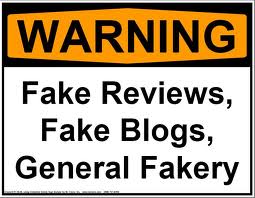
Fake reviewsThink about those reviews that mean so much to you when considering whether to purchase a particular product or a service …

It could be that the comments you’re reading are bogus – or at least not based on the reviewer’s first-hand experience.

An online survey of nearly 1,200 U.S. adults age 18 and older, conducted by marketing research firm YouGov in January 2014, found that more than one in five respondents admitted to having posted online reviews about products or services they hadn’t actually bought or used.

The percentage is somewhat higher for men (~23%) than it is for women (~17%).

Why do people post reviews or comments on products and services they haven’t tried?  Here’s what the survey respondents reported:

  • “Just felt like it”:  ~32% gave this reason
  • “Didn’t like the idea of the product”:  ~22%
  • “Didn’t like the manufacturer”:  ~19%

These stats might suggest that there are more “negative” reviews being posted online than what reflects the actual experience with the product or service.

But the YouGov survey also found that far more people leave good reviews than bad ones:

  • ~57% have left a mixed review
  • ~54% have left a good review
  • Only ~21% have ever left a bad review

What drives someone to leave a bad review?  The #1 reason is obvious … but the #2 reason might surprise you.  And the #3 reason is just mercenary:

  • ~88% want to warn others about a disappointing product or service
  • ~23% believe that venting their frustrations will leave them feeling less angry
  • ~21% are hoping to get a refund or some other monetary consideration from the company in question

The veracity of online reviews is important because the vast majority of adult consumers check them before deciding to purchase a product or service.

This YouGov survey is no different:  It found that ~79% consult reviews at least sometimes … and ~26% reported that they “always” check reviews before buying a product or service.

FakeryThe YouGov report comes hard on the heels of a Virginia lawsuit wherein a carpet cleaning service charged online review website Yelp with publishing negative reviews posted by people who had never been customers of the store.  The cleaning service claimed that the negative reviews had hurt its business.

In that case, a judge ordered Yelp to reveal the identities of the seven “anonymous” reviewers — who I’m sure never thought their “unidentified antics” would ultimately be revealed for all the world to see.

It may just be that posting a “faux” review has now become a little riskier.

People may think twice now before engaging in their little mischief.  I’m sure most of them can think of a lot better things to do than to be hauled into court for an alleged infraction like that — or at the very least, having their name brought into the legal proceedings.

Boston Consulting Group predicts “the end of consumer marketing as we have long known it.”

Boston Consulting Group recently conducted a survey of American consumers to see how their spending habits and approach to brands differs by age group.

Millennials GenXers Baby BoomersThe results give us a quantifiable measure of the differences in outlook between three major age groups:  Millennials (age 18 to 34), Gen-Xers (age 35 to 49), and Baby Boomers and older consumers (age 50 and up).

The survey findings led BCG researchers to declare that Millennials’ perspectives are characterized by a “reciprocity principle.”  By this, they mean that these younger consumers expect “mutual relationships” with companies and their brands.

This isn’t so very surprising considering the ability of the Internet and social media platforms to provide an easy platform for airing their opinions.

A positive brand experience may prompt consumers to take favorable “public” action on behalf of the brand.

A disappointing experience most assuredly will prompt vocal criticism via product or service reviews, social media, blog posts, and leaving comments.

digital-multitaskingAnd the juicier the commentary, the more likely it is to go viral.

The BCG survey found that younger consumers are far more prone to participate in the world of “reciprocity.”

The differences were pretty dramatic when asking respondents in the different age groups whether they agreed with certain statements:

“Brands identify who I am, and my values.”

  • Millennials:  ~44% agree
  • Gen-Xers:  ~38%
  • Boomers and older:  ~33%

“People seek me for knowledge and brand opinion.”

  • Millennials:  ~51% agree
  • Gen-Xers:  ~42%
  • Boomers and older:  ~34%

“I’m willing to share my brand preferences online or on social media.”

  • Millennials:  ~55% agree
  • Gen-Xers:  ~43%
  • Boomers and older:  ~28%

Evaluating the survey findings, the BCG report posits that Millennials are “the leading indicators of large-scale changes in consumer behavior.”

Rather dramatically, BCG also concludes that this particular generational transition is “ushering in the end of consumer marketing as we have long known it,” and that the linear framework companies have used for decades to manage brand image and engagement is headed out the window.

“… Marketers must embrace the reality that marketing is an ecosystem of multidirectional engagement rather than a process that is controlled and pushed by the company,” the BCG report states.

My personal view is that the Boston Consulting Group’s conclusions are probably on-target … but the question is the degree.

I don’t think many major brands are going to simply cede control of their marketing and messaging to the cyberspace or the social cloud.  They’ve worked too long and too hard on their brand image and identity to give up that easily.

For more on the survey findings and conclusions, here’s BCG’s summary article.

Take Your Pick: One Super Bowl Ad Spot … or 14 Billion Facebook Ad Impressions

Super Bowl Ad Cost


This year a single 30-second ad spot during the Super Bowl TV broadcast will cost a cool $4 million.

And that’s just for the placement alone — not the dollars that go into producing the ad.

The high cost of advertising is directly related to Super Bowl viewership, of course, which is predicted to be north of 100 million people this year.

Still, $4 million is a really hefty sum, even for major brand advertisers.  Just how big is underscored in some comparative figures put together by Jack Marshall, a reporter at marketing e-zine Digiday.

Jack Marshall
Digiday’s Jack Marshall

In lieu of spending $4 million on a single ad spot, here’s how Marshall reported that the promotional money could be spent in alternative ways:

  • 14 billion Facebook Ad Impressions – According to digital marketing software firm Kenshoo, right-hand column “marketplace” ads on Facebook averaged 27 cents per thousand impressions during 2013.  This means that for $4 million, an advertiser could run a Facebook marketplace ad every second of every day for the next 469 years.
  • 3 billion Banner Ad Impressions – In 2013, average online display ad CPMs were running just shy of $1.30, looking globally.  Applying that figure to the U.S. market translates into 3 billion display ad impressions for your $4 million spend.
  • 160 million Sponsored Content Views – The typical charge is ~$25 to distribute sponsored content to 1,000 readers.  At that rate, $4 million would give you 160 million impressions (provided a publisher could actually deliver that many!).
  • 10.8 million Paid Search Clicks – With an overall average cost-per-click of 37 cents in 2013, $4 million would cover just shy of 11 million clicks.  That may be one-tenth the size of the Super Bowl viewing audience … but at least your audience would be actually searching for your product or service instead of heading to the kitchen for more corn chips and queso dip.

These are just some of the comparative figures outlined by Jack Marshall in his article.  You can read the others here.