Social Branding: Reality-Check Time

social brandingWith all of the attention marketers have been paying to social media, it’s always helpful to look and re-look at information that gives us clues as to how customers are actually interfacing with brands in the social sphere.

Statistics published in a just-released report titled Digital Brand Interactions Survey, based on research conducted by web content management company Kentico Software, gives us a reality check on just how [non-]essential social media actually is in the greater branding picture.

The Kentico research queried approximately 300 American consumers age 18 or older via an online survey administered in February 2014.  Let’s start with the most basic finding:  the degree to which consumers “like” or “follow” brands on social networks such as Twitter, Facebook and Instagram:

  • No brands followed on social media:  ~40%
  • 1 to 10 brands followed:  ~39%
  • 11 to 20 brands followed:  ~7%
  • 21 to 30 brands followed:  ~6%

Considering how many different brands the typical consumer encounters in his or her daily life (dozens? … hundreds?), following ten or fewer brands on social media represents only a very small proportion of them.

Yet that’s exactly where four in five consumers are when it comes to social branding.

So … how do companies get into that rarefied group of brands that are, in fact, followed by consumers?  Here’s what the Kentico survey discovered:

  • Already interested in the brand and wanted to stay informed:  ~40%
  • Followed on social media to receive special offers:  ~39%
  • Followed because of a recommendation from a friend or family member:  ~12%
  • Didn’t really know the brand before, but wanted to learn more about it:  ~8%

These results suggest that the notion that social branding is an easy way to attract new customers may be flawed.  Instead, social branding is better-suited to deepening brand engagement with existing customers.

Money talks as well (discounts or other special offers) – and be sure to offer them often.

kentico logoIn another piece of evidence that points to social branding’s relatively weak ability to drive incremental sales … Kentico found that ~72% of its survey respondents “never” or “hardly ever” purchase a product after hearing about it on a social network.

An equal percentage of respondents have “never” or “hardly ever” had brand encounters online that altered their already-existing perception of those brands.

So it would seem that much of the “heat” generated by social branding may be adding up to very little “light.”

On the other hand, there is also some good news for brands in the social realm:  The incidence of people “unliking” or “unfollowing” brands is quite low:  Only about 5% of the survey respondents reported such actions.

When that does happen, it’s often because a brand has been publishing too many social posts – or the content of the posts themselves is uninteresting.

The biggest takeaway notion from the Kentico research is to remind us to maintain a degree of skepticism about the impact of social branding – and to understand that in most cases, social media activities are going to remain the “ornaments” on the marketing tree rather than be the “tree” itself.

In fact, that’s probably the case even more now — as consumers become bombarded with ever-more marketing messages from ever-more brands with every passing day.

HubSpot’s Marketing Predictions: Hits and Misses

soothsayingOne of the things I like about SaaS inbound marketing firm HubSpot is the steady stream articles and white papers the company publishes on varied facets of marketing and communications. 

They’re often quite meaty and beneficial as informational resources.

Moreover, HubSpot isn’t afraid to go out on a limb and render a pretty strong “point of view” about various factors and trends in the fast-evolving marketing world.

The risk is that some of those perspectives can end up being “off” – or looking even a bit silly – in retrospect. 

But more often than not, HubSpot’s trendspotting is on the money.

Marketing Prediction Hits & Misses (HubSpot)Here’s a case in point:  HubSpot’s team of analysts made a number of marketing predictions for the year 2013.  Recently, it revisited those predictions to judge whether they’d turned out to be on the mark or not.

These are HubSpot’s 2013 marketing predictions that it feels were on target: 

  • Content and social will matter even more for search engine optimization.
  • Stop-and-start campaigns will fade, and real-time will be ‘in.’
  • E-mail will live on.
  • Inbound marketing will spread enterprise-wide.

At the same time, four other marketing predictions for 2013 didn’t pan out so well, as underscored by HubSpot’s own cheeky editorial commentary about them:

  • Mobile or bust … “Not so hot.”
  • Marketing becomes accountable for revenue generation … “Meh.”
  • ‘Big data’ becomes real for businesses … “Nope.”
  • Print is dead … “Not even close.”

HubSpot’s post-mortem discussion points on these “misses” are interesting.  Quoting from its report:

  • Mobile or bust:  “Customers pay attention to multiple screens … and smart marketers capture attention by adding value wherever a consumer pays attention  … we need to be prepared, not by targeting just [mobile] but by embracing them all according to our specific customers and data.”
  • Marketing becomes accountable for revenue generation:  “The biggest challenge … has been proving ROI.       Even more frustrating … has been the lack of sales and marketing alignment in many companies.  Tracking can also get tricky, thanks to trying to reach fragmented digital audiences against so many channels … As much as lots of us really want this prediction to be a hit, it’s still largely aspirational.”
  • ‘Big data’ becomes real:  “Big data remains mainly a buzzword to many companies and markets — and continues to be more of a prediction than a reality …”
  • Print is dead:  “Saying ‘print is dead’ has lost pretty much all of its roots in reality … nor will it die in the next few years.”

Ever intrepid, HubSpot isn’t shying aware from new forecasts for 2014.  Looking forward, what do its analysts predict for this year?

  • Podcasting will continue to grow substantially.
  • Marketing departments will become more like engineering departments.
  • Social listening tools will gain context and get smarter.
  • The economy will become highly collaborative.
  • Marketers will become more holistic and less channel-focused.

And one more HubSpot prediction that’s a particular favorite of mine:

We’ll check back again a year from now to see how well HubSpot’s prognosticators fared this time around.

What types of word terms perform best in social media?

Words that sell in social mediaEver since the rise of social media platforms, marketers have wondered if the terms and phrases that generate the best response in direct marketing also perform as well in the social arena.

One reason why:  There have been plenty of experts emphasizing how consumers don’t wish to be “sold” in their social interactions, but instead prefer to develop a relationship of give-and-take with brands.

Dan Zarrella, Social Media Scientist at HubSpot

Now we have some empirical analysis to guide us, conducted by Dan Zarrella, a social media scientist at SaaS inbound marketing firm HubSpot based on reviewing ~200,000 links containing tweets.

Mr. Zarrella found that the tweets that contain more verbs and adverbs experience higher clickthrough rates than noun- and adjective-heavy tweets.

Zarrella’s research also found that when social media posts ask for an explicit action on the part of the recipient, that tends to increase clicks and engagement.

For instance, retweets are three times more likely to happen when people are specifically requested to do so.

Interestingly, the most “retweetable” words in the HubSpot analysis turn out to be the same terms that do well in e-mail marketing and other forms of direct marketing:

  • You
  • Please
  • Post
  • Blog / Blog Post
  • Free
  • Media
  • Help
  • Great
  • How To
  • Top
  • Check Out

In a parallel research endeavor, a recent evaluation of blog posts by writer and software analytics specialist Iris Shoor reveals how much a post’s title impacts on the volume of “opens.”

In her analysis, Ms. Shoor studied posts on 100 separate blogs, using an evaluation technique that rank-sorted blog posts from the most read to the least shared.

What were the words that resulted in the most opens?  Shoor calls them the “blood in the water” terms:

  • bleeds leadsKill
  • Fear
  • Dark
  • Bleeding
  • War
  • Dead
  • Fantasy

Translation?  Negative terms are more powerful for shares than more ordinary terms (e.g., positive ones).

It’s very much like the old adage in the newspaper world:  “If it bleeds, it leads.”

That’s another takeaway from the most recent research:  What’s worked in the offline world over the years appears to be working very much the same way in the online space today.

Plus ça change, plus c’est la même chose …

Fake online product reviews: How pervasive are they?

Fake reviewsThink about those reviews that mean so much to you when considering whether to purchase a particular product or a service …

It could be that the comments you’re reading are bogus – or at least not based on the reviewer’s first-hand experience.

An online survey of nearly 1,200 U.S. adults age 18 and older, conducted by marketing research firm YouGov in January 2014, found that more than one in five respondents admitted to having posted online reviews about products or services they hadn’t actually bought or used.

The percentage is somewhat higher for men (~23%) than it is for women (~17%).

Why do people post reviews or comments on products and services they haven’t tried?  Here’s what the survey respondents reported:

  • “Just felt like it”:  ~32% gave this reason
  • “Didn’t like the idea of the product”:  ~22%
  • “Didn’t like the manufacturer”:  ~19%

These stats might suggest that there are more “negative” reviews being posted online than what reflects the actual experience with the product or service.

But the YouGov survey also found that far more people leave good reviews than bad ones:

  • ~57% have left a mixed review
  • ~54% have left a good review
  • Only ~21% have ever left a bad review

What drives someone to leave a bad review?  The #1 reason is obvious … but the #2 reason might surprise you.  And the #3 reason is just mercenary:

  • ~88% want to warn others about a disappointing product or service
  • ~23% believe that venting their frustrations will leave them feeling less angry
  • ~21% are hoping to get a refund or some other monetary consideration from the company in question

The veracity of online reviews is important because the vast majority of adult consumers check them before deciding to purchase a product or service.

This YouGov survey is no different:  It found that ~79% consult reviews at least sometimes … and ~26% reported that they “always” check reviews before buying a product or service.

FakeryThe YouGov report comes hard on the heels of a Virginia lawsuit wherein a carpet cleaning service charged online review website Yelp with publishing negative reviews posted by people who had never been customers of the store.  The cleaning service claimed that the negative reviews had hurt its business.

In that case, a judge ordered Yelp to reveal the identities of the seven “anonymous” reviewers — who I’m sure never thought their “unidentified antics” would ultimately be revealed for all the world to see.

It may just be that posting a “faux” review has now become a little riskier.

People may think twice now before engaging in their little mischief.  I’m sure most of them can think of a lot better things to do than to be hauled into court for an alleged infraction like that — or at the very least, having their name brought into the legal proceedings.

Boston Consulting Group predicts “the end of consumer marketing as we have long known it.”

Boston Consulting Group recently conducted a survey of American consumers to see how their spending habits and approach to brands differs by age group.

Millennials GenXers Baby BoomersThe results give us a quantifiable measure of the differences in outlook between three major age groups:  Millennials (age 18 to 34), Gen-Xers (age 35 to 49), and Baby Boomers and older consumers (age 50 and up).

The survey findings led BCG researchers to declare that Millennials’ perspectives are characterized by a “reciprocity principle.”  By this, they mean that these younger consumers expect “mutual relationships” with companies and their brands.

This isn’t so very surprising considering the ability of the Internet and social media platforms to provide an easy platform for airing their opinions.

A positive brand experience may prompt consumers to take favorable “public” action on behalf of the brand.

A disappointing experience most assuredly will prompt vocal criticism via product or service reviews, social media, blog posts, and leaving comments.

digital-multitaskingAnd the juicier the commentary, the more likely it is to go viral.

The BCG survey found that younger consumers are far more prone to participate in the world of “reciprocity.”

The differences were pretty dramatic when asking respondents in the different age groups whether they agreed with certain statements:

“Brands identify who I am, and my values.”

  • Millennials:  ~44% agree
  • Gen-Xers:  ~38%
  • Boomers and older:  ~33%

“People seek me for knowledge and brand opinion.”

  • Millennials:  ~51% agree
  • Gen-Xers:  ~42%
  • Boomers and older:  ~34%

“I’m willing to share my brand preferences online or on social media.”

  • Millennials:  ~55% agree
  • Gen-Xers:  ~43%
  • Boomers and older:  ~28%

Evaluating the survey findings, the BCG report posits that Millennials are “the leading indicators of large-scale changes in consumer behavior.”

Rather dramatically, BCG also concludes that this particular generational transition is “ushering in the end of consumer marketing as we have long known it,” and that the linear framework companies have used for decades to manage brand image and engagement is headed out the window.

“… Marketers must embrace the reality that marketing is an ecosystem of multidirectional engagement rather than a process that is controlled and pushed by the company,” the BCG report states.

My personal view is that the Boston Consulting Group’s conclusions are probably on-target … but the question is the degree.

I don’t think many major brands are going to simply cede control of their marketing and messaging to the cyberspace or the social cloud.  They’ve worked too long and too hard on their brand image and identity to give up that easily.

For more on the survey findings and conclusions, here’s BCG’s summary article.

SoLoMo: The Newest Buzz Term in Marketing Communications

solomoEvery few years or so, we start hearing a pithy (and sometimes obnoxious) new buzz term in marketing communications.

The most recent entry into the lexicon is SoLoMo – a cutesy amalgam of three terms:  Social Media, Location, and Mobile Devices.

SoLoMo purports to convey the convergence of these three elements into a powerful new driver for marketing:  sparking audience engagement and brand usage via the use of social media, and targeting consumers via their mobile devices when they are locationally proximate.

businesspersonBeyond the inevitable “wink-wink, nudge-nudge” aspects of this term and the “oh-so relevant” connotation it has for those who choose to name-drop it in casual conversation, another drawback I see is the term’s emphasis on tactics rather than on the true meaning of today’s always-connected customers and the potential this offers for relationship-building.

Right now, there are more than a few company and brand marketers who are trying to figure out the best way to have their customers do all sorts of things that will benefit a product’s acceptance and position in the market — things like checking in to a physical location, then taking a mobile picture and uploading it to an Instagram or Facebook page.

This over-reliance on “shiny new object tactics” is what gets marketers to the same place as designing a new and novel app that doesn’t actually fill a true need – and hence becomes an inglorious failure.

Here’s what’s actually going on with consumers today:

  • They have more digital connections available to them than ever before.
  • Because of the pervasiveness of interactivity, consumers expect information to be available to them at any time – and on any device.

The good news is that marketers can establish just these sorts of connections with consumers, simply by using the very same social platforms.  The bigger challenge is making those connections meaningful and relevant.  That’s where effectiveness so often falls by the roadside.

Social media is an “ism” to many marketers … whereas to regular people, they hardly think of it that way.  For them, it’s just another way to engage in their relationships with friends, acquaintances, industry colleagues, fellow hobbyist … and favorite brands.  Other than the digital aspect of the communication, there’s really very little difference from the connections people have established and maintained for years the old-fashioned way.

Location is much more than simply where someone happens to be.  It’s the context of understanding when — and what — the person is doing at or near that location.  Knowing that makes for a more relevant – and potentially profitable — interactions.

Today’s focus on Mobile everything has become almost as myopic as marketers’ tunnel-focus on desktops was a few years back.  Today, we’re dealing with consumers who are perpetually connected.  As for which device, it simply depends on what’s handy at the moment – desktops, laptops, tablets, smartphones.  So, strategies and tactics that focus on one or two of these to the exclusion of the others will fall short of the mark.

While we can give an acknowledging nod to the SoLoMo buzz term, the key is to recognize that it’s actually about today’s perpetually connected consumers — and all of the expectations that come along with that.

In other words, marketers need to be people-focused … but tactics-agnostic.

Twitter’s “Potemkin Village Problem” Isn’t Getting Any Better

“Millions of fake accounts dog Twitter.”

“Twitter dogged by bogus accounts.”

social-media-inflated-statsI’ve blogged before about the scads of Twitter accounts that are accounts in name only.

It’s been a problem for years.

But now, it takes on even greater significance as the market valuation of Twitter is being measured in the tens of billions as the company issues publicly traded stock in its IPO.

To this end, I found a recent Wall Street Journal article penned by technology reporter Jeff Elder particularly interesting in that it pulls together various pieces of evidence that have been building … and which together showcase the extent of Twitter’s “Potemkin Village” problem.  (Note the headlines from this article displayed above.)

Essentially, the problem is a plethora of “faux” Twitter accounts being created by an underground network of sellers – including 20 or so major operations scattered around the world – that then offer these accounts for sale to companies and brands wishing to “juice” their Twitter follower statistics to appear more consequential than they actually are.

Consider these points from Mr. Elder’s article:

  • Faux accounts abound on Twitter because users aren’t limited to having a single account – nor are they required to use their real names.
  • In securities filings, Twitter claims that “fake” accounts represent fewer than 5% of its active user accounts.
  • But this past summer, security researchers Andrea Stroppa and Carlo de Micheli reportedly uncovered more than 20 million fake accounts for sale on Twitter – which is closer to 10% of Twitter’s active account base.  (Twitter had no comment on this report.)
  • Stroppa and de Micheli also unearthed the existence of software programs that allow spammers to create unlimited fake accounts on Twitter.  (Twitter had no comment on this report.)

Evidently, Twitter has taken stabs at reducing fakery among its account base — however sporadically.

About a year ago, the company reportedly worked with a team of researchers from UC Berkeley and George Mason University to identify fake Twitter accounts and minimize “robot” activity.  This was done by actually purchasing fake Twitter accounts on the black market and then identifying their common characteristics.

A filter subsequently developed was then able to block ~95% of such accounts – but it was only a matter of days before the underground market figured out ways to get around the new filters.

Within two short weeks, the filters were successfully blocking only about 50% of new fake Twitter accounts, and that percentage has continued to decline further since then.

And these faux accounts are available for a ridiculously small amount of money.  For instance, this past November one marketer purchased 1,000 accounts from an online vendor located in Pakistan … for a whopping $58.

This marketer then programmed them to “follow” the Twitter account of a rap artist client who was interested in boosting his standing on the social network.

In addition, those same accounts have been used to retweet the rapper’s own tweets, thereby giving them greater exposure on Twitter.

And believe it or not, this sort of ruse often works, because prominence on Twitter can lead to legitimate attention by an unwitting press and other “influencers.”

But it’s all blue smoke and mirrors, of course.

The downside?  As more of these stories get reported and shine a light on the seedy underside of the Twittersphere, it can’t help but have a negative impact on the social platform’s reputation.

… Beginning with people like you and me.

Customer testimonials and user reviews: Social media takes a time-honored marketing tactic … and puts it on steroids.

product and service ratingsThere’s no question that most people value hearing the opinions of others when deciding whether to purchase a new product.

But in the fast-evolving world of social media where there’s been an exponential increase in testimonials, ratings and recommendations about various products and services, what types of recommendations resonate most?

We may have some answers to that question in results from a recent survey sponsored by marketing firm Social Media Link, which was issued in October to all members within the company’s Smiley360 community brand activation program.

Dubbed the “Social Recommendation Index,” the 20-question online survey was answered by more than 10,300 respondents.

The survey isn’t exactly a true cross-section of American consumers in that the vast majority of the respondents were women.  Moreover, most respondents were between the ages of 25 and 45.  Still, the results are certainly worth a look.

For starters, three-fourths of the respondents stated that fewer than 10 reviews are all that they need to make a purchase decision.

Moreover, the most valuable reviews tend to be the ones that include personal stories, rather than a laundry list of product benefits.

By contrast, “star” ratings are the least influential type of review by far:  Only ~15% of respondents report that those ratings are the most important way to influencing their purchase decisions.

The degree of impact of a product review also depends on who’s doing the reviewing:

  • 86% cite reviews by friends and family members as having the  biggest impact
  • 39% are influenced by blogger reviews 
  • Only 11% report that celebrity reviews have the most impact

I’m not at all surprised about the paltry figure for celebrities.  Celebrity endorsements in general are far less influential than many marketers would like to admit – a topic I’ve blogged about in the past.

"It's OK.  Your cousin Merlin also likes the product!"
“It’s OK. Your cousin Merlin also likes the product!”

Considering that “friends and family” are the most influential reviewers, it also comes as little surprise that survey respondents view Facebook as the most trusted of all the major social platforms:

  • Facebook:  ~68% consider highly trustworthy
  • Pinterest:  ~56%
  • YouTube:  ~51%
  • Twitter:  ~41%

Commenting on the research conclusions, Social Media Link’s CEO Susan Frech stated this:  “The survey found that people don’t need hundreds of recommendations and reviews to entice purchase; it’s really about receiving a quality message from a trusted source.”

Click here to view an infographic summarizing the Social Recommendation Index key findings.

What about you?  Is your view different from what’s been reported in this study?  If so, please share your observations with other readers here.

Where do people spend their time online?

How much time to people spend online ... and doing what?With the ever-growing options for where people spend their time when online, what’s the latest in terms of their online behaviors?

That’s the question The Buntin Group, a MarComm and branding agency, and Survey Sampling International (SSI) were trying to answer when they conducted a survey of American web users in May 2013. 

The survey was conducted among adults who use at least two tech platforms (including e-mail, text or social) to connect with others during a given week.

What the survey found is that Americans are spending more time than ever online – about 23 hours per week on average.  That’s nearly a full day out of a seven-day week.

Drilling down further, the survey found that e-mail communications continues to be the most prevalent online activity, but it’s followed closely by Facebook:

  • Average time per week spent on e-mail communications:  7.8 hours
  • Average time spent on Facebook:  6.8 hours
  • Average time spent on YouTube:  5.0 hours
  • Average time on Google+:  4.3 hours
  • Average time on Twitter:  4.2 hours

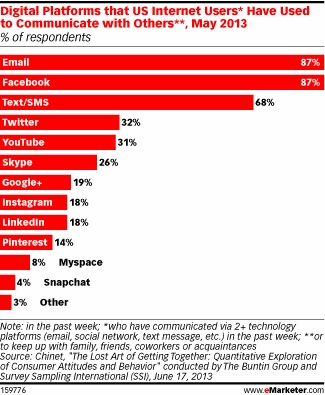
In keeping with these findings, the survey also found that e-mail and Facebook are where most respondents log in most often to communicate with others:

Social Platforms used by Internet Users

But here’s another interesting finding from the survey:  From time to time, even the most digitally connected people find themselves fatigued by all of their online activity.

In fact, nearly 55% of the survey respondents reported that they had “walked away from technology at least occasionally” in the past year to gain more in-person time.

An even larger ~62% reported that they plan to reduce their “tech socializing time” in the upcoming year and instead focus on more face-to-face interaction.

Speaking personally, e-mail and YouTube are indispensable to me.  Facebook is a “nice to have” platform when it comes to keeping up with friends and family — and I usually check in once a day.  But I have gone as long as two weeks without logging on and haven’t felt worse for it. 

I spend far less time on Twitter than the survey average … and I don’t even have a Google+ account (nor do I have any plans to set one up).

What about you?  Based on your experience, does 23 hours of online activity weekly seem excessive – or close to the mark? 

Do you take “online vacations” periodically?  And which online activities are most important and valuable to you?  Please share your thoughts here.