More B-to-B Web Behavior Findings from Optify

Optify logoThis is my second post on the very interesting findings from Optify’s analysis of the behavior of visitors to business-to-business websites during 2012.

[Refer to my earlier post for a quick overview of salient “top-line” results.]

As part of its analysis, Optify uncovered some interesting factors pertaining to “organic” web searches, which represent ~41% of all visits to B-to-B websites.  Here’s what stands out in particular:

  • Forget all of the talk about Bing/Yahoo taking a bite out of Google on the search front. Optify found that Google is responsible for nearly 90% of all organic search activity in the B-to-B realm, making it the #1 referring source of traffic – and it isn’t even close.  (Bing’s coming in at a whopping ~6% of the search traffic.)
  • Organic search visits from Bing do show slightly better engagement rates in the form of more page views per visit, as well as better conversion rates (e.g., filling out a form). But with such low referring traffic to begin with, it’s fair to say that Google was — and remains — the cat’s meow when it comes to organic search.
  • “Branded” searches – ones that include the name of the company – account for nearly one-third of all visits from organic search. Plus, they show the highest engagement levels as well: ~3.7 page views per visit on average.

Optify notes a few clouds on the horizon when it comes to evaluating the success of a company’s organic search program. Ever since Google introduced its “blocked search data” securred socket layer (SSL) option (https://google.com), the incidence of blocked referring keyword data has increased rapidly:

  • Block referring keyword data now represents over 40% of all search queries.
  • Non-branded keywords that are known (and thus available for analysis) have dropped to just 35% of all organic searches.

Here’s the bad news:  As blocked keyword searches continue to grow in popularity – and who wouldn’t choose this option when it’s so easy and readily available – it’s creating a veritable “data oblivion” confronting marketers in their attempts to analyze and improve their SEO performance.

In a subsequent blog post, I’ll summarize key findings from Optify pertaining to paid search (SEM) and social media in the B-to-B realm.

Charting e-mail read rates. (Correction: non-read rates.)

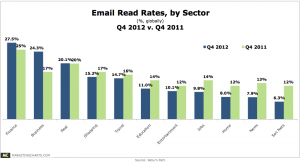
E-Mail Read Rates (Open Rates), Return Path, 4th Quarter 2012One of the great things about e-mail marketing is the ability to track nearly everything about its success (or lack thereof).

A recent Return Path Intelligence Report on e-mail statistics covering the 4th Quarter of 2012 is a case in point. Return Path conducts these studies by monitoring data from thousands of e-mail campaigns that utilize its delivery platforms.

Specifically, the  study tracks the inbox, blocking and filtering rates for more than 400,000 campaigns that use Return Path’s Monitor and Email Client Monitor suites, along with panel data from the company’s Inbox Insight program.

For the 4th study, Return Path reviewed nearly 250 ISPs in North and South America, Europe, Asia and Australia.

And what does its most recent study find? Fewer than one in five e-mails (17%) were opened. And that rate is slightly lower than what was recorded in the 2011 4th Quarter study.

However, some business sectors performed substantially better than the average:

  • Finance sector: ~28% open (read) rate
  • Business sector: ~24%
  • Real estate sector: ~20%

Shopping e-mails fared less well, with a read rate of ~15% (down from ~17% the previous year).

E-mail open rates in the education (~11%) and entertainment (~10%) fields were lower still.

And the worst sectors? News sector e-mails had an average open rate of only ~8%, while social networking e-mails fared even worse at ~6%.

Moreover, both of these bouncing-in-the-basement sectors experienced very significant drop-offs from the previous year, underscoring how they continue to struggle in their efforts to be interesting and relevant to readers.

For those who wish to view additional results and analysis, the Return Path report is available here.  It’s a free download.

No big deal after all: High-flying “Daily Deal” companies crash to earth.

Groupon hits the skidsI’ve blogged before about the rapid rise of so-called “daily deal” online coupon companies. But from the get-go, there were nagging questions about the long-term viability of these social couponing programs. One particularly foreboding indication was how few vendors return after trying their first campaign.

… Something about making money (or not) on these deals and whether (or not) couponers would become repeat customers.

A bit more time has gone by since that blog post, and today the news about daily deal sites looks pretty grim. In fact, Groupon, the market leader, has just reported another quarter of poor earnings due to the stagnation of its core business activities.

Groupon also reported that the average revenue per “active” customer (one who has purchased a deal from Groupon within the past 12 months), declined more than 15% … to ~$64 from ~$76.50 a year earlier.

Groupon’s stock price is also way down; it’s now ~$2.75, nearly 90% below its share price when the company went public barely one year ago. Consequently, the company’s market value has shrunk to ~$1.8 billion, compared to ~$13 billion when it went public.

The situation is much the same over at Living Social, Groupon’s most significant competitor. Its part owner, Amazon, just reported a quarterly loss for the previous quarter after it wrote down its investment in Living Social.

What’s the reason for the dismal turn of events? Maybe it’s that the business model for these daily deal programs is … fundamentally flawed?

While at first blush, daily deals seem like a great way for smaller businesses to generate awareness, marketing buzz and attract new customers, it comes at a price: sacrificing the profit margin.

Indeed, the price promotion aspects of the business model are pretty problematic. In the “bad old days,” local and regional merchants used Yellow Pages advertising, perhaps supplemented by the occasional Valpak® coupon mailer.

But typically, Yellow Pages advertising doesn’t have a discounting component. Groupon and other daily deals do … in spades.

Because a daily deal doesn’t “take” until a sufficient number of people avail themselves of the offer, the deal needs to be lucrative enough to attract consumer volume … which is what makes this type of program a challenge for businesses to do over and over again.

And now, new research published by Raymond James & Associates proves the point. This consulting firm surveyed ~115 merchants that had participated in at least one daily deal promotion during fall 2012. It found that ~40% of the merchants would “not likely” run another such promotion over the next 2-3 years.

Why is this? The commission rates on these deals are high, for one thing. But also, merchants found a low incidence of return or repeat customers gained through the promotion. Conclusion: Daily deal customers come for the discount … and leave thereafter.

Other survey findings? How about these:

  • ~32% of the merchants lost money on their daily deal promotion.
  • ~40% feel that daily deal promotions are “less effective” than other forms of marketing.

Rakesh ‘Rocky’ Agrawal, a social media specialist and consultant, is blunt in his assessment of the situation: “I’ve always maintained that this is a hype-driven business built on an unsustainable business model – both for the merchants and for Groupon.”

So what’s the solution for Groupon and other social coupon programs? After all, it now seems clear that many merchants won’t be returning for new campaigns anytime soon. We can see the potential pie shriveling up before our very eyes.

In response, Groupon has begun expanding into a more traditional discount online retail operation (Groupon Goods). In fact, this endeavor now accounts for the bulk of the company’s recent revenue growth.

But there’s absolutely nothing new or extraordinary about this venture, as it just mirrors dozens of other sites that do the same thing.

One thing that does differentiate Groupon from other online merchant sites is its hefty sales force of “live people” interfacing with merchants and businesses – something only social networking and user review website Yelp! comes close to matching. For smaller businesses, the human touch is important when dealing with newfangled marketing concepts.

On the other hand, it’s also a costly differentiation that doesn’t tend to scale well – except with more human bodies. So there’s a palpable concern that Groupon will be unable to deliver these other services profitably compared to more technology-oriented competitors.

Returning to the daily deals component, Groupon and others are also facing the reality that they need to offer merchants a bigger cut of the promotion dollars. They’re also finding it more lucrative to push “perishable inventory” deals (e.g., at restaurants and hotels) where big discounts might make more sense for merchants compared to those for durable products.

All in all, Utpal Dholakia, a professor of management at Rice University’s Jones Graduate School of Business and a close observer of the segment, sees no easy answers. “The heyday for daily deals are behind us,” he concludes.

The Free Lunch Ends on Facebook

Promoted posts on Facebook is the only way to get exposure anymore.
Promoted posts are the only way to ensure decent exposure on Facebook now.

It had to happen.  Suffering from a raft of unflattering news stories about its inability to monetize the Facebook business model and under withering criticism from investors whose post-IPO stock price has been battered, Facebook has been rolling out new policies aimed at redressing the situation.

The result?  No longer can companies or organizations utilize Facebook as a way to advance their brand “on the cheap.”

Under a program that began rolling out this summer and has snowballed in recent months, businesses must pay Facebook anywhere from a fiver to triple figures to “promote” each of their posts to the people who have “liked” their pages plus the friends of those users.

And woe to the company that doesn’t choose to play along or “pay along” … because the average percentage of fans who sees any given non-promoted post has plummeted to … just 16%, according to digital marketing intelligence firm comScore.

Facebook views this as a pretty significant play, because its research shows that Facebook friends rarely visit a brand’s Facebook page on a proactive basis. 

Instead, the vast degree of interaction with brands on Facebook comes from viewing newsfeed posts that appear on a user’s own Facebook wall.

What this means is that the effort that goes into creating a brand page on Facebook, along with a stream of compelling content, is pretty much wasted if abrand isn’t  willing to spend the bucks to “buy”exposure on other pages.

So the new situation in an ever-changing environment boils down to this:

  • Company or brand pages on Facebook are (still) free to create.  
  • To increase reach, companies undertake to juice the volume of “likes” and “fans” through coupons, sweepstakes, contests and other schemes that cost money.
  • And now, companies must spend more money to “promote” their updates on their fan’s own wall pages.  Otherwise, only a fraction of them will ever see them.

Something else seems clear as well:  The promotion dollars are becoming serious money

Even for a local or regional supplier of products or services that wishes to promote its brand to its fan base, a yearly budget of $5,000 to $10,000 is likely what’s required take to generate an meaningful degree of exposure.

Many small businesses were attracted to Facebook initially because of its free platform and potential reach to many people.  Some use Facebook as their de facto web presence and haven’t even bothered to build their own proprietary websites.

So the latest moves by Facebook come as a pretty big dash of cold water.  It’s particularly tough for smaller businesses, where a $10,000 or $20,000 advertising investment is a major budget item, not a blip on the marketing radar screen.

What’s the alternative?  Alas, pretty much all of the other important social platforms have wised up, it seems. 

For those businesses who may wish to scout around for other places in cyberspace where they can piggyback their marketing efforts on a free platform, they won’t find all that much out there anymore.  Everyone seems to be busily implementing “pay-to-play” schemes as well.

FourSquare now has “promoted updates” in which businesses pay to be listed higher in search results on its mobile app.  And LinkedIn has an entire suite of “pay-for” options for promoting companies and brands to target audiences.

It’s clearly a new world in the social sphere … but one that reverts back to the traditional advertising monetary model:  “How much money do you have to spend?”

B-to-B e-mail marketing: From sleepy to creepy?

Unwanted e-mails from businesses and brandsThe amount of information that companies know about the behavior of their customers has been growing, thanks to the “digital footprints” people leave all over the place when interacting with companies and brands via web surfing, e-mail and e-commerce.

Still, up until now, there’s been a polite dance wherein the companies don’t acknowledge the degree of that knowledge. Call it a sort of digital politeness.

But that seems to be changing, as the stakes have grown higher for engaging with customers via online, social and e-mail communications rather than traditional advertising.

Take Pitney Bowes in the B-to-B world, for example. In recent months, its marketing staff has sent out e-mail communiqués to their opt-in customers containing messages like, “We notice it’s been a while since you opened an email from us.”

That creepy little missive is as impertinent as it is likely false. Considering the wide swath of people who use the Microsoft Outlook e-mail platform – and many of those use preview panes and have set their default preferences to block images – in reality Pitney Bowes doesn’t actually know if its customers have been reading its e-mail messages or not.

It’s also unclear whether Pitney Bowes really wants its opt-in recipients to go away rather than just browbeating people into engaging with their e-mails more.

This has manifested itself in e-mail messages sent asking if customers are still interested in receiving e-mails so they can “continue receiving the latest from PB.” But despite this implicit threat to be dropped from Pitney Bowes’ e-mail database, ignoring those e-mails doesn’t seem to result in that actually happening.

Rather, it’s just a continuation of more borderline-creepy e-mails with messages chiding the recipient for potentially missing out on “valuable information about supplies, offers, discounts, new products and thought leadership pieces.”

Thought leadership pieces? The leaders of Pitney Bowes may think quite highly about their company and its “vaunted” position in industry … but self-describing itself as being the fount of industry-leading knowledge is a surefire way to get laughed out of town.

Just like the obnoxious teacher’s pet in school or the crashing bore at a cocktail party, no one enjoys interacting with a know-it-all who just can’t wait to corner you and tell you all about his or her latest feats of accomplishment.

In a world where most businesses are spending more effort than ever trying to collect e-mail addresses for ongoing engagement with customers and prospects, here’s a little reminder to them: Try disseminating content that is actually of value to people … which is what will get them to engage with you.

More often than not, that content won’t be about their products and services.

Tower of Babble: Four billion e-mail addresses and counting.

Billions of e-mail addressesDavid Baker, a global vice president at marketing technologies firm Acxiom and e-mail expert extraordinaire, wrote recently that when speaking with an employee at one of the major online database aggregators, he was informed that this company had a grand total of 4 billion e-mail addresses on file.

And of these, ~2 billion had names and addresses associated with them.

These numbers are dramatically higher than the worldwide estimate of e-mail addresses published by the Pingdom blog in its Internet 2011 in Numbers report.

Think about this for a moment. Considering that the total population of the United States is a little over 310 million, how many e-mail addresses per person are floating around out there?

Strip away the very young … plus teens and ‘tweens who don’t engage nearly so much in e-mail … and we’re left with the realization that among the core adult audience of Boomers and GenXers, there’s really no such thing as a single e-mail address that can be tied to one individual.

Even if we ourselves don’t maintain multiple e-mail accounts for different purposes, surely we know people who do. One person I know is juggling no fewer than 20 separate e-mail addresses; he claims to be keeping them all straight.

This notion of multiplicity is at cross-purposes with how marketers have traditionally viewed prospecting. We’ve been conditioned to think about an individual as being tied to one physical address and one e-mail address – in the same manner as a discrete mobile phone number or a unique social security number.

In theory, all of these are vehicles of monetization, with e-mail being particularly attractive because of the low cost associated with reaching prospects in that manner.

But in actuality, there’s a great deal of complexity:

  • Which e-mails are associated with opt-in permission?
  • Which e-mail addresses are primary (highly active) versus secondary (relatively inactive)?
  • Which e-mails are valid, but lying dormant?

Because e-mail addresses are “cheap/free,” they’re ephemeral. They aren’t “linear” in the same sense as the data on a residence, a business address or even a mobile phone number can deliver.

Mr. Baker concludes that, far from becoming easier, “the ability to engage a customer through e-mail across a portfolio of communications is becoming more costly and complex.”

With 4 billion e-mail addresses sloshing around in the digital space, there’s no doubt e-mail marketing will continue to be a major force in marketing. Even if half of them are cyber-zombies, digital Potemkin villages or what-have-you.

The challenge is in sorting it all out.

I think the e-mail specialists are going to be at this for a good long time to come.

Reasons Why the Facebook IPO Bombed

Facebook IPO failureShare prices of Facebook stock have been distinctly underwhelming since the first day of trading — to the tune of ~30% off its original offer price. And everyone seems to have an explanation as to why.

I’m partial to a list of reasons put out by Dan Janal, president of PRLeadPlus.com and author of the business book Reporters Are Looking for You.

Mr. Janal has come up with a dozen reasons for the Facebook IPO failure. The ones that struck me as most compelling are these:

  • The public is not as dumb as Wall Street thinks. Chalk it up to too many other dot.com “can’t miss” opportunities that whiffed big-time.
  • Who has excess money to throw around? Small investors are struggling with underwater mortgages and mountainous debt … so how do they have extra funds to throw at an IPO? Get real. (And the institutional investors stayed away because they were clearly “in the know” about how unrealistic Facebook’s IPO share pricing really was.)
  • Who goes on Facebook to actually buy things? Precious few, that’s who. And if buyers aren’t on Facebook … then advertisers won’t be there either. And with that, there goes a big part of Facebook’s business rationale down the toilet. (GM backed out of its Facebook advertising program – very publicly – just days before the IPO. That timing suggests they were trying to tell the market something!)
  • Friends aren’t really “friends.” Indeed, many Facebook friends are more like acquaintances, which is a lot less compelling when it comes to word-of-mouth influencing. (LinkedIn connections are far more “honest” in terms of being “all about business.”) When Facebook contends that friend networks will influence more buyers, investors look at their own friend networks … and they don’t buy the hype.
  • There’s a huge gulf between Facebook “friendships” and actual “engagement.” And if friends don’t engage, a big piece of what makes the Facebook power matrix potentially so potent falls away.

Mr. Janal maintains that the characteristics that make the Facebook platform what it is aren’t the same ones that’ll launch “a million new millionaires.”

Sure, the early investors who acquired stock options early in the game came out big winners. But precious little of that largesse turns out to be in the cards for the rest of the investors.

Bombs away.

The “Digital Natives” are Restless …

Digital Natives, Digital Multi-taskingDigital natives” is a term used to describe consumers who have grown up with mobile technology as part of their daily lives – essentially people age 25 and younger.

And man, do these whippersnappers behave differently than the rest of us! “A Biometric Day in the Life,” a newly released research study from Time, Inc., reveals how the myriad digital devices and platforms are affecting the media consumption habits of the Digital Natives compared to the rest of the population.

The salient finding from the Time research: On average, Digital Natives switch their attention between various media platforms a whopping 27 times in a single hour. That’s nearly once every other minute.

[For purposes of the analysis, media platforms includes television, magazines, desktop computers, tablets, smartphones, as well as channels within platforms.]

What’s the impact of this “multi-tasking to the max” behavior? The Time study posits that Digital Natives’ emotional engagement with content is less involved and more constrained.

In fact, the study concludes that these people tend to use media to regulate their mood; if they grow tired or bored, they switch to something else.

The study’s comparison of Digital Natives’ interaction with their digital devices to the rest of the population is also instructive. Natives tend to divide their time equally between digital and non-digital media, whereas the rest of us spend about two-thirds of our time with non-digital media.

Moreover, Digital Natives are significantly more likely to take their devices from room to room with them when they are at home (~65% versus ~40% for the rest of the population). One natural result of this tendency is that it makes switching platforms even easier.

And what about texting? Nearly nine out of ten Digital Natives report that they send or receive text messages on a typical day (compared to half of the rest of the population).

In fact, more than half of Digital Natives state that they “prefer texting people rather than talking to them.” Fewer than 30% of the rest of us feel that way.

Social media behaviors are similar; ~80% of Digital Natives report that they access Facebook at least once per day – far greater than rest of the population accesses (~57%).

The Time survey’s findings suggest that the traditional way of delivering marketing messages with a clear “beginning, middle and end” may be morphing into something dramatically different from what we’ve known.

Dr. Carl Marci, CEO and chief scientist at Innerscope Research as well as a staff psychiatrist as Massachusetts General Hospital, has made several interesting observations about the Time study:

 Patterns of visual attention and emotional consequences may be changing as a result of modern media consumption.

 The brains of a new generation of Americans may be becoming “rewired.”

 Marketers are facing an increasingly complex media environment, making it harder to reach and engage their target audiences.

If Dr. Marci’s observations are accurate, things are going to get much less predictable – and a lot more challenging – for marketers.

Data-Driven Pricing: Biting the Hand that Feeds

Data-driven-pricingWe hear the claim all the time: Online shopping gives you the best opportunity to find the best pricing on goods.

But here’s the rude reality: Developments in “data-driven pricing” is putting the lie to that assertion.

Although it’s a turn of phrase that hasn’t received very much play – at least until now – data-driven pricing is the latest method by which sellers are hankering to extract every last dollar they can from buyers.

Think of it as the digital version of global zone pricing in the petroleum industry, wherein gas companies charge filling stations in well-heeled areas more for the exact same gasoline product that they sell for less elsewhere.

But in the digital realm, online retailers like travel sites are keeping track of customer IP addresses and recording past shopping activities in order to serve up higher prices to the people who are interacting with their sites.

These retailers are taking customer loyalty … and standing it on its head.

Using browsing and shopping data collected about each customer – including every time a site is visited via Google search results – retailers can determine in real-time if they can get away with charging a higher price.

And that may well be why you paid $75 more for your air ticket than the person seated next to you on the plane who also purchased their ticket online on the exact same day.

Now, this scenario isn’t universally true. When there are many retailers to choose from on a particular item, along with ample supply of a good, the consumer can usually hold out for the lowest combination of price, shipping (hopefully little or none), and sales taxes (hopefully none).

But on items ranging from airline tickets to concert tickets, the online consumer is often up against a stacked deck.

Believing that online shopping is the slam-dunk way to extract the lowest price from the retail channel is a notion that’s out of date at best … and naïve at worst. Simply put, data-driven systems have gotten a whole lot “smarter.”

Some consumers might respond by hesitating before buying – no longer assuming that the price they’re being offered is the “lowest available” one.

So here’s a question: When consumers become more cautious about buying online, who’s hurt more?

The consumer? Or the suddenly smarter retailer?

Retailing Comes Full Circle … Courtesy of Amazon

Amazon’s been busy revolutionizing the world of retailing for well over a decade now. So what’s its latest trick? Bricks-and mortar stores.

Yes, you read that right. Amazon’s going into the physical retail game.

What’s behind this seemingly bizarre turn away from 21st century online retailing back to something that seems almost quaint? It’s pretty fundamental, actually. There are many products that consumers find easier to purchase after being able to interact with them physically and personally.

From apparel to electronics to sporting goods, sometimes there’s no substitute for the visceral, sensory experience. Online images, videos, product ratings and customer reviews all have their place, and Amazon doesn’t see those aspects becoming any less important over time.

Indeed, the Amazon store concept builds on all that, attempting to create a multi-channel retailing structure that truly serves the needs to consumers whenever and however they wish.

If what Amazon is developing is “just another” retail shop, it’ll be much ado about nothing. But it’s more likely that Amazon will try to create a retail experience in the manner of an Apple store – creating an environment that has its own special personality and attracts shoppers because of it.

Amazon may generate a good deal of buzz about its newest venture and the novelty of it all. Good for them. But the Amazon initiative also speaks to a more fundamental truth: reminding us that the marketplace is made up of human beings, not machines. People are social … and sometimes we hunger for more than just looking at an image on a computer screen.

If Amazon can successfully integrate its new physical stores concept with its phenomenally successful online retail business, it’ll be another step forward in the creation of truly integrated, multi-channel retailing.

It’s good to see that people are at the center of the model – literally and figuratively.