

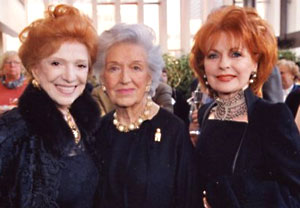
Risë Stevens: A Living Legend

Risë Stevens poses with a young Gen-Y fan, New York City (2006).
Risë Stevens as Carmen, her signature role at the Metropolitan Opera for 20+ years.
Risë Stevens (c), honorary chairperson of the 2004/05 Career Bridges award program supporting promising young opera singers at the outset of their careers.
This past week, a living legend in the world of the arts has celebrated a birthday. When Risë Stevens was born in Bronx borough 96 years ago, New York City was very much like it is today … the largest city in the United States, with a rich ethnic diversity including many first-generation immigrants. A city of amazing contrasts, from dirt-poor neighborhoods to districts of fabulous wealth and style.

Miss Stevens’ background was typical of many. Her father was a first-generation Swedish Protestant, her mother a second-generation Russian Jew. Growing up on the tough neighborhood streets of the Bronx, the bright lights of Manhattan must have seemed a world apart rather than just a few short miles away.

In her rise to the top of the billboards at the Metropolitan Opera, Stevens would have her share of luck – the onset of World War II in Europe gave American-born soloists their best chance ever to star in the limelight. But it also took years of practice, sheer hard work and “paying her dues” on provincial stages in places as diverse as Prague and Buenos Aires. Much of those early years are recounted in her biography Subway to the Met, published in the late 1950s.

Miss Stevens’ rich mezzo-soprano voice, coupled with her highly attractive physical appearance, made her a natural for several femme fatale operatic roles such as Dalila in Saint-Saens’ Samson & Dalila, Giulietta in Offenbach’s The Tales of Hoffmann and, most notably, the title role in Bizet’s Carmen. But early in her Met career, management seemed disinclined to cast her in this role, perhaps because several other stars were already filling the honors there. Not willing to accept this situation, Stevens did a true star turn, getting herself cast opposite Bing Crosby in the Hollywood blockbuster movie Going My Way in which, as Father O’Malley’s erstwhile neighborhood chum and now star of the opera, she sang the famous Habañera from the opera Carmen.

That seemed to do the trick, as the American public now clamored to see her sing the role. Dutifully, the Metropolitan Opera cast her as Carmen within the year, and for the next two decades, Stevens would practically own the role at the Met. (And it was as Carmen that Stevens made her last performance before retiring from the Met stage in 1961.)

The number of people who were introduced to the world of opera through Miss Stevens during the 1940s and 1950s is astonishingly large. Her compelling portrayal of Bizet’s cigar-factory worker temptress has been cited as THE defining catalyst for opera lovers in countless postings all over the web (you can read some examples here, here and here).

But beyond the limelight and the marquee board, there is another reason why Risë Stevens has been loved by so many: she has always been true to herself, and to her art. You can see that in how, despite the fact that she probably made more money starring in just three Hollywood films than she made in her entire career on the opera stage, she left Hollywood and returned to opera because it was her true love.

… You can see it by her loyalty in promoting the art of opera and her beloved Met Opera company. Even today, she remains on the board of directors of the Metropolitan Opera Guild, making her association with the company more than 70 years running.

… You can also see it in her compelling “up-from-poverty” personal story … and in her long and loving 65+ year marriage to her Viennese-born Hungarian husband, Walter Surovy.

And you can see it in the genuine interest she takes in people of all backgrounds and generations. Unlike so many stars who, once they are famous, become absolute personality horrors – full of arrogance and snobbery — Risë Stevens has never lost her connection to the “real world.” My own two daughters have carried on a correspondence with their “Miss Risë” for 15 years, who they’ve come to regard as a kind of special relative who lives far, far away and is larger than life in some respects.

From them, and from so many others: Happy Birthday, Risë … and may you celebrate many more!

Even John Q. Public doesn’t believe newspapers are going to survive …

It’s not just inside observers who are predicting the demise of the printed newspaper. The “Great American Public” seems to be well clued in to the problems of newspapers also. In fact, a poll released by Rasmussen Reports on May 12, 2009 reports that fully two thirds of adult Americans believe daily papers will disappear within the next ten years.

Even more dramatic, nearly one in five respondents think that it will happen within three years.

When two thirds of all adult Americans predict daily papers will go the way of the dinosaur within the coming decade, that’s big news. No longer is this just a discussion among industry insiders … it’s crept into the popular culture. That’s yet another big danger signal for the papers.

All of this is underscored by Rasmussen’s findings that a majority of Americans (56%) purchase a paper once per week or less — and 37% rarely or never buy a print version of their local paper.

In a possibly related development, Rasmussen’s surveys report that the credibility of newspapers and other media has declined in the public’s eyes. For example, only about one in four respondents has a favorable opinion of the New York Times. That may be a new low for a paper that likes to think of itself as America’s #1 print news source.

The most recent Newspaper Association of America’s financial figures are showing that newspapers have lost a whopping $18 billion over the past three years in their print operations. And while many papers have been counting on their online operations to counterbalance all of this red ink, total Internet revenues over the same period amounted to ~$9 billion — not nearly enough to erase the losses on the print side.

Of course, as this is 2009, the story would not be complete without government officials coming to the rescue, offering their share of interesting proposals. But how does the public feel about these efforts by politicians to save the newspapers? Nearly 40% favor federal government subsidies to keep newspapers in business … but slightly more than half feel it’s better simply to let them go out of business.

It will be interesting to see what the federal and state legislatures actually end up doing — whether it be turning newspaper companies into not-for-profit entities as Senator Ben Cardin of Maryland has suggested … or providing special business tax breaks for the industry as has been proposed by Washington’s governor Christine Gregoire.

Whatever is attempted, my prediction is that it won’t have nearly the positive effect its proponents hope for. The sweep of change in the communications arena is simply too broad and deep for that.

Marabel Chanin: A Symbol of a City

Marabel Chanin, speaking to reporters outside her home in Detroit's North End in summer 2008.
One of the sadder stories to hit the television airwaves in recent days concerns Marabel Chanin, an elderly woman living alone in an urban “ghost” neighborhood. When Marabel, a single woman, moved to Detroit’s North End back in 1964, the area, adjacent the Palmer Park Golf Course, was a beautiful, established Detroit neighborhood graced by roomy, circa 1920s single-family homes and lush landscaping.

Moving forward some 45 years later, Marabel was the last person on her block of Robinwood Avenue, living in daily (and nightly) fear of break-ins, gunfire, or worse. Complaints to police went nowhere, so her phone call to the local Detroit Fox News affiliate TV station (WJBK’s Problem Solvers) was a last-ditch attempt to find a solution to her dilemma.

Marabel’s story, profiled by the station last summer, brought the issues of crime & grime, urban decay and danger down to the most personal level and struck a nerve with viewers across the Detroit viewing area. The story ended up on the Internet, where I viewed the news clip on YouTube while researching my blog entry on the city of Detroit’s decline. It was so moving, I felt compelled to contact WJBK-TV, hoping to hear a good end to the story.

Unfortunately, as was chronicled in a follow-up report by the station broadcast last week, there was no good end. In fact, Marabel passed away in her home right around Christmas and was discovered days later. And now, five months on, her body remains at the county morgue, claimed by no one. Because of severe budget shortfalls, there are no funds to bury her or the nearly 100 other unclaimed bodies that are being kept there.

A story like this is gripping enough on a purely personal level … but it is also powerful in a larger context. To what degree does someone like Ms. Chanin — a single person of middle-class means but without close relatives — bear the blame for allowing herself to become the last person living on her city block in a trashed neighborhood? Or are there also larger forces at work that overwhelm the ability of someone of modest means (and elderly as well) to figure out a solution and act on it?

It was the southern agrarian writer Andrew Lytle who wrote in an essay years ago about the potentially dehumanizing effects of urban living. Lytle believed people were meant to live in smaller communities, where folks know each other and look out for neighbors in need. He also warned against large-scale industrialization, arguing that economic downturns lead to massive unemployment and thus dislocation of workers, whereas people who work the land usually can get by in a bad economy.

Of course, Lytle did not anticipate the advent of “industrialized agriculture” and the effect that would have on small farmers. But when you consider the economic landscape in 2009 and its effects not only on Detroit but also communities like Elkhart, IN, Lytle’s essay suddently takes on a very contemporary significance.

And what of Marabel Chanin? WJBK-TV has established a fund to provide a burial ceremony for her — and to do the same with some of the others unclaimed at the morgue. Tax-deductible donations to the “Marabel Chanin & Friends” fund are being accepted c/o National City Bank/PNC (First National Bank Building, 660 Woodward Avenue, Detroit, MI 48226). Reportedly, community response has been strong.

Happy Birthday to a Renaissance Man

Previn in younger days
andre-previn-at-801André Previn turned 80 years old earlier this month, which gives us cause to reflect on the incredible life of this highly interesting, very creative man. In his musical life, he’s demonstrated a versatility and catholicity that surpasses even Leonard Bernstein’s reputation.

Born in Germany, raised in the United States and truly a citizen of the world, Previn has lived out his life in the European capitals of London, Paris and Berlin … and here in the U.S. in places as diverse as Hollywood and Pittsburgh. A true wunderkind, he burst onto the musical scene back in the early 1950s, recording fine jazz piano arrangements that were released on 10” RCA Victor 78-r.p.m. and LP records … then soon migrated over to MGM Studios, writing musical scores for more than a dozen Hollywood films.

I own a few of Previn’s early jazz albums. His song arrangements are little gems – each one their own special musical adventure. Listen to his rendition of Stella by Starlight, for example, and you’ll immediately understand his special way with the music.

Previn’s pop music career masked the fact that he had studied classical music at the Paris Conservatory, and in San Francisco under the tutelage of the great French conductor Pierre Monteux. By the 1960s, Previn had moved from pop back to his classical roots, issuing a series of critically acclaimed recordings with the best symphony orchestras of London. His interpretations of the symphonies of Ralph Vaughan-Williams and Sir William Walton … along with recordings of the important British choral masterworks Belshazzar’s Feast and The Rio Grande remain touchstone performances, nearly 40 years on.

In his later years, in addition to guest-conducting the world over, Previn has penned a steady stream of memorable compositions, including several concertos for his ex-wife, the celebrated violinist Anne-Sophie Mutter. Even more impressive is Previn’s foray into the world of opera. His 1998 composition A Streetcar Named Desire has received more than 20 productions – an almost unheard of feat for a contemporary opera. And today, he’s busily at work writing a new work for the Houston Grand Opera to premiere next month, based on Noel Coward’s 1938 play Still Life (later made into the movie Brief Encounter).

At age 80, André Previn shows absolutely no sign of slowing down. And why should he? Musically speaking, he still has much to say … and the arts world is richer for it.

Happy Birthday, Maestro!

Holy Smoke! Social Marketing Gets Religion

As if we needed further proof that today’s social marketing phenomenon is seeping into every corner of people’s lives … faith-based web sites are now embracing the latest social techniques full-on.

One such example is Tangle, a site that provides family-friendly content and forums with a Christian perspective. Since merging with GodTube earlier this year, Tangle has experienced rapid growth. Particularly popular is the site’s interactive “prayer wall,” a kind of cyber equivalent to Jerusalem’s Wailing Wall where members can post prayers and petitions to the Almighty.

But in a 21st century twist, other members can comment on those prayers, a kind of running commentary from the spiritual side chamber. Talk about spilling the beans! It’s certainly a far cry from the Holy Week tradition of private auricular confession to a priest.

Not all of the action is on the Christian side of the ledger, either. Our Jewish Community, a project of Cincinnati’s Congregation Beth Adam, provides information, insights and discussion points related to Passover and other Jewish holidays – complete with blog entries and Twitter feeds.

These social marketing initiatives, in combination with the proliferation of faith-based informational web sites, prove yet again that old-time faith is flourishing in new-world cyberspace. Indeed, the web has provided the most effective means yet for like-minded, smaller or geographically far-flung religious communities such as Eastern Orthodox Christians, Traditional Anglicans/Episcopalians and Sephardic Jewish communities to find themselves and nurture their shared beliefs and culture. Hey, more power to them.

Now, before we get too breathless about the mobile media revolution …

For those of us in the communications field or otherwise on the bleeding edge of communications, it may come as something of a surprise to learn that the rest of the world isn’t all that engaged with (or even interested in) many of the communications techniques and gadgets that so absorb us.

To underscore this point, a study published recently by the Pew Internet & American Life Project reports that only about one-third of the adult U.S. population finds mobile Internet communications to be particularly interesting or attractive to them. And, horror of horrors, the remaining two-thirds aren’t being pulled by mobility further into the digital world.

The Pew study categorizes information and communication technology users into different sub-groups that have been given catchy descriptive names. Five of them, labeled “digital collaborators,” “media movers,” “roving nodes,” “ambivalent networkers” and “mobile newbies” collectively make up just over one third of the population. The study combines these groups together as people who are “motivated by mobility.”

On the other hand, a clear majority of people fall into a second segment dubbed the “stationary media majority.” Sub-groups within this segment include “desktop veterans,” “drifting surfers,” the “information encumbered,” the “tech indifferent,” and those who are just simply “off the network.”

While it may be tempting to assume that the ranks of the “motivated by media” segment will continue to grow at the same rapid pace (or even faster) going forward, the Pew study throws cold water on such a notion. Indeed, it finds that the “stationary media majority” segment, far from becoming more comfortable or accepting of cell phones and other mobile devices, is actually displaying increasingly more negative attitudes about them.

Maybe it’s an understandable reaction to the relentless press of new technology for people to push back like this. And we’ve seen it before – back in the 1970s and ’80s with the high-tech/high-touch phenomenon when desktop computers were being introduced in a big way into the office environment.

People do come around eventually, of course. But it takes longer than many would expect. And it’s really too bad when some early adopters respond with impatience and exasperation. Instead, why not just chill and give the rest of the world a chance to catch up?

Even better, let them do it on their own terms and at their own pace.

Skyscraper Graveyard

apartment-buildingBook TowerOn a trip to Detroit a few days ago, my family and I stayed downtown in one of the city’s newly renovated grande dame hotels. The 1920s-era Fort Shelby Hotel, now part of the Doubletree chain, reopened last December after being closed for more than 25 years. It’s a jewel of a property stuck in the middle of one of the most depressed cities in America. Reportedly, a whopping $80 million was spent on its renovation.

The timing couldn’t have been worse. Just up the street is the even more palatial Westin Book-Cadillac, which was the world’s largest hotel when it first opened in 1924. It, too, stood vacant starting in the early 1980s, miraculously avoiding the wrecking ball before being rescued in a $200 million+ renovation and reopening this past October.

So what will help fill the rooms of these showcase hotel properties? If a flood of reservations actually materializes, it will be for the myriad lawyers, accountants and government officials descending on the city to pick apart General Motors and Chrysler Corporation.

The city of Detroit can’t seem to catch a break. First, there’s the real estate crisis that has seen property values plunge even faster than the national average. Today, the city’s median home sales price is below $10,000, which has to be the record low for a major U.S. city.

Next up, the spectacle of dilapidated infrastructure, a dysfunctional school system plus governmental corruption, nepotism and favoritism run amok – all culminating in Detroit’s mayor being sent to prison.

Now comes the implosion of Detroit’s auto industry that has sparked the nation’s renewed attention on the crumbling city, including human-interest television reporting and lurid photo essays like the one just published in Time magazine.

Sadly, this is Detroit. Riding the People Mover, the 2.5-mile monorail system that loops the perimeter of downtown, one can peer into the second-story levels of building after vacant building. It’s truly a metaphor for the entire city … and a peepshow for the rest of the nation.

Is there a natural bottom? The investors in Detroit’s old hotels seem to think so. But you have to wonder, would those investors have moved forward with these initiatives knowing what they know today?

It was photographer and social commentator Camilo Jose Vergara who suggested more than ten years ago that the empty skyscrapers of downtown Detroit be preserved in their current state as a memorial and monument to a vanishing industrial age. Of course, the city government leaders were horrified at the idea and objected loudly. But really, what other use could they possibly come up with for these relics – silent and stark reminders that a city once the nation’s fifth largest has shrunk in under 50 years to less than half its former size.