When “Push” Comes to “Pull” in Marketing

Push versus pull marketing.  "Push" has the upper hand now.
"Push" vs. "pull" marketing: Does "pull" have the upper hand now?
It’s clear that social media is delivering a wide range of interesting and beneficial online experiences for people. One that’s among the most highly valued is the ability to “vet” products, services and brands through reading reviews posted by “real people.”

According to a survey of ~3,330 consumers conducted in late 2011 by Deloitte’s Global Consumer Products Group, a large majority of consumers report that they rely on user reviews to guide their purchase decisions, rather than merely being influenced by brand advertising.

The Deloitte survey found that nearly two-thirds of consumers read consumer-written product reviews online. Of that group, 82% report that their purchase decisions have been directly influenced by these reviews – either confirming their decision to buy or causing them to switch to an alternative product or service.

Because of the perceived value of these consumer reviews, most people begin their search for information via a search engine query or by going to blogs, e-commerce sites such as Amazon that also feature consumer reviews, or review sites like TripAdvisor and Yelp.

By contrast, the incidence of people beginning their information quest at a company or brand website is far lower.

These dynamics are part of the reason why so many companies and brands are looking to increase their engagement with the online public. They’re particularly keen on ferreting out their natural allies – people who have a strong positive opinions about their brand – and turning them from armchair advocates into vocal cheerleaders.

For many marketers, this means going well-beyond collecting “likes” and similar “trophy counts.” They’re also continually monitoring comments in the social sphere concerning the quality of their products and customer service in order to make sure they deal with any issues or complaints expeditiously in order to minimize negative fallout in the “review” environment.

There’s also a powerful impulse for brands to offer “incentives” to customers in exchange for posting positive reviews. Those incentives can range from the small or innocuous – offering discount coupons or inexpensive product samples – all the way to incentives that seem more like bribes. (Here’s the latest example of this, courtesy of Honda.)

The keen attention companies are paying to social platforms reminds us that we’re in the midst of a migration away from traditional “push” marketing into a land of “pull” marketing.

There have always been “push” and “pull” aspects to marketing, advertising and PR, of course. But the balance of energy these days appears to be shifting quite sharply in the direction of “pull.”

There’s no reason to think that pattern will change anytime soon.

Retailing Comes Full Circle … Courtesy of Amazon

Amazon’s been busy revolutionizing the world of retailing for well over a decade now. So what’s its latest trick? Bricks-and mortar stores.

Yes, you read that right. Amazon’s going into the physical retail game.

What’s behind this seemingly bizarre turn away from 21st century online retailing back to something that seems almost quaint? It’s pretty fundamental, actually. There are many products that consumers find easier to purchase after being able to interact with them physically and personally.

From apparel to electronics to sporting goods, sometimes there’s no substitute for the visceral, sensory experience. Online images, videos, product ratings and customer reviews all have their place, and Amazon doesn’t see those aspects becoming any less important over time.

Indeed, the Amazon store concept builds on all that, attempting to create a multi-channel retailing structure that truly serves the needs to consumers whenever and however they wish.

If what Amazon is developing is “just another” retail shop, it’ll be much ado about nothing. But it’s more likely that Amazon will try to create a retail experience in the manner of an Apple store – creating an environment that has its own special personality and attracts shoppers because of it.

Amazon may generate a good deal of buzz about its newest venture and the novelty of it all. Good for them. But the Amazon initiative also speaks to a more fundamental truth: reminding us that the marketplace is made up of human beings, not machines. People are social … and sometimes we hunger for more than just looking at an image on a computer screen.

If Amazon can successfully integrate its new physical stores concept with its phenomenally successful online retail business, it’ll be another step forward in the creation of truly integrated, multi-channel retailing.

It’s good to see that people are at the center of the model – literally and figuratively.

“Fanning out” when it comes to brands and social media engagement.

Social media may well be taking the famous 90-9-1 principle of online engagement … and bringing it to new lows.

It’s hard not to come to this conclusion when reviewing the results of research conducted by the Ehrenberg-Bass Institute for Marketing Science. This Australian-based University think-tank studied the actual engagement levels of people who have “liked” the top 200 brands on Facebook by considering the degree to which fans actually shared posts or commented on the brand.

Over a six-week period of study, Ehrenberg-Bass found that fewer than one half of one percent of the brand fans actually “engaged” in any way at all.

The conclusion? It turns out that social media fan bases and actual engagement are two very different things.

Categories that do somewhat better in “engagement” are ones like alcohol, cars and electronics. But interestingly enough, the study also found that the so-called “passion” brands – such as Harley-Davidson, Porsche or Nike – don’t perform much better than “regular” brands: 0.66% engagement versus 0.35%.

In its report conclusions, Ehrenburg-Bass questions whether the Herculean efforts being made by some brands to “bribe” their way to thousands of “fans” and “likes” is really worth the cost in terms of the added product discounts, coupons and other goodies that are being proffered to entice consumers to become brand fans.

When you boil it down, the Ehrenburg-Bass research confirms yet again a basic truism about branding: Much as we would love to think otherwise, the marketplace isn’t nearly as enamored with our brands and products as we think they should be.

To us, the branding so important. To them … it’s just one big shrug of the shoulders.

Taking the “phone” out of “smartphone.”

SmartphonesAs more consumers migrate to the smartphone from traditional feature phones, we’re seeing a transformation of the mobile phone away from its original “tele” purpose.

That’s the conclusion of several studies by analytics firms Flurry and Wireless Intelligence.

In an analysis of smartphone users’ app activity conducted in December 2011, Flurry found the an interesting breakdown of daily activity that places mobile gaming at the top of the list:

 Playing downloaded mobile games: ~49% of daily app activity
 Interacting with Facebook and other social networks: ~30%
 Viewing mobile entertainment: ~7%
 Checking/reading news: ~6%
 Other applications: ~8%

And Wireless Intelligence found some very intriguing figures in its analysis of smartphone user activity conducted in mid-2011.

Of the average ~38 hours of time spent on smartphones per month, actual “phone calling” represented less than one-fourth of the time:

Messaging activities: ~29% of smartphone user time
 Interacting with apps: ~29%
 Voice activities: ~23%
 Web browsing: ~19%

What we’re seeing is that the original purpose of the cellphone has devolved into a position of distinctly lower importance. In time, it could well become the asterisk at the bottom of the page.

And this is happening inside the span of 15 years.

To borrow a phrase from former Speaker of the House Newt Gingrich, you’d be hard-pressed to cite another device that has so “fundamentally and profoundly” changed its functionality and user purpose over such a short amount of time.

It makes one wonder what the next 15 years will bring …

Clean energy initiatives banging up against cold harsh reality.

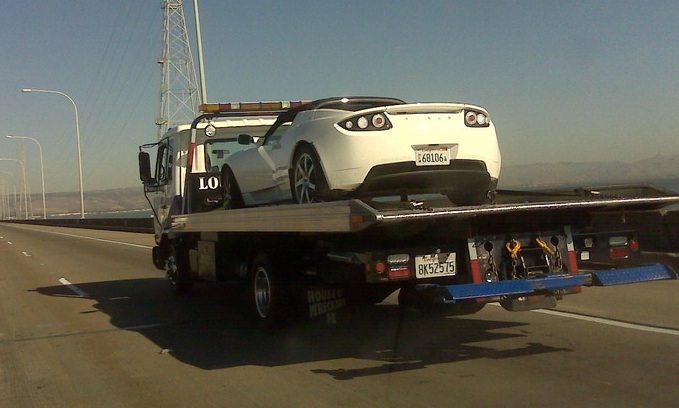
Inoperable Tesla Roadster being towed on a flatbed.Let’s face it: This hasn’t been a very good year for environmental and clean energy initiatives. First it was the Solyndra debacle — a saga that appears to be never-ending.

Next were the reports of “global warmists” getting caught fabricating documents in an attempt to deflect attention away from the steadily mounting data that’s making global warming no longer the “consensus view” in the scientific community.

And now we have a damning report about Tesla Motors’ vaunted Roadster electric vehicles, the darling of the clean car crowd.

It turns out that most of the Roadster models sold into the market suffer from severe design flaws that can essentially destroy the value of the car. If the vehicle’s battery becomes totally discharged, the car becomes completely immobile; the vehicle won’t start, and it can’t even be pushed down the street.

The only remedy for hapless Roadster owners? Tesla will cheerfully replace the battery system … for a cool $40,000. And the owners will have to pay the entire bill, too, because Tesla’s warranty policy does not cover car damage due to battery failure.

That is correct: For those who purchase a Roadster, when it comes to battery-related repairs there’s no warranty … no insurance available from outside carriers … and no payment plan.

[To be fair, Tesla does offer a $12,000 “battery replacement program” for cars whose batteries are more than seven years old. Of course, that figure doesn’t begin to cover the ~$32,000 battery replacement cost plus ~$8,000 in labor charges.]

Some auto industry wags have started to call the Roadster by another name – the “Brickster.” That’s because when the car is immobilized due to the death of the battery, it becomes completely inoperable — basically thousands of pounds of dead weight.

Owners who face the misfortune of a full battery discharge will come to find out that conventional towing won’t work because the car’s wheels won’t even turn. Instead, they’ll have to figure out a way to lift the entire vehicle onto a flatbed truck for towing and repair … in the process spending additional hundreds (or thousands) of dollars in towing fees.

And lest people think that the battery depletion occurs only because of stupidity on owners’ part in forgetting to plug their vehicle in … not so fast. In some instances cars were plugged in but the electrical charge wasn’t strong enough to charge the battery, perhaps because an extension cord was too long.

And considering the hefty ~$109,000 sticker price of a Roadster, it’s disappointing to discover that the vehicle’s battery can become fully discharged in as little as one week’s time. Good luck with that if you find yourself stuck somewhere that’s not in close proximity to an electrical power source.

And for people parking their Roadster at the airport lot during a family vacation … better just hope that the charging mechanism is working properly. Either that, or have someone check up on your vehicle several times during your trip, lest your vacation ends up costing you an additional forty-grand.

The Tesla cautionary tale is yet another example of the disconnect that exists between the promise of clean energy and the practical challenges of turning it into reality.

To begin with, at ~$109,000 a pop, how many consumers can even afford the cost of a Roadster? And how many people who could afford the vehicle will actually plan to sink their hard-earned cash into a product that possesses such fatal design flaws? Even gas pump prices of $7 or $8 per gallon won’t change that dynamic.

Tesla has sold only ~2,500 Roadsters so far. But its aggressive plans call for manufacturing ~25,000 of its new Model S Roadsters by the end of 2013.

The company’s optimistic forecasts are based on the belief that the Model S’s lower price tag of ~$50,000 will attract a new and larger crop of consumers.

But I wonder if that will actually happen. After all, the sticker price remains high … and the “battery bricking” issue will only become more apparent to consumers as more Roadster vehicles end up on the highway.

Time will tell whether the Tesla Roadster’s fortunes will soar to new heights … or sink under its own (dead)weight. Maybe it’s worth making a $40,000 bet on the outcome.

Social Media Communities: Digital Potemkin Villages?

Social media stats riddled with fake accounts and cipher profilesMarketers like to talk about the 90-9-1 rule of web engagement: For every 100 people who are online, one person creates content … 9 people comment on that content … and the remaining 90 may lurk and read, but never participate in any other way.

The more we learn about social media engagement, the more we’re seeing the same phenomenon at work. To wit, studies of social networks like Twitter, Facebook and Google+ are finding far fewer numbers of “real” and “active” users than the gross statistics would suggest.

Alarmingly, these evaluations are finding that as many as half of social media accounts could be fake, or are ones that contain no user profiles.

And if there isn’t a user profile, of what value is a social media account to marketers? After all, it’s the information in these user profiles that provides the data for targeted advertising and marketing campaigns.

Just how extensive is the problem?

Let’s start with Google+, one of the latest entrants into the social media sweepstakes. Kevin Kelly, an industry specialist, published author and former editor of Wired magazine, recently conducted an analysis of the ~560,000 people who have him in their Google+ “circles.”

Reviewing a random sample of these ~560,000 users, he found that the majority of them had not made a single post … had not posted their image … and/or had never made a single comment.

More specifically, here’s what Kelly found:

Only ~30% had ever posted anything
 ~6% were “spammers”
 Fully ~36% were “ghosts” … accounts lacking even a user profile

Evidently, Google+ is taking “ghostwriting” to new heights.

What about Twitter?

Several editors at Popular Mechanics magazine reported recently that only ~25% of their Twitter followers were “real.” About half were identified as fake users or spammers.

Twitter may be tweeting away … but how many people are actually listening and who’s actually engaging?

Who’s gaming the system here? Clearly, there are reasons why people are trying to show higher social media engagement than is actually occurring. Marketing campaigns love to cite metrics where the number of followers and “likes” is high. It’s great for bragging rights … and sometimes financially beneficial, too, when performance goals are met and monetary payouts triggered.

And today there are plenty of ways for people to find services that will jumpstart campaigns by garnering thousands of followers or “likes” … all for a tidy fee, of course.

It would be nice if the social media platforms would step up to the plate and show some transparency in what’s going on. It’s highly likely that these platforms have developed sophisticated ways to pinpoint which of their accounts are real … versus those that are contrived.

But will they be publishing their findings anytime soon? Don’t hold your breath.

Until marketers can get a better handle on the “real facts” behind the elevated engagement numbers being hyped, it’s best to view any such stats with a jaundiced eye.

Here’s a suggestion: Take any stats you might hear about page “likes,” viral video views and the like … and discount them by a massive percentage – say, by 50%. Then, you might be approaching the reality.

Over time, we’ll probably learn more about “authenticity” when it comes to tracking true activity and engagement in the social realm. Marketers would do well to demand it. It’s just not clear how soon it’ll happen.

Until then, keep your antenna up and apply caveats all over the place.

(Still) Seeking the Sweet Spot with QR Codes

QR codesI’ve blogged before about how QR codes – those splotchy icons at which someone can point their mobile device and be taken to a website for product information, a coupon or some other type of content – seem to be having difficulty becoming accepted by the mainstream of U.S. consumers.

And now we have yet more evidence to suggest that QR codes may never achieve the level of potential that marketers have hoped for them.

Youth marketing and esearch firm Archrival give us the latest clues as to the lack of adoption we’re seeing when it comes to QR codes. Here are two key findings from a survey it conducted among 500+ students at 24 American college campuses in late 2011:

 Although ~80% of respondents owned a smartphone and claimed to have come in contact with QR codes, only ~21% were actually able to successfully scan the QR code example that was presented in the Archrival’s survey.

 Three out of four respondents reported that they’d be “unlikely” to scan even one QR code in the future.

What’s the problem? Archrival uncovered a number of hurdles when it comes to QR codes. Several of them could be classified as “deal breakers” in the overall scope of things:

 Many survey respondents did not realize that a third-party app needs to be activated in order to scan a QR code. They mistakenly assume that it can be activated with their camera.

 Other respondents believe that the QR code-reading process is too lengthy and cumbersome.

And on a more fundamental level, doubts are being expressed about the value or usefulness of the web landing pages that are promoted via the QR codes.

What we may be witnessing is a dynamic that’s similar in some respects to what happened with CD-ROMs about a decade ago. There was once a boomlet of CD-ROMs being sent via mail to consumer and B-to-B customers. CDs were viewed as a great way to provide extensive rich content that was difficult to download and expensive to print traditionally.

But because the tool was “one step removed” (it needed to be loaded into a desktop computer in order to be viewed), the rate of interaction with these CDs turned out to be abysmal.

Similarly with QR codes, first there’s the need to possess a smartphone with a barcode scanning app installed. Once properly equipped, people then need to take the time to find and launch the app on their mobile device before pointing the camera at the QR code.

For many in today’s “instant gratification” world, taking those extra steps, however simple, may be a bridge too far.

Consumers and coupons: The latest stats are in.

Consumers are redeeming coupons more than ever in 2011Coupons are big business in the USA. According to the latest Coupon Facts Report published by NCH/Valassis, a whopping $470 billion worth of coupons were offered by consumer package goods marketers in 2011.

Of this, an estimated $4.6 billion in coupons were redeemed. That represents more than 3.5 billion individual coupons at an average value of ~$1.30 per coupon.

It’s not surprising to learn that the offering of coupons by manufacturers spiked during the recessionary period that began in late 2008, when shoppers were more value-conscious than ever.

But by 2011, manufacturer behavior changed. In fact,this past year saw the first decrease in coupon offerings since 2008 (the drop was 8%) … although the volume hasn’t declined anywhere close to the volume of coupons consumer goods manufacturers offered back before the recession started:

 2007: $373 billion in coupon value distributed
 2008: $379 billion
 2009: $445 billion
 2010: $511 billion
 2011: $470 billion

Not every consumer category behaved similarly in 2011. Grocery product marketers reduced the total quantity of coupons they made available during the year, while marketers of health and beauty products showed no such decline.

With the increased popularity of digital couponing, one would expect that the growth rate in this segment would significantly outpace that of traditional coupons.

That turns out to be correct: NCH estimates that ~11% more print-at-home and paperless coupon offers were distributed in 2011 compared to the previous year.

But digital couponing still represents only a very small fraction of the total coupon landscape, which continues to be dominated by the free-standing inserts that are found in nearly every Sunday newspaper published in America. Here’s how FSIs dominate:

 Free-standing inserts: ~89% of U.S. coupon distribution in 2011
 In-store handouts: ~4%
 Direct mail: ~2%
 Magazines: ~2%
 Coupons inside or on product packaging: ~1%
 Digital couponing (paperless or print-at-home): ~1%

One other interesting study finding is that even though manufacturers reduced the volume of their coupon offerings during 2011 … consumers themselves showed no inclination to reduce their participation.

In fact, coupon redemption was up more than 9% in 2011 versus 2010. Clearly, many people are still thinking in “recession mode” when it comes to squeezing every ounce of productivity from their shopping dollar.

Marketing Measurement: Aiming Really High … Scoring Kinda Low

Marketing ROI - return on investmentThere’s clearly a disconnect in the world of business regarding the theory and practice of ROI measurement for marketing campaigns.

That’s the key takeaway from the 2011 State of Marketing Management Report, based on a survey of 200+ U.S. marketing professionals in the B-to-B and B-to-C realm.

The research was conducted by Ifbyphone, a Chicago-based developer of voice-based marketing automation platforms, with results published in December 2011.

More than 80% of the marketers surveyed report that their executive management expects every campaign to be measured. But fewer than 30% of the respondents believe they can effectively evaluate the ROI of each campaign.

Not surprisingly, e-mail marketing, with its robust reporting capability, is the program that is reportedly most easy to measure for return on investment … whereas public relations programs are most difficult.

Here’s how eight marketing techniques fared in the survey in terms of their ROI measurement “difficulty”:

 E-mail marketing: ~53% of respondents report difficulty measuring ROI
 Direct mail campaigns: ~59% report difficulty
 Online advertising: ~60% report difficulty
 Print advertising campaigns: ~66% report difficulty
 Tradeshow marketing: ~72% report difficulty
 Social media: ~74% report difficulty
 Search engine optimization: ~76% report difficulty
 Public relations: ~82% report difficulty

The survey found some correlation between the types of marketing tools utilized and greater ability to measure ROI. The most popular tools used by the survey respondents included these five:

 Web analytics: ~48% utilize
 e-Mail marketing software analytics: ~47%
 Lead counts from online contact forms: ~38%
 Social media monitoring: ~30%
 Call tracking: ~27%

The study’s bottom-line finding: Marketers have a good deal more work to do to meet senior management expectations for campaign measurement … as well as to meet their own high standards.

Now for the tough part …

Compensatory Damages? Comparing Public and Private Sector Employee Compensation

Public sector worker protests against benefits cutsFor years, it was a truism so well understood it could be etched in stone: A government job was one where the pay wasn’t all that great … but the benefits were wonderful and there was good job security.

The accepted tradeoff was between receiving lower salary compensation in the public sector in exchange for job security and good benefits. Lower reward, perhaps … but also lower risk.

Over the past decade, however, there’s a growing perception that this balance has shifted almost entirely in the direction of public sector workers. And now we have the data to prove it.

A recently released analysis by the Congressional Budget Office reports that federal government employees receive significantly higher total compensation than private sector workers with the same level of education and/or experience.

The CBO analysis found that the average salary for federal workers runs approximately 2% higher than similar jobs in the private sector. So the private sector salary premium seen historically no longer exists.

Benefits are another key factor. And in fact, the value of federal employee benefits now exceeds private sector programs by a whopping 48%. Taken together, total compensation for federal workers exceeds their like counterparts in the private sector by 16%.

That isn’t chump change. With federal employee compensation running $200 billion per year, a 16% premium in compensation represents a beaucoup bucks, actually.

But even with these stark statistics, we continue to hear complaints about the plight of public sector employees. To see how off-tone this sounds, compare the new CBO report with the continuing claims of the federal Office of Personnel Management that federal workers are underpaid by 26% compared to private sector positions.

That contention goes all the way back to the early 1990s, but it’s still quoted as if it’s Gospel truth some 20+ years later.

Really? Which one of these two studies do you believe more?

With the beating that companies in the private sector have had to take in order to remain competitive in a down economy – indeed, even to survive – the notion that federal workers’ average total compensation is lower than comparable private sector jobs doesn’t pass the snicker test.

And what about state and local public sector jobs? The studies may not be as comprehensive, but the evidence looks very much the same. Anecdotally, I know that every time salaries and benefit packages earned by public officials in my state and/or local jurisdictions are published, I hear howls of protest from people who feel that the compensation is way out of line with the rest of the market.

Public employee unions like to talk a lot about fairness. And at the end of the day, it is about fairness: In an economy where business has been battered, unemployment and underemployment continues to be rampant, and many employees who have managed to hold on to their jobs have had to endure big sacrifices in salary cuts, benefit cuts and increased co-pays … for public sector employees to expect the world to stand still for them and them alone seems anything but fair.

Consider the fact that a significant number of local governments – and even some states – are facing huge looming pension payouts and other financial obligations that threaten to bankrupt them. In such an environment, it’s unrealistic for public sector advocacy groups to think they can hold jurisdictions to 25-year-old commitments that were based on actuarial and tax revenue assumptions that are no longer valid.

A couple of maxims are in order: Times change. You can’t get blood out of a turnip. And yes, we can get ourselves out of this situation. But people are going to have to be flexible in their thinking for the effort to succeed.