Ziggeo: The HR Manager’s Newest Friend

Ziggeo logoWho hasn’t ever interviewed someone and known within the first minute or so that the meeting was going to be a complete waste of time?

[Then the fun part was having to make inconsequential small talk for the rest of the interview just to appear civil!]

Unfortunately, this scenario happens more often than we’d care to admit.  And considering the effort involved in planning and conducting phone or in-person interviews, it’s a major waste of time and resources.

But now a company has come along that harnesses the Internet and camera technology to offer a different approach that I find pretty intriguing.

It’s called ZiggeoFounded by entrepreneurs Susan Danziger and Oliver Friedmann, it’s an online service that enables HR managers and others to screen job candidates and other people using video technology.

It’s as simple as posing a few questions on the Ziggeo site … then providing a Ziggeo link to the interested parties for them to respond.

Job candidates simply click on the link to receive the questions.  They respond with short video recordings, which the HR manager can view at his or her convenience.  It’s an efficient and inexpensive way to prescreen job candidates in the very first stage of the interview process.

Since most people have video capabilities embedded in their digital devices these days, they can respond easily without being impeded by a lack of technical tools.  And if candidates balk at participating … chances are those people wouldn’t have ended up on the short-list of finalists anyway.

Job interview via videoZiggeo has also incorporated a simple “rating” functionality into its system to make it easy to grade the quality of video responses, which would come in handy for people who are evaluating a large number of candidates.

I think this is a great way to separate the “wheat from the chaff” when it comes to people selection.  Plus, we get to see how people are responding to our own specific questions … not having to rely just on resumes, covers letters and the like.

While job applicants are probably the biggest potential uses, there are numerous other applications of the Ziggeo approach.  I can see it being used to screen all manner of people:

  • Interns
  • Casting calls
  • Babysitters
  • Adult/senior caretaking
  • Roommates and apartment mates

Ziggeo can also serve as a quick, easy and affordable method to “vet” video testimonials and media interviews.

Like so many other web-based offerings, Ziggeo offers different usage plans based on the level of need.  There’s a free plan that allows for video clips up to 20 seconds in length, as well as a “personal” paid plan that allows clips up to two minutes long.

The Ziggeo Pro premium-level service levels goes a lot further than that, allowing  for hundreds of videos up to 15-minutes in length plus multiple screening rooms, which should prove most popular with hiring practitioners and human resources departments at large companies.

I don’t have personal experience with this tool myself, but it seems like its positive attributes as a “first sort” for personnel selection would far outweigh any negative aspects.

What experience have readers had with Ziggeo or similar video screening services?  Would you recommend using them, or are there drawbacks?  Please share your comments here.

A new survey paints a more nuanced picture of public attitudes about government and business …

To hear the politicians in Washington talk, the American people are either looking for government to solve society’s ills … or they want government to butt out completely.

2013 Public Affairs Pulse SurveySuch black-and-white perspectives rarely turn out to be accurate … and now we have additional proof in the form of a May 2013 telephone survey of ~1,600 adults living in the United States, conducted by Princeton Survey Research Associates for the Public Affairs Council, a leading professional organization for public affairs executives (nonpartisan).

Among the key takeaways of the 2013 Public Affairs Pulse survey research:

  • Trust in business:  Three out of four respondents feel that major companies generally do a good job of “providing useful goods and services,” and two-thirds also believe they’re doing a good job of serving their customers.  But by similar margins, they also believe that companies should take on more responsibility in providing community services like quality education, affordable healthcare, and food banks.
  • Government regulations:  Opinions are split;  a slight majority (~52%) feels that government regulation of business “usually does more harm than good” … but ~44% believe that “regulation is necessary to protect the public interest.”
  • Trust in government declines with age (and familiarity?):  A majority of Millennials give the federal government favorable scores, compared to ~44% of Gen Xers and just 35% of Baby Boomers.

Another figure stands out, too:  Only around 37% of the respondents express “a lot” or “some” trust and confidence in the government’s ability to fix the country’s problems.  This finding appears to support the notion that the government is not a panacea for the nation’s problems.

Michael Barone, political analyst and observer
Political analyst Michael Barone first espoused the idea of the “50/50 nation” following the 2000 U.S. presidential election.

But the survey results also underscore the theory espoused by Michael Barone, Mickey Kaus and other observers of the American electorate that America remains a “50/50” nation when it comes to the political parties and their philosophical underpinnings.

… And that puts us right back where we we’ve been for the past decade and a half … despite the posturing of our political leaders.

For additional findings from the 2013 Public Affairs Pulse survey, click here.

Andrew Mason’s Next Act: Groupon’s ex-CEO Releases a Music Album

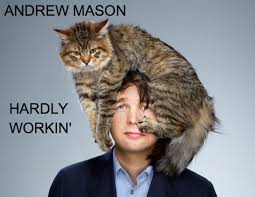
Andrew Mason - Hardly Workin' music album
Groupon’s ex-CEO Andrew Mason is releasing a music album titled — appropriately enough — “Hardly Workin’.”

I’ve blogged before about the tribulations of Groupon and its “daily deal” couponing business.

The company has found it incredibly difficult to develop a sustaining business model, what with increased competition and the propensity for vendors to cease their participation after one or two deals due to disappointing program results.

With Groupon taking 50% of every deal plus a credit-card handling fee, far too many vendors found that they couldn’t make money on “daily deal” promotions, and often, “repeat business” from the ultra-price-savvy consumers who tend to participate in such schemes never materialized

Groupon founder and former CEO Andrew Mason was hardly the typical head of a dotcom business.  His business background was rather thin, despite having started a Saturday morning bagel delivery service in suburban Pittsburgh when he was just 15 years old.

Instead, Mason graduated from Northwestern University in 2003 with a degree in music, signaling where his interests truly lie.  After having worked at several Chicago-area tech companies, Mason managed to snag some seed money from Chicago entrepreneur Eric Lefkofsky, and Groupon was born in 2008.

By 2010, Groupon was the latest star in the constellation of online businesses, with annual revenues of ~$800 million.  In December of that year, Groupon was offered $6 billion to sell to Google, but Mason and his company board foolishly declined the offer.

But within two years, Groupon’s fortunes had turned dramatically for the worse.  Herb Greenberg of CNBC named Mason the “Worst CEO of the Year” in 2012, writing:

“Mason’s goofball antics, which can come off more like a big kid than company leader, almost make a mockery of corporate leadership – especially for a company with a market value of more than $3 billion.  It would be excusable, even endearing, if the company were doing well … but it’s not.”

After one too many missed quarterly goals, Groupon’s board of directors ousted Mason on February 28, 2013.  On the day of his dismissal, Mason wrote to his employees:

“After four and a half intense and wonderful years as CEO of Groupon, I’ve decided that I’d like to spend more time with my family.  Just kidding – I was fired today.  If you’re wondering why … you haven’t been paying attention.”

But now Mason is back – just not in the same way.  This time, it’s as a musician.  The former punk band keyboardist (and also husband of pop singer Jenny Gillespie) is releasing an album titled “Hardly Workin’” that contains seven songs.  It was produced by Don Gehman, who has also worked with R.E.M. and John Mellencamp, among others.

Here’s what Mason has to say about his latest project:

“I managed over 12,000 people at Groupon, most under the age of 25.  One thing that surprised me was that many would arrive at orientation with minimal understanding of basic business wisdom.”

This album pulls some of the most important learnings from my years at the helm of one of the fastest-growing businesses in history, and packages them as music.  Executives, mid-level management and front-line employees are all sure to find valuable takeaways.”

*  *  *  *  *

“If you’re seeking business wisdom, you don’t need no MBA — look no further than the beauty that surrounds us every day …”

*  *  *  *  *

With lyrics like these, one wonders if Andrew Mason isn’t talking so much about 12,000 employees, but instead about himself!

Where do people spend their time online?

How much time to people spend online ... and doing what?With the ever-growing options for where people spend their time when online, what’s the latest in terms of their online behaviors?

That’s the question The Buntin Group, a MarComm and branding agency, and Survey Sampling International (SSI) were trying to answer when they conducted a survey of American web users in May 2013. 

The survey was conducted among adults who use at least two tech platforms (including e-mail, text or social) to connect with others during a given week.

What the survey found is that Americans are spending more time than ever online – about 23 hours per week on average.  That’s nearly a full day out of a seven-day week.

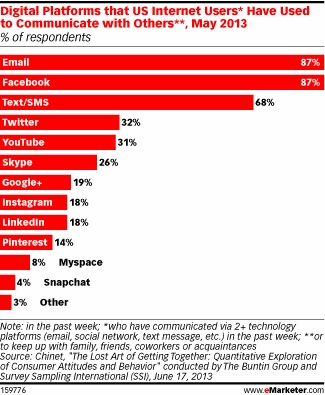
Drilling down further, the survey found that e-mail communications continues to be the most prevalent online activity, but it’s followed closely by Facebook:

  • Average time per week spent on e-mail communications:  7.8 hours
  • Average time spent on Facebook:  6.8 hours
  • Average time spent on YouTube:  5.0 hours
  • Average time on Google+:  4.3 hours
  • Average time on Twitter:  4.2 hours

In keeping with these findings, the survey also found that e-mail and Facebook are where most respondents log in most often to communicate with others:

Social Platforms used by Internet Users

But here’s another interesting finding from the survey:  From time to time, even the most digitally connected people find themselves fatigued by all of their online activity.

In fact, nearly 55% of the survey respondents reported that they had “walked away from technology at least occasionally” in the past year to gain more in-person time.

An even larger ~62% reported that they plan to reduce their “tech socializing time” in the upcoming year and instead focus on more face-to-face interaction.

Speaking personally, e-mail and YouTube are indispensable to me.  Facebook is a “nice to have” platform when it comes to keeping up with friends and family — and I usually check in once a day.  But I have gone as long as two weeks without logging on and haven’t felt worse for it. 

I spend far less time on Twitter than the survey average … and I don’t even have a Google+ account (nor do I have any plans to set one up).

What about you?  Based on your experience, does 23 hours of online activity weekly seem excessive – or close to the mark? 

Do you take “online vacations” periodically?  And which online activities are most important and valuable to you?  Please share your thoughts here.

College Kids and their “Gadget Goodies”

I’ve received a few interesting comments from readers about my recent blog post about so-called “digital dementia.”  One reader and business colleague of mine, Syed Tahir Rasul, had this to say:

“In the 1990s, we were taught that playing computer games would even sharpen our mental skills.  But now this enormous increase in gadgets, [even] in the hands of five-year olds … is certainly alarming.  This is causing some sort of disorder for sure.  But then again, we can’t live without these gadgets now!”

College students and their electronic gadgetsThis got me to wondering:  I have two twenty-something daughters who are most definitely “wired” up one side and down the other.  But is this behavior the norm or the exception?

I found some answers in the form of results from a new online survey of ~1,525 college students aged 18 to 34 conducted by market research firm Crux Research for re:fuel, a branding and media company.  To be included in the survey, each respondent had to be taking at least one course on a physical campus.

With ~22 million U.S. college students expected to be enrolled for the 2013/14 college year, one would imagine the behaviors of this large group would track fairly closely with the overall behaviors of this age cohort.

What the re:fuel research shows is that the average American college student possesses seven devices in their technology “arsenal” (that’s up from six a year earlier).  So it’s definitely a “gadget grab-bag” with these kids.

Laptops and smartphones lead the pack in popularity:

  • Laptop computer:  ~85% of American college students own one
  • Smartphone:  ~69%
  • Video gaming console:  ~68%
  • MP3 player:  ~67%
  • Printer:  ~62%
  • Digital camera:  ~61%
  • Flat-screen TV:  ~60%

—————————————————

  • Desktop computer:  ~48%
  • Tablet computer:  ~36%
  • Handheld gaming system:  ~35%
  • Feature phone:  ~33%
  • Camcorder/video recorder:  ~25%
  • E-reader:  ~21%
  • Tivo/DVR:  ~18%

The “break” we observe between ownership rates of 60%+ and below 50% is as much a function of changing tastes in digital equipment as anything else.  “Old fashioned” feature phones are biting the dust as more college kids trade up to smartphones.  In fact, the survey reveals that more than 30% of the respondents say they intend to purchase a new smartphone in the coming year.

[Considering the ownership rates that already exist, quite a few students will be trading up not from a feature phone, but from another smartphone.]

Who uses camcorders anymore, when so many smartphones take just as good-quality pictures?

Desktop computers?  Why even bother?

There’s a good deal more information contained in the re:fuel college study — covering not only technology ownership but also student spending, online behaviors, media consumption habits, and engagement on social platforms.  You can review report highlights here.

If you have college-age kids … or if you’ve been a student yourself recently, I’m interested to hear your perspective on these trends.  Please share your thoughts.

Welcome to Modern Times’ Newest Malady: “Digital Dementia.”

Digital dementia among young people: studies in South Korean, the U.S. and Germany confirmIt seems like a new “unintended consequence” of our digital age emerges every other week.  Recently it’s been a spate of warnings about the dangers of texting while driving.

And now we have reports of a condition dubbed “digital dementia” that’s supposedly plaguing teens and Millennials.

This phenomenon is being reported out of South Korea, a country that happens to have the highest rate of smartphone adoption in the world.  More than two thirds of all South Korean adults have a smartphone, and among teenagers, it’s nearly as high (~64%).

Indeed, according to the country’s Ministry of Science, smartphone adoption by South Korean teens has jumped more than 200% since 2011 when it was less than 22%.

So what is “digital dementia”?  It’s described as the deterioration in cognitive abilities that comes from an imbalanced development of brain functions.

Commenting on the use of smartphones and gaming devices among young people, “Heavy users are likely to develop the left side of their brains, leaving the right side untapped or underdeveloped,” claims Byun Gi-won, a physician at the Balance Brain Centre in Seoul.

According to Dr. Gi-won, such overuse results in symptoms that are more commonly observed in people who have psychiatric illnesses or have suffered head injuries.

The country’s Ministry of Science estimates that nearly one in five South Koreans ages 10-19 use their smartphone seven hours per day or more.  That’s up sharply from around 10% doing so just a year before.

Is the phenomenon of “digital dementia” among the young confined to South Korea or East Asia?  Manfred Spitzer, a professor of neuroscience in Germany, thinks not.  He’s the author of a book on digital dementia that was published in 2012, wherein he warned of the dangers of allowing children to spend too much time on electronic devices such as tablets, smartphones and game devices.

Dr. Manfred Spitzer, author of "Digital Dementia."
Do you recognize this face? Dr. Manfred Spitzer, author of “Digital Dementia.”

In fact, Dr. Spitzer maintains that deficits in brain development are irreversible.  His solution:  Ban digital media from German classrooms completely.

Dream on, professor.  That’s certainly not going to happen!

Likewise, we have a recent study from the University of Southern California at Los Angeles that points to increasing memory problems among people ages 18-39.  The UCLA report blames “modern lifestyles,” claiming that the many digital gadgets within easy reach of young people prevent them from developing memorization skills and other forms of focus.

On the other hand, that same UCLA study concludes that for some older patients suffering from mental decline, engaging in brain-fitness computer games like Luminosity or Posit Science’s Brain HQ have improved their language and memory skills significantly.

Considering that age-related memory decline affects as many as 40% of older adults, that UCLA finding may turn out to be as noteworthy on the positive side of the ledger as the South Korean one on the negative side about young people.

Like any other “transformational” technology, the digital revolution continues to play out in unexpected ways.  Somehow, I expect us to be hearing many more reports of this type as the years roll on.

Not that these theories of cognitive weakness don’t have their detractors.  You can read several strongly worded retorts here and here.

What do readers think?  Big news … or bunk?  Please share your thoughts here.

The $25 Tweet

Value of a tweetA marketing analytics firm is claiming that the average tweet on branded Twitter sites is worth a little over $25.

Yep, you read that correctly; $25.62, to be precise.

The revenue estimate comes to us courtesy of SumAll, a data visualization and analytics firm.  It reached that conclusion after reviewing more than 900 of its customers’ social media program efforts.  SumAll published its findings last week in an infographic.

To those who might look at the ~$25 figure and scoff (that may be most readers), it should be noted that once the total number of people who see an individual tweet is taken into consideration, the amount of revenue gained per impression is only about one half of one penny, on average.

To put this into context, $0.005 revenue-per-impression is lower than most other marketing tools and about on par for AdWords revenues-per-impression.

The imputed revenue from tweets amounts to about 1%-2% in incremental revenues, according to SumAll’s study group.

Not surprisingly, this announcement was met with questions … and some skepticism.  Asked to explain further how SumAll came up with its results, a SumAll spokesperson replied on the company’s blog:

“… Our data comes from our own user base of over 30,000 people.  We anonymize the data first and then aggregate all the data to derive new, interesting insights from a broad population.  For this infographic, we collected data from all users who have a Twitter stream and commerce stream, and conducted some calculations to derive the value of each tweet.”

There, that should clear up matters nicely, right?

As if pre-anticipating the muffled sniggers or raised eyebrows in reaction to this “non-response response,” the blog response continued:

“This is obviously a little overgeneralized, but I hope that [it] clears some things up.”

Uh-huh.  Or as radio NPR talk show host Diane Rehm might say, “All right and we’ll leave it at that.”

The experience of our clients hasn’t approached what SumAll is reporting … but I’m interested in hearing what kind of results other companies may have experienced using Twitter as a social marketing platform.  Any particularly positive stories (or negative ones) to report?  Please share you observations here.

If the Purchase Funnel is Dead, it’s been Replaced by … What?

For most marketing professionals over the age of 30, the purchase funnel was one of the fundamental staples of their business training.

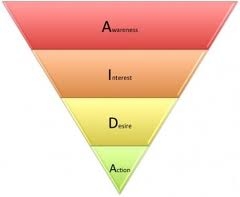
AIDA purchase funnelIn fact, the famous “AIDA” model – which stands for awareness, interest, desire and action – was first posited as far back as 1898 by Elias St. Elmo Lewis, an American sales and advertising professional and business writer.

“AIDA” was also the inspiration behind the classic purchase funnel – an orderly, simple path consumers take on the way to selecting and purchasing a product or service.

AIDA has had a good run, because for more than a century, the AIDA purchase funnel has meshed neatly with the various advertising and MarComm tactics that have come along the pike – print advertising, direct mail marketing, radio, television – and even the Internet.

While some people might contend that the advent of the Internet disrupted traditional buying processes, the greater reality is that it brought certain aspects of the buying process into sharper relief. Search engine optimization and search engine marketing stepped in to play nicely within the “interest, desire and action” steps.

Even better, Internet marketing made ineffective “soft” attitudinal metrics less important; all of a sudden, it became much easier to make educated decisions about sales and marketing programs based on hard evidence.

But with social media taking center stage, everything is now scrambled. The tidy “linear” purchase process just doesn’t reflect what’s happening now that “interactivity all over the place” is the thing.

But what exactly is the new “thing” when it comes to the purchase process? There’s a lot of discussion … lots of thinking … but not much in the way of conclusions.

Perhaps the most well-known attempt at replacing AIDA with a new model has been made by consulting firm McKinsey. In 2009, it came up with the “modern” version of the purchase funnel which it dubbed “the consumer decision journey.”

McKinsey purchase funnel
McKinsey’s new model has been described as a “purchase cycle,” a “customer journey,” and various other alternative explanations — you can take your pick.

But what exactly is that? When you look at how McKinsey attempts to graph it … it may be the proverbial “big ol’ mess.”  I’ve pictured it here so you can try and have some fun with it.

The “McKinsey Whatever” may be hard to grasp pictorially, but there’s one thing’s about it: it’s surely not linear.

There are two circles (kind of). Consumers can go around within the circles forwards or backwards. They can also go sideways between the two (sort of).

Truth be told, the “McKinsey Thingamabob” is fairly difficult to untangle. At least that’s the claim of some business observers such as Jon Bond, a marketing specialist and cofounder of branding agency Kirschenbaum Bond Senecal. He writes this:

“I’ve been in 20 meetings where the ‘McKinsey Frankenfunnel’ has come up , and not once has anyone had the courage to admit that they didn’t have a clue what to do with it.”

Bond goes on to posit that introducing this new model was a masterstroke on the part of McKinsey (wittingly or unwittingly) because it’s become a boon to its consulting business: Companies have to hire McKinsey so the consulting firm can explain it, he notes wryly.

Whether it’s the McKinsey diagram or any other one that’s been proffered recently in an attempt to illustrate the new purchasing paradigm (one being a Google model with the eyebrow-raising acronym “ACID”) – what’s clear is that the purchase process is more complex then ever before. And in that process, the number of touchpoints has also grown dramatically.

Perhaps the best thing to do is to jump out of the funnel (or box, or circles, or whatever the purchase cycle is today). Instead of focusing on impressions or touchpoints, let’s remember the big thing that interactivity has placed in the hands of purchasers: far more opportunity to see and hear what trusted influencers are saying about products, services and brands.

It’s like going back to traditional, pre-1900 word-of-mouth advertising — and putting it on steriods.

Jon Bond contends that this new riff on WOM may be the smarter way of looking at the purchase journey a customer takes today. Instead of the “old AIDA” or the “new interactivity,” he suggests focusing more on three degrees of “trust“:

  • Before trust: Even if the brand is known, it’s not yet trusted because no credible third party has validated the brand in the eyes of the buyer.
  • Trust exists: An interaction happens with a trusted influencer who recommends the brand or has positive things to say about it.
  • Advocacy: Nirvana for companies, wherein a highly satisfied customer also becomes a brand advocate, providing third-party validation and attracting additional new customers because of the resulting brand credibility.

Incidentally, the above scenario is particularly effective in the B-to-B world, where credibility and the “CYA” impulse have always played big roles in guiding business buyers to make purchase decisions they won’t regret later.

Consider it the IBM principle, writ large:  You’ve probably heard the adage that “nobody ever got fired for recommending IBM.”  Now, in the “Age of Interactivity,” that principle can apply across the board.

H. Owen Reed at 103: The Dean of American Composers Celebrates a Birthday

H. Owen Reed, Dean of American composers.
H. Owen Reed, the “Dean of American composers,” turned 103 years old on June 17, 2013.  “In 100 years you can pack in a lot,” he says.

The American composer H. Owen Reed celebrates a birthday this week. At 103 years old, he is surely America’s oldest composer “of note” today. And if you ever played a musical instrument and were involved in a concert band ensemble, chances are you’ve performed his highly accessible and engaging music.

Herbert Owen Reed is a product of the American Midwest – born in 1910 and raised in Missouri not far from Kansas City. His family had musical interests; his father was a country fiddler and his mother played the piano.

Young Owen dutifully took lessons in classical piano as was the custom in many a middle-class household in those days. But he was more interested in popular piano ditties than he was in Beethoven or Bach.

H. Owen Reed, band director, in 1936.
H. Owen Reed directing the band “The Missourians” in 1936.

Reed was also attracted to swing band music, eventually leading several bands of his own. This early interest would inform aspects of his later career as a classical composer, as some of Reed’s most famous and oft-performed pieces are scored for concert bands.

In 1937, Reed received his Ph.D. in music composition from the Eastman School of Music in Rochester, NY. Among his teachers was the esteemed Howard Hanson, head of the school and a popular composer in his own right.

Other leading musicians with whom Reed was fortunate to study included the composers Aaron Copland and Bohuslav Martinú, and the conductor Leonard Bernstein.

Reed achieved his big break as a composer at a relative early age. In the late 1940s, following an extended study of Mexican folk music in several provinces south of the border, Reed composed a “Mexican Folk Song Symphony for Band” he subtitled La Fiesta Mexicana.

Just a few years later, this piece would receive its first recording by Frederick Fennell and the Eastman Wind Ensemble – and a blockbuster recording it was.

Stunningly recorded by Mercury Living Presence engineers led by C. Robert Fine employing his famed “single microphone” technique, La Fiesta Mexicana burst on the classical record scene and became an overnight sensation.

La Fiesta Mexicana, Frederick Fennell, Eastman Wind EnsembleMusic lovers were dazzled by the color and inventiveness of the score – as well as the sonic power of the recording — an absolutely incredible audio accomplishment in 1954.

Drawing from a variety of authentic Mexican folk melodies, Reed created a highly substantive three-movement symphony, brimming with freshness and imagination throughout its nearly 30-minute duration.

The work was a major trend-setting accomplishment that sparked interest on the part of other American composers who were inspired to pen their own works for concert band.

It’s not an exaggeration to suggest that La Fiesta Mexicana sparked a whole new genre of “long-form” compositions for wind ensemble.

The 1954 premiere recording of La Fiesta Mexicana would be the first of many made of Reed’s score in the ensuing decades – nearly 30 at last count. Nearly all major American wind ensembles – many of them associated with America’s best university music programs – have seen fit to record the work. Concert bands as far away as Japan have issued recordings.

Several recordings of the symphony have been made by the U.S. armed forces bands as well. This YouTube clip of the third movement of La Fiesta Mexicana, recorded recently by the U.S. Marine Band, delivers all of the energy and freshness inherent in Reed’s score.

[I’ve heard perhaps a half-dozen different recordings of La Fiesta Mexicana. I keep coming back to the original 1954 Fennell version as the one that delivers the best combination of artistic interpretation and audiophile sound. Underscoring that recording’s reputation is the fact that it remains commercially available even today, fully 60 years after it was recorded!]

While Reed’s symphonic band scores are the most famous and popular of his musical output, they are by no means the full extent of Reed’s creative energies. He has also composed operas, chamber and instrumental music, and works scored for symphony orchestra (including a youthful symphony).

Reed’s long musical career is also distinguished by the fact that he was on the faculty of Michigan State University for nearly 40 years – from 1939 until his retirement in 1976 (and since then as a distinguished professor emeritus). Many of Reed’s own students have gone on to become well-known composers in their own right. And he is the recipient of numerous honors and awards, including a Guggenheim Fellowship for Creative Work in Musical Composition.

Reed’s appreciation of the musical legacy of the cultures of the Americas has been an abiding interest over the decades. In addition to his music research in Mexico in the late 1940s and again the early 1960s, he has studied the folk music traditions of the Caribbean Basin, as well as the Native American music of Arizona and New Mexico.

At age 103, H. Owen Reed is surely a link to America’s musical past. Yet he is also a man of today who retains a keen interest in “all things musical.” I found this YouTube clip of Reed at age 102, performing the popular American standard Misty, particularly endearing.

So here’s a hearty toast to H. Owen Reed, the Dean of American composers, on the occasion of his 103rd birthday.  Well done, master!

To Find Newspaper Readers in the United States … Head East

Newspaper stackThe news about newspaper readership rates has been uniformly bleak over the past decade or so.

In fact, readership rates for daily print newspaper have declined almost 20% since 2001, according to trend studies conducted by market research firm Scarborough.

Today, national daily print newspaper readership rates stand at around 37% of adults, down from ~50% just a dozen years ago.

Interestingly however, there are distinct differences in readership rates based on geography. 

Readership appears to be highest in the Northeast and Industrial Midwest regions, whereas it’s significantly lower than the national average across the Southeast, Texas and the Pacific Southwest.

Which metropolitan market takes top honors for readership? It’s Pittsburgh, where ~51% of the adult population reads daily print newspapers.

Other high readership rates are found in a cluster of markets within a 250-mile radius of Pittsburgh, it turns out:

  • Pittsburgh Metro Area: ~51% of adults read daily print newspapers
  • Albany/Schenectady/Troy Metro: ~49%
  • Hartford/New Haven Metro: ~49%
  • Cleveland Metro: ~48%
  • Buffalo/Niagara Fall Metro: ~47%
  • New York City Metro: ~47%
  • Toledo Metro: ~47%

Only one other metropolitan market charts daily newspaper readership as high: Honolulu, at ~47% adult readership.

Highest and Lowest Daily Newspaper Readership by Major Metropolitan Market
(Source: AdvertisingAge Magazine)

At the other end of the scale are various Sunbelt urban markets. Here are the five metropolitan areas that bring up the rear when it comes to the lowest daily newspaper readership rates:

  • Atlanta Metro Area: ~23% of adults read daily print newspapers
  • Houston/Galveston Metro: ~24%
  • San Antonio Metro: ~24%
  • Las Vegas Metro: ~26%
  • Bakersfield Metro: ~26%

What’s the cause of these geographic discrepancies?

It may be age demographics, which tend to skew younger in these Sunbelt markets.

Perhaps it’s the ethnic composition of the markets – although pretty much all of them on both lists have diverse populations.

So I turn the question over to the readers:  If you have any insights (or even simply suspicions) to share, I welcome your comments.