Evil eye? Google’s vision for the future.

pay-per-gaze creepy disturbingTo understand where Google is heading next in the world of advertising, consider this:  The company has just been granted a patent on its “pay-per-gaze” eye-tracking system.

You might wonder what that might be.

Pay-per-gaze is an ad system that utilizes Google Glass for tracking the ads that consumers see online and elsewhere.  The gaze-tracking capability comes from another Google innovation:  a head-mounted tracking device that communicates with a server.

According to the patent documentation, the tracking devices includes eyeglasses with side-arms that engage the ears of the user … a nose bridge that engages the nose of the user … and lenses through which the user views the external scenes wherein the scene images are captured in real-time.

And it need not be limited to tracking online advertising, either; pay-per-gaze functionality could potentially extend to billboards, magazines, newspapers and other printed media, Google notes.

But the idea is even more revolutionary than that:  Not only does it aim to measure how long an individual looks at an ad, but also how “emotionally invested” the consumer is by virtue of measuring pupil dilation.

So the tracking system not only will show how long someone looks at an ad, but also will measure the emotional response.  The patent also covers a provision for “latent pre-searching” which would display search results over a user’s field of vision using Google Glass or another wearable computer.

If all of this seems like “Big Brotherism” at its worst … you may well be correct.  But Google is doing its best to downplay such sinister connotations.  It’s emphasizing that users can opt out of “pay-per-gaze” tracking, and that all data will be anonymized.

But let’s get this straight:  The world’s biggest search engine was just granted a patent for the most “sticky” form of advertising possible – ads that literally flash in front of someone’s eyes.

And when we add in aspects like measuring pupil dilation, it won’t be long before Google will be able to determine how good eats, or good looks, are affecting our emotional response.

One wonders how much farther we can go with measuring advertising engagement and buying intent. 

Then again, we already have an answer, of sorts.  As early as 2000, experiments with electromagnetic brainwaves have shown that people can literally “think” instructions and thereby cause an action.

Imagine combining Google’s pay-per-gaze and pay-per-emotion with electromagnetic brainwave tracking.  Add in a credit card number, and there’s no telling what could happen just with a fleeting thought or two!

If all of this sounds creepy and disturbing … get used to it.  With the likes of Google and the NSA at the helm, “creepy and disturbing” may well become the “new normal” for society.

Craigslist: The $5 billion juggernaut that crippled an industry.

Craigslist logoIt’s common knowledge that the business model for newspapers started going awry in a major way with the decline in newspaper classified advertising.

Craigslist played a huge role in that development, as the online classifieds site went about methodically entering one urban market after another across the United States.

And now we have quantification of just how impactful Craigslist’s role was.  It comes in the form of a May 2013 study authored by Robert Seamans of New York University’s Stern School of Business and Feng Zhu of the University of Southern California.

Titled Responses to Entry in Multi-Sided Markets:  The Impact of Craigslist on Local Newspapers, the study explored the dynamics at play over the period 2000-2007, focusing on newspapers’ degree of reliance on classifieds at the time of Craigslist’s entry into their markets.

What the researchers found was that those newspapers that relied heavily on classified ads for revenue experienced more than a 20% decline in classified advertising rates following Craigslist’s entry into their markets.

But that isn’t all:  The outmigration of classified advertising to Craigslist was accompanied by other negative trend lines — an increase of subscription prices (up 3%+) and lowering circulation figures (down nearly 5%).

Even newspaper display advertising rates fell by approximately 3%.

Were these developments “cause” or “effect”?  The study’s authors posit that fewer classified ads may have diminished the incentive for people to purchase the newspapers.  Also, display advertising rates tend to track circulation figures, so once the “decline cycle” started, it was bound to continue.

The study concludes that by offering buyers and sellers a free classified ad alternative to paid listings in newspapers, Craigslist saved users approximately $5 billion over the seven-year period.

Those dollars came right out of the hides of the newspapers, of course … and changed the print newspaper industry for good.

But here’s the thing:  The experience of the newspaper industry has relevance beyond just them.  “The boundaries between media industries are blurred and advertisers are able to reach consumers through a variety of platforms such as TV, the Internet and mobile devices,” the authors write.

The unmistakable message to others in the media is this:  It could happen to you, too.

A full summary of the Seamans/Zhu report can be found here.

Expect Stormy Weather for the U.S. Cloud Computing Industry

NSA SpyingMy brother, Nelson Nones, has lived and worked outside the United States for years.  From his vantage point “outside looking in,” I find that his perspectives on U.S. socio-political developments are often somewhat different from the conventional thinking here at home.

This was clearly evident when the news broke In early June about the National Security Agency (NSA) surveillance of e-mail and other digital content.  Within just a couple days, Nelson had penned a thought piece on the implications of these revelations on the cloud computing industry.

In his view, the NSA revelations are likely to have numerous serious implications.  As he states in his analysis:

“… these threats will be perceived to be so serious that many businesses could decide to abandon the use of cloud computing services going forward — or refuse to consider cloud computing at all — because they bear full responsibility for compliance yet now realize that they have little or no ability to control the attendant non-compliance risks when utilizing major cloud services providers. 

In view of recent revelations, the tantalizing cost savings and efficiencies from cloud computing may be overwhelmed by the financial, business continuity and reputational risks.”

Geoprise Technologies logo
Out front: Geoprise Technologies was among the first to warn about the negative consequences of NSA surveillance programs on the U.S. cloud computing industry.

You can read Nelson’s full article on his company’s website, Geoprise Technologies Corporation.

I wondered how long it would take for these views to gain traction here in the United States.

It didn’t take long at all.  In fact, the Information Technology & Innovation Foundation, a Washington, DC-based think tank focusing on technology policies, released a report a few days ago in which it projects the U.S. cloud computing industry to forfeit between $22 billion and $35 billion in lost business as a result of the revelations about the NSA’s electronic surveillance programs.

That represents between 10% and 20% of a cloud computing market that is expected to be a $207 billion industry by 2016 – revenues which are likely to be sucked up by European and Asian companies instead.

ITIF logo (Information Technology & Innovation Foundation)The ITIF report warns that the NSA’s surveillance programs “will likely have an immediate and lasting impact on the competitiveness of the U.S. cloud computing industry if foreign customers decide the risks of storing data with a U.S. company outweighs the benefit.”

The implications are huge because up until now, the United States has been the acknowledged leader in cloud computing usage and innovation, even as other countries have tried to play catch-up.

The ITIF report has garnered the attention of the business press — big time.  The Guardian has published a story as has the Financial Times.  The story has leached into general news and opinion sites as well, such as The Daily Kos — and others are sure to follow suit.

All of this is a pretty major deal because the cloud computing industry represents one of the fastest growing sectors of the digital communications market.  Global spending on cloud computing is anticipated to grow by 100% between 2012 and 2016.

That compares to growth of only about 3% for the global IT market as a whole.

And in case people are thinking that the ITIF report might be unduly alarmist … it appears that the giant sucking sound of cloud computing business going elsewhere has already begun to happen.

Some U.S. tech companies are reporting that they’ve already lost customers, as concerns mount over the NSA’s PRISM program that lets the federal government tap into user information and e-mails held by Internet companies.

The Cloud Security Alliance, a coalition of industry practitioners, corporations, associations and other key stakeholders whose mission is to promote the use of best practices in providing security assurance within cloud computing field, conducted a survey in June and July of companies located outside the U.S.  That survey found that ~56% of the responding companies are now less likely to use a U.S.-based cloud computing service, thanks to the NSA’s spying program.

One out of ten respondents reported that they have already canceled contracts with U.S. companies.  And that’s only within the past few weeks.

Meanwhile, non-U.S. players in the cloud computing market must surely be laughing all the way to the bank.  For example, Artmotion, the largest hosting company in Switzerland, reported a ~45% increase in revenue within just the first month after Edward Snowden’s release of details about the PRISM program.

To be sure, Europeans are wasting no time weighing in on the messy situation the American cloud computing industry suddenly faces.  Neelie Kroes, European Commissioner for Digital Affairs, had this to say:

“If European cloud customers cannot trust the United States government, then maybe they won’t trust U.S. cloud providers either.  If I am right, there are multibillion-euro consequences for American companies.  If I were an American cloud provider, I would be quite frustrated with my government right now.”

Germany’s Interior Minister Hans-Peter Friedrich was even more blunt:

“Whoever fears their communication is being monitored in any way should use services that don’t go through American servers.”

What are the companies that fear their communications are being monitored, as Mr. Friedrich posits?  Pretty much all of the bigger ones, I’d think.

OK, U.S. government and administration officials:  Have fun unscrambling this egg!

Social Marketers Behaving Badly …

Social marketers behaving badlyEx-Cong. and New York City mayoral candidate Anthony Weiner hasn’t been the only one misbehaving on social media.

Chipotle Mexican Grill also gets a time-out to sit in the corner for its social media hi-jinks. 

It turns out that a supposed hacking of Chipotle’s Twitter account in mid-July was nothing more than a ploy to grab attention and gain more Twitter followers.

For those who haven’t heard, Chipotle’s Twitter stream appeared to have been hacked as a series of bizarre and nonsensical tweets were posted over the span of several hours – until the company claimed to have solved the problem.

As it turned out … the whole thing was completely manufactured – all of those crazy tweets published by the company itself.

A few days later, a Chipotle spokesperson came clean, admitting that the whole episode was actually a carefully orchestrated effort to gain more Twitter followers, in concert with the company’s 20th anniversary.

Did it work?  Evidently yes … because Chipotle had ~4,000 more Twitter followers at the end of the campaign than it did at the beginning.

But some marketing professionals were critical of the ploy.  Here are a few representative comments:

  • Chipotle is a brand about honesty and authenticity; faking a hack if off-brand.”  (Rick Liebling, Y&R Creative Culturalist)
  • “Most of these stunts … strike me as being pretty lazy.  It’s like making your CEO do a press conference drunk and then apologizing for it once he sobers up.”  (Ian Schafer, Deep Focus CEO)
  • Chipotle’s pico de gallo was more ‘weak sauce’ than ‘muy caliente.’”  (Saya Weissman, Digiday Editor)

On second thought, perhaps it’s not such a good idea to “mess with the market” when upside is a few additional social media contacts (that probably won’t stick around), and the downside is brand irritation or even humiliation.

After all, Chipotle’s net gain in Twitter followers represented an uptick of just 1.7%

That seems a bit paltry considering the potential blowback and reputation risk.

Ziggeo: The HR Manager’s Newest Friend

Ziggeo logoWho hasn’t ever interviewed someone and known within the first minute or so that the meeting was going to be a complete waste of time?

[Then the fun part was having to make inconsequential small talk for the rest of the interview just to appear civil!]

Unfortunately, this scenario happens more often than we’d care to admit.  And considering the effort involved in planning and conducting phone or in-person interviews, it’s a major waste of time and resources.

But now a company has come along that harnesses the Internet and camera technology to offer a different approach that I find pretty intriguing.

It’s called ZiggeoFounded by entrepreneurs Susan Danziger and Oliver Friedmann, it’s an online service that enables HR managers and others to screen job candidates and other people using video technology.

It’s as simple as posing a few questions on the Ziggeo site … then providing a Ziggeo link to the interested parties for them to respond.

Job candidates simply click on the link to receive the questions.  They respond with short video recordings, which the HR manager can view at his or her convenience.  It’s an efficient and inexpensive way to prescreen job candidates in the very first stage of the interview process.

Since most people have video capabilities embedded in their digital devices these days, they can respond easily without being impeded by a lack of technical tools.  And if candidates balk at participating … chances are those people wouldn’t have ended up on the short-list of finalists anyway.

Job interview via videoZiggeo has also incorporated a simple “rating” functionality into its system to make it easy to grade the quality of video responses, which would come in handy for people who are evaluating a large number of candidates.

I think this is a great way to separate the “wheat from the chaff” when it comes to people selection.  Plus, we get to see how people are responding to our own specific questions … not having to rely just on resumes, covers letters and the like.

While job applicants are probably the biggest potential uses, there are numerous other applications of the Ziggeo approach.  I can see it being used to screen all manner of people:

  • Interns
  • Casting calls
  • Babysitters
  • Adult/senior caretaking
  • Roommates and apartment mates

Ziggeo can also serve as a quick, easy and affordable method to “vet” video testimonials and media interviews.

Like so many other web-based offerings, Ziggeo offers different usage plans based on the level of need.  There’s a free plan that allows for video clips up to 20 seconds in length, as well as a “personal” paid plan that allows clips up to two minutes long.

The Ziggeo Pro premium-level service levels goes a lot further than that, allowing  for hundreds of videos up to 15-minutes in length plus multiple screening rooms, which should prove most popular with hiring practitioners and human resources departments at large companies.

I don’t have personal experience with this tool myself, but it seems like its positive attributes as a “first sort” for personnel selection would far outweigh any negative aspects.

What experience have readers had with Ziggeo or similar video screening services?  Would you recommend using them, or are there drawbacks?  Please share your comments here.

A new survey paints a more nuanced picture of public attitudes about government and business …

To hear the politicians in Washington talk, the American people are either looking for government to solve society’s ills … or they want government to butt out completely.

2013 Public Affairs Pulse SurveySuch black-and-white perspectives rarely turn out to be accurate … and now we have additional proof in the form of a May 2013 telephone survey of ~1,600 adults living in the United States, conducted by Princeton Survey Research Associates for the Public Affairs Council, a leading professional organization for public affairs executives (nonpartisan).

Among the key takeaways of the 2013 Public Affairs Pulse survey research:

  • Trust in business:  Three out of four respondents feel that major companies generally do a good job of “providing useful goods and services,” and two-thirds also believe they’re doing a good job of serving their customers.  But by similar margins, they also believe that companies should take on more responsibility in providing community services like quality education, affordable healthcare, and food banks.
  • Government regulations:  Opinions are split;  a slight majority (~52%) feels that government regulation of business “usually does more harm than good” … but ~44% believe that “regulation is necessary to protect the public interest.”
  • Trust in government declines with age (and familiarity?):  A majority of Millennials give the federal government favorable scores, compared to ~44% of Gen Xers and just 35% of Baby Boomers.

Another figure stands out, too:  Only around 37% of the respondents express “a lot” or “some” trust and confidence in the government’s ability to fix the country’s problems.  This finding appears to support the notion that the government is not a panacea for the nation’s problems.

Michael Barone, political analyst and observer
Political analyst Michael Barone first espoused the idea of the “50/50 nation” following the 2000 U.S. presidential election.

But the survey results also underscore the theory espoused by Michael Barone, Mickey Kaus and other observers of the American electorate that America remains a “50/50” nation when it comes to the political parties and their philosophical underpinnings.

… And that puts us right back where we we’ve been for the past decade and a half … despite the posturing of our political leaders.

For additional findings from the 2013 Public Affairs Pulse survey, click here.

Andrew Mason’s Next Act: Groupon’s ex-CEO Releases a Music Album

Andrew Mason - Hardly Workin' music album
Groupon’s ex-CEO Andrew Mason is releasing a music album titled — appropriately enough — “Hardly Workin’.”

I’ve blogged before about the tribulations of Groupon and its “daily deal” couponing business.

The company has found it incredibly difficult to develop a sustaining business model, what with increased competition and the propensity for vendors to cease their participation after one or two deals due to disappointing program results.

With Groupon taking 50% of every deal plus a credit-card handling fee, far too many vendors found that they couldn’t make money on “daily deal” promotions, and often, “repeat business” from the ultra-price-savvy consumers who tend to participate in such schemes never materialized

Groupon founder and former CEO Andrew Mason was hardly the typical head of a dotcom business.  His business background was rather thin, despite having started a Saturday morning bagel delivery service in suburban Pittsburgh when he was just 15 years old.

Instead, Mason graduated from Northwestern University in 2003 with a degree in music, signaling where his interests truly lie.  After having worked at several Chicago-area tech companies, Mason managed to snag some seed money from Chicago entrepreneur Eric Lefkofsky, and Groupon was born in 2008.

By 2010, Groupon was the latest star in the constellation of online businesses, with annual revenues of ~$800 million.  In December of that year, Groupon was offered $6 billion to sell to Google, but Mason and his company board foolishly declined the offer.

But within two years, Groupon’s fortunes had turned dramatically for the worse.  Herb Greenberg of CNBC named Mason the “Worst CEO of the Year” in 2012, writing:

“Mason’s goofball antics, which can come off more like a big kid than company leader, almost make a mockery of corporate leadership – especially for a company with a market value of more than $3 billion.  It would be excusable, even endearing, if the company were doing well … but it’s not.”

After one too many missed quarterly goals, Groupon’s board of directors ousted Mason on February 28, 2013.  On the day of his dismissal, Mason wrote to his employees:

“After four and a half intense and wonderful years as CEO of Groupon, I’ve decided that I’d like to spend more time with my family.  Just kidding – I was fired today.  If you’re wondering why … you haven’t been paying attention.”

But now Mason is back – just not in the same way.  This time, it’s as a musician.  The former punk band keyboardist (and also husband of pop singer Jenny Gillespie) is releasing an album titled “Hardly Workin’” that contains seven songs.  It was produced by Don Gehman, who has also worked with R.E.M. and John Mellencamp, among others.

Here’s what Mason has to say about his latest project:

“I managed over 12,000 people at Groupon, most under the age of 25.  One thing that surprised me was that many would arrive at orientation with minimal understanding of basic business wisdom.”

This album pulls some of the most important learnings from my years at the helm of one of the fastest-growing businesses in history, and packages them as music.  Executives, mid-level management and front-line employees are all sure to find valuable takeaways.”

*  *  *  *  *

“If you’re seeking business wisdom, you don’t need no MBA — look no further than the beauty that surrounds us every day …”

*  *  *  *  *

With lyrics like these, one wonders if Andrew Mason isn’t talking so much about 12,000 employees, but instead about himself!

Where do people spend their time online?

How much time to people spend online ... and doing what?With the ever-growing options for where people spend their time when online, what’s the latest in terms of their online behaviors?

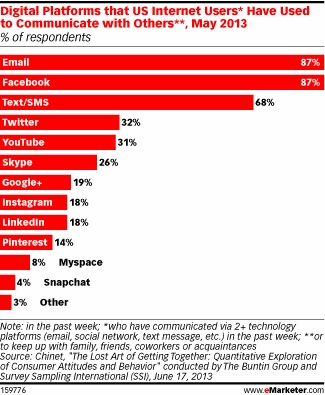
That’s the question The Buntin Group, a MarComm and branding agency, and Survey Sampling International (SSI) were trying to answer when they conducted a survey of American web users in May 2013. 

The survey was conducted among adults who use at least two tech platforms (including e-mail, text or social) to connect with others during a given week.

What the survey found is that Americans are spending more time than ever online – about 23 hours per week on average.  That’s nearly a full day out of a seven-day week.

Drilling down further, the survey found that e-mail communications continues to be the most prevalent online activity, but it’s followed closely by Facebook:

  • Average time per week spent on e-mail communications:  7.8 hours
  • Average time spent on Facebook:  6.8 hours
  • Average time spent on YouTube:  5.0 hours
  • Average time on Google+:  4.3 hours
  • Average time on Twitter:  4.2 hours

In keeping with these findings, the survey also found that e-mail and Facebook are where most respondents log in most often to communicate with others:

Social Platforms used by Internet Users

But here’s another interesting finding from the survey:  From time to time, even the most digitally connected people find themselves fatigued by all of their online activity.

In fact, nearly 55% of the survey respondents reported that they had “walked away from technology at least occasionally” in the past year to gain more in-person time.

An even larger ~62% reported that they plan to reduce their “tech socializing time” in the upcoming year and instead focus on more face-to-face interaction.

Speaking personally, e-mail and YouTube are indispensable to me.  Facebook is a “nice to have” platform when it comes to keeping up with friends and family — and I usually check in once a day.  But I have gone as long as two weeks without logging on and haven’t felt worse for it. 

I spend far less time on Twitter than the survey average … and I don’t even have a Google+ account (nor do I have any plans to set one up).

What about you?  Based on your experience, does 23 hours of online activity weekly seem excessive – or close to the mark? 

Do you take “online vacations” periodically?  And which online activities are most important and valuable to you?  Please share your thoughts here.

College Kids and their “Gadget Goodies”

I’ve received a few interesting comments from readers about my recent blog post about so-called “digital dementia.”  One reader and business colleague of mine, Syed Tahir Rasul, had this to say:

“In the 1990s, we were taught that playing computer games would even sharpen our mental skills.  But now this enormous increase in gadgets, [even] in the hands of five-year olds … is certainly alarming.  This is causing some sort of disorder for sure.  But then again, we can’t live without these gadgets now!”

College students and their electronic gadgetsThis got me to wondering:  I have two twenty-something daughters who are most definitely “wired” up one side and down the other.  But is this behavior the norm or the exception?

I found some answers in the form of results from a new online survey of ~1,525 college students aged 18 to 34 conducted by market research firm Crux Research for re:fuel, a branding and media company.  To be included in the survey, each respondent had to be taking at least one course on a physical campus.

With ~22 million U.S. college students expected to be enrolled for the 2013/14 college year, one would imagine the behaviors of this large group would track fairly closely with the overall behaviors of this age cohort.

What the re:fuel research shows is that the average American college student possesses seven devices in their technology “arsenal” (that’s up from six a year earlier).  So it’s definitely a “gadget grab-bag” with these kids.

Laptops and smartphones lead the pack in popularity:

  • Laptop computer:  ~85% of American college students own one
  • Smartphone:  ~69%
  • Video gaming console:  ~68%
  • MP3 player:  ~67%
  • Printer:  ~62%
  • Digital camera:  ~61%
  • Flat-screen TV:  ~60%

—————————————————

  • Desktop computer:  ~48%
  • Tablet computer:  ~36%
  • Handheld gaming system:  ~35%
  • Feature phone:  ~33%
  • Camcorder/video recorder:  ~25%
  • E-reader:  ~21%
  • Tivo/DVR:  ~18%

The “break” we observe between ownership rates of 60%+ and below 50% is as much a function of changing tastes in digital equipment as anything else.  “Old fashioned” feature phones are biting the dust as more college kids trade up to smartphones.  In fact, the survey reveals that more than 30% of the respondents say they intend to purchase a new smartphone in the coming year.

[Considering the ownership rates that already exist, quite a few students will be trading up not from a feature phone, but from another smartphone.]

Who uses camcorders anymore, when so many smartphones take just as good-quality pictures?

Desktop computers?  Why even bother?

There’s a good deal more information contained in the re:fuel college study — covering not only technology ownership but also student spending, online behaviors, media consumption habits, and engagement on social platforms.  You can review report highlights here.

If you have college-age kids … or if you’ve been a student yourself recently, I’m interested to hear your perspective on these trends.  Please share your thoughts.

Welcome to Modern Times’ Newest Malady: “Digital Dementia.”

Digital dementia among young people: studies in South Korean, the U.S. and Germany confirmIt seems like a new “unintended consequence” of our digital age emerges every other week.  Recently it’s been a spate of warnings about the dangers of texting while driving.

And now we have reports of a condition dubbed “digital dementia” that’s supposedly plaguing teens and Millennials.

This phenomenon is being reported out of South Korea, a country that happens to have the highest rate of smartphone adoption in the world.  More than two thirds of all South Korean adults have a smartphone, and among teenagers, it’s nearly as high (~64%).

Indeed, according to the country’s Ministry of Science, smartphone adoption by South Korean teens has jumped more than 200% since 2011 when it was less than 22%.

So what is “digital dementia”?  It’s described as the deterioration in cognitive abilities that comes from an imbalanced development of brain functions.

Commenting on the use of smartphones and gaming devices among young people, “Heavy users are likely to develop the left side of their brains, leaving the right side untapped or underdeveloped,” claims Byun Gi-won, a physician at the Balance Brain Centre in Seoul.

According to Dr. Gi-won, such overuse results in symptoms that are more commonly observed in people who have psychiatric illnesses or have suffered head injuries.

The country’s Ministry of Science estimates that nearly one in five South Koreans ages 10-19 use their smartphone seven hours per day or more.  That’s up sharply from around 10% doing so just a year before.

Is the phenomenon of “digital dementia” among the young confined to South Korea or East Asia?  Manfred Spitzer, a professor of neuroscience in Germany, thinks not.  He’s the author of a book on digital dementia that was published in 2012, wherein he warned of the dangers of allowing children to spend too much time on electronic devices such as tablets, smartphones and game devices.

Dr. Manfred Spitzer, author of "Digital Dementia."
Do you recognize this face? Dr. Manfred Spitzer, author of “Digital Dementia.”

In fact, Dr. Spitzer maintains that deficits in brain development are irreversible.  His solution:  Ban digital media from German classrooms completely.

Dream on, professor.  That’s certainly not going to happen!

Likewise, we have a recent study from the University of Southern California at Los Angeles that points to increasing memory problems among people ages 18-39.  The UCLA report blames “modern lifestyles,” claiming that the many digital gadgets within easy reach of young people prevent them from developing memorization skills and other forms of focus.

On the other hand, that same UCLA study concludes that for some older patients suffering from mental decline, engaging in brain-fitness computer games like Luminosity or Posit Science’s Brain HQ have improved their language and memory skills significantly.

Considering that age-related memory decline affects as many as 40% of older adults, that UCLA finding may turn out to be as noteworthy on the positive side of the ledger as the South Korean one on the negative side about young people.

Like any other “transformational” technology, the digital revolution continues to play out in unexpected ways.  Somehow, I expect us to be hearing many more reports of this type as the years roll on.

Not that these theories of cognitive weakness don’t have their detractors.  You can read several strongly worded retorts here and here.

What do readers think?  Big news … or bunk?  Please share your thoughts here.