SoLoMo: The Newest Buzz Term in Marketing Communications

solomoEvery few years or so, we start hearing a pithy (and sometimes obnoxious) new buzz term in marketing communications.

The most recent entry into the lexicon is SoLoMo – a cutesy amalgam of three terms:  Social Media, Location, and Mobile Devices.

SoLoMo purports to convey the convergence of these three elements into a powerful new driver for marketing:  sparking audience engagement and brand usage via the use of social media, and targeting consumers via their mobile devices when they are locationally proximate.

businesspersonBeyond the inevitable “wink-wink, nudge-nudge” aspects of this term and the “oh-so relevant” connotation it has for those who choose to name-drop it in casual conversation, another drawback I see is the term’s emphasis on tactics rather than on the true meaning of today’s always-connected customers and the potential this offers for relationship-building.

Right now, there are more than a few company and brand marketers who are trying to figure out the best way to have their customers do all sorts of things that will benefit a product’s acceptance and position in the market — things like checking in to a physical location, then taking a mobile picture and uploading it to an Instagram or Facebook page.

This over-reliance on “shiny new object tactics” is what gets marketers to the same place as designing a new and novel app that doesn’t actually fill a true need – and hence becomes an inglorious failure.

Here’s what’s actually going on with consumers today:

  • They have more digital connections available to them than ever before.
  • Because of the pervasiveness of interactivity, consumers expect information to be available to them at any time – and on any device.

The good news is that marketers can establish just these sorts of connections with consumers, simply by using the very same social platforms.  The bigger challenge is making those connections meaningful and relevant.  That’s where effectiveness so often falls by the roadside.

Social media is an “ism” to many marketers … whereas to regular people, they hardly think of it that way.  For them, it’s just another way to engage in their relationships with friends, acquaintances, industry colleagues, fellow hobbyist … and favorite brands.  Other than the digital aspect of the communication, there’s really very little difference from the connections people have established and maintained for years the old-fashioned way.

Location is much more than simply where someone happens to be.  It’s the context of understanding when — and what — the person is doing at or near that location.  Knowing that makes for a more relevant – and potentially profitable — interactions.

Today’s focus on Mobile everything has become almost as myopic as marketers’ tunnel-focus on desktops was a few years back.  Today, we’re dealing with consumers who are perpetually connected.  As for which device, it simply depends on what’s handy at the moment – desktops, laptops, tablets, smartphones.  So, strategies and tactics that focus on one or two of these to the exclusion of the others will fall short of the mark.

While we can give an acknowledging nod to the SoLoMo buzz term, the key is to recognize that it’s actually about today’s perpetually connected consumers — and all of the expectations that come along with that.

In other words, marketers need to be people-focused … but tactics-agnostic.

Cue up the e-mail Rogues’ Gallery: Here’s what people are purging from their inboxes.

e-mail rogues galleryAnyone who’s had an e-mail account for any length of time likely faces ever-increasing inbox volumes.

And trying to keep those groaning inboxes in check can be a never-ending task.  Now a recent report gives us clues as to what e-mails are being purged most frequently by recipients.

It’s been released by Unroll.Me, a service that scans users’ e-mail accounts for all of the lists to which they are subscribed — knowingly or not.  It then gives people the opportunity to unsubscribe, or to consolidate groups of e-mails into a single regular update.

It turns out, many people are unwittingly “subscribed” to receive e-mails from vendors based on something as benign as making a single online purchase.  So Unroll.Me finds a substantial incidence of people taking unsubscribe actions when given the chance.

Unroll.Me’s report claims that it prevented more than 1 billion e-mails, offers and updates from reaching inboxes last year via its service.

Of particular interest than the overall volume is the list of e-marketers that have been dissed the most by customers.

Leading the list is 1-800-Flowers.  A whopping ~53% of Unroll.Me users had those e-mails stopped during 2013.

[A personal note about 1-800-Flowers:  Over the past five years, our family has used this service to order flowers twice a year (Christmas and birthday) to exactly one person.  For those twice-a-year transactions, I estimate conservatively that we receive more than 200 e-mail solicitations each year — most with breathless offers promising deep discounts on orders.  Do those offers make us more inclined to purchase from them?  Hardly.]

According ton Unroll.Me, other e-marketers that experienced high unsubscribe rates in 2013 include:

  • Ticketweb:  ~48% unsubscribe rate
  • ProFlowers:  ~45%
  • Expedia:  ~45%
  • Active.com:  ~45%
  • Oriental Trading: ~44%

At the other end of the scale are companies and services that remain subscribed to by two-thirds or more of those who received their e-mails.

This “Star Gallery” is made up of Facebook, Google+, Twitter and LinkedIn.  What these e-mailers share in common is that they are social platforms, with engagement and interest levels higher because of the topics involved (friends, acquaintances, contacts and shared interests).

In other words, it’s the people they know, not the things companies want to sell them.

Now, back to the purging …

Mobile advertising doesn’t work so well … but why?

Lack of advertising engagementOne of the complaints marketers have had about mobile advertising is that the engagement levels are so pitifully low.

But is this really so surprising? … seeing as how clickthrough rates on online banner ads have been in the dumper for years now – well before the explosion of tablet and smartphone usage.

Helpfully, a research study conducted by Praveen Kopalle, a Dartmouth marketing professor, gives us insights as to why mobile ad engagement is so low.  Here are the reasons cited most often in that survey:

  • Mobile screens are too small – 72% of respondents cited this as a reason why they steer clear of mobile ads.
  • Too busy for ads – 70% claimed they don’t have time for ads when they’re on-the-go.
  • Can’t return easily to the content originally being viewed – 69% found this aspect irritating enough to avoid taking action on an ad.
  • Ads take too long to load – 53% cited this factor, which is clearly dependent on the type of mobile device or service available.
  • Not in the mood for ads – 42% identified this as a factor (some things never change).

Other findings in Dr. Kopalle’s survey underscore the fact that mobile advertising needs cut to the chase, because mobile device owners are generally not in “browse” mode while using them.  Consider these contrasting findings between mobile device users and people using desktop or laptop computers:

  • The typical mobile consumer is on his or her smartphone or tablet eight times a day for approximately 15 minutes per session.
  • Desktop and laptops users are more likely to be engaged only once or twice per day – but spend around two hours per session.

Moreover, when mobile devices users are performing information-seeking tasks, nearly half of them reported that ads “do not register” with them. 

The takeaway message for marketers:  In addition to targeting ads to the right audiences, the advertising messages themselves better be super-compelling, because mobile users won’t be paying attention for very long – if at all.

More on Mobile Apps Marketing: Acquisition Costs are Higher than Ever

Mobile appsRight after publishing my blog post about the high attrition rates of mobile app usage, I heard from one of my loyal readers about another interesting development on the app front.

Now that there are millions of mobile apps being offered to consumers, it’s becoming much more costly for developers to market new ones to their mobile audiences.

Fiksu, a mobile app marketing firm, reports that the cost to acquire a “loyal app user” – that is, a person who opens an app three or more times – increased by nearly a third in 2012.

According to Fiksu, the average acquisition cost for a loyal user is now $1.62, compared to $1.30 in 2011.

This isn’t to say that app downloads have declined as a result.  Quite the contrary:  They achieved record-breaking volume in 2012.  But the growth rate has been slowing, in part due the larger download basis.

As for the implications raising costs and higher competition for the consumer’s attention, Sarah Perez of TechCrunch warns that “… in 2014, we might see more of the newer, younger companies trying darker shades of ‘growth hacking’ as a way to find initial traction.

Marketing Fail? Too Many Mobile Apps are Deleted within Days of Downloading

Mobile appsHere’s an interesting statistic offered up by marketing consultant Rich MeyerThree-fourths of mobile apps are deleted within three weeks of being downloaded by their users.

How can the attrition rate be so high?

According to Meyer, it’s because people decide they don’t really have a need for the apps … or they find them too difficult to use and master.

I suspect the percentage may also be so high because marketers fail to query their target audiences prior to developing apps to determine now much of a need it will be satisfying.

… Or to put it another way, to avoid falling into the trap of developing a cure for something that isn’t a disease.

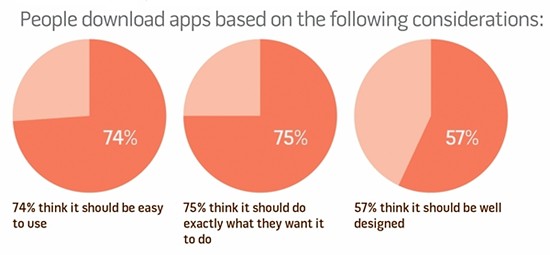
Mobile App Preferences
Sources: MarketingProfs; Harris Interactive and EffectiveUI field survey, 2010.

Meyer believes part of the dynamic at work is a knee-jerk “bias for action” as the marketing playing field shifts endlessly.

“It’s called ‘do it’ because everyone else is doing it, and it results in not only bad marketing, but in turned off consumers and customers,” he maintains.

Questions as simple as “What would you like to see in a mobile app?” … or testing an app concept with a sample of potential users before spending the effort and energy to produce it would be good places to start.

Marketers can use the research findings to adjust the proposed design of an app — or to trash it altogether and come up with an alternative one that actually meets a need.

If more companies did this, perhaps the 75% deletion rate for mobile apps would cease to be so flat-out dismal.

Twitter’s “Potemkin Village Problem” Isn’t Getting Any Better

“Millions of fake accounts dog Twitter.”

“Twitter dogged by bogus accounts.”

social-media-inflated-statsI’ve blogged before about the scads of Twitter accounts that are accounts in name only.

It’s been a problem for years.

But now, it takes on even greater significance as the market valuation of Twitter is being measured in the tens of billions as the company issues publicly traded stock in its IPO.

To this end, I found a recent Wall Street Journal article penned by technology reporter Jeff Elder particularly interesting in that it pulls together various pieces of evidence that have been building … and which together showcase the extent of Twitter’s “Potemkin Village” problem.  (Note the headlines from this article displayed above.)

Essentially, the problem is a plethora of “faux” Twitter accounts being created by an underground network of sellers – including 20 or so major operations scattered around the world – that then offer these accounts for sale to companies and brands wishing to “juice” their Twitter follower statistics to appear more consequential than they actually are.

Consider these points from Mr. Elder’s article:

  • Faux accounts abound on Twitter because users aren’t limited to having a single account – nor are they required to use their real names.
  • In securities filings, Twitter claims that “fake” accounts represent fewer than 5% of its active user accounts.
  • But this past summer, security researchers Andrea Stroppa and Carlo de Micheli reportedly uncovered more than 20 million fake accounts for sale on Twitter – which is closer to 10% of Twitter’s active account base.  (Twitter had no comment on this report.)
  • Stroppa and de Micheli also unearthed the existence of software programs that allow spammers to create unlimited fake accounts on Twitter.  (Twitter had no comment on this report.)

Evidently, Twitter has taken stabs at reducing fakery among its account base — however sporadically.

About a year ago, the company reportedly worked with a team of researchers from UC Berkeley and George Mason University to identify fake Twitter accounts and minimize “robot” activity.  This was done by actually purchasing fake Twitter accounts on the black market and then identifying their common characteristics.

A filter subsequently developed was then able to block ~95% of such accounts – but it was only a matter of days before the underground market figured out ways to get around the new filters.

Within two short weeks, the filters were successfully blocking only about 50% of new fake Twitter accounts, and that percentage has continued to decline further since then.

And these faux accounts are available for a ridiculously small amount of money.  For instance, this past November one marketer purchased 1,000 accounts from an online vendor located in Pakistan … for a whopping $58.

This marketer then programmed them to “follow” the Twitter account of a rap artist client who was interested in boosting his standing on the social network.

In addition, those same accounts have been used to retweet the rapper’s own tweets, thereby giving them greater exposure on Twitter.

And believe it or not, this sort of ruse often works, because prominence on Twitter can lead to legitimate attention by an unwitting press and other “influencers.”

But it’s all blue smoke and mirrors, of course.

The downside?  As more of these stories get reported and shine a light on the seedy underside of the Twittersphere, it can’t help but have a negative impact on the social platform’s reputation.

… Beginning with people like you and me.

When Google Glass clashes with reality … watch out for shards.

Google Glass Groupies on the prowl.

Like self-driving cars, Google Glass devices – those intriguing contraptions that allow users to be “online connected” at all times – appear to be one of those innovations that spark a thousand “what if?” scenarios.

And it’s not at all clear what all the implications of Google Glass may be.  But we’re beginning to get some clues as to what’s in store for users.

For starters, Google Glass owners have been sternly warned against using them in locker rooms, movie theaters, casinos … and even restaurants.

And earlier this month, attorney Paul Alan Levy of Public Citizen, a consumer advocacy group, claimed that Google Glass wearers in some states could potentially face prosecution for recording people without their explicit consent.

Public Citizen logoIn a recent online column, Mr. Levy wrote:

“Many states require the consent of all parties in a conversation – at least, conversations not occurring in public situations – and provide both criminal penalties and a civil cause of action for participants.”

While such laws are on the books in just 12 states at the moment, collectively those jurisdictions represent more than a third of the American population (including the all-important states of California, Florida, Pennsylvania and Illinois).

So far, there doesn’t appear to be any record of prosecutions pertaining to using a Google Glass device to record someone without his or her consent.  But since these devices are such a rarity yet, that seems hardly surprising.

Too, there’s the possibility that the courts will rule that people are giving the wearer of a Google Glass device implicit consent to record them.  However, there’s something to the notion that many people would be basically clueless about whether they’re being recorded because of their unfamiliarity with the device and the technology.

And as if that angle isn’t enough, now there’s a company (FacialNetwork) that has developed a real-time facial recognition app for Google Glass.   With this app, called NameTag, people can snap a photo and search for more information online about the image – all in one action.

With new technology like this, finding a mate (or just a good-time girl or guy) will never be the same again.

Nor will the inevitable charges of invasion of privacy or stalking that follow.

Of course, to hear how the folks at FacialNetwork characterize it, you’d never think there were any potential negative consequences.  Instead, it’s all sweetness and light.  As NameTag co-creator Kevin Tussy puts it:

“It’s not about invading anyone’s privacy; it’s about connecting people that want to be connected.  We will even allow users to have one profile that is seen during business hours, and another that is only seen in social situations.”

Whatever.

And now … let the legal wrangling begin.

JWT’s Annual Forecast of Key Trends for Upcoming Year: “All About Me”

JWT (J Walter Thompson)For the past decade or so, marketing communications firm JWT Worldwide (for the tradition-minded, the alternate name for J. Walter Thompson) has issued an annual forecast of key trends for the upcoming year.

For 2014, JWT has identified certain key trends it believes will “shape our world” in the upcoming year and beyond.  They’re pretty interesting – and it’s hard to argue with most of them.

Here are four trends that struck me as the most interesting and significant:

  • The Age of Impatience – With the mainstreaming of the on-demand economy and an “always-on” culture, consumers want what they want now – or yesterday preferably!
  • The End of Anonymity – The NSA surveillance revelations were the icing on the cake here:  Unless you’re a monk on Mount Athos, it’s no longer possible to remain unobserved or untracked by corporations and governments – and you might not even be able to fly below radar on Mt. Athos.
  • Rage Against the Machine – In the inevitable backlash against the “end of anonymity,” many consumers resent or fear technology, even as they embrace it.  But like that second dark chocolate truffle, it’s the classic conundrum of hating the very thing you can’t resist.
  • Remixing Tradition – Taking cherished traditions and recasting them in a new light – whatever “feels right” today.  The burgeoning support for gay marriage is just one manifestation of this trend.

In order to develop its annual key trends forecast, JWT engages in a combination of qualitative and quantitative research and analysis.  For this year’s report, that included an online survey of ~1,000 adults in the U.S. and U.K., along with input from ~70 JWT planners and researchers across numerous markets.

The JWT forecast includes a total of ten trends.  The 2014 JWT report outlines all ten of them.  Are there any you particular agree with — or disagree perhaps?

Customer testimonials and user reviews: Social media takes a time-honored marketing tactic … and puts it on steroids.

product and service ratingsThere’s no question that most people value hearing the opinions of others when deciding whether to purchase a new product.

But in the fast-evolving world of social media where there’s been an exponential increase in testimonials, ratings and recommendations about various products and services, what types of recommendations resonate most?

We may have some answers to that question in results from a recent survey sponsored by marketing firm Social Media Link, which was issued in October to all members within the company’s Smiley360 community brand activation program.

Dubbed the “Social Recommendation Index,” the 20-question online survey was answered by more than 10,300 respondents.

The survey isn’t exactly a true cross-section of American consumers in that the vast majority of the respondents were women.  Moreover, most respondents were between the ages of 25 and 45.  Still, the results are certainly worth a look.

For starters, three-fourths of the respondents stated that fewer than 10 reviews are all that they need to make a purchase decision.

Moreover, the most valuable reviews tend to be the ones that include personal stories, rather than a laundry list of product benefits.

By contrast, “star” ratings are the least influential type of review by far:  Only ~15% of respondents report that those ratings are the most important way to influencing their purchase decisions.

The degree of impact of a product review also depends on who’s doing the reviewing:

  • 86% cite reviews by friends and family members as having the  biggest impact
  • 39% are influenced by blogger reviews 
  • Only 11% report that celebrity reviews have the most impact

I’m not at all surprised about the paltry figure for celebrities.  Celebrity endorsements in general are far less influential than many marketers would like to admit – a topic I’ve blogged about in the past.

"It's OK.  Your cousin Merlin also likes the product!"
“It’s OK. Your cousin Merlin also likes the product!”

Considering that “friends and family” are the most influential reviewers, it also comes as little surprise that survey respondents view Facebook as the most trusted of all the major social platforms:

  • Facebook:  ~68% consider highly trustworthy
  • Pinterest:  ~56%
  • YouTube:  ~51%
  • Twitter:  ~41%

Commenting on the research conclusions, Social Media Link’s CEO Susan Frech stated this:  “The survey found that people don’t need hundreds of recommendations and reviews to entice purchase; it’s really about receiving a quality message from a trusted source.”

Click here to view an infographic summarizing the Social Recommendation Index key findings.

What about you?  Is your view different from what’s been reported in this study?  If so, please share your observations with other readers here.

Raspberry Chorus: Yahoo’s Newest E-Mail Interface

If you use Yahoo’s e-mail platform and can’t stand its new interface (actually there have been two of them within the past year, with the second one even more irritatingly clunky than the first), raise your hand.

Yahoo's e-mail interface failIf you did, you’re among the scads of people who are unimpressed, irritated or even angry about the changes.

As it turns out, even Yahoo’s own employees are in a negative frame of mind about using Yahoo’s e-mail (or its search tool).

That fact was inadvertently revealed to the world in November when an internal company memo was leaked.  In the memo, Yahoo senior vice president of communications Jeff Bonforte and chief information officer Randy Roumillat wrote:

“Earlier this year we asked you to move to Yahoo Mail for your corporate email account.  25 percent of you made the switch (thank you).  But even if we used the most generous of grading curves … we have clearly failed in our goal to move our co-workers to Yahoo Mail. 

“It’s time for the remaining 75 percent to make the switch.  Beyond the practical benefits of giving feedback to your colleagues on the Mail team, as a company it’s a matter of principle to use the products we make.  (BTW, same for Search.)

Messrs. Bonforte and Roumillat seem to forget that this is America of the 21st Century — not the Soviet Union of the 1960s. 

If three-fourths of a company’s employees won’t use its own products, those products can’t be very good.  And the notion of coercion seems only destined to backfire – witness the leaking of the company memo. 

That’s Raspberry #1.

It doesn’t help that the two principals chose as their e-mail subject line this little bon mot:  “Windows 95 called and they want their mail app back.”

Implying that your recipients are mindless rubes isn’t a way to foster much in the way of cooperation and goodwill …

That’s Raspberry #2.

If Yahoo’s top brass were smart, they’d spend less time trying to pressure their employees – who must know a thing or two about the (de)merits of the interface. 

Instead, they should listen to the millions of Yahoo e-mail account holders who are none-too-pleased with the company’s latest “innovations.” 

That would be Raspberries #3 through #500,000 or so.  And yes, I’m in that category.

Consider comments like these that have been appearing all over cyberspace:

  • “The new Yahoo Mail is awful.  At least Yahoo Classic worked.  I’ll be moving everything I can from Yahoo.  Ugh.”
  • “Yahoo Mail seems as slow as treacle after the recent ‘forced march’ out of Yahoo Classic.  If it doesn’t get better soon, they are not going to have any users left.”
  • “I get buttonholed almost everywhere I go by [Yahoo email] users – including prominent techies – who complain about the new version.”
  • “Yahoo email and search are horrible … Yahoo email needs to be thrown out and rebuilt from scratch.  They need to also get someone who has a clue to create a spam filter.  The ‘stickiness’ of Yahoo email, search and other products sucks, plain and simple.”

This last comment also refers to a related issue.  As Wall Street Journal writer Kara Swisher noted in a story published in the industry website AllThingsD:

“A relentless and vocal group of Yahoo Mail users have been complaining vociferously after the Silicon Valley Internet giant drastically revamped its popular email service in October.  The ire includes a lot of distress over the removal of its tabs function and the addition of a multi-tasking feature in its place.”

As for me, I’d been struggling with the latest e-mail interface for awhile, thinking I might eventually come to like it (or at least to tolerate it).  After a few weeks, I came to the realization that this was never going to happen. 

That’s when I decided to figure out if there was to get the old interface back. 

The good news – at least for now – is this:  You can restore Yahoo Classic email. 

Yahoo doesn’t make it obvious, but by following the steps below, you can get yourself back out of e-mail purgatory:

  • After you open your Yahoo email, click on the small steamboat wheel located at the top right corner and select “Settings” from the dropdown menu.
  • Click on “Viewing Email” … then click on the box at the bottom labeled “Basic” and your screen will update to the classic version of Yahoo email.
  • Click on your browser’s “Back” button, and you will be returned to the original Mail Plus version of Yahoo (with the tabs).

These procedures should work with all of the major browsers (IE, Firefox and Safari).  But you may need to repeat these steps whenever you refresh your browser, or close mail and reopen. 

Even so, that’s way better than having to struggle with the new Yahoo interface.

What are your thoughts?  Do you agree or disagree that the new Yahoo email interface is a “huge leap backwards” in terms of user-friendly functionality?  Please share your comments pro or con with other readers here.