What do B-to-B buyers really want in a website?

Hint:  Forget social media.

btob web surfingAs online communications continues to evolve, B-to-B marketers have more options than ever to interface with prospects and suspects.

In fact, it’s pretty easy to get distracted by the latest “shiny objects” in marketing … and we sometimes see a lack of focus — and “prioritization all over the map” — as a result.

With company websites serving as the “hub” of marketing communications, it’s only natural to try to align the information provided to prospective customers with what they’re seeking.

A recent survey of several hundred B-to-B companies conducted by DH Communications and KoMarketing Associates sought to determine what business-to-business buyers are doing once they land on a vendor website. Which elements on the site increase a vendor’s credibility … and at the other end of the scale, what causes visitors to leave?

The results of this survey confirm what many have suspected. In a nutshell:

  • Buyers come to a vendor’s website with one thought foremost in mind: to qualify the company in order to begin the process of moving towards a purchase.

And this:

  • Buyers believe the vendor qualification process should be simple and straightforward, and they don’t have time to deal with it any other way.

This mission manifests itself in the following typical behaviors when landing on a website:

  1. The first place visitors go is straight to the products and services pages.
  2. They want to see technical information … and published pricing information, too.
  3. They look for testimonials or case examples to see how others have solved their problems using the products or services.
  4. If they don’t already know the company, they check out the “about us” pages to gauge its credibility as a supplier – but only after they’ve determined that its products or services are aligned with their needs.
  5. They have little interest in social media – and hence mostly ignore those elements.

Website Must-Haves

The survey asked respondents which informational content elements are “must-haves” for a B-to-B website. It found that these elements are of greatest importance:

  • Contact information: ~68% consider a “must-have”
  • Pricing information: ~43%
  • Technical information: ~38%
  • Case studies/white papers/articles: ~38%
  • Shipping information: ~37%

The first item on the list above may seem like a given. But it turns out that many websites don’t offer visitors the most preferred methods of contact: an e-mail address (~81% want this option) and/or a phone number (~57% want this).

What about “Contact Us” forms? It turns out that quite a few visitors don’t like them at all. It makes sense to offer them … but also to provide other contact options. Otherwise, some visitors will leave the site without any further engagement — or so they claim.

Axing the Distractions

Because most visitors come to vendor websites to gather information and research products in preparation for making a buying decision, things that detract from those objectives are viewed as an interruption and a distraction.

Some elements are so irritating, they’ll compel visitors to leave the website altogether.  What are those? Video and/or audio clips that play automatically, animated web designs and other visual hijinks, plus pop-up messages are the worst offenders.

Basically, anything that interrupts the visitor’s train of thought reduces the vendor’s credibility and helps the push the company further down the buyer’s list of prioritized vendors.

What’s Missing from Vendor Websites

The survey also asked respondents to cite what they feel is lacking on many vendor sites. Their responses to this question could be considered an indictment of B-to-B websites the world over!

  • Case studies/white papers/articles: ~54% say these are most lacking on websites
  • Pricing information: ~50%
  • Product reviews: ~42%
  • Technical support details: ~42%
  • Testimonials/client list: ~31%

Social Media?

To consider the social media attitudes revealed in this survey of B-to-B buyers is to wonder what all the fuss has been about over the past five years. In citing how impactful social media is on the buying process … it’s clear that the impact isn’t great at all:

  • Social media isn’t a factor: ~37%
  • Neutral feelings about social media: ~26%
  • Social media is a factor, but not a “deal-breaker”: ~30%
  • Social media is a big factor: ~6%

The takeaway?  If B-to-B web content managers spent less time on social media and more time on pricing information, case study testimonials and robust technical data, it would be a more valuable use of their energies.

I’ve summarized some of the key survey results above – but there are more research findings available in a 32-page report summary just published by KoMarketing Associates. You can download it here.

Online Marketplaces: The Brightest Stars in the e-Commerce Galaxy?

online commerceGiven a choice between buying a branded product from Amazon and a similarly priced one from an e-commerce store on the brand’s own website, which purchase option do most people choose?

In most cases, people opt for Amazon.

And why wouldn’t they? Online marketplaces like Amazon devote the vast bulk of their energies to removing the obstacles to purchasing products and improving the overall buyer experience.

The e-commerce stores on most company or brand websites don’t get nearly the same degree of laser-focused attention.

So it comes as little surprise that as online e-commerce continues to evolve, marketplaces like Amazon, eBay and Grainger are outpacing general e-commerce websites in terms of their growth and popularity.

Let’s face it, compared to most standard e-commerce sites, e-marketplace sites do a superior job dealing with the four major customer drivers:  selection, value, convenience and user confidence.

It shows in the growth statistics. Looking back over the past decade, Amazon’s yearly growth has averaged around 32%.  Compare those stats to standard sites … and there isn’t much of a comparison.

If anything, the future looks even brighter for marketplaces. With the increased adoption of mobile devices for online shopping, dedicated mobile apps from marketplaces like eBay and Amazon are making buying by phone easier and more convenient than ever.

Their mobile apps iron out the “payment kinks and concerns” that have bothered some mobile purchasers. These apps solve the potential security problem of having to input payment or address/shipping information into the phone when the purchase is made.

The rise of online marketplaces isn’t limited to just Amazon and eBay, either. Numerous other robust e-commerce marketplaces in both the B-to-C and B-to-B realm are thriving, too – not just in the United States but in the developing world also.

The global aspect is quite important, actually. Marketplace e-commerce may represent only about one-third of total online sales in the U.S. … but in China, such marketplaces are capturing closer to 80% of the online business.

It helps that these marketplaces offer many PayPal-like payment options. This solves the problems of payment when fewer people overseas use credit cards for purchases. (In China, less than 5% of online customers pay via credit card.)

These developments don’t presage the end of “conventional” e-commerce sites, of course. But they do suggest that companies should seriously consider online marketplaces as a prime channel for getting their products into the hands of end-users.

After all, it’s only natural that customers are going to take the “path of least resistance” – making the buying process as effortless as possible.

Online marketplaces have that game down to a science. No one does it better.

Affluent consumers around the world: More similar than different.

Moods and mindsets converge.

worldwide affluent consumers

As the world becomes more interconnected, it’s having an impact on the mindsets of marketplaces. A confluence of perspectives appears to be happening.

A good case in point is affluent consumers. The idea that rich or affluent people are something of a homogeneous segment was put forth about 10 years ago in Robert Frank’s book Richistan.

The author contended that affluent consumers are united by shared characteristics and shared experiences that are becoming progressively more distinct from middle-class consumers.

In fact, he posited that Affluents had implicitly become their own country (“Richistan”).

Since then, we’ve had a global recession or two … along with social unrest on nearly every continent. Have the sociological trend lines changed?

A recent analysis of results from an Ipsos MediaCT survey of affluent consumers in ~50 countries suggests not.

Commenting on the research findings, author  and journalist Stephen Kraus writes, “Affluents continue to form a globally coherent segment marked by cross-border similarities in attitudes, lifestyles and marketplace preferences … this analysis also finds a remarkably consistent demographic, psychographic and media profile among Affluents around the world.”

Regarding the consumption of media, Ipsos found that affluent consumers are using mobile devices and digital media far more than before – not at all surprising since this segment is also noted for being early adopters of new technologies and products.

But even with the big growth of mobile and digital, Affluents’ use of traditional media has declined only modestly. Overall, the segment is more engaged in media than ever before, with the newer forms of media usage “layered” on top of older ones.

For companies that market “high-end” products and services to the affluent segment, it’s actually becoming easier to apply the same messaging and marketing across multiple countries and cultures – with allowances for language differences being made, of course.

Despite all the convergence that’s happened, some attitudinal qualities of affluent consumes continue to distinguish themselves between different cultures, however. For example, the Ipsos survey found these differing characteristics:

  • Growth in luxury purchases is strongest among affluent consumers in the Asia-Pacific region.
  • Latin American affluent consumers are particularly enthusiastic users of social media – and international media in general.
  • American affluent consumers are strong in spending on recreational activities such as golf, tennis and skiing.

And European Affluents?  Well, they’re more subdued in their economic optimism – and their spending – at the moment.


Fast Fade: Unpaid brand posts on Facebook are getting rarer by the day.

Lower ReachIt was just a matter of time.

Once Facebook ramped up its advertising program in order to monetize its platform and mollify its investors, unpaid posts by companies and brands were sure to be the collateral damage.

Sure enough, the recent monthly stats show that the “organic reach” of unpaid content published on company and brand pages on Facebook has been cut in half from where it was just a short time ago.

To illustrate, look at these stark figures gathered in an analysis by Ogilvy of 100+ country-level brand pages measuring the average reach of unpaid posts:

  • October 2013: 12.2%
  • November 2013: 11.6%
  • December 2013: 8.8%
  • January 2014: 7.7%
  • February 2014: 6.2%

What these stats show is that within the span of less than six months, the average reach of unpaid brand posts dropped by nearly 50%

To go even further, an anonymous source familiar with Facebook’s long-term strategy is claiming that its new algorithm could ultimately reduce the reach of organic posts to 2% or less.

Actually, the reason for the squeeze is more than just Facebook’s desire to increase advertising revenue.

Here’s a dynamic that’s also significant:  A Pew Research study conducted in mid-2013 found that the typical adult American Facebook user has around 340 friends.

That average is up nearly 50% from approximately 230 friends in 2010.

Of course, more friends mean more status updates eligible for feeds … and Facebook’s not going to display them all to everyone — even if it wanted to.

Also, Facebook users “like” an average of 40 company, brand, group or celebrity pages each, according to a 2013 analysis done by Socialbakers, a social media analytics firm.  That translates into an average of ~1,440 updates every month.

Compare those figures to five years ago, when the average number of page “likes” was fewer than five … yielding fewer than 25 monthly updates on average.

Clearly, there’s no way Facebook is going to to be able to display all of these updates to followers.  So … the content is squeezed some more.

The final nail in the coffin is the rise in “promoted” posts – the ones that brands pay dollars to promote. It’s only natural that Facebook is going to give those posts priority treatment.

Thus, the hat-trick combination of more friends, more likes and more promoted posts is what’s causing “organic” brand posts to go the way of the dodo bird.

In retrospect, it was only a matter of time before a major social platform like Facebook would seek to monetize its program in a big way.

In some respects, it’s amazing that the free ride lasted as long as it actually did …

The Continuing Ambivalence about Twitter

Or is it more a division of the house?

ambivalenceOf all of the social media platforms that have taken root, the one that seems to cause the most divided opinions among the marketing and communication specialists I know is Twitter.

… And these are the folks who have been diligent about “following the script” for crafting tweets that are interesting, informative, and get noticed.

Each social platform has its strong and weak attributes, of course … but I hear far more mixed views about Twitter than I do about Pinterest, Facebook and LinkedIn.

This is amply illustrated in a recent discussion that was started on LinkedIn’s B2B Marketing Group, of which I’m a member.

Joel Harrison, Editor-in-Chief of B2BMarketing.net, posed this question to the group’s members:

“If Twitter ceased to exist tomorrow, would we all be better off?”

This rather provocative query elicited a range of reactions pro and con – which was to be expected.

However, I was a little surprised that the comments were weighted roughly two-thirds negative about Twitter versus positive.

Remember, this is a discussion group made up of marketing professionals — people you’d expect to be keen on pretty much any established social platform that has an extensive following for marketing purposes.

… Which, even if you discount the ~30% of accounts that “fake, faux and farcical” – still makes Twitter qualify as one of the leading social media platforms.

But consider these comments about Twitter posted by members of the B2B Marketing Group on LinkedIn:

“16 characters solve this dilemma: ‘Don’t take part.’”

 “I once read a tweet that said, ‘This is the generation that had nothing to say, and said it.’ Sums it up pretty well.”

 “My target audiences … have not mentioned that they prefer to communicate on that channel, so until that happens, there isn’t much going on.”

 “I like the old BBC mission: ‘Entertain, inform and educate.’ If you don’t do any of that, I ain’t following.”

 “Useful as an additional channel for customer service and sharing experiences – if the customer wants it.”

 “It depends on the industry and the target audience.”

 “As a marketer, it’s useful.  On a personal level, it annoys the hell out of me.”

These statements don’t sound like a ringing endorsement of the platform, do they?

Of course, they were posted on a business-to-business discussion board, so presumably people were commenting based on their B-to-B perspective; consumer marketing opinions are likely somewhat different.

What are your opinions about Twitter? Based on your own experience, how important and how effective has Twitter been to your marketing efforts?  Is it a critical component … or is it just one more ornament on the MarComm tree? Please share your comments for the benefit of other readers.

Advertising and MarComm: So often ineffective … yet so often necessary.

Ineffective MarketingIn a column published in late 2013 titled “Why Does Most Marketing Stink?”, Forbes BrandVoice writer Michael Brenner (who is also a marketing executive at SAP) reminds us how the marketplace is tuning out the advertising and marketing messages being pitched to it.

We’ve heard these stats before, but it’s sobering to think of them in the aggregate.  Here are the figures that Brenner reported:

  • On any given day, consumers encounter more than 5,000 marketing messages (which is up significantly from approximately 2,000 messages only a few years ago).
  • ~85% of consumers skip TV ads that appear on their screen.
  • ~45% of direct mail goes straight to the trash without ever being opened.
  • Two-thirds of American adults have placed themselves on the “Do Not Call” Registry to avoid telemarketing pitches.
  • Nine out of ten e-mails are never opened.
  • 99.5% of e-mails receive no clicks.
  • 0.1% (or fewer) of banner ads receive clicks.
  • Eye-tracking studies show that most people have near-complete “banner blindness” when visiting web pages.

Seeing these stats presented all in one place is almost enough to make one swear off of advertising for good!

Except for one thing:  Some sort of promotion is essential for the success of nearly every enterprise.  It’s hard to think of any company or organization that has been successful without engaging in advertising or promotion of some kind, at some point in its evolution.

Of course, the hottest new approach in a MarComm field hungry for more effective strategies and tactics is “content marketing.”

But how new is that concept, exactly?

After all, let’s remember that advertising guru David Ogilvy preached that very gospel for decades, exhorting companies to concentrate on the content of their advertising, not its form.

Michael Brenner suggests that companies “publish content that informs and entertains customers through a content strategy that holistically considers audience content and channel needs.”

… Which is a fancy way of saying that companies need to think beyond the obvious traditional marketing channels.

Plus, they should focus on creating content that provides insights and answers, not the standard feature/benefit information about their products or services.

Let’s see how successful companies can be in leading with content marketing.  Surely, the results couldn’t be worse than the grim MarComm stats quoted in the Forbes BrandVoice column.

Social Branding: Reality-Check Time

social brandingWith all of the attention marketers have been paying to social media, it’s always helpful to look and re-look at information that gives us clues as to how customers are actually interfacing with brands in the social sphere.

Statistics published in a just-released report titled Digital Brand Interactions Survey, based on research conducted by web content management company Kentico Software, gives us a reality check on just how [non-]essential social media actually is in the greater branding picture.

The Kentico research queried approximately 300 American consumers age 18 or older via an online survey administered in February 2014.  Let’s start with the most basic finding:  the degree to which consumers “like” or “follow” brands on social networks such as Twitter, Facebook and Instagram:

  • No brands followed on social media:  ~40%
  • 1 to 10 brands followed:  ~39%
  • 11 to 20 brands followed:  ~7%
  • 21 to 30 brands followed:  ~6%

Considering how many different brands the typical consumer encounters in his or her daily life (dozens? … hundreds?), following ten or fewer brands on social media represents only a very small proportion of them.

Yet that’s exactly where four in five consumers are when it comes to social branding.

So … how do companies get into that rarefied group of brands that are, in fact, followed by consumers?  Here’s what the Kentico survey discovered:

  • Already interested in the brand and wanted to stay informed:  ~40%
  • Followed on social media to receive special offers:  ~39%
  • Followed because of a recommendation from a friend or family member:  ~12%
  • Didn’t really know the brand before, but wanted to learn more about it:  ~8%

These results suggest that the notion that social branding is an easy way to attract new customers may be flawed.  Instead, social branding is better-suited to deepening brand engagement with existing customers.

Money talks as well (discounts or other special offers) – and be sure to offer them often.

kentico logoIn another piece of evidence that points to social branding’s relatively weak ability to drive incremental sales … Kentico found that ~72% of its survey respondents “never” or “hardly ever” purchase a product after hearing about it on a social network.

An equal percentage of respondents have “never” or “hardly ever” had brand encounters online that altered their already-existing perception of those brands.

So it would seem that much of the “heat” generated by social branding may be adding up to very little “light.”

On the other hand, there is also some good news for brands in the social realm:  The incidence of people “unliking” or “unfollowing” brands is quite low:  Only about 5% of the survey respondents reported such actions.

When that does happen, it’s often because a brand has been publishing too many social posts – or the content of the posts themselves is uninteresting.

The biggest takeaway notion from the Kentico research is to remind us to maintain a degree of skepticism about the impact of social branding – and to understand that in most cases, social media activities are going to remain the “ornaments” on the marketing tree rather than be the “tree” itself.

In fact, that’s probably the case even more now — as consumers become bombarded with ever-more marketing messages from ever-more brands with every passing day.

The [dis]connect between content “quality” and online advertising.

Jack Marshall
Digiday’s Jack Marshall

I really appreciate the work of Jack Marshall, a reporter at marketing e-zine Digiday, who is helping to expose and explain the “brave new world” of online display advertising and how it has evolved into something that’s rife with problems.

ad exchangesConsider a recent column of Marshall’s titled “Is this the worst site on the Internet?”

In it, he notes that for “legitimate” online publishers that rely on advertising as their revenue model, that model is becoming a more daunting proposition with each passing day.

And a big reason is the emergence of other websites that are “gaming” the online system – not to mention the ad tech middlemen that are their willing accomplices.

Essentially, what’s happening is that ad dollars are being siphoned away from websites that provide professionally produced content and are going to sites that are explicitly constructed to serve up as many ad impressions as possible.

These sites contain little or no original content.

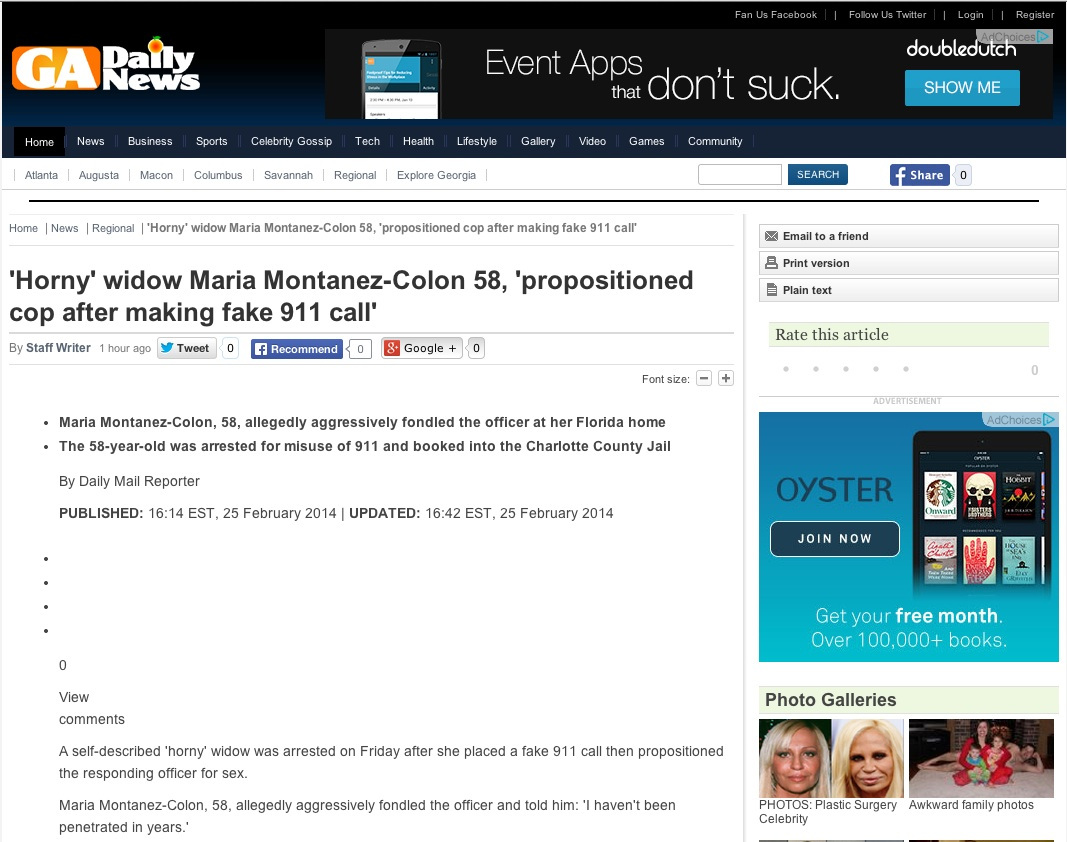
Marshall’s “Exhibit A” is Georgia Daily News, a website which purports to cover “news, traffic, sports, politics, entertainment, gossip and local events in Atlanta.”

As Marshall contends, “What it actually features is content ‘curated’ from elsewhere on the web, and some it has simply stolen from other major news sites” such as the Daily Mail.

Sizable chunks of the website’s content have nothing to do with Atlanta.

GADailyNews home pageConsidering the type of general news site it purports to be, GADailyNews.com doesn’t attract very much traffic at all.  And why would it? — since it contains precious little information of value or interest to anyone who is actually “seeking news about Atlanta.”

But it sure does generate a lot of ad impressions.  According to Marshall, each article page on the site features seven display ad units – all of which refresh every 20 seconds or so.

In the two-minute span of time it took him to read an article about Katy Perry and John Mayer (content copied from an Australian news site), Marshall was served more than 40 ad impressions.

Marshall continues:

“One page has served me nearly 500 ads in just 20 minutes – and I couldn’t stop refreshing them even if I wanted to.”

[And these ads aren’t for B-list advertisers, either.  They’re for brands like American Airlines, Hilton Hotels, Charles Schwaab and others.]

What’s happening here, of course, is that websites and ad tech middlemen have figured out that the algorithms of even the “quality” ad vendors like Google, AdRoll, and Bizo can be gamed pretty easily to serve ads on a low-quality site like Georgia Daily News, which is owned by a single-person entity called Integrated News Media Corporation.

It’s hardly the type of media vehicle that big-brand advertisers would normally wish to use for advertising.  But thanks to the vagaries and complexity of the ad exchange landscape, they are.

For every Georgia Daily News site, there are hundreds of others like it that cobble together seemingly valuable content with a passably convincing set of audience characteristics.

Put it together, and it adds up to problems on two levels.

First, advertisers are paying for impressions that are near-worthless.

Second, since there are finite ad dollars available, legitimate online publishers are losing out on those funds, which are far more important to their well-being than they are for sites that don’t engage in any true journalism at all.

As Jack Marshall concludes:

“Thanks to fraudulent traffic, dubious sites and middlemen with low quality standards, life is only getting harder for those publishers with expensive content teams to support.”

At Times Square, it’s “location-location-location” when it comes to advertising.

The building at 1 Times Square in New York City is nearly 100% vacant.

One Times Square Building (2010).

But if you’re the owner of the building, why should you even care?

That’s because the building takes in a reported near-$25 million per year in advertising revenues – thanks to the digital signage on the building being rented to top brands like Anheuser-Busch, Dunkin’ Donuts and Sony (among others).

Media, Sports & Entertainment Marketing Officer Blaise D’Sylva of Anheuser-Busch keeps it pithy:

“There’s a statement we make in being there – and we think the placement we’ve got is outstanding.”

Of course, there’s more to it than simply “making a statement.”  According to the Times Square Alliance, each year more than 100 million pedestrians pass through Times Square.

Moreover, foot traffic volume is running ~90% higher compared to 1996.

I’m quite sure these traffic volumes are central to any go/no-go advertising decisions being made by the big brands.

Where night is day:  Times Square advertising.
Where the night is as bright as day: Times Square advertising.

The Wall Street Journal reports that billboard signage in Times Square is actually the priciest outdoor advertising in the world.

Considering its location at the intersection of “high traffic” and “high trend,” marketers think it’s an investment worth making — and the rates they’re willing to pay proves the point.

HubSpot’s Marketing Predictions: Hits and Misses

soothsayingOne of the things I like about SaaS inbound marketing firm HubSpot is the steady stream articles and white papers the company publishes on varied facets of marketing and communications. 

They’re often quite meaty and beneficial as informational resources.

Moreover, HubSpot isn’t afraid to go out on a limb and render a pretty strong “point of view” about various factors and trends in the fast-evolving marketing world.

The risk is that some of those perspectives can end up being “off” – or looking even a bit silly – in retrospect. 

But more often than not, HubSpot’s trendspotting is on the money.

Marketing Prediction Hits & Misses (HubSpot)Here’s a case in point:  HubSpot’s team of analysts made a number of marketing predictions for the year 2013.  Recently, it revisited those predictions to judge whether they’d turned out to be on the mark or not.

These are HubSpot’s 2013 marketing predictions that it feels were on target: 

  • Content and social will matter even more for search engine optimization.
  • Stop-and-start campaigns will fade, and real-time will be ‘in.’
  • E-mail will live on.
  • Inbound marketing will spread enterprise-wide.

At the same time, four other marketing predictions for 2013 didn’t pan out so well, as underscored by HubSpot’s own cheeky editorial commentary about them:

  • Mobile or bust … “Not so hot.”
  • Marketing becomes accountable for revenue generation … “Meh.”
  • ‘Big data’ becomes real for businesses … “Nope.”
  • Print is dead … “Not even close.”

HubSpot’s post-mortem discussion points on these “misses” are interesting.  Quoting from its report:

  • Mobile or bust:  “Customers pay attention to multiple screens … and smart marketers capture attention by adding value wherever a consumer pays attention  … we need to be prepared, not by targeting just [mobile] but by embracing them all according to our specific customers and data.”
  • Marketing becomes accountable for revenue generation:  “The biggest challenge … has been proving ROI.       Even more frustrating … has been the lack of sales and marketing alignment in many companies.  Tracking can also get tricky, thanks to trying to reach fragmented digital audiences against so many channels … As much as lots of us really want this prediction to be a hit, it’s still largely aspirational.”
  • ‘Big data’ becomes real:  “Big data remains mainly a buzzword to many companies and markets — and continues to be more of a prediction than a reality …”
  • Print is dead:  “Saying ‘print is dead’ has lost pretty much all of its roots in reality … nor will it die in the next few years.”

Ever intrepid, HubSpot isn’t shying aware from new forecasts for 2014.  Looking forward, what do its analysts predict for this year?

  • Podcasting will continue to grow substantially.
  • Marketing departments will become more like engineering departments.
  • Social listening tools will gain context and get smarter.
  • The economy will become highly collaborative.
  • Marketers will become more holistic and less channel-focused.

And one more HubSpot prediction that’s a particular favorite of mine:

We’ll check back again a year from now to see how well HubSpot’s prognosticators fared this time around.