Twitter Followers: Fake, Faux or Farcical?

Fake followers:  They're all over Twitter
Fake followers: They’re all over Twitter.

I’ve blogged before about the nagging suspicions many people have about the true level of engagement on Twitter. Some have referred to Twitter accounts as “digital Potemkin Villages” and other (unprintable) characterizations.

And now we have the latest indications that Twitter’s “blue smoke and mirrors” extends to the most important global brands.

Status People, a purveyor of social media management platforms, has develop an analytical tool it calls the “Fake Follower Checker” that evaluates the characteristics of brand followers to determine to what extent they are “real people” as opposed to fakers.

According to Status People, up to half of the followers of the 20 most important global brands are either complete fakes, or inactive.

Of course, it is possible that some brand followers do nothing but follow … and rarely if ever post tweets of their own. But it’s also easy to surmise that the value of an inactive follower isn’t nearly as high as one who engages on the Twitter platform.

Details on how Status People conducts its Twitter follower analysis can be found here. In a nutshell, Status People sampled up to 1,000 records and assessed activity against a number of spam criteria. Those criteria included the degree to which Twitter accounts have few or no followers and few or no tweets … but that follow many other Twitter accounts.

For the record, here are the proportion of major brand followers on Twitter that Status People deems are “good” versus “inactive” or “fake,” ranked from highest to lowest percentage score:

  • Gillette: 64% “good” followers
  • GE: 61%
  • Oracle: 60%
  • Toyota: 60%
  • Cisco: 54%
  • IBM: 53%
  • Mercedes: 53%
  • H-P: 52%
  • Disney: 51%
  • McDonalds: 51%
  • Coca-Cola: 50%
  • Honda: 50%
  • Louis Vuitton: 50%
  • Samsung: 46%
  • Intel: 44%
  • BMW: 43%
  • Microsoft: 42%
  • Nokia: 37%
  • Google: 27%

And what about one of the biggest U.S. brands out there right now:  Brand Obama?  Of the President’s nearly 19 million followers on Twitter, the reports are that nearly three-fourths of them are fake, too. 

Some have questioned why Status People has gone to all of this effort shine a light on Twitter fakery. “What harm is done?” these folks seem to be asking.

In response, Status People contends that fake Twitter accounts exist to build status and power beyond what is legitimate, and that those behind them are gaming the system in an effort to burnish brand credentials unfairly.

But I think it’s actually worse than that.  Twitter fakers run the risk of turning the entire Twitter enterprise into one big farce. I know too many people who have completely turned away from Twitter in the past year, becoming convinced that the entire platform is simply an elaborate façade masking a “whole lot of nothing.”

This can’t be what the folks at Twitter want people to think of their own brand!

Social media: All that glitters is … what?

Fake followers, fans, friends on social mediaChances are, you haven’t heard of Anthony Gemma, and I hadn’t either. 

Unless you live in Rhode Island, that is.  Mr. Gemma is a businessman who’s running for U.S. Congress there. And despite the fact that he has yet to win his own political party’s primary, he has already amassed nearly 1 million Twitter followers.

That’s more followers than presidential candidate Mitt Romney.

According to various social media monitoring services, Gemma’s Twitter account added ~400,000 followers in February 2012 alone.

And how about this stunning statistic: Between January and February of this year, the number of friends on Mr. Gemma’s personal Facebook page jumped some 5,600% to nearly 170,000 people.

How is this possible? For clues, we can start by noting that Mr. Gemma has described himself as a “social media guru.” In addition to owning a regional plumbing business, he’s also headed up a concern called Mediapeel, which bills itself as a providing “media strategy advice” to companies.

And therein lie clues to the sudden surge of “interest” in Mr. Gemma and his Congressional campaign in the social media sphere.  One can only imagine the lengths to which Mr. Gemma and his campaign staff are going in order to show off the candidate’s “obvious” fame and notoriety.

But are Mr. Gemma’s social media followers for real? Or are they of the same ilk of the famed digital “Potemkin Villages” that have sprung up all over the Internet?

Consider a few telltale signs about Anthony Gemma and his fantabulous social media presence:

  • Fewer than 1% of Gemma’s Twitter follows are based in Rhode Island … but nearly 15% are in Canada. You’ll find another 2% from London, England, plus thousands of others from places all over the globe.  I’m not sure how far afield Mr. Gemma takes his regional plumbing business, but this geographic map is intriguing to say the least.
  • Gemma’s Twitter “fans” are an unusually  inactive bunch. On February 24, 2012 – the same day Mr. Gemma’s Twitter account picked up a tidy 87,000 new followers in one fell swoop – he asked his Twitter audience to retweet a photo. A whopping six people chose to do so.
  • Earlier this year, after the progressive organization Rhode Island’s Future questioned the validity of Mr. Gemma’s burgeoning bevy of Facebook friends and noted that the most popular origin of his friends, followers and fans was an unlikely location — Frankfurt, Germany — all of the names referenced in the RIFuture blog post mysteriously disappeared from Gemma’s social sites.  Interestingly, however, the most prevalent place of origin for Gemma’s personal Facebook page’s friends is another foreign city: Moscow.  I guess Mr. Gemma’s international interests range from the Germanic to the Slavic.

Although it’s impossible to know for sure, these signs suggest that there’s precious little “there there” when it comes to the extent of Mr. Gemma’s true social media footprint.

And in fact, just last week the political website Politico made the latest attempt to get to the bottom Anthony Gemma’s questionable social media presence.

Politico took note of this tweet from Mr. Gemma’s account, posted on July 24, 2012:  “Don’t add up your troubles, count your blessings. RETWEET to pass it on!”

Of Gemma’s nearly 1 million “followers”, only 17 did so.

And while one of them actually appears to be a Rhode Islander, the others include followers from Sydney, Calcutta, the Baltic States, Indonesia …

… But none from Potemkin Village.

Coming Attractions: A Newly Sanitized YouTube

YouTube Cleaning up its ActThe YouTube phenomenon has been one of the biggest success stories of all in cyberspace.

Over the years, YouTube has gone from being a weird corner of the web made up of curious, strange and often forgettable video clips, to a site that attracts millions of viewers every day – some of whom have essentially ditched all other forms of video viewing in favor of mining the vast trove of material YouTube carries on its platform.

In the years since Google acquired YouTube, traffic and usage have exploded, even as the video fare has become more varied (and also more professional).

But there’s one holdover from the early years that continues to bedevil Google: YouTube is a repository of some of the most inflammatory, puerile and downright disgusting commentary that passes for “discourse,” posted by all manner of rabble.

But now, Google is signaling a strategy that has the potential to clean up the crude comments on YouTube – and in a big way.

YouTube is now strongly encouraging users to post their YouTube comments using the name identity associated with their Google+ account.

In fact, if you decline to do so after being prompted, you’ll be asked to state a reason why, underscoring the nudge away from “screen name anonymity” and towards “real-name identity.”

The notion is that people will be less likely to post flaming comments when their “true” web identity is known – that people will exude good behavior in “polite cyber-company,” as it were.

Of course, one needs to possess a Google+ account in order to link his or her identity on YouTube. But that’s for today only; some observers see YouTube’s move as just the first step toward hiding – and eventually eliminating – all comments coming from anonymous accounts.

So the new bargain will be something closer to this: “Open a Google+ account and link your YouTube account to your Google+ account … or else forfeit your ability to post any comments at all on YouTube.”

The likely result will be a much more “sanitized” YouTube – less edgy, but also less red-faced embarrassing. And that’s just what many brands, businesses and advertisers would like to see happen.

Of course, YouTube’s moves may well spur the launch of an alternative site that seeks to preserve the (nearly) anything-goes environment of the YouTube of yore.

Perhaps it could be called “YouCrude,”  But, as it happens, that handle’s already been nabbed — by a fellow WordPress blogger!

“Don’t Tread On Me”: Employees have strong feelings about employers gaining access to their social media profiles.

Social media privacyRecent news reports that some companies are asking their current employees or prospective new hires to grant them access to their private social media profiles haven’t set well with many people.

It seems that while people don’t mind publishing their personal information for friends and families to see, they’re not keen at all on employers having access as well.

This is borne out in the latest American Pulse survey from BIGinsight, a consumer information portal. In that survey, which queried nearly 3,600 American adults over the age of 18, respondents were asked how they would react to a request by an employer to hand over personal social media passwords, thereby gaining access to their profiles.

Approximately one in five of the survey respondents reported that they are not engaged in social media.  But among the remainder, most would resist the employer’s request … even to the extent of quitting their job:

  • Would quit a job or withdraw an employment application: ~52%
  • Would delete social media pages to prevent them from being seen: ~21%
  • Would go ahead and provide social media passwords to the employer: ~14%
  • Would edit social media profiles first … then provide passwords: ~13%

Based on the opinions of the respondents, it’s not at all surprising that the survey also found that ~85% think that when employers asking for access to social media profiles, it’s an invasion of privacy.  And only about 11% of respondents would be “comfortable” sharing their social media profiles with a potential employer.

There does seem to be a bit of altruism at work, because the preponderance of survey respondents (~72%) claim that they have “nothing to hide” on their social sites.

No doubt, Americans’ views about online privacy are borne out of the “live free or die … don’t tread on me” tradition of individualism in this country.  We love our ability to express ourselves … but spare us the KGB/Stasi routine!

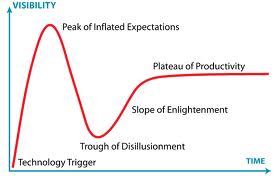
Does Gartner’s “Hype Cycle” Chart Apply to Social Media?

Hype Cycle Chart (Gartner, Inc.)That’s what author and digital marketing specialist Jeff Molander seems to think. In fact, it’s the topic of an article he wrote recently in Target Marketing magazine titled “What Game Changer? Moving past the Social Media Revolution that Never Was.”

As can be seen in the diagram at right, the Gartner “Hype Cycle” model begins with a technology trigger that generates a groundswell of interest and expectations, which is then followed by a crash when the early expectations fail to pan out.

Things do move forward again – much more slowly – as the sober reflection on early disappointments helps temper expectations to more realistic levels, characterized by Gartner as a “plateau of productivity.”

It is Mr. Molander’s contention that the characterization of social media as a “game-changing” phenomenon has been so overstated and sensationalized, most companies today are probably working against their own best interests in how they’re dealing with it.  Which is to say, not using it properly as a selling tool.

Here’s how Mr. Molander puts it: “The difference between fooling around with social media and selling with it relies on the use of time-tested direct response practices – not new tools and techniques.”

Those basic practices include:

  • Solving customers’ problems
  • Provoke customer responses that connect to the sales funnel
  • Discovering customers’ needs as they evolve … then using this knowledge to improve the response rate

The companies that are successful in selling goods and services via social media are promoting interactions in ways that answer questions and solve problems.

Of course, there is absolutely nothing new or novel about this: “Solving customer challenges” has always been an effective way to cultivate AIDA (awareness, interest, desire and action).

It also continues to be the best way to move customers toward making a purchase.

What social media can do is make the process easier to accomplish, due to social’s interactive nature. Approached in the proper way – and done with regularity – facilitating digital Q&A interactions will help leverage and drive sales.

I think Mr. Molander’s point of view is correct. Using social media as a platform for sales isn’t about some kind of “secret formula” for content creation or figuring out the ideal time to publish a Twitter tweet or blog post. It’s about using the “new” platforms to facilitate “old” sales concepts.

You know – the ones that work.

Reasons Why the Facebook IPO Bombed

Facebook IPO failureShare prices of Facebook stock have been distinctly underwhelming since the first day of trading — to the tune of ~30% off its original offer price. And everyone seems to have an explanation as to why.

I’m partial to a list of reasons put out by Dan Janal, president of PRLeadPlus.com and author of the business book Reporters Are Looking for You.

Mr. Janal has come up with a dozen reasons for the Facebook IPO failure. The ones that struck me as most compelling are these:

  • The public is not as dumb as Wall Street thinks. Chalk it up to too many other dot.com “can’t miss” opportunities that whiffed big-time.
  • Who has excess money to throw around? Small investors are struggling with underwater mortgages and mountainous debt … so how do they have extra funds to throw at an IPO? Get real. (And the institutional investors stayed away because they were clearly “in the know” about how unrealistic Facebook’s IPO share pricing really was.)
  • Who goes on Facebook to actually buy things? Precious few, that’s who. And if buyers aren’t on Facebook … then advertisers won’t be there either. And with that, there goes a big part of Facebook’s business rationale down the toilet. (GM backed out of its Facebook advertising program – very publicly – just days before the IPO. That timing suggests they were trying to tell the market something!)
  • Friends aren’t really “friends.” Indeed, many Facebook friends are more like acquaintances, which is a lot less compelling when it comes to word-of-mouth influencing. (LinkedIn connections are far more “honest” in terms of being “all about business.”) When Facebook contends that friend networks will influence more buyers, investors look at their own friend networks … and they don’t buy the hype.
  • There’s a huge gulf between Facebook “friendships” and actual “engagement.” And if friends don’t engage, a big piece of what makes the Facebook power matrix potentially so potent falls away.

Mr. Janal maintains that the characteristics that make the Facebook platform what it is aren’t the same ones that’ll launch “a million new millionaires.”

Sure, the early investors who acquired stock options early in the game came out big winners. But precious little of that largesse turns out to be in the cards for the rest of the investors.

Bombs away.

What to Make of all the Interest in Pinterest …

I love PinterestUntil now, I’ve hesitated to blog about Pinterest, the digital bulletin board and newest “breakout network” in social media.  I wanted to see how it was evolving before jumping to conclusions about its importance and staying power.

Without a doubt, Pinterest is one of the biggest stories in the social sphere right now. It seems that something as simple as enabling users to post “boards” of their collections of photos has struck a nerve.

Pinterest is one of the most user-friendly social sites in cyberspace.  Pinterest participants use a “bookmarklet” button installed in their browser to affix photos or images to virtual bulletin boards set up on particular topics or themes such as interior decorating, food arts and fashion.  Each image has an accompanying clickthrough link to the web page where it was found.  Users can also “re-pin” images they find on other Pinterest boards.

Simple, easy … and popular.  In its most recent Digital Marketing Benchmark & Trend Report, Experian reports that Pinterest is now the third most popular U.S. social networking site. Only Facebook and Twitter rank higher.

Just how well is Pinterest doing? Consider that this invitation-only site has ~10 million users and receives nearly 25 million visits in a single week. That’s 30 times larger the volume of visits recorded on Pinterest just six months ago.

I’m still trying to determine how much staying power this latest social media phenom possesses. The rapid adoption rate tells us something right off the bat … and there are a few additional reasons why Pinterest may be here to stay in a big way:

  • Pinterest is a highly effective form of digital scrap-booking that seems to be extremely popular with its users.
  • Online audience measurement firm comScore reports that users spend an average of 1.5 hours per month on Pinterest, second only to Facebook.
  • Pinterest is easy and intuitive to use, making it popular with people who aren’t your typical “geeky” computer user. Pinterest users tend to skew older … more female (~80% actually) … and generally located more in “flyover country” than in coastal zones like New York and California.

Any time a social network can claim to have attracted the hearts and minds of the broader population, that’s noteworthy … and it leads me to believe that Pinterest isn’t merely a passing fad.

Indeed, we may have just scratched the surface of what Pinterest will be and what it will offer in the years ahead.

What are your thoughts about Pinterest?  Dynamic or dull?  Flash-in-the-pan or here to stay?  And how do you see it being used by marketers to promote their products and brands?

Klout and Klouchebag: Action and Reaction.

Klout scoreIt had to happen: The combination of social media measurement capabilities and ego gratification has brought forth attempts to “quantify” a person’s influence level in social media.

One of the better-known of these endeavors is run by Klout, a San Francisco-based entity launched in September 2009 that applies social media analytics to measure people’s influence across their social network.

Underscoring the company’s sense of self-importance is its proclaimed tagline/slogan:  “The Standard for Influence.”

Klout purportedly accomplishes this by analyzing data mined from Twitter, Facebook and other social sites – information such as the size of a person’s network, the content created, and how others interact with that content.

Klout profiles built from these bits of information include a “score” ranging from 1 to 100 – the higher a score representing a higher assessment of the breadth and depth of a person’s online influence.

Reportedly, more than 100 million of such profiles have been built by Klout over the past two years. And how is Klout building these scores? It’s using Twitter data points such as:

  • “Follower” and “following” volumes
  • The incidence of “spam” or “dead” following accounts
  • List memberships
  • Retweet activity
  • Unique mentions

Somehow, it doesn’t seem surprising at all that Klout’s rating and ranking activities have come under attack. And the criticism is not just coming from people who are questioning the methodology behind the analysis and rating. Some social critics contend that scoring devalues authentic online communication.

Movie critic, writer and novelist John Scalzi has written that Klout’s very premise is “socially evil” in that it exploits the “status anxiety” of social media participants. Charles Stross, a tech writer and sci-fi author, goes even further: He labels Klout “the Internet equivalent of herpes.”

But perhaps the most biting criticism comes in the form of satire, courtesy of Tom Scott, a freelamce web developer and humorist who has launched “Klouchebag.”

What’s Klouchebag? According to Scott, it measures “how much of an asshat you are on Twitter.”

In the same fashion as Klout, Klouchebag establishes a rating score. But this one is based on the ARSE rating system, an eyebrow-raising acronym that stands for:

  • Anger (“profanity and rage”)
  • Retweets
  • Social Apps (“every useless check-in on Foursquare or similar location-based social platform”)
  • English Usage (“exclamation marks!!! … ALL CAPS … or no capitalization at all … will definitely raise this score”)

For Tom Scott, Klouchebag satirizes what he considers to be a “pseudo-scientific” effort to create a social media hierarchy. He hopes its emergence will contribute to a backlash against Klout and other similar ventures.

When it comes to Klout, Scott is merciless: “I’d been annoyed with the idea of Klout for a while … [which] is one of the worst ideas ever put online. Klout annoys me for the same reason that search engine optimization annoys me: It’s an enormous amount of effort designed to game an arbitrary and often-changing system. Imagine if all that time went into actually making interesting things, or caring about the people around you.”

Maybe Tom Scott has forgotten a thing or two about human nature: People are often smitten by vanity and pride – and the desire for fame. It’s been that way ever since the dawn of time. Why should we expect anything different from people today?

[One can only imagine what Andy Warhol would have said about people and their “15 minutes of fame” had he lived in our era of social media!]

“Fanning out” when it comes to brands and social media engagement.

Social media may well be taking the famous 90-9-1 principle of online engagement … and bringing it to new lows.

It’s hard not to come to this conclusion when reviewing the results of research conducted by the Ehrenberg-Bass Institute for Marketing Science. This Australian-based University think-tank studied the actual engagement levels of people who have “liked” the top 200 brands on Facebook by considering the degree to which fans actually shared posts or commented on the brand.

Over a six-week period of study, Ehrenberg-Bass found that fewer than one half of one percent of the brand fans actually “engaged” in any way at all.

The conclusion? It turns out that social media fan bases and actual engagement are two very different things.

Categories that do somewhat better in “engagement” are ones like alcohol, cars and electronics. But interestingly enough, the study also found that the so-called “passion” brands – such as Harley-Davidson, Porsche or Nike – don’t perform much better than “regular” brands: 0.66% engagement versus 0.35%.

In its report conclusions, Ehrenburg-Bass questions whether the Herculean efforts being made by some brands to “bribe” their way to thousands of “fans” and “likes” is really worth the cost in terms of the added product discounts, coupons and other goodies that are being proffered to entice consumers to become brand fans.

When you boil it down, the Ehrenburg-Bass research confirms yet again a basic truism about branding: Much as we would love to think otherwise, the marketplace isn’t nearly as enamored with our brands and products as we think they should be.

To us, the branding so important. To them … it’s just one big shrug of the shoulders.

Social Media Communities: Digital Potemkin Villages?

Social media stats riddled with fake accounts and cipher profilesMarketers like to talk about the 90-9-1 rule of web engagement: For every 100 people who are online, one person creates content … 9 people comment on that content … and the remaining 90 may lurk and read, but never participate in any other way.

The more we learn about social media engagement, the more we’re seeing the same phenomenon at work. To wit, studies of social networks like Twitter, Facebook and Google+ are finding far fewer numbers of “real” and “active” users than the gross statistics would suggest.

Alarmingly, these evaluations are finding that as many as half of social media accounts could be fake, or are ones that contain no user profiles.

And if there isn’t a user profile, of what value is a social media account to marketers? After all, it’s the information in these user profiles that provides the data for targeted advertising and marketing campaigns.

Just how extensive is the problem?

Let’s start with Google+, one of the latest entrants into the social media sweepstakes. Kevin Kelly, an industry specialist, published author and former editor of Wired magazine, recently conducted an analysis of the ~560,000 people who have him in their Google+ “circles.”

Reviewing a random sample of these ~560,000 users, he found that the majority of them had not made a single post … had not posted their image … and/or had never made a single comment.

More specifically, here’s what Kelly found:

Only ~30% had ever posted anything
 ~6% were “spammers”
 Fully ~36% were “ghosts” … accounts lacking even a user profile

Evidently, Google+ is taking “ghostwriting” to new heights.

What about Twitter?

Several editors at Popular Mechanics magazine reported recently that only ~25% of their Twitter followers were “real.” About half were identified as fake users or spammers.

Twitter may be tweeting away … but how many people are actually listening and who’s actually engaging?

Who’s gaming the system here? Clearly, there are reasons why people are trying to show higher social media engagement than is actually occurring. Marketing campaigns love to cite metrics where the number of followers and “likes” is high. It’s great for bragging rights … and sometimes financially beneficial, too, when performance goals are met and monetary payouts triggered.

And today there are plenty of ways for people to find services that will jumpstart campaigns by garnering thousands of followers or “likes” … all for a tidy fee, of course.

It would be nice if the social media platforms would step up to the plate and show some transparency in what’s going on. It’s highly likely that these platforms have developed sophisticated ways to pinpoint which of their accounts are real … versus those that are contrived.

But will they be publishing their findings anytime soon? Don’t hold your breath.

Until marketers can get a better handle on the “real facts” behind the elevated engagement numbers being hyped, it’s best to view any such stats with a jaundiced eye.

Here’s a suggestion: Take any stats you might hear about page “likes,” viral video views and the like … and discount them by a massive percentage – say, by 50%. Then, you might be approaching the reality.

Over time, we’ll probably learn more about “authenticity” when it comes to tracking true activity and engagement in the social realm. Marketers would do well to demand it. It’s just not clear how soon it’ll happen.

Until then, keep your antenna up and apply caveats all over the place.