Move Over, Howard Stern: Now Google’s the “King of All Media”

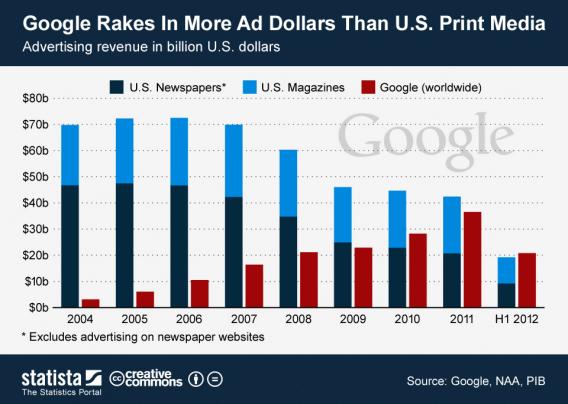
Google and Print Advertising Revenue Trends, 2004-2012It’s official. With nearly $21 billion in ad revenue generated during the first half of 2012, Google now attracts more advertising business than all U.S. print media combined.

That is correct:  German-based statistics portal Statista reports that Google garnered ~$20.8 billion in total ad revenues over the period, while all U.S. newspapers and magazines took in only about $19.2 billion.

Never mind that the comparison isn’t completely apples-to-apples … in that print revenues are for the United States only, while Google generates ad revenues worldwide. Still, it’s a dramatic milestone, and it says a lot about the fortunes (and future) of print versus online advertising.

Statista has helpfully published trend charts that show how quickly the ad picture has changed (see above). Only a few years ago, print advertising dominated the scene, but the trajectories of it and Google have been on opposite paths ever since.

It was inevitable that the lines would eventually cross, but how many could have foreseen it happening as early as 2012?

As if on cue, Advance Publications, a company that owns a number of venerable newspapers in New Orleans, Cleveland and elsewhere, has just announced that it is likely to cut the publication frequency of the Plain Dealer newspaper from its current seven days a week.

If Advance follows through on its intentions, it will join the New Orleans Times Picayune as a daily newspaper that’s no longer a daily.

The publisher’s letter to Plain Dealer readers described the newspaper’s future in lofty terms, noting that changes were coming as the paper seeks to “embrace dynamic shifts in the way information is consumed.”  And other such language.

It also noted that the pending changes are “not about cost-cutting.” But who believes that?

And in fact, the publisher’s letter states also that “if we maintain the status quo, we risk doing what everyone – our employees, advertisers and the community – wants to avoid: disappearing.”

If people don’t see a correlation between the Statista data and what the Plain Dealer has in store for its readers … they’re living on another planet. 

The Millennial generation: Are they redefining the concept of “news consumption”?

News consumption habits (millennials)Recently, I read an interesting column written by Emily Anatole that addresses how the Millennial generation is reshaping the concept of “news” and how it is consumed.

Anatole notes that Millennials are criticized for not being news consumers, but she argues against this point. 

In her view, the younger generation is simply getting their news in a different way.  She writes:  “Milleninials’ approach to consumer news reflects how they differ … they perceive the ‘power of the pack’ – or Facebook updates, tweets and trending topics as we know them – as more valuable than the fact-checked, overly polished POV of one reporter.”

Anatole’s company, research firm Youth Pulse, Inc. (YPulse), conducted a survey in October 2012 of ~1,800 people aged 14-34, which found that television remains the top way in which this age group gets the news, with more than 70% reporting that they turn to TV to stay informed.

However, two-thirds of the respondents also reported that they get their news from Facebook, while approximately one-third get news from Twitter.

If these stats seem a bit unusual for those of us in the over-40 or -50 set, consider this:  Today’s 17-year-old was barely twelve when the iPhone first came out. 

So an environment in which comments, updates and opinions aren’t part of the “standard media mix” isn’t just a quaint memory; for Millennials, it never existed!

For the younger generation, becoming part-and parcel of “journalism” in its broadest sense is an integral part of the equation.  Uploading or sharing videos, tweeting a comment, updating a social status … it’s all part of a “co-created experience” where the lines are blurred between the media industry and consumers of the news.

Impatience has always been a trait of the young — as far back as the Children’s Crusade or even before.  So it shouldn’t come as much surprise that Millennials would tend to go for “immediacy” over “credibility.” 

Given the choice of learning something “first” — even if the details or veracity of the story are sketchy — versus waiting around for a well-curated 5:00 pm news broadcast … well, it’s not even a fair fight anymore.

And here’s another important point to consider:  Whereas we older generation-types were trained to seek out news by buying the daily paper or tuning in to a radio or TV broadcast, today’s younger generation can afford to be less perspicacious.  The news comes to them without barely lifting a finger because of friends and others in their social sphere sharing stories, leaving comments, and tweeting.

Some believe it’s yet another “e-volution” that’s turning out to be more “re-volutionary” than we could have imagined. 

What’s your take?

Storm Clouds on the Horizon for National Food Brands?

Archer Farms store brand (Target)

Generic Food BrandsAre we seeing the beginning of an upheaval when it comes to national food brands?

Over the past 30 years or so, the United States has faced its share of recessions and sharp economic cycles, with the resulting stresses on consumer budgets.

Through it all, so-called “store” and generic food brands have continued to represent only about 15% to 20% of all retail food dollar sales.

National food brands have done their part to promote themselves as the “quality” choice over store brands, as well as to promote product sales through couponing and various other attempts to beat back the “value” alternatives.

Their success has been pretty decent, all things considered … up to now. But that might be about to change.

Rabobank’s Food & Agribusiness Research and Advisory Group has just issued a report predicting that private-label food brands are poised to jump to a 25%-30% share of the market over the next ten years.

That would make the U.S. similar to what has happened in Europe, where one in three products purchased today is a retailer-branded product.

What’s behind the anticipated rise in store brands? The Rabobank report cites several contributing causes:

  • Food retailers have more sales reach and sales clout than ever. It’s not just traditional supermarkets but also warehouse clubs, drugstore chains and dollar stores.
  • Retailers are expanding their private-label initiatives into more than simply “low cost/high value” lines.
  • Stores are putting greater marketing muscle behind their own store brands – witness Target and its Market Pantry, Archer Farms and Up & Up product families.

Nicholas Fereday of Rabobank sums it up this way:

“Retailer brands have matured from their original positioning as ‘cheap and cheerless’ generic products into a more diverse range of national brand equivalents, and more recently, highly innovative premium products … On grocery shelves around the U.S., from convenience stores to upscale supermarkets, retail brands now complete successfully and often win against national brands, earning consumer trust in terms of pricing, quality, image and value.”

What are the ways the national brands can fight back against the store-brand trend? Rabobank suggests one good approach is to develop completely new products that address unmet needs.

Otherwise, they’ll end up being on the losing end of the equation, since the marketing efforts as well as attractive pricing of the store brands will ultimately prove irresistible to the majority of consumers.

The ad-supported web: Will it fall under its own weight?

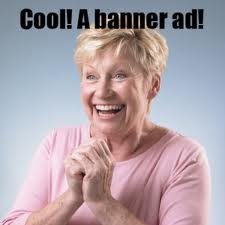
Banner advertisingFor the past (nearly) 20 years, the biggest thing that’s kept the Internet free for users is advertising – banner display advertising in particular.

Bloggers and other online publishers large and small rely on revenue from web banner ads to fund their activities. That’s because the vast majority of them don’t have pay walls … nor do they sell much in the way of products and services.

Because of this, the temptation is for publishers to serve up as many display ads as possible on each page.

It’s not unusual to see web pages that tile ten or more ads in the right-hand column. Usually the content of these ads has no relevance to readers, and the overall appearance isn’t conducive at all to reader engagement, either.

And that’s the problem.

Because of conditioning, people don’t even “see” these ads anymore. The advertising space has become one big blur – as easy to gloss over as if the ads weren’t even there to begin with.  (When’s the last time you clicked on a banner ad?)

Attempts to come up with other display advertising types – pop-ups and pop-unders, animations and other rich media, skycrapers and so forth – haven’t done much to change the picture. Indeed, they’re so ubiquitous – and so predictable – we don’t even consider the ads to be annoying anymore; they’re just part of the “décor.”

I’ve blogged before about how clickthrough rates on banner advertising are bouncing along in the basement, making them less and less valuable for advertisers to consider placing. And ads that are priced on a pay-per-click basis can’t be giving advertisers much in the way of revenue either, since relevance and engagement rates are so abysmally low.

The bottom line is that we now have a “lose-lose-lose” situation in online advertising:

  • Advertisers lose because of near-zero user engagement, thereby limiting their potential to drive business.
  • Publishers lose because ad revenues aren’t sufficient to bankroll their activities.
  • Readers lose because of lack of relevance and an incredible degree of page clutter.

So it seems that the ad-supported online publishing model is in a bit of a fix – and the question is how things can evolve to create a more satisfying result for all parties.

I’d be interested in hearing your thoughts on this issue:  What will online publishing look like in another five or ten years?  Anyone willing to hazard a guess?

Google Gone Wild: Has its AdWords pay-per-click program become too costly for businesses?

Google advertisingNo one should be surprised by the huge success of Google’s AdWords pay-per-click advertising program. Almost single-handedly, that service has vaulted the company into the top ranks of U.S. corporations.

And why not? As an advertising concept, pay-per-click has no peer. Capturing the attention of customers when they’re in the midst of searching for specific goods and services is the ultimate in effective targeting.

What’s more, Google’s pioneering advertising model, where advertisers set their own bid pricing and pay only when someone clicks on a link to their web landing pages, made the program affordable for everyone – from the biggest national brands down to the neighborhood store.

Google also offered all sorts of geographic and time-of-day filters to make it easier for businesses to target people at the right time and the right place … yet another boon to smaller businesses that otherwise couldn’t hope to compete against the big national players.

Many advertisers were able to participate in pay-per-click programs at a fraction of the cost of traditional display advertising, where advertisers pay significant fees up-front for “wait and wish for” customer engagement.

A few years back, it wasn’t unusual to be able to conduct a lucrative AdWords program bidding, with clickthrough pricing running well below $1 per click.

Because Google continues to possess the lion’s share of search activity (two-thirds or more of all search volume despite the best efforts of Bing/Yahoo and others to chip away at it), it was only natural for more and more advertisers to gravitate to Google’s AdWords program as the best venue for pay-per-click advertising.

But the temptation to get in the game has had the predictable result: pay-per-click bid rates have been climbing steadily.

Whereas before, an advertiser could expect to get good exposure on search results pages with a modest bid, it’s not possible to accomplish that anymore without bidding $5, $10, $15 or even more per click.

That’s beginning to drive some businesses away – particularly smaller ones without the deep pockets of the big firms.  For for many of them, it’s simply not sustainable to pay that much money just to get someone to visit their website.

AdGooroo, a search intelligence database firm that studies the pay-per-click market, reports that ~96% of pay-per-click advertisers spend less than $10,000 per month on such programs. That compares to millions of dollars spent by the largest companies.

Richard Stokes, AdGooroo’s founder, states this: “The only way for smaller advertisers to get an edge is to spend a lot of time improving the quality and relevance of their ads. The problem is that everyone else is doing that as well.”

So where does this leave us now? We’re beginning to get some hints that Google may have tapped out on advertiser demand. Some companies are dropping pay-per-click programs altogether, while others are scaling back while redirecting resources to other forms of promotion – traditional and social.

We have additional proof of this in the earnings report filed by Google just last week. The company reported that advertising sales continue to grow, but at a slowing rate.

And even more interestingly, average cost-per-click rates have declined by ~15%. That’s the first-ever decline since the AdWords program was launched.

Here’s another development:  heightened interest and focus on obtaining better natural search rankings by optimizing websites for content relevance.

Imagine that:  companies looking for ways to make their websites more relevant to viewers as well as search engine bots!

The heightened SEO emphasis has worked for many companies – at least up until now. Google may want to increase advertising revenues, but it also wants to ensure that its search functionality continues to deliver the most relevant and quality results so that users don’t begin to migrate to other search platforms.

But some advertisers may be wondering if the “Chinese wall” between advertising and natural search is as high or as airtight as it once was. They contend that their natural search rankings seem to perform better when they’re also actively engaged in pay-per-click advertising campaigns … and perform less well when they’re not.

Whether there’s any actual proof of this happening is mere conjecture. After all, the same company that runs AdWords is also running the search algorithms. So there’s really no way to prove this from the outside looking in.

Golfers’ Paradise: Portland? Seattle?? Rochester???

Golfing at Stone Creek Golf Course, with view of Mt. Hood
Keeping your eye on the ball is a bit more challenging at Stone Creek Golf Course, with dramatic views of Mt. Hood ready to distract at every turn …

I live in the Mid-Atlantic region of the country. And around these parts, a vacation often takes golf lovers to North Carolina, or maybe to Florida or Scottsdale in the winter months. (Scotland is the “Holy Grail” of golf destinations, of course.)

So I was somewhat surprised to read that Golf magazine has come up with some pretty big surprises in its listing of the “Top 10 U.S. Cities” for golf, published in August.

The list was developed in conjunction with the National Golf Foundation, so presumably it was compiled with the input of the “leading authorities” in the sport.

Some of the cities on the Top Ten list come as little surprise:

  • #3:  Las Vegas, NV
  • #5:  Orlando, FL
  • #7:  San José, CA

A few others wouldn’t necessarily be ones I would have thought of initially, but they do make sense:

  • #2: Columbus, OH  (the birthplace of Jack Nicklaus)
  • #4: Dallas, TX  (more than 100 golf courses are open to the public)
  • #8: Atlanta, GA  (the Sugarloaf course is here, along with two PGA Tour sites)

That leaves four other cities that I was surprised to see listed at all:

#10 is Rochester, NY  –  This city might have ranked higher for golf in my book than Buffalo or Cleveland, but to make the “Ten Best” list is … remarkable. It was included because there are ~65 golf courses, and median green fees are a huge bargain at just ~$30.

#9 is Portland, OR  –  I would have thought “weather issues” would make this city a non-contender, but Golf magazine found otherwise. Moreover, there are ~50 courses including Stone Creek Golf Club with its dramatic views of Mount Hood.

#6 is Seattle, WA  –  Wouldn’t the (rainy/cloudy) weather be even more of an issue here than in Portland? Evidently not, as Golf magazine ranked it among the top six cities, noting 60+ courses and median green fees of around $45.

And #1 is … Austin, TX —  This city was so-named because it “has the nation’s best combination of weather, name [course] designs, and affordable, accessible golf.”

It looks like the golf lovers among us will need to start expanding our horizons when it comes to vacation destinations.

Hmm, I wonder what our spouses will think of spending an exciting week in Austin, Columbus or Rochester …?

The Free Lunch Ends on Facebook

Promoted posts on Facebook is the only way to get exposure anymore.
Promoted posts are the only way to ensure decent exposure on Facebook now.

It had to happen.  Suffering from a raft of unflattering news stories about its inability to monetize the Facebook business model and under withering criticism from investors whose post-IPO stock price has been battered, Facebook has been rolling out new policies aimed at redressing the situation.

The result?  No longer can companies or organizations utilize Facebook as a way to advance their brand “on the cheap.”

Under a program that began rolling out this summer and has snowballed in recent months, businesses must pay Facebook anywhere from a fiver to triple figures to “promote” each of their posts to the people who have “liked” their pages plus the friends of those users.

And woe to the company that doesn’t choose to play along or “pay along” … because the average percentage of fans who sees any given non-promoted post has plummeted to … just 16%, according to digital marketing intelligence firm comScore.

Facebook views this as a pretty significant play, because its research shows that Facebook friends rarely visit a brand’s Facebook page on a proactive basis. 

Instead, the vast degree of interaction with brands on Facebook comes from viewing newsfeed posts that appear on a user’s own Facebook wall.

What this means is that the effort that goes into creating a brand page on Facebook, along with a stream of compelling content, is pretty much wasted if abrand isn’t  willing to spend the bucks to “buy”exposure on other pages.

So the new situation in an ever-changing environment boils down to this:

  • Company or brand pages on Facebook are (still) free to create.  
  • To increase reach, companies undertake to juice the volume of “likes” and “fans” through coupons, sweepstakes, contests and other schemes that cost money.
  • And now, companies must spend more money to “promote” their updates on their fan’s own wall pages.  Otherwise, only a fraction of them will ever see them.

Something else seems clear as well:  The promotion dollars are becoming serious money

Even for a local or regional supplier of products or services that wishes to promote its brand to its fan base, a yearly budget of $5,000 to $10,000 is likely what’s required take to generate an meaningful degree of exposure.

Many small businesses were attracted to Facebook initially because of its free platform and potential reach to many people.  Some use Facebook as their de facto web presence and haven’t even bothered to build their own proprietary websites.

So the latest moves by Facebook come as a pretty big dash of cold water.  It’s particularly tough for smaller businesses, where a $10,000 or $20,000 advertising investment is a major budget item, not a blip on the marketing radar screen.

What’s the alternative?  Alas, pretty much all of the other important social platforms have wised up, it seems. 

For those businesses who may wish to scout around for other places in cyberspace where they can piggyback their marketing efforts on a free platform, they won’t find all that much out there anymore.  Everyone seems to be busily implementing “pay-to-play” schemes as well.

FourSquare now has “promoted updates” in which businesses pay to be listed higher in search results on its mobile app.  And LinkedIn has an entire suite of “pay-for” options for promoting companies and brands to target audiences.

It’s clearly a new world in the social sphere … but one that reverts back to the traditional advertising monetary model:  “How much money do you have to spend?”

“Corporate Speak”: Updating the Buzzword Baedeker

Corporate buzzwords
Corporate buzzwords: Meaningless blather, signifying nothing.

All of us are familiar with them: jargon words and phrases that have become so overused, they’re nothing more than meaningless noise.

These are the so-called “descriptive” terms that are meant to add flavor and emphasis to a particular subject, but are more likely to make you want to roll your eyes – or maybe even reach for the nearest comfort bag.

Traditionally, the worst offenders have been high technology companies and other B-to-B firms when it comes buzzwords. But we’ve been seeing the phenomenon leech into consumer categories as well, such as automobiles and healthcare services.

Even worse, we’re now seeing a new generation of buzzwords coming to light, joining the veteran terms that have been plaguing us for years now.

Some of the old standbys are still overused today, unfortunately.  They include terms like:

  • Cutting-edge
  • Flexible
  • Next generation (or the too-cute variation NextGen)
  • Out-of-the-box
  • Partnering
  • Robust
  • Seamless
  • Solutions provider
  • Synergies
  • Toolbox
  • Turnkey
  • Value-added
  • World-class

Today, one may be more likely to encounter a crop of more contemporary-sounding – but equally obnoxious – phrases such as these:

  • Best-of-breed
  • Best practices
  • Core competency
  • Groundbreaking
  • Integrated
  • Mission-critical
  • Scalable
  • Thought leader

Much as we’d like for these buzzwords to just go away quietly, that’s hardly likely. And there’ll be plenty more new ones to come along in the future.

In fact, marketing strategist David Meerman Scott and others are already taking a stab at predicting tomorrow’s new buzz terms. You can view one such prediction here.

Unfortunately, there aren’t any buzz-cuts in the offing when it comes to lowering the level of “corporate noise” out there, however welcome that might be …

So if you can’t beat ’em … join ’em.  Are there any particularly irritating buzz terms you encounber that aren’t noted above?  Post a comment and let’s see what we can add to the list.