A new milestone for LinkedIn: 200 million users.

LinkedIn reaches a new milestone:  200 million registrants.
LinkedIn is adding new registrants at a rate of two per second.

It may have gotten lost in the shuffle amongst the news about other social platforms like Twitter, Facebook … and now Pinterest and Instagram … but LinkedIn has quietly signed up its 200 millionth user.

While LinkedIn may have only a fraction of the 1 billion users who have signed up on Facebook, reaching the 200 million milestone is a pretty big deal for a professional networking site, and in fact makes LinkedIn the 800 lb. gorilla in the professional social segment.

LinkedIn is adding nearly 175,000 new registrants each day; that averages out to about two per second. So it comes as no surprise that if you look at LinkedIn’s trajectory over the recent years, it like one of those exponential lines:

  • January 2009: 32 million user registrations
  • March 2011: 100 million
  • December 2012: 200 million

LinkedIn has gone worldwide, too – although it’s not as international as Facebook. There are LinkedIn members in more than 200 countries and territories.  The United States continuing to lead the pack, but it now represents well fewer than half of registrants:

  • USA: ~74 million user registrants (37%)
  • India: ~18 million (9%)
  • United Kingdom: ~11 million (6%)
  • Brazil: ~11 million (6%)
  • Canada: ~7 million (4%)

There are detractors to look at Facebook and its user profile and see a lot of chaff among the wheat: a large portion “wannabe” professionals who are sole proprietors of varying degrees of consequence or even validity.

But at least these people actually exist, which is much more than you can say about the Twittersphere – the very archetype of the “digital Potemkin Village.”

LinkedIn’s growth isn’t just noteworthy in and of itself. It’s also become much more of a revenue machine … to the tune of an 80%+ rise in 2012 3rd Quarter revenues in over the same period in 2011. Look for that trend to continue.

Launched a decade ago, LinkedIn’s been fluttering around the periphery of the “big boys’ club” in social media for the better part of a decade.

Clearly, they’ve joined the club now.

Grand Funk: PC Sales are in the Doldrums

PC sales decline in 2012
Eyebrow-rasing stat: Worldwide PC shipments declined in 2012 … the first drop since 2001.

If people had any doubts about the inexorable rise of tablet devices and smartphones, the sales results for the holiday season would surey erase them.

In fact, for the first time in five years, holiday PC sales have actually declined. Tech industry tracking firm IDC reports that personal computer manufacturers sold just shy of 90 million units worldwide during the last quarter of 2012. That’s down more than 6% compared to PCs sold in the final quarter of 2011.

What makes the news doubly troubling for the PC segment is that, unlike in 2009 when sales of all tech devices were hammered by a worldwide recession, this time around sales of other devices such as tablets and smartphones have grown substantially.

And considering 2012 as a whole, the news is even worse. The estimated 352 million PCs sold were ~3% lower than in 2011, which makes this the first annual decline in more than a decade – since 2001 in fact, when the 9/11 attacks roiled markets and impacted sales of all goods across the board.

And it isn’t trouble for just one manufacturer, either: The 2012 sales drop hit all of the big players including Dell, HP and Lenovo.

What about the prognosis for 2013?

It’s not much better. IDC is forecasting mediocre growth in the PC segment (less than 3%) — although at least that isn’t a decline.

But on the downside, it’s very possible that tablets will actually outsell PCs in 2013 – a possibility that would have seemed unthinkable just one or two years ago.

We’re hearing a number of explanations for the slump in PC sales. One of those is that Microsoft’s new Windows 8 operating system isn’t doing much to excite buyers – at least not so far.  The surge in new PC hardware purchases, which commonly occurrs when newer versions of Windows have been introduced, hasn’t happen this time around.

More fundamental than the Windows 8 conversion rate are signs that PCs are losing their edge over other devices in the perception that they’re the most secure, reliable and efficient options.

This shift may be less about PCs themselves or their quality, and more about the aggressiveness by folks like Apple iPad and their incursions into the PC “space.”

Weighing the Odds on Marketing Predictions for 2013

MarComm Crystal Ball Predictions for 2013One thing each New Year invariably brings is a passel of marketing and communications forecasts for the upcoming year.

And 2013 is no exception. I’ve seen more than 25 articles in the business press over the past several weeks that take a stab at predicting the future – and that’s without even looking to find them.

With each prediction list containing anywhere from 5 to 25 items, there’s a lot to consider – and also a good deal of overlap. The big question is, how many of these predictions will turn out to be accurate, as opposed to wishful thinking?

I thought I’d highlight some of the more interesting forecasts and list them here  — along with my odds on the likelihood they will come true.  So here goes … see what you think:

2013 MarComm Predictions from the Experts

Responsive design” and its ability to detect devices and deliver a satisfying viewer experience will take center stage in 2013 now that smartphone sales have overtaken PCs and more e-mails than ever are being read on mobile devices.
(Michael Della Penna, Responsys)
Chance of happening (my odds): 100%.

Special characters in e-mail subject lines are here to stay.
(Chad White, MediaPost E-Mail Insider)
Chance of happening: 100% (unfortunately).

Twitter will start personalizing Twitter feeds in 2013, based on an algorithm consisting of influence, engagement, alignment, gravity, and subscriber interests.
(Rich Brooks, Flyte New Media)
Chance of happening: 90%.

Google+ will become a “must use” service not because of its social elements, but because it will be the central hub for managing a company’s “official” online public presence in the eyes of Google.
(Anita Campbell, Small Business Trends)
Chance of happening: 80%.

Mobile transactions and payments will become huge – the biggest “disruption” in local search – and making it much easier to close the research-online/buy-offline loop and calculating actual ROI on specific marketing campaigns.
(David Mihm, SEOmoz)
Chance of happening: 70%.

After struggling for years to gain adoption, the QR Code will die – a good concept done in by its clunky interface and application.
(Peter Platt, iMedia Connection)
Chance of happening: 70%.

Triggered e-mails will give sophisticated marketers a sustainable competitive edge over other markers.
(Chad White, MediaPost E-Mail Insider)
Chance of happening: 60%.

More industries such as the financial, legal, accounting and medical fields will get serious about social media in 2013 as clarity about potential regulatory issues is established.
(Stephanie Sammons, Wired Advisor)
Chance of happening: 60%.

2013 will be the year of visual marketing. Video in e-mail will finally take off, thanks to HTML5 video capabilities.
(Ekaterina Walter, Intel)
Chance of happening: 60%.

2013 will be the “year of the invisible computer,” finally fulfilling writer Donald Norman’s prophecy made back in 1999 wherein people don’t focus on the technology at all, but on what information and services the technology can deliver.
(Peter Platt, iMedia Connection)
Chance of happening: 50%.

Marketers will use fewer social sites in 2013, preferring to have a solid presence in one or two channels rather than to try to dominate in every single platform.
(Ed Gandia, International Freelancers Academy)
Chance of happening: 50%.

Apple will launch iRadio, taking on Pandora in Internet radio and integrating into the iTunes iOS app.
(Richard Greenfield, BTIG)
Chance of happening: 50%.

2013 will not be the “year of the [fill in the blank],” but will build on the digital accomplishments of the past.
(Peter Platt, iMedia Connection)
Chance of happening: 40%.

By the end of the year, one in three paid clicks will come from a tablet or smartphone as the “living room on the go” enables seamless content portability for consumers.
(Sid Shah, Adobe)
Chance of happening: 30%.

SlideShare will be the fastest growing social network in 2013.
(Joe Pulizzi, Content Marketing Institute)
Chance of happening: 20%.

The number of podcasters will double in 2013, tapping into 1 billion smartphone users and their desire for accessing quality, on-demand talk.
(Michael Stelzner, Social Media Examiner)
Chance of happening: 20%.

Voice assistants will become the rule than the exception, in response to consumers’ increasing expectations for immediate and customized support in all forms of outreach.
(Robert Passikoff, Brand Keys)
Chance of happening: 20%.

The age of the PC is over in 2013, as a true “pivot point” is reached due to the penetration of smartphones and tablets.
(Will Margiloff, IgnitionOne)
Chance of happening: 20%.

2013 will be the year marketers stop using the term “social media” when referring to campaigns … and Facebook will “own” mobile advertising.
(Peter Shankman, Geek Factory founder)
Chance of happening: 10%.

Marketing budgets will now be established based on outcomes, not history, eclipsing the traditional dynamic of building budgets based on “last year” figures.
(David Cooperstein, Forrester Research)
Chance of happening: 10%.

2013 will bring the death of static web pages.
(Raj de Datta, BloomReach)
Chance of happening: Nil.

So, what do you think of these fearless predictions? Which ones are most likely to come true?  Would you place different odds on some of them? Feel free to share your observations with the other readers.

Observations on the Newtown Tragedy and its Larger Societal Implications

Shady Hook School, Newtown, CTI’m going to take a step away from the usual focus of my blog posts to address the larger cultural factors that really need to be on everyone’s radar screen as we “process” the horrific actions in Newtown, CT. The school massacre has left a community reeling and I’m sure many are re-examining their thinking about what this all means in the “larger context” of our society and culture.

A good friend of mine I’ve known since college, Wesley Green, is someone whose opinion I value highly. He’s been a “media person” for decades and always has interesting observations to share about the “bigger meaning” of events as they occur.

Wes sent me his observations about Newtown, meant for my eyes only, but I found them thought-provoking and compelling enough to want to share with my blog audience. With his permission, here is what Wes shared with me:

We all wonder how something like this could happen …

The natural disposition of humans is to be compassionate and outward looking. We are by nature people of community—predisposed to love and take care of each other. But … when afflicted by a psychological or neurological injury, humans lurch towards some form of narcissism.

Common in small children whose frontal lobes are not fully developed, narcissism re-emerges, sometimes with a vengeance, in adults as an unconscious reaction to neurological/psychological disequilibrium. As far as I can tell, all mental illness is accompanied by some form of narcissism in that one’s capacity for empathy is somehow impaired.

How narcissistic tendencies are enabled …

The modern world unfortunately gives people novel opportunities to indulge any narcissistic tendencies. Video games allow people to be the heroes of their own virtual worlds – worlds in which they have power and prestige.

Websites, including social sites, also allow people to feel more … consequential.

But I think the most insidious modern innovation remains television. Not only does TV blur the lines between fantasy and reality, it can actually turn fantasy into reality.

Why TV may be a linchpin …

More than any other media, television has the power to take “nobodies” and transform them into “somebodies” almost overnight. We see it on American Idol, The X-Factor, and a host of reality TV shows (Jersey Shore, anyone?). So much celebrity is doled out, it becomes an achievable goal to many – including people with weapons.

TV also has power no other media have to legitimize formerly illegitimate behavior. The Brady Bunch did more than people realize to legitimize blended families. Years later, shows like Modern Family and Glee helped change our attitudes about gays.

But … there is a flip side: Behaviors once considered not just off-limits but barbaric also have gained some legitimacy when those behaviors are seen to bring global attention to a “worthy” cause and thus advance it. For years now, violent demonstrations and terrorist attacks have been scripted to maximize broadcast exposure.

It doesn’t take much imagination for a narcissist to connect dots and suffuse his/her own personal fantasies with the same import. “Round-the-clock international newsfeeds” and “deadly impulses” make for a combustible mixture.

Newtown TragedySo, what does this mean?

It seems to me that the problem isn’t that these “suburban terrorists” see too much violence on television and in the news. It’s that they yearn to see themselves on television and in the news.

While they may have an impulse to vent their rage, what they really covet is the immortality that comes with a leading role in some sort of Götterdämmerung—in prime time.

Regulating automatic weapons may help, but when glory beckons a twisted ego, I suspect that ego will find a way to answer the call.

Alas, ironically, as we become increasingly connected to each other through technology, we’re being forced to put up new barricades to protect ourselves from those who want to use that “connectedness” to advertise their own perverse agendas and/or raise their own humiliatingly low profiles.

Is it something particular about America and our culture?

It’s too pat a response to contend that more restrictive gun control laws are all that stand in the way of solving the problems of mass shooting in the United States. I think that answer is deceptively easy – and insufficient.

The more I think about this, I suspect there may be one more important ingredient in the toxic brew: the central place of “aspiration” in the American psyche.

In the U.S., self-worth is largely defined by achievement. We are what we manage to accomplish in life. (Not so much in most other countries/cultures. At least, not historically.) All of us — except African-Americans and Native Americans — are descended from people who came here chasing dreams.

Even today, we measure ourselves by milestones along similar personal journeys. In fact, so important is “accomplishment” in our culture that we now have a website that purports to be able to quantify it: Klout.

It is instructive, I think, that all the young gunmen who have perpetrated these awful acts are males of European or Asian descent. They come out of middle-class, strongly aspirational cultures. It leaves one to wonder if the same ethos that drives innovation in Silicon Valley and entrepreneurial activity coast to coast also factors heavily into the narcissistic fantasies of disturbed young men. Mass murder is simply the shadow side of headline personal success: headline personal failure.

Remember this line from Arthur Miller’s play Death of a Salesman:

“I’m gonna show you and everybody else that Willy Loman did not die in vain. He had a good dream. It’s the only dream you can have — to come out Number One man.”

Interesting, no?

When you understand the strong impulse middle-class Americans have to make a splash in life — our fascination with the BIG statement … and then factor in the disorientation of mental illness and the opportunities for really big statements afforded by the modern media, maybe the questions “Why in America?” and “Why these middle-class young men?” begin to answer themselves a little more easily.

What’s ahead?

It’s chilling to contemplate, but the future may look a lot like this:

We’ll increasingly live in gated communities.
 We’ll increasingly shop in malls with airport-like security.
 We’ll increasingly worship behind doors outfitted with metal detectors.
 We’ll increasingly send our kids to schools that look like Fort Knox.
 Our physical connectedness will dissipate even as our virtual connectedness expands.

A horrific thought. What’s worse, I suspect there isn’t a whole lot we can do about it – gun control regulations or no.

In addition to Wesley’s observations above, I’d be interested in your own views about Newtown and what it says about our society and culture. Please share your thoughts below if you feel so inclined.


Bank of America: The Financial Institution Everyone Loves to Hate

Bank of AmericaIf you’ve ever had an unpleasant or unfulfilling experience regarding Bank of America and how it handles transaction fees, branch operations or customer service in general, raise your hand.

Uh-huh.  I thought so. 

Our family’s lone experience working with BofA (when an inherited bank CD matured a few years back) was enough to elicit the famous cry:  “Never again!”

Evidently, we’re not alone.  According to the latest American Customer Satisfaction Index report, customers give Bank of America its lowest satisfaction score in more than a decade.

In fact, BofA’s 2012 score of ACSI score of 66 out of possible 100 points is two points lower than its 2010 score.

There’s more:  Not only does BofA trail all of its main banking competitors, it’s the only financial institution with a customer satisfaction grade that is actually lower than its pre-recession level.

Not surprisingly, the bank is also the least popular one among consumers.  It’s had that ignominious distinction for four years running.

Just how are big banks faring in general?  The ACSI report reveals the following index scores (out of a possible 100):

  • JPMorgan Chase:  74 (up 7 points from 2010)
  • Wells Fargo:  71 (-2)
  • Citigroup:  70 (-1)
  • Bank of America:  66 (-2)

In general, consumers tend to rate smaller banking institutions, with an aggregate score of 79, higher than their big-bank rivals.  But the highest ratings in this sector are reserved for credit unions (82).

Incidentally, the American Customer Satisfaction Index is also calculated for the major insurance carriers — one of the 47 industries and 10 sectors that it surveys quarterly.  Who’s on top there?  Blue Cross/Blue Shield scores best among health insurance firms with a 73 rating, while Aetna brings up the rear with a 67 score.

As for property and casualty insurance providers, the scores are somewhat better.  State Farm and Progressive lead in this category with an 81 score … but none of the other major firms do significantly worse.

If you’re interested in exploring the results in greater depth, you can review the current and historical ACSI scores here.

The Confluence of “Mature Marketing” and B-to-B MarComm

Conference attendees, mature marketing and B-to-B buyersIn recent years, a seemingly endless stream MarComm literature has been published focusing on how to communicate effectively with different target groups. 
Whether it’s seniors … baby boomers … Gen-X or Gen-Yers … minority populations … B-to-B or technical audiences, marketers have all sorts of helpful advice coming in from all sides.

The more I’ve been reading this material, the more I’m seeing confluence rather than divergence. 

For example, there’s a high degree of commonality between marketing to “mature” consumers and B-to-B audiences.  The overlap is huge, actually.

Consider these aspects of crafting strong MarComm messages that make good sense for both B-to-B and mature audiences:

  • Sticking to the facts about products or services.  Both audiences tend to make judgments and decisions based on “information and intelligence” rather than “emotions or peer pressure.”
  • Providing lots of content.  “More is more” with these audiences, which tend to be far more voracious in their reading habits and appreciate the availability of copious information.
  • Avoiding “hype” in MarComm messages.  These audiences have “seen it all” and aren’t easily bamboozled.
  • Avoiding “talking down” to these audiences.  They are experienced people (and experience is the best educator); they have good instincts, too.
  • Designing communications so that these audiences will stick around and absorb what marketers have to say.  This means avoiding small type, garish colors and gratuitous design elements … not to mention the slow-loading graphics or animated visual hi-jinks that pepper too many websites.

None of this is to contend that emotions don’t play a role in driving purchase decisions.  But the reasoning processes that mature audiences and B-to-B buyers use to filter and evaluate MarComm messages are far more consequential than any “creative” aspects of the message platform could possibly deliver.

It would be nice if more marketers would remember this when crafting campaigns that target the “thinking” audiences out there.

Persistent Myth: The Ten Most Persuasive Words in the English Language

Advertising word cloud - persuadable wordsIt’s something many of us in MarComm have heard about and read about for years now: Which words are the most persuasive ones in the English language?

In fact, it’s been the topic of entire news articles since the 1960s.

The words in question sound just about as relevant today as they must have back when the first “definitive” list was published:

  • Discover
  • Easy
  • Guarantee
  • Health
  • Love
  • Money
  • New
  • Proven
  • Results
  • You

It’s a solid list … and it certainly seems like these words would be among the most persuasive ones in our language.

It’s also plausible that some sort of formal “research” would have been conducted to come up with the list in the first place.

But that doesn’t appear to be the case at all.  In fact, it seems more likely that the list was dreamed up on the back of a napkin by an advertising copywriter looking for an interesting new copy “angle.”

Allegedly, the first appearance of the English language’s  most persuasive words was in a trade publication called “Marketing Magazine.” But no evidence exists that such a publication ever really existed.

Instead, it appears that several businesses decided to publish a list of persuasive words as a way of promoting their own products and services.  Attributing the list of words to a third-party (fictitious) publication with an authentic-sounding name gave their promotional messages an added flavor of credibility.

The list appeared first in a New York Times advertisement in 1961, and it was picked up several months later for an ad run in the Washington Post by Levitt & Sons, a real estate developer (of Levittown fame) that was promoting its new Maryland-based Belair at Bowie development at the time.

Both ads touted the elusive “Marketing Magazine” as the source for the list of most persuadable words.

And then the group of words began to morph, as “lists” of this kind are wont to do. More “experts” got into the game … more words were switched out or added … and more sources were cited as being the wellspring of the research: Duke University; the University of California; Yale University’s Psychology Department (!).

But who really cares about the provenance of the list? As it turns out, these “persuade” terms are among the most popular ones that advertising copywriters have used for years.  And for the most part, the terms retain their power to persuade, 50 years on.

For the record, other words that have made it onto the list at various times include:

  • Amazing
  • Announcing
  • Bargain
  • Compare
  • Easy
  • Free
  • Happiness
  • Hurry
  • Improvement
  • Introducing
  • Miraculous
  • Now
  • Offer
  • Quick
  • Remarkable
  • Revolutionary
  • Safety
  • Sensational
  • Suddenly

Regardless of which words actually belong on a “Top Ten” list as opposed to being the runners-up, there’s one thing you can say about all of them: They’re oldies but goodies. 

And this, too:  Plus ça change, plus c’est la même chose.  (The more things change, the more they stay the same.)

Internet Music Does a Number on Traditional Listening Habits

Changing trends in music listening habits favor Internet radio and on-demand music services.
Changing trends in music listening habits finds Internet radio and on-demand music services growing at the expense of CDs and AM/FM radio.  Pandora radio users reflect the broader trend.

I’ve suspected for some time that the rise in popularity of on-demand music services as well as Internet radio are fundamentally changing how consumers consume music.

And now we have quantification showing the extent of those changes.

Marketing research firm NPD Group has just released results from a survey it conducted among American Internet users age 13 and older. It found that half of Internet users have listened to music on Internet radio or an on-demand music service at least once over the past three months.

User activity is split equally between Internet radio services such as Pandora, and on-demand services like Spotify and Rhapsody (about 37% each).

Internet radio appears to be growing in popularity significantly faster than the on-demand music audience. Internet radio audience increased ~27% over the past year, while the on-demand music audience grew by just ~18%.

By contrast, the audience fell in other categories – most dramatically in listening to CDs:

• Digital downloads: ~2% decline
• AM/FM radio: ~4% decline
• Music CDs: ~16% decline

Since finally breaking into the mainstream about three years ago, the Pandora Internet radio service has really taken a bite out of the conventional ways of listening to music. Moreover, about one-third of all Pandora users are now listening to music via the service in their cars. As a result, since 2009 the percentage of Pandora users who also listen to AM/FM radio has declined by ~10%. Even more dramatic has been the drop in Pandora users also listening to CDs on non-computer devices and/or on portable music players (-21%).

An intriguing  finding of the survey is that using Internet radio and on-demand music services has increased audience engagement with new music:  More than half of the respondents reported that these services have aided in their discovery of music that is new to them. 

Clearly, innovations such as Pandora’s “music genome” have made it easier and more fulfilling for listeners to broaden their musical horizons, branching out from musical styles that are familiar and most pleasing to them.

But an even more interesting finding may be this one: Two-thirds of respondents have used these services to rediscover older music – the music of their youth.

In this case at least, “what’s old is new again.”

It’s Official: Instagram is in the Big Leagues Now

Thanksgiving Day 2012 on Instagram
Thanksgiving Day 2012 broke all records for Instagram’s photo sharing volume, with over 10 million photos shared and more than 225 per second at its peak.

Instagram, the mobile photo sharing service that came on the scene about two years ago, has been quietly building a following among many people who are attracted to its simplicity and ease of use, along with the enhanced image quality it offers. 

This past Thanksgiving proves how important Instagram has become within the social media fabric.  On Thanksgiving Day, fully 10 million photos were shared on Instagram.

At its peak time at 3:40 pm (Eastern Standard Time), photos were being shared at a rate of ~225 per second.  and throughout the the peak dinner hours from 1:00 pm to 6:00 pm EST, more than 200 photos per second were being shared.

According to Instagram’s statistics, Thanksgiving Day was the busiest in the service’s history, which normally has about 5 million photos uploaded per day.

Facebook, which acquired Instagram in September, sees far more photo uploads on its flagship social platform – around 300 million images per day – which makes Instagram a relative babe in the woods. 

But Facebook looks to have big plans for Instagram, including a goal of doubling the number of app users from ~100 million to ~200 million.

Clearly, Instagram is one social platform that merits following in the months ahead.  Now that it’s joined the rarified ranks of the other platforms that have broken through to the “big leagues,” it’ll be interesting to see where Instagram goes from here and how it monetizes itself.

Move Over, Howard Stern: Now Google’s the “King of All Media”

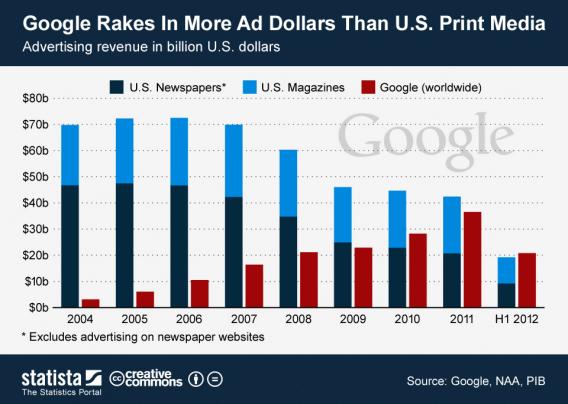
Google and Print Advertising Revenue Trends, 2004-2012It’s official. With nearly $21 billion in ad revenue generated during the first half of 2012, Google now attracts more advertising business than all U.S. print media combined.

That is correct:  German-based statistics portal Statista reports that Google garnered ~$20.8 billion in total ad revenues over the period, while all U.S. newspapers and magazines took in only about $19.2 billion.

Never mind that the comparison isn’t completely apples-to-apples … in that print revenues are for the United States only, while Google generates ad revenues worldwide. Still, it’s a dramatic milestone, and it says a lot about the fortunes (and future) of print versus online advertising.

Statista has helpfully published trend charts that show how quickly the ad picture has changed (see above). Only a few years ago, print advertising dominated the scene, but the trajectories of it and Google have been on opposite paths ever since.

It was inevitable that the lines would eventually cross, but how many could have foreseen it happening as early as 2012?

As if on cue, Advance Publications, a company that owns a number of venerable newspapers in New Orleans, Cleveland and elsewhere, has just announced that it is likely to cut the publication frequency of the Plain Dealer newspaper from its current seven days a week.

If Advance follows through on its intentions, it will join the New Orleans Times Picayune as a daily newspaper that’s no longer a daily.

The publisher’s letter to Plain Dealer readers described the newspaper’s future in lofty terms, noting that changes were coming as the paper seeks to “embrace dynamic shifts in the way information is consumed.”  And other such language.

It also noted that the pending changes are “not about cost-cutting.” But who believes that?

And in fact, the publisher’s letter states also that “if we maintain the status quo, we risk doing what everyone – our employees, advertisers and the community – wants to avoid: disappearing.”

If people don’t see a correlation between the Statista data and what the Plain Dealer has in store for its readers … they’re living on another planet.