What does e-mail engagement mean to consumers? Getting a discount.

e-mail engagement is all about providing discounts to customersIf you suspect that most people opt in to receive commercial e-mails so that they can receive discounts on the products want … you’re absolutely right.

The latest proof of this is in a survey of ~1,000 consumers conducted earlier this year by BlueHornet, a San Diego-based e-mail marketing services company.

That survey found that the percentage of consumers signing up to receive commercial e-mails in order to receive discounts is a whopping 95%.

So while marketers may want to believe that “engagement” with consumers is all about brand affinity and excitement … all that is much less important to them than simply getting a good deal on the product or service.

There will always be a desire for companies to nurture personalized, relevant conversations with customers via their e-mail communications.

After all, a highly engaged customer base that sees a brand as tops in its field … perhaps leader in innovation and technology … and above all, a brand that makes a true difference in the customer’s personal or business life.

All of these objectives represent Holy Grail of marketing. By all means, marketers can and should strive for this level of brand engagement – however hard to attain it may be.

But to make it a whole lot easier easier, offer a coupon or discount as well.  Preferably big.

A Newspaper Startup in 2012 … Is this Madness?

European Daily, preview editionOver the past decade or more, seemingly all the business trends on the newspaper front have been negative. So to read that a new transnational newspaper is being planned for a Fall 2012 launch comes as a pretty big surprise.

Yes, you heard that right:  The European Daily plans to hit the streets in a few months’ time. In the meantime, the budding newspaper already has a website up and running.

The European Daily is the brainchild of three young entrepreneurs from Sweden and Germany. “We are a publication that partly targets a more senior audience who, to a great extent, still prefers print, as well as a traveling audience who wants to read their news on a flight or at their hotel,” says Johan Malmsten, one of the three founders.

Does this sort of thinking sound like a recipe for success in 2012?

At first blush, it seems like a pipe dream. Two huge roadblocks appear to be standing in the way of success. First, the market dynamics have been ugly for traditional newspapers … their traditional business model swept away by the Internet and changing ways that consumers access the news.

Add to this the mounting political and economic crisis in Europe, which could result in the European Union’s breakup, rather than any sort of renewed consolidation.  Is this the right time to be introducing a media property that’s “pan-European” in its character?

Mr. Malmsten discounts these threats. Instead he asserts, “Some people have praised us on our perfect timing, given the vivid current debate about Europe and the fact that a European news source and a common public sphere have never been as much in demand.”

“Europe is a daily reality for millions of Europeans, and that won’t change. We see giving these people a news source and a daily point of reference as our mission,” he adds.

Looking at the newspaper’s launch plans, it’s pretty clear the investors are fully committed to their mission. A staff of 30 is being constructed for the paper — about half of them focused on content.  The editorial team will be based in Amsterdam in Holland.

A “preview” edition of the European Daily was printed last year and ~40,000 copies were distributed in key urban centers like Paris, London, Berlin and Brussels. Reportedly, the reception was highly positive.

But I have doubts whether a completely new newspaper title can be launched successfully – especially one that’s based on a conventional print-centric product with a digital adjunct. It seems like we’ve seen this movie before:  This very formula has been tried and found wanting – even among established newspaper brands.

It will be interesting to look back in about two or three years and see if this endeavor adds up to much – or instead has gone by the wayside.

Anyone care to weigh in with odds on the front end?

Does Gartner’s “Hype Cycle” Chart Apply to Social Media?

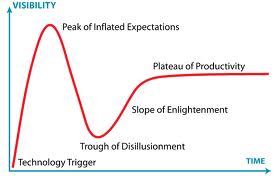
Hype Cycle Chart (Gartner, Inc.)That’s what author and digital marketing specialist Jeff Molander seems to think. In fact, it’s the topic of an article he wrote recently in Target Marketing magazine titled “What Game Changer? Moving past the Social Media Revolution that Never Was.”

As can be seen in the diagram at right, the Gartner “Hype Cycle” model begins with a technology trigger that generates a groundswell of interest and expectations, which is then followed by a crash when the early expectations fail to pan out.

Things do move forward again – much more slowly – as the sober reflection on early disappointments helps temper expectations to more realistic levels, characterized by Gartner as a “plateau of productivity.”

It is Mr. Molander’s contention that the characterization of social media as a “game-changing” phenomenon has been so overstated and sensationalized, most companies today are probably working against their own best interests in how they’re dealing with it.  Which is to say, not using it properly as a selling tool.

Here’s how Mr. Molander puts it: “The difference between fooling around with social media and selling with it relies on the use of time-tested direct response practices – not new tools and techniques.”

Those basic practices include:

  • Solving customers’ problems
  • Provoke customer responses that connect to the sales funnel
  • Discovering customers’ needs as they evolve … then using this knowledge to improve the response rate

The companies that are successful in selling goods and services via social media are promoting interactions in ways that answer questions and solve problems.

Of course, there is absolutely nothing new or novel about this: “Solving customer challenges” has always been an effective way to cultivate AIDA (awareness, interest, desire and action).

It also continues to be the best way to move customers toward making a purchase.

What social media can do is make the process easier to accomplish, due to social’s interactive nature. Approached in the proper way – and done with regularity – facilitating digital Q&A interactions will help leverage and drive sales.

I think Mr. Molander’s point of view is correct. Using social media as a platform for sales isn’t about some kind of “secret formula” for content creation or figuring out the ideal time to publish a Twitter tweet or blog post. It’s about using the “new” platforms to facilitate “old” sales concepts.

You know – the ones that work.

Reasons Why the Facebook IPO Bombed

Facebook IPO failureShare prices of Facebook stock have been distinctly underwhelming since the first day of trading — to the tune of ~30% off its original offer price. And everyone seems to have an explanation as to why.

I’m partial to a list of reasons put out by Dan Janal, president of PRLeadPlus.com and author of the business book Reporters Are Looking for You.

Mr. Janal has come up with a dozen reasons for the Facebook IPO failure. The ones that struck me as most compelling are these:

  • The public is not as dumb as Wall Street thinks. Chalk it up to too many other dot.com “can’t miss” opportunities that whiffed big-time.
  • Who has excess money to throw around? Small investors are struggling with underwater mortgages and mountainous debt … so how do they have extra funds to throw at an IPO? Get real. (And the institutional investors stayed away because they were clearly “in the know” about how unrealistic Facebook’s IPO share pricing really was.)
  • Who goes on Facebook to actually buy things? Precious few, that’s who. And if buyers aren’t on Facebook … then advertisers won’t be there either. And with that, there goes a big part of Facebook’s business rationale down the toilet. (GM backed out of its Facebook advertising program – very publicly – just days before the IPO. That timing suggests they were trying to tell the market something!)
  • Friends aren’t really “friends.” Indeed, many Facebook friends are more like acquaintances, which is a lot less compelling when it comes to word-of-mouth influencing. (LinkedIn connections are far more “honest” in terms of being “all about business.”) When Facebook contends that friend networks will influence more buyers, investors look at their own friend networks … and they don’t buy the hype.
  • There’s a huge gulf between Facebook “friendships” and actual “engagement.” And if friends don’t engage, a big piece of what makes the Facebook power matrix potentially so potent falls away.

Mr. Janal maintains that the characteristics that make the Facebook platform what it is aren’t the same ones that’ll launch “a million new millionaires.”

Sure, the early investors who acquired stock options early in the game came out big winners. But precious little of that largesse turns out to be in the cards for the rest of the investors.

Bombs away.

The “Digital Natives” are Restless …

Digital Natives, Digital Multi-taskingDigital natives” is a term used to describe consumers who have grown up with mobile technology as part of their daily lives – essentially people age 25 and younger.

And man, do these whippersnappers behave differently than the rest of us! “A Biometric Day in the Life,” a newly released research study from Time, Inc., reveals how the myriad digital devices and platforms are affecting the media consumption habits of the Digital Natives compared to the rest of the population.

The salient finding from the Time research: On average, Digital Natives switch their attention between various media platforms a whopping 27 times in a single hour. That’s nearly once every other minute.

[For purposes of the analysis, media platforms includes television, magazines, desktop computers, tablets, smartphones, as well as channels within platforms.]

What’s the impact of this “multi-tasking to the max” behavior? The Time study posits that Digital Natives’ emotional engagement with content is less involved and more constrained.

In fact, the study concludes that these people tend to use media to regulate their mood; if they grow tired or bored, they switch to something else.

The study’s comparison of Digital Natives’ interaction with their digital devices to the rest of the population is also instructive. Natives tend to divide their time equally between digital and non-digital media, whereas the rest of us spend about two-thirds of our time with non-digital media.

Moreover, Digital Natives are significantly more likely to take their devices from room to room with them when they are at home (~65% versus ~40% for the rest of the population). One natural result of this tendency is that it makes switching platforms even easier.

And what about texting? Nearly nine out of ten Digital Natives report that they send or receive text messages on a typical day (compared to half of the rest of the population).

In fact, more than half of Digital Natives state that they “prefer texting people rather than talking to them.” Fewer than 30% of the rest of us feel that way.

Social media behaviors are similar; ~80% of Digital Natives report that they access Facebook at least once per day – far greater than rest of the population accesses (~57%).

The Time survey’s findings suggest that the traditional way of delivering marketing messages with a clear “beginning, middle and end” may be morphing into something dramatically different from what we’ve known.

Dr. Carl Marci, CEO and chief scientist at Innerscope Research as well as a staff psychiatrist as Massachusetts General Hospital, has made several interesting observations about the Time study:

 Patterns of visual attention and emotional consequences may be changing as a result of modern media consumption.

 The brains of a new generation of Americans may be becoming “rewired.”

 Marketers are facing an increasingly complex media environment, making it harder to reach and engage their target audiences.

If Dr. Marci’s observations are accurate, things are going to get much less predictable – and a lot more challenging – for marketers.


Data-Driven Pricing: Biting the Hand that Feeds

Data-driven-pricingWe hear the claim all the time: Online shopping gives you the best opportunity to find the best pricing on goods.

But here’s the rude reality: Developments in “data-driven pricing” is putting the lie to that assertion.

Although it’s a turn of phrase that hasn’t received very much play – at least until now – data-driven pricing is the latest method by which sellers are hankering to extract every last dollar they can from buyers.

Think of it as the digital version of global zone pricing in the petroleum industry, wherein gas companies charge filling stations in well-heeled areas more for the exact same gasoline product that they sell for less elsewhere.

But in the digital realm, online retailers like travel sites are keeping track of customer IP addresses and recording past shopping activities in order to serve up higher prices to the people who are interacting with their sites.

These retailers are taking customer loyalty … and standing it on its head.

Using browsing and shopping data collected about each customer – including every time a site is visited via Google search results – retailers can determine in real-time if they can get away with charging a higher price.

And that may well be why you paid $75 more for your air ticket than the person seated next to you on the plane who also purchased their ticket online on the exact same day.

Now, this scenario isn’t universally true. When there are many retailers to choose from on a particular item, along with ample supply of a good, the consumer can usually hold out for the lowest combination of price, shipping (hopefully little or none), and sales taxes (hopefully none).

But on items ranging from airline tickets to concert tickets, the online consumer is often up against a stacked deck.

Believing that online shopping is the slam-dunk way to extract the lowest price from the retail channel is a notion that’s out of date at best … and naïve at worst. Simply put, data-driven systems have gotten a whole lot “smarter.”

Some consumers might respond by hesitating before buying – no longer assuming that the price they’re being offered is the “lowest available” one.

So here’s a question: When consumers become more cautious about buying online, who’s hurt more?

The consumer? Or the suddenly smarter retailer?

What people say: More believable than what brands say.

Word of mouth and review/ratings sites trump branding activityWord of mouth has always been a powerful influencer over the success or failure of a product in the market. So when surveys show that consumers value the opinion of their friends most when it comes to the value of a product, there’s nothing particularly unusual about that news.

But consider the explosion in the popularity of review sites like Angie’s List and Yelp, plus other sources of information and opinion in cyberspace over the past few years. These have made it possible to access the opinions of significantly more people than ever before.

Nielsen’s most recent Global Trust in Advertising Survey, which queried ~28,000 consumers around the world in late 2011, found that ~92% of respondents trust word-of-mouth recommendations from friends and family members.

Interestingly, that percentage is actually up from 2007, when Nielsen found ~75% of respondents trusting their friends as a good source of information.

What about online consumer reviews written by complete strangers? Consumers’ trust levels in those information sources has also gone up; it’s ~70% today compared to ~55% back in 2007.

The picture is different with branding and advertising, however. Trust in traditional advertising (TV, radio, magazines and newspapers) has dropped in recent years. Today, only about 47% of Nielsen survey respondents say they trust those sources of information.

Online advertising has actually improved its standing with consumers, but trust levels are still mired in the 30s: 36% trust online video ads … ~33% trust online banner ads … ~39% trust paid search engine advertising.

And when it comes to branded content like company websites, consumer trust in these “owned media” is running below 60%, while e-mail communiqués are scoring even lower on the trust scale (around 50%).

The Nielsen survey results underscore why developing a robust social media presence has become such an important strategy for so many brands. Clearly, recommendations and reviews from friends and strangers alike is having the strongest impact on the purchase decisions that are being made.

Of course, building a social media presence is only half the battle: Whether the content is positive, neutral or negative has huge implications as well. A few negative reviews or ratings can stop a purchaser dead in his or her tracks. Just ask anyone in the hospitality industry, whose establishments are in some senses almost held hostage by TripAdvisor and other rating sites.

Sometimes “permission slips” aren’t enough when it comes to e-mail deliverability.

Bounced-emails-undelivered-emailsIn case you’ve been wondering how much marketing e-mail actually reaches its intended targets, a recently released benchmark report from e-mail scoring and certification services provider Return Path has some answers. It finds that only about 75% of “permissioned” e-mails are actually making their way through.

That means one in every four e-mails are either hitting a spam or junk folder, or are being blocked by ISP-level filtering.

The report was based on analysis of data from Return Path’s Mailbox Monitor service, which tracks the delivery, filtering and blocking rates for more than 600,000 e-mail campaigns.

Interestingly, the delivery stats for business-to-business marketing e-mail aren’t much lower than for business-to-consumer e-mail. This was considered somewhat surprising because of company-level filtering systems like Postini, MessageLabs and Symantec that are installed at many large corporations. Presumably, they do a more thorough job of filtering e-correspondence.

The Return Path report also included a few cautionary notes for marketers:

 Many e-mailers believe that whatever gets deployed and doesn’t bounce must be reaching inboxes. But senders are notified only when the e-mail is a hard bounce – not if it has ended up in a spam or junk folder.

 Relying on rented e-mail files in the B-to-B world can be dangerous, as those files can be riddled with spam traps. Commercial entities are always on the search for new prospects and leads … but merging a good in-house list with a few of these bad boy rental lists can result in compromising the entire database.

 In the consumer sector, many marketers aren’t paying close enough attention to inbox placement rates. For example, data about Gmail shows that while many marketers are ostensibly achieving a 90%+ deliverability rate, fewer than one in five of those emails are actually being directed to the “priority” inboxes within Gmail as designated by the recipients. And you can bet that precious few of the other ~80% are getting any sort of attention at all from consumers.

More details about the Return Path report can be found here – well-worth checking out.

When “Push” Comes to “Pull” in Marketing

Push versus pull marketing.  "Push" has the upper hand now.
"Push" vs. "pull" marketing: Does "pull" have the upper hand now?
It’s clear that social media is delivering a wide range of interesting and beneficial online experiences for people. One that’s among the most highly valued is the ability to “vet” products, services and brands through reading reviews posted by “real people.”

According to a survey of ~3,330 consumers conducted in late 2011 by Deloitte’s Global Consumer Products Group, a large majority of consumers report that they rely on user reviews to guide their purchase decisions, rather than merely being influenced by brand advertising.

The Deloitte survey found that nearly two-thirds of consumers read consumer-written product reviews online. Of that group, 82% report that their purchase decisions have been directly influenced by these reviews – either confirming their decision to buy or causing them to switch to an alternative product or service.

Because of the perceived value of these consumer reviews, most people begin their search for information via a search engine query or by going to blogs, e-commerce sites such as Amazon that also feature consumer reviews, or review sites like TripAdvisor and Yelp.

By contrast, the incidence of people beginning their information quest at a company or brand website is far lower.

These dynamics are part of the reason why so many companies and brands are looking to increase their engagement with the online public. They’re particularly keen on ferreting out their natural allies – people who have a strong positive opinions about their brand – and turning them from armchair advocates into vocal cheerleaders.

For many marketers, this means going well-beyond collecting “likes” and similar “trophy counts.” They’re also continually monitoring comments in the social sphere concerning the quality of their products and customer service in order to make sure they deal with any issues or complaints expeditiously in order to minimize negative fallout in the “review” environment.

There’s also a powerful impulse for brands to offer “incentives” to customers in exchange for posting positive reviews. Those incentives can range from the small or innocuous – offering discount coupons or inexpensive product samples – all the way to incentives that seem more like bribes. (Here’s the latest example of this, courtesy of Honda.)

The keen attention companies are paying to social platforms reminds us that we’re in the midst of a migration away from traditional “push” marketing into a land of “pull” marketing.

There have always been “push” and “pull” aspects to marketing, advertising and PR, of course. But the balance of energy these days appears to be shifting quite sharply in the direction of “pull.”

There’s no reason to think that pattern will change anytime soon.

Retailing Comes Full Circle … Courtesy of Amazon

Amazon’s been busy revolutionizing the world of retailing for well over a decade now. So what’s its latest trick? Bricks-and mortar stores.

Yes, you read that right. Amazon’s going into the physical retail game.

What’s behind this seemingly bizarre turn away from 21st century online retailing back to something that seems almost quaint? It’s pretty fundamental, actually. There are many products that consumers find easier to purchase after being able to interact with them physically and personally.

From apparel to electronics to sporting goods, sometimes there’s no substitute for the visceral, sensory experience. Online images, videos, product ratings and customer reviews all have their place, and Amazon doesn’t see those aspects becoming any less important over time.

Indeed, the Amazon store concept builds on all that, attempting to create a multi-channel retailing structure that truly serves the needs to consumers whenever and however they wish.

If what Amazon is developing is “just another” retail shop, it’ll be much ado about nothing. But it’s more likely that Amazon will try to create a retail experience in the manner of an Apple store – creating an environment that has its own special personality and attracts shoppers because of it.

Amazon may generate a good deal of buzz about its newest venture and the novelty of it all. Good for them. But the Amazon initiative also speaks to a more fundamental truth: reminding us that the marketplace is made up of human beings, not machines. People are social … and sometimes we hunger for more than just looking at an image on a computer screen.

If Amazon can successfully integrate its new physical stores concept with its phenomenally successful online retail business, it’ll be another step forward in the creation of truly integrated, multi-channel retailing.

It’s good to see that people are at the center of the model – literally and figuratively.