Optify Measures the Current State of B-to-B Online Marketing

Optify logoEach year Optify, a developer of digital marketing software for business-to-business marketing professionals, analyzes web behaviors to develop a “benchmark” report on B-to-B marketing.

The annual Optify benchmark report is interesting in that the findings are developed not from surveys, but from actual web activity. 

Optify’s most recent report, released in early 2013, was produced using data gleaned from more than 62 million web visits, ~215 million page views and ~350,000 leads from more than 600 small and medium-sized websites of B-to-B firms.

Optify used its proprietary visitor and lead tracking technology to collect and aggregate the data.  U.S.-based B-to-B sites that garnered between 100 to 100,000 monthly visits were included in the research.

There are many interesting findings – enough to chew on so that I will cover them in several blog posts.  In all likelihood, some of the findings will confirm your perceptions … while others may be a tad surprising.

Web Traffic

As in business-to-consumer web marketing, there is cyclicality in web traffic in the B-to-B world.  But according to Optify, it’s almost the polar opposite:

  • Higher traffic:  January through March + September and October
  • Lower traffic:  Summer months + end of year

Source of Web Traffic

Optify found that the overwhelming amount of B-to-B web traffic comes from two main sources — organic search and direct traffic.  Other sources – particularly social media – are a good deal more peripheral:

  • Organic search:  ~41% of web traffic
  • Direct traffic:  ~40%
  • Referral links:  ~12%
  • Paid search:  ~5%
  • Social media:  ~2%

Lead Conversion Rate

Optify defines the “conversion rate” as the percent of web visitors who submitted a query or filled out some other type of form during a single visit.  Using this definition, Optify found that the average conversion rate was around 1.6%. 

But the best sources for lead conversions differ from the most prevalent sources of web traffic:

  • E-mail source:  ~2.9% conversion rate
  • Other referral links:  ~2.0%
  • Paid search:  ~2.0%
  • Direct traffic:  ~1.7%
  • Organic search:  ~1.5%
  • Social media:  ~1.2%

Page Views per Web Visit

Optify found that the average visitor viewed three pages on the website during their visit.

… But Big Variations

Optify found a good deal of variability in web activity.  To illustrate this, it has published findings broken out by medians and for percentile groups as follows:

  • Median visits per month per website:  1,784
  • 75th percentile of websites:  4,477
  • 25th percentile of websites:  339
  • Median page views per website visit (monthly average):  3.03
  • 75th percentile median page views:  4.04
  • 25th percentile media page views:  1.80
  • Median lead conversion rate (monthly average):  1.6%
  • 75th percentile median conversion rate:  3.3%
  • 25th percentile median conversion rate:  0.5%

There’s much more in the Optify report that’s worth reviewing … which I’ll share ina follow-up blog post.
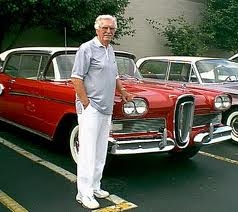
Remembering Roy Brown, designer of the star-crossed Edsel, one of the biggest flops in automotive history.

Roy Brown, designer of the Ford Edsel
Roy Brown, Jr., designer of the Edsel.

I remember my father, who had a 45+ year career in industrial/commercial sales and marketing, having an interesting artifact hanging on the wall of his office: a hubcap from a 1958 Ford Edsel sedan.

It was an interesting prop because it represents one of the biggest marketing flops in American automotive history … and underscores what can happen when product development efforts ignore what market research is telling them.

Recently, Roy Brown, Jr., one of the key players in the Edsel fiasco, passed away at the age of 96. As the lead designer on the product, Mr. Brown bore the brunt of blame for the “glorious failure” that was the Edsel.

Of course, that rap isn’t entirely fair; introducing a new motor car is a team effort that involves a host of people. And in the case of the Edsel, the design of the vehicle was only one of several key failures.

Consider just how many ways the Edsel ran afoul of good product development practices:

  • The car was developed based on out-of-date consumer research. The late 1950s was the beginning of changing consumer tastes in car designs:  moving away from exuberant fins and outlandish colors and towards a more refined style. By the time the Edsel became available at dealerships, consumer tastes had shifted and the country was in a recession.
  • The design of the car was controversial. Its most memorable design feature was its “horse collar” grille, unfortunately referred to by some as a toilet seat. It was different from any other car on the market — but the notoriety wasn’t positive. Some wags joked that the car’s front resemble “an Oldsmobile sucking a lemon,” while others were even less charitable, noting that the grille design was suggestive of a giant vulva.
  • Despite undertaking a highly publicized naming effort for the vehicle that ultimately reached more than 6,000 possibilities being considered, Ford rejected all of these suggestions and chose to name the car after the lone son of company’s founder. The “Edsel” – a clunker of a car name if ever there was one – did nothing to endear the buying public to the brand, seeming more like corporate nepotism taken to the extreme.

Ford predicted great things for the Edsel. The company launched a glitzy ad campaign for the automobile in 1957, touting it as a revolutionary “car of the future” and projecting first-year unit sales of more than 200,000 vehicles.

Instead, when it debuted in Ford showrooms in 1958 carrying a list price between $2,300 and $3,800, consumers were distinctly underwhelmed.

But even with disastrous first-year sales, Ford limped along with the Edsel until finally killing the brand in 1960. In all, only ~100,000 Edsels had been sold over three model years.

The total cost of the Edsel boondoggle to Ford was ~$350 million, which translates into nearly $2.8 billion in today’s dollars.

Roy Brown was the man held most responsible for the failure of the Edsel. But ever the optimist, the designer didn’t let this become the end of his career. In fact, Brown bounced back to work on successful new introductions such as the Ford Falcon and Mercury Comet. These turned out to be everything the Edsel wasn’t.

Mr. Brown didn’t disown his star-crossed child, either. In fact, he drove his own Edsel car (a stunning fire-engine red model) nearly to the end of his life — no doubt happy to know that in later years, mint-condition and restored Edsel cars were selling for upwards of $100,000 apiece. And there are highly active Edsel car clubs with members located throughout the United States and Canada.

So, maybe it’s not such a bad legacy in the end.

Groupon’s Slow-Motion Train Wreck

Groupon failure of business modelI’ve blogged before (several times, actually) about the problems with Groupon’s business model and the difficulties it’s encountered since going public.

It seems that the twin whammies of new competitors plus merchants’ increasing unwillingness to take a bath on offering deep-discounted products and services to ultra price-sensitive consumers have been enough to send Groupon’s business into a financial tailspin.

One key takeaway from the Groupon couponing experience: Consumers who are attracted to bottom-of-the-barrel pricing have absolutely no brand loyalty thereafter – unless they’re offered a similarly extreme price discount the next time around.

Understandably, merchants aren’t much interested in marketing practices that boil down to being creative ways to divorce profits from sales.

And now, with yet another quarter of dismal financials just released, Groupon’s board of directors has done the inevitable: separating CEO and founder Andrew Mason from his company.

As the famously quirky Mason, who was once a student of music at Northwestern University, put it in a letter to Groupon employees (which he also released publicly “since it will leak anyway”):

“After four and a half intense and wonderful years as CEO of Groupon, I’ve decided that I’d like to spend more time with my family. Just kidding – I was fired today. If you’re wondering why … you haven’t been paying attention.”

And then Mason goes on to summarize the ugly facts: two quarters of missing the company’s own financial expectations, along with a stock price that’s baely one-fifth of Groupon’s listing price when the company went public ~18 months ago.

Business observer and talk-show personality Jeff Macke has been merciless in his condemnation of Groupon’s recent business performance. He writes:

“In its short, ignominious history as a public company, Groupon crushed the hopes of more true believes than Santa Claus and Jim Jones combined. From its closing level on the day of its IPO in November 2011, GRPN shares have lost more than 80%, driven by accounting scandals, an ill-conceived international expansion and generally poor execution of a not-very-smart business model … What is fresh information is the company’s hideous earnings miss … when it reported a 12-cent loss versus expectations of a 2-cent gain.”

Late moves by the company to staunch the bleeding – such as taking a smaller cut of revenue on daily deals during the latest holiday season in an attempt to attract and keep merchants – haven’t been very successful and haven’t reassured investors.

In late 2012, Andrew Mason was dubbed “Worst CEO of the Year” by CNBC’s Herb Greenberg.  But not every business journalist and analyst has been completely critical of CEO Mason. In an interview with the New York Times, Stifel Nicolaus’ Jordan Rohan remarked: “I view Mason as a visionary idea generator. Few would argue with how impressive the Groupon organization was as it grew.”

But Mr. Rohan went on to report, “However, at some point it became the overgrown toddler of the Internet – operationally clumsy [and] not quite ready to make adult decisions.”

For many of us in the marketing field, peering at Groupon from the outside was like seeing a slow-moving train wreck in the making, so the latest news is pretty much what we expected.

But perhaps the biggest surprise is how similar it all looks to the ill-starred Internet pure-plays of the dotcom bubble a decade ago.

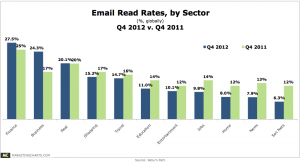
Charting e-mail read rates. (Correction: non-read rates.)

E-Mail Read Rates (Open Rates), Return Path, 4th Quarter 2012One of the great things about e-mail marketing is the ability to track nearly everything about its success (or lack thereof).

A recent Return Path Intelligence Report on e-mail statistics covering the 4th Quarter of 2012 is a case in point. Return Path conducts these studies by monitoring data from thousands of e-mail campaigns that utilize its delivery platforms.

Specifically, the  study tracks the inbox, blocking and filtering rates for more than 400,000 campaigns that use Return Path’s Monitor and Email Client Monitor suites, along with panel data from the company’s Inbox Insight program.

For the 4th study, Return Path reviewed nearly 250 ISPs in North and South America, Europe, Asia and Australia.

And what does its most recent study find? Fewer than one in five e-mails (17%) were opened. And that rate is slightly lower than what was recorded in the 2011 4th Quarter study.

However, some business sectors performed substantially better than the average:

  • Finance sector: ~28% open (read) rate
  • Business sector: ~24%
  • Real estate sector: ~20%

Shopping e-mails fared less well, with a read rate of ~15% (down from ~17% the previous year).

E-mail open rates in the education (~11%) and entertainment (~10%) fields were lower still.

And the worst sectors? News sector e-mails had an average open rate of only ~8%, while social networking e-mails fared even worse at ~6%.

Moreover, both of these bouncing-in-the-basement sectors experienced very significant drop-offs from the previous year, underscoring how they continue to struggle in their efforts to be interesting and relevant to readers.

For those who wish to view additional results and analysis, the Return Path report is available here.  It’s a free download.

The corporate resource commitment to social media: Plenty of talk … but how much action?

Social media staffing prospects for 2013 are no better than they were in 2012.With social media activity seemingly bursting at the seams, it’s also risen near the top of many marketing departments’ punch lists of tactics to reach, engage with and influence their customers and prospects.

But when it comes to putting serious resources behind that effort, how much of a commitment is really there?

A recent Ragan Communications/NASDAQ OMX Corporate Solutions survey suggests that the commitment to social media may be a lot of “talk” … and a lot less “walk.”

The November 2012 survey of ~2,700 social media professionals found that two-thirds of the respondents perform their social media tasks above and beyond their regular marketing duties:

  • Social media tasks are on top of current responsibilities: ~65% of respondents
  • Have established a team for social media activities: ~27%
  • Use an in-house team along with an outside social media agency or planner: ~5%
  • Outsource all social media efforts: ~3%

For the distinct minority of companies that have seen fit to devote some degree of dedicated personnel to their social media program, nearly 85% of them have created teams of three people or fewer … and in more than 40% of the cases, it’s just a single individual instead of a team.

What departments within companies are involved in social media activities?  No surprise here:  It’s the usual suspects (marketing and public relations) with a variety of other departments having their toe in the water as well:

  • Marketing: ~70% of departments are involved in social media activities
  • Public relations: ~69%
  • Corporate communications: ~49%
  • Advertising: ~26%
  • Customer service: ~19%
  • Information technology: ~17%
  • Legal personnel: ~14%

As to whether we’re on the cusp of something much bigger in terms of resourcing social media activities, this isn’t evident much at all from the future plans of the businesses surveyed by Ragan.

Let’s begin with budgets. Excluding salaries and benefits, half of the companies surveyed have social media budgets of $10,000 or less – and one-quarter have essentially no dollars at all earmarked for social media:

  • Annual social media budget $1,000 or less: ~23% of respondents
  • $1,000 to $5,000: ~14%
  • $5,000 to $10,000: ~13%
  • $10,000 – $50,000: ~22%
  • $50,000+: ~26%

When asked whether companies had expanded their social media personnel assignments during 2012, fewer than one-third of the respondents answered affirmatively.

… And the trend doesn’t look much different for 2013, with more than three-fourths of the respondents reporting that there aren’t any plans to hire additional social media practitioners this year.

What about interns, that fallback position for cheap and easy labor?

Fewer than one-fourth of the respondents reported that interns are employed by their companies for social media tasks. Most others believe that using typically inexperienced interns for the potentially sensitive customer engagement aspects of social media is a “non-starter,” as they consider those sensitivities to be a disqualifying factor.

And in the cases where interns do help out in social media efforts, the vast majority of their activity is confined to Facebook and Twitter, as compared to LinkedIn, blogging,creating online “thought leadership” articles and the like.

How satisfied are companies with how they’re doing in the social media realm? According to this study, there’s rampant dissatisfaction with the degree to which companies feel able to measure the impact of social media on their sales and their businesses.

The tracking mechanisms put in place by companies range the gamut, but it’s not clear how convinced practitioners are that the information is accurate or actionable.

  • Track interaction and engagement (e.g., followers, fans, likes): ~86% of respondents
  • Track web traffic: ~74%
  • Track brand reputation: ~58%
  • Track customer service and customer satisfaction: ~41%
  • Track new lead generation: ~40%
  • Track new sales revenues: ~31%

The vast bulk of tracking activity happens using in-house mechanisms or free measurement tools (~59% use those), although the paid measurement tools offered by HootSuite and Radian6 do have their share of users.

The takeaway from the Ragan/NASDAQ research is this:  Company staffing and resource allocations have a ways to go to catch up with all the talk about social media.

Chances are, those resources will be easier to allocate once proof of social media’s payback potential can be shown.  But that might take substantially more time to prove than some people would like.

As if to underscore this notion, statistics compiled by IBM researchers covering the past holiday season found that less than 1% of all online purchases on Black Friday emanated from Facebook.  The percentage of purchases from Twitter was even lower — undetectable, in fact.

And similarly paltry results were charted for the rest of the 2012 holiday season.

As long as social media marketing continues to contribute such pitiful sales revenues, get used to seeing scant social media budgets and near-zero increases in dedicated human resources.

As direct marketing specialist and raconteur Denny Hatch has so pointedly remarked:

“Social media marketing is an oxymoron.  You cannot monetize a giant cocktail party.”

What do you think?  Is Mr. Hatch onto something … or is he just reaching for dramatic effect?  Share your own thoughts if you’d like.

Weighing the Odds on Marketing Predictions for 2013

MarComm Crystal Ball Predictions for 2013One thing each New Year invariably brings is a passel of marketing and communications forecasts for the upcoming year.

And 2013 is no exception. I’ve seen more than 25 articles in the business press over the past several weeks that take a stab at predicting the future – and that’s without even looking to find them.

With each prediction list containing anywhere from 5 to 25 items, there’s a lot to consider – and also a good deal of overlap. The big question is, how many of these predictions will turn out to be accurate, as opposed to wishful thinking?

I thought I’d highlight some of the more interesting forecasts and list them here  — along with my odds on the likelihood they will come true.  So here goes … see what you think:

2013 MarComm Predictions from the Experts

Responsive design” and its ability to detect devices and deliver a satisfying viewer experience will take center stage in 2013 now that smartphone sales have overtaken PCs and more e-mails than ever are being read on mobile devices.
(Michael Della Penna, Responsys)
Chance of happening (my odds): 100%.

Special characters in e-mail subject lines are here to stay.
(Chad White, MediaPost E-Mail Insider)
Chance of happening: 100% (unfortunately).

Twitter will start personalizing Twitter feeds in 2013, based on an algorithm consisting of influence, engagement, alignment, gravity, and subscriber interests.
(Rich Brooks, Flyte New Media)
Chance of happening: 90%.

Google+ will become a “must use” service not because of its social elements, but because it will be the central hub for managing a company’s “official” online public presence in the eyes of Google.
(Anita Campbell, Small Business Trends)
Chance of happening: 80%.

Mobile transactions and payments will become huge – the biggest “disruption” in local search – and making it much easier to close the research-online/buy-offline loop and calculating actual ROI on specific marketing campaigns.
(David Mihm, SEOmoz)
Chance of happening: 70%.

After struggling for years to gain adoption, the QR Code will die – a good concept done in by its clunky interface and application.
(Peter Platt, iMedia Connection)
Chance of happening: 70%.

Triggered e-mails will give sophisticated marketers a sustainable competitive edge over other markers.
(Chad White, MediaPost E-Mail Insider)
Chance of happening: 60%.

More industries such as the financial, legal, accounting and medical fields will get serious about social media in 2013 as clarity about potential regulatory issues is established.
(Stephanie Sammons, Wired Advisor)
Chance of happening: 60%.

2013 will be the year of visual marketing. Video in e-mail will finally take off, thanks to HTML5 video capabilities.
(Ekaterina Walter, Intel)
Chance of happening: 60%.

2013 will be the “year of the invisible computer,” finally fulfilling writer Donald Norman’s prophecy made back in 1999 wherein people don’t focus on the technology at all, but on what information and services the technology can deliver.
(Peter Platt, iMedia Connection)
Chance of happening: 50%.

Marketers will use fewer social sites in 2013, preferring to have a solid presence in one or two channels rather than to try to dominate in every single platform.
(Ed Gandia, International Freelancers Academy)
Chance of happening: 50%.

Apple will launch iRadio, taking on Pandora in Internet radio and integrating into the iTunes iOS app.
(Richard Greenfield, BTIG)
Chance of happening: 50%.

2013 will not be the “year of the [fill in the blank],” but will build on the digital accomplishments of the past.
(Peter Platt, iMedia Connection)
Chance of happening: 40%.

By the end of the year, one in three paid clicks will come from a tablet or smartphone as the “living room on the go” enables seamless content portability for consumers.
(Sid Shah, Adobe)
Chance of happening: 30%.

SlideShare will be the fastest growing social network in 2013.
(Joe Pulizzi, Content Marketing Institute)
Chance of happening: 20%.

The number of podcasters will double in 2013, tapping into 1 billion smartphone users and their desire for accessing quality, on-demand talk.
(Michael Stelzner, Social Media Examiner)
Chance of happening: 20%.

Voice assistants will become the rule than the exception, in response to consumers’ increasing expectations for immediate and customized support in all forms of outreach.
(Robert Passikoff, Brand Keys)
Chance of happening: 20%.

The age of the PC is over in 2013, as a true “pivot point” is reached due to the penetration of smartphones and tablets.
(Will Margiloff, IgnitionOne)
Chance of happening: 20%.

2013 will be the year marketers stop using the term “social media” when referring to campaigns … and Facebook will “own” mobile advertising.
(Peter Shankman, Geek Factory founder)
Chance of happening: 10%.

Marketing budgets will now be established based on outcomes, not history, eclipsing the traditional dynamic of building budgets based on “last year” figures.
(David Cooperstein, Forrester Research)
Chance of happening: 10%.

2013 will bring the death of static web pages.
(Raj de Datta, BloomReach)
Chance of happening: Nil.

So, what do you think of these fearless predictions? Which ones are most likely to come true?  Would you place different odds on some of them? Feel free to share your observations with the other readers.

The Confluence of “Mature Marketing” and B-to-B MarComm

Conference attendees, mature marketing and B-to-B buyersIn recent years, a seemingly endless stream MarComm literature has been published focusing on how to communicate effectively with different target groups. 

Whether it’s seniors … baby boomers … Gen-X or Gen-Yers … minority populations … B-to-B or technical audiences, marketers have all sorts of helpful advice coming in from all sides.

The more I’ve been reading this material, the more I’m seeing confluence rather than divergence. 

For example, there’s a high degree of commonality between marketing to “mature” consumers and B-to-B audiences.  The overlap is huge, actually.

Consider these aspects of crafting strong MarComm messages that make good sense for both B-to-B and mature audiences:

  • Sticking to the facts about products or services.  Both audiences tend to make judgments and decisions based on “information and intelligence” rather than “emotions or peer pressure.”
  • Providing lots of content.  “More is more” with these audiences, which tend to be far more voracious in their reading habits and appreciate the availability of copious information.
  • Avoiding “hype” in MarComm messages.  These audiences have “seen it all” and aren’t easily bamboozled.
  • Avoiding “talking down” to these audiences.  They are experienced people (and experience is the best educator); they have good instincts, too.
  • Designing communications so that these audiences will stick around and absorb what marketers have to say.  This means avoiding small type, garish colors and gratuitous design elements … not to mention the slow-loading graphics or animated visual hi-jinks that pepper too many websites.

None of this is to contend that emotions don’t play a role in driving purchase decisions.  But the reasoning processes that mature audiences and B-to-B buyers use to filter and evaluate MarComm messages are far more consequential than any “creative” aspects of the message platform could possibly deliver.

It would be nice if more marketers would remember this when crafting campaigns that target the “thinking” audiences out there.

No big deal after all: High-flying “Daily Deal” companies crash to earth.

Groupon hits the skidsI’ve blogged before about the rapid rise of so-called “daily deal” online coupon companies. But from the get-go, there were nagging questions about the long-term viability of these social couponing programs. One particularly foreboding indication was how few vendors return after trying their first campaign.

… Something about making money (or not) on these deals and whether (or not) couponers would become repeat customers.

A bit more time has gone by since that blog post, and today the news about daily deal sites looks pretty grim. In fact, Groupon, the market leader, has just reported another quarter of poor earnings due to the stagnation of its core business activities.

Groupon also reported that the average revenue per “active” customer (one who has purchased a deal from Groupon within the past 12 months), declined more than 15% … to ~$64 from ~$76.50 a year earlier.

Groupon’s stock price is also way down; it’s now ~$2.75, nearly 90% below its share price when the company went public barely one year ago. Consequently, the company’s market value has shrunk to ~$1.8 billion, compared to ~$13 billion when it went public.

The situation is much the same over at Living Social, Groupon’s most significant competitor. Its part owner, Amazon, just reported a quarterly loss for the previous quarter after it wrote down its investment in Living Social.

What’s the reason for the dismal turn of events? Maybe it’s that the business model for these daily deal programs is … fundamentally flawed?

While at first blush, daily deals seem like a great way for smaller businesses to generate awareness, marketing buzz and attract new customers, it comes at a price: sacrificing the profit margin.

Indeed, the price promotion aspects of the business model are pretty problematic. In the “bad old days,” local and regional merchants used Yellow Pages advertising, perhaps supplemented by the occasional Valpak® coupon mailer.

But typically, Yellow Pages advertising doesn’t have a discounting component. Groupon and other daily deals do … in spades.

Because a daily deal doesn’t “take” until a sufficient number of people avail themselves of the offer, the deal needs to be lucrative enough to attract consumer volume … which is what makes this type of program a challenge for businesses to do over and over again.

And now, new research published by Raymond James & Associates proves the point. This consulting firm surveyed ~115 merchants that had participated in at least one daily deal promotion during fall 2012. It found that ~40% of the merchants would “not likely” run another such promotion over the next 2-3 years.

Why is this? The commission rates on these deals are high, for one thing. But also, merchants found a low incidence of return or repeat customers gained through the promotion. Conclusion: Daily deal customers come for the discount … and leave thereafter.

Other survey findings? How about these:

  • ~32% of the merchants lost money on their daily deal promotion.
  • ~40% feel that daily deal promotions are “less effective” than other forms of marketing.

Rakesh ‘Rocky’ Agrawal, a social media specialist and consultant, is blunt in his assessment of the situation: “I’ve always maintained that this is a hype-driven business built on an unsustainable business model – both for the merchants and for Groupon.”

So what’s the solution for Groupon and other social coupon programs? After all, it now seems clear that many merchants won’t be returning for new campaigns anytime soon. We can see the potential pie shriveling up before our very eyes.

In response, Groupon has begun expanding into a more traditional discount online retail operation (Groupon Goods). In fact, this endeavor now accounts for the bulk of the company’s recent revenue growth.

But there’s absolutely nothing new or extraordinary about this venture, as it just mirrors dozens of other sites that do the same thing.

One thing that does differentiate Groupon from other online merchant sites is its hefty sales force of “live people” interfacing with merchants and businesses – something only social networking and user review website Yelp! comes close to matching. For smaller businesses, the human touch is important when dealing with newfangled marketing concepts.

On the other hand, it’s also a costly differentiation that doesn’t tend to scale well – except with more human bodies. So there’s a palpable concern that Groupon will be unable to deliver these other services profitably compared to more technology-oriented competitors.

Returning to the daily deals component, Groupon and others are also facing the reality that they need to offer merchants a bigger cut of the promotion dollars. They’re also finding it more lucrative to push “perishable inventory” deals (e.g., at restaurants and hotels) where big discounts might make more sense for merchants compared to those for durable products.

All in all, Utpal Dholakia, a professor of management at Rice University’s Jones Graduate School of Business and a close observer of the segment, sees no easy answers. “The heyday for daily deals are behind us,” he concludes.

Storm Clouds on the Horizon for National Food Brands?

Archer Farms store brand (Target)

Generic Food BrandsAre we seeing the beginning of an upheaval when it comes to national food brands?

Over the past 30 years or so, the United States has faced its share of recessions and sharp economic cycles, with the resulting stresses on consumer budgets.

Through it all, so-called “store” and generic food brands have continued to represent only about 15% to 20% of all retail food dollar sales.

National food brands have done their part to promote themselves as the “quality” choice over store brands, as well as to promote product sales through couponing and various other attempts to beat back the “value” alternatives.

Their success has been pretty decent, all things considered … up to now. But that might be about to change.

Rabobank’s Food & Agribusiness Research and Advisory Group has just issued a report predicting that private-label food brands are poised to jump to a 25%-30% share of the market over the next ten years.

That would make the U.S. similar to what has happened in Europe, where one in three products purchased today is a retailer-branded product.

What’s behind the anticipated rise in store brands? The Rabobank report cites several contributing causes:

  • Food retailers have more sales reach and sales clout than ever. It’s not just traditional supermarkets but also warehouse clubs, drugstore chains and dollar stores.
  • Retailers are expanding their private-label initiatives into more than simply “low cost/high value” lines.
  • Stores are putting greater marketing muscle behind their own store brands – witness Target and its Market Pantry, Archer Farms and Up & Up product families.

Nicholas Fereday of Rabobank sums it up this way:

“Retailer brands have matured from their original positioning as ‘cheap and cheerless’ generic products into a more diverse range of national brand equivalents, and more recently, highly innovative premium products … On grocery shelves around the U.S., from convenience stores to upscale supermarkets, retail brands now complete successfully and often win against national brands, earning consumer trust in terms of pricing, quality, image and value.”

What are the ways the national brands can fight back against the store-brand trend? Rabobank suggests one good approach is to develop completely new products that address unmet needs.

Otherwise, they’ll end up being on the losing end of the equation, since the marketing efforts as well as attractive pricing of the store brands will ultimately prove irresistible to the majority of consumers.