Victory of the hayseeds: Meredith Corporation makes a play for Time, Inc.’s magazine titles.

Meredith Corporation logoIf the imminent acquisition of the magazine portfolio of Time, Inc. by publishing giant Meredith Corporation goes through as planned, it will mark a symbolic end to the dominance of New York City in the consumer magazine publishing game.

And for this long run to end at the hands of a family-owned publishing company based in Des Moines, Iowa seems pretty ironic: Manhattan’s fashionable streets vanquished by the cornfields of Iowa!

You have to go back nearly a century to see how things got started. The year 1922 saw the founding of Time magazine in New York City. That same year, out in Iowa, Edwin Thomas Meredith started a publication called Fruit, Garden & Home. That magazine would be renamed Better Homes & Gardens shortly thereafter.

Today, BHG is one of the biggest consumer magazine titles in the United States. It’s a flagship brand among a well-known group of titles published by Meredith Corporation including American Baby, Family Circle, Ladies Home Journal, Parents, Family Fun, Every Day with Rachel Ray and Eating Well.

These publications and others help give Meredith a commanding edge in the important women’s reader demographic. And now, the pending acquisition of the Time media properties – including Fortune, Sports Illustrated and People magazine in addition to Time – gives Meredith important penetration into other readership sectors as well.

Meredith’s recent growth strategies aren’t confined to print alone. It’s also signed licensing agreements with retailers like Wal-Mart for selling home and outdoor products. The company seems intent on generating income from a group of strong, powerful brands that transcends merely print to encompass merchandising and other marketing schemes.

There may be delicious irony in the fact that the “nerve center” for consumer and news publications may soon be migrating from New York City to Des Moines.

“The revenge of the hayseeds,” as it were.

But in another way, perhaps it’s only fitting. It could be argued that New York City is no longer the “intellectual umbilical cord” for news and consumer style trends – and hasn’t been for some time; its monopoly on being the arbiter of such things disappeared years ago.

Besides, Des Moines is probably a lot more representative of the readership of U.S. consumer magazines than Manhattan Island is.

What do analysts think of Meredith’s moves on Time? Keach Hagey, a reporter for The Wall Street Journal, spoke with industry analysts and found that many expect Meredith to make important moves to streamline operations and increase efficiencies. These actions will likely trim ~25% of operating expenses from the merged business.

Hagey goes on to report, “They believe Meredith’s no-nonsense culture and roots in consumer marketing might finally enable the kind of cross-brand advertising buying that Time, Inc.’s titles always seemed ripe for, but only just started to move into.”

If Meredith indeed has a collaborative, team-oriented culture that minimizes office politics, that seems like a better recipe for success in a tough business environment like consumer magazine publishing is today.

Fourteen billion web pages … but you can get from any one to any other in 19 clicks or less.

Opte Project Web Network Map
A visualization of the ~14 billion pages that make up the network of cyberspace. Red lines represent links between web pages in Asia … blue lines for North America … yellow for Latin America … green for Europe, Africa and the Middle East … white for unknown IP addresses.  (Opte Project)

There are an estimated 14 billion+ web pages in existence. But even with this massive number, you can navigate from any single one of those pages to any other in 19 clicks or less.

That’s the finding of Albert-László Barabási, a Hungarian-Romanian physicist and network theorist. He’s constructed a simulated model of the web, and in doing so discovered that of the ~1 trillion web documents in existence (this figure includes every image or other file hosted on every one of the ~14 billion web pages), most are poorly connected.

In other words, they’re linked to just a few other pages or documents.

But the web also has a smallish number of pages associated with search engines, indexes and aggregators that are highly connected and can move from one area of cyberspace to another.

It is these “super-potent” nodes that allow people to navigate from most areas to most others relatively easily.

Physicist Albert-László Barabási
Albert-László Barabási, physicist and network theorist.

Hence Barabási’s “19 clicks or fewer” finding.

He posits that the web mirrors fundamental human experience: the impulse for people to tend to cluster into communities (both real and virtual).

Thus, the pages that make up the web aren’t linked randomly. They’re part of an interconnected organizational structure that includes country, region, subject/topic area and so forth.

That interconnectivity is illustrated nicely in the Opte Project’s “map” of cyberspace. This endeavor, spearheaded by Internet entrepreneur Barrett Lyon, gives us intriguing visualizations of the web and how it is interconnected.

The resulting picture (see above) is impressive, visually arresting … and even a bit scary.

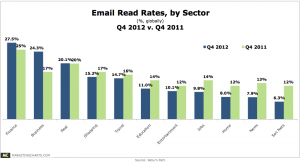
Charting e-mail read rates. (Correction: non-read rates.)

E-Mail Read Rates (Open Rates), Return Path, 4th Quarter 2012One of the great things about e-mail marketing is the ability to track nearly everything about its success (or lack thereof).

A recent Return Path Intelligence Report on e-mail statistics covering the 4th Quarter of 2012 is a case in point. Return Path conducts these studies by monitoring data from thousands of e-mail campaigns that utilize its delivery platforms.

Specifically, the  study tracks the inbox, blocking and filtering rates for more than 400,000 campaigns that use Return Path’s Monitor and Email Client Monitor suites, along with panel data from the company’s Inbox Insight program.

For the 4th study, Return Path reviewed nearly 250 ISPs in North and South America, Europe, Asia and Australia.

And what does its most recent study find? Fewer than one in five e-mails (17%) were opened. And that rate is slightly lower than what was recorded in the 2011 4th Quarter study.

However, some business sectors performed substantially better than the average:

  • Finance sector: ~28% open (read) rate
  • Business sector: ~24%
  • Real estate sector: ~20%

Shopping e-mails fared less well, with a read rate of ~15% (down from ~17% the previous year).

E-mail open rates in the education (~11%) and entertainment (~10%) fields were lower still.

And the worst sectors? News sector e-mails had an average open rate of only ~8%, while social networking e-mails fared even worse at ~6%.

Moreover, both of these bouncing-in-the-basement sectors experienced very significant drop-offs from the previous year, underscoring how they continue to struggle in their efforts to be interesting and relevant to readers.

For those who wish to view additional results and analysis, the Return Path report is available here.  It’s a free download.

Pew Research: Bookworms Going Increasingly Digital

Digital bookworms
Pew finds more readership of e-books, mirroring the healthy increase in tablet computer, smartphone and e-reader sales.

According to the Pew Research Center’s latest survey of American adults (ages 16 and older), ownership of a tablet computer or an e-reader such as a Kindle or Nook has grown substantially in the past year.

According to Pew’s year-over-year findings, ownership grew from ~18% in late 2011 to ~33% by late 2012.

[For those who are counting, tablet ownership increased from ~10% to ~25% of adults, while e-reader ownership rose a little slower, from a similar 10% level to about 19%.]

Based on these findings from Pew, it shouldn’t come as much surprise that e-book readership is also on the rise.

Other results in the Pew survey confirm this: The percent of U.S. adults who read an e-book within the past year is now ~23%, up from ~16% a year earlier.

Conversely, the proportion of printed book readers is declining; Pew finds that ~67% of adults read at least one printed book during the year, which is a drop from ~75% in late 2012 and ~78% in late 2011.

Who are most likely to be reading e-books? According to Pew, they’re the “usual suspects”: better-educated (college or greater); higher-income ($75,000+ annual household income); and folks who are in the 30-49 age range.

No significant differences were discerned in gender or racial segments, although the incidence of e-book readership skews somewhat higher among urban/suburban dwellers compared to those living in rural areas.

And there’s one other type of book platform with some degree of popularity among U.S. adults: ~13% of respondents reported that they had listened to at least one audio book over the course of the year.

Now to a fundamental question: Are we a nation of readers?

The answer to that question depends on your point of view, of course. Some people devour books all the time, while others will do anything they can to avoid reading a single one.

The Pew survey found that book readers tackled an average of 15 books across all “platforms” during the course of the year.

But the median number of books read was just six, leading one to conclude that some people are really, really voracious readers, and they drive the average much higher than the median figure.

Additional findings from the always-interesting Pew research in its invaluable Internet & American Life Project can be found here, for those who are interested in looking through more of the “entrails” …

Apps come of age. (Translation: Average app revenues are cratering.)

Smartphone app developmentWell, it was nice while it lasted.

App developers have had a pretty lucrative playing field over the past several years. But like so much else in cyberspace where there’s a “drive to the bottom,” paid apps are no longer the path to guaranteed revenue riches they might have been once.

According to mobile market research firm Research-2-Guidance, total paid app revenues continued to grow in 2012 – and by a healthy rate of 27% — to reach $8 billion.

But at the same time, the average revenue generated per paid app fell at the very same 27% rate.

As a result, the average revenue generated per paid app declined from ~$26,700 in 2011 to just ~$19,500 in 2012.

Research-2-Guidance posits that the decline in average sales per paid app could ultimately lead to a situation where developing paid apps is no longer a profitable endeavor.

“There are now so many applications available that supply even exceeds demand,” company spokesperson Vincenzo Serricchio noted in a summary statement.

In line with the notion that “everything in cyberspace wants to be free,” information technology research and advisory firm Gartner projects that by 2016, nearly 95% of app storefront downloads will be free rather than paid apps.

And even among the paid apps, the Gartner analysis estimates that nine out of ten of these app downloads will be priced at $3 or lower.

Yet another forecast – this one by Strategy Analytics – predicts that the average price for all phone apps (free and paid combined) will drop to just 8 cents per app by 2017.

Most major brands don’t really care about pushing paid versus free apps, as they typically use them for boosting branding exposure and engagement rather than for revenue generation per se. However, with so many quality free app options being offered, the question is how many app developers – particularly those in the gaming field – ultimately will find the new landscape unprofitable or otherwise unpalatable.

Stay tuned.

Delaware’s unclaimed property gambit: Small state … Big bucks.

The state of Delaware is serious about collecting unclaimed property at corporations.The state of Delaware has a reputation for being very friendly to corporations. And that’s not just talk, because there are more corporations registered in Delaware than in any other state.

In fact, more than half of all publicly listed U.S. companies have chosen to incorporate in Delaware.

But it turns out that there’s another side to the coin: This “business friendly” state is also ruthless about going after the unclaimed property that these corporations possess.

Companies that are incorporated in Delaware are obligated to turn over all unclaimed monetary property to the state. And the state is relentless in pursuing those funds.

For unclaimed dividends and securities, the Delaware law kicks in after three years. For other unclaimed property such as gift certificate balances and life insurance benefits, the state claims possession after five years.

There’s criticism, of course. Many contend that Delaware is unduly onerous in its unclaimed property dictates when compared to other states.

Chances are, such criticism falls on deaf ears. Why? I like what Chris Hopkins, a lawyer with Crowe Horwath LLP, says about the situation: “Unclaimed property is crack for the state of Delaware,” he contends.

And how much is the unclaimed property worth? Estimates are that Delaware has collected more than $1.2 billion in property, interest and penalties in just the past three years. The state uses the proceeds it collects to conduct state business – just as it would using state income tax revenues.

And woe to any company that neglects to keep proper tabs on its unclaimed property, because Delaware looks back more than 30 years when it conducts audits.

How many companies have robust records going back that far?

No records? No problem! The state will cheerfully estimate the amount your company owes – along with all of the accrued interest and penalties, of course. And they’ll accept your payment with a smile.

But there’s been enough grumbling about the record-keeping requirements that the state has grudgingly initiated a “temporary voluntary disclosure program,” wherein companies can make a good faith effort to identify unclaimed property dating back to “only” 1996.

If companies can show that they aren’t hiding any problems, the state will forego further auditing back into prior years.

Delaware Secretary of State Jeffrey Bullock stated this about the new voluntary program: “There was a recognition that we had to come up with a better system to meet the ultimate goal, which is to have companies in compliance.”

So which goal is it?  Companies in compliance? … Or a cool billion in added revenues for the state’s coffers?

You know the answer.

The corporate resource commitment to social media: Plenty of talk … but how much action?

Social media staffing prospects for 2013 are no better than they were in 2012.With social media activity seemingly bursting at the seams, it’s also risen near the top of many marketing departments’ punch lists of tactics to reach, engage with and influence their customers and prospects.

But when it comes to putting serious resources behind that effort, how much of a commitment is really there?

A recent Ragan Communications/NASDAQ OMX Corporate Solutions survey suggests that the commitment to social media may be a lot of “talk” … and a lot less “walk.”

The November 2012 survey of ~2,700 social media professionals found that two-thirds of the respondents perform their social media tasks above and beyond their regular marketing duties:

  • Social media tasks are on top of current responsibilities: ~65% of respondents
  • Have established a team for social media activities: ~27%
  • Use an in-house team along with an outside social media agency or planner: ~5%
  • Outsource all social media efforts: ~3%

For the distinct minority of companies that have seen fit to devote some degree of dedicated personnel to their social media program, nearly 85% of them have created teams of three people or fewer … and in more than 40% of the cases, it’s just a single individual instead of a team.

What departments within companies are involved in social media activities?  No surprise here:  It’s the usual suspects (marketing and public relations) with a variety of other departments having their toe in the water as well:

  • Marketing: ~70% of departments are involved in social media activities
  • Public relations: ~69%
  • Corporate communications: ~49%
  • Advertising: ~26%
  • Customer service: ~19%
  • Information technology: ~17%
  • Legal personnel: ~14%

As to whether we’re on the cusp of something much bigger in terms of resourcing social media activities, this isn’t evident much at all from the future plans of the businesses surveyed by Ragan.

Let’s begin with budgets. Excluding salaries and benefits, half of the companies surveyed have social media budgets of $10,000 or less – and one-quarter have essentially no dollars at all earmarked for social media:

  • Annual social media budget $1,000 or less: ~23% of respondents
  • $1,000 to $5,000: ~14%
  • $5,000 to $10,000: ~13%
  • $10,000 – $50,000: ~22%
  • $50,000+: ~26%

When asked whether companies had expanded their social media personnel assignments during 2012, fewer than one-third of the respondents answered affirmatively.

… And the trend doesn’t look much different for 2013, with more than three-fourths of the respondents reporting that there aren’t any plans to hire additional social media practitioners this year.

What about interns, that fallback position for cheap and easy labor?

Fewer than one-fourth of the respondents reported that interns are employed by their companies for social media tasks. Most others believe that using typically inexperienced interns for the potentially sensitive customer engagement aspects of social media is a “non-starter,” as they consider those sensitivities to be a disqualifying factor.

And in the cases where interns do help out in social media efforts, the vast majority of their activity is confined to Facebook and Twitter, as compared to LinkedIn, blogging,creating online “thought leadership” articles and the like.

How satisfied are companies with how they’re doing in the social media realm? According to this study, there’s rampant dissatisfaction with the degree to which companies feel able to measure the impact of social media on their sales and their businesses.

The tracking mechanisms put in place by companies range the gamut, but it’s not clear how convinced practitioners are that the information is accurate or actionable.

  • Track interaction and engagement (e.g., followers, fans, likes): ~86% of respondents
  • Track web traffic: ~74%
  • Track brand reputation: ~58%
  • Track customer service and customer satisfaction: ~41%
  • Track new lead generation: ~40%
  • Track new sales revenues: ~31%

The vast bulk of tracking activity happens using in-house mechanisms or free measurement tools (~59% use those), although the paid measurement tools offered by HootSuite and Radian6 do have their share of users.

The takeaway from the Ragan/NASDAQ research is this:  Company staffing and resource allocations have a ways to go to catch up with all the talk about social media.

Chances are, those resources will be easier to allocate once proof of social media’s payback potential can be shown.  But that might take substantially more time to prove than some people would like.

As if to underscore this notion, statistics compiled by IBM researchers covering the past holiday season found that less than 1% of all online purchases on Black Friday emanated from Facebook.  The percentage of purchases from Twitter was even lower — undetectable, in fact.

And similarly paltry results were charted for the rest of the 2012 holiday season.

As long as social media marketing continues to contribute such pitiful sales revenues, get used to seeing scant social media budgets and near-zero increases in dedicated human resources.

As direct marketing specialist and raconteur Denny Hatch has so pointedly remarked:

“Social media marketing is an oxymoron.  You cannot monetize a giant cocktail party.”

What do you think?  Is Mr. Hatch onto something … or is he just reaching for dramatic effect?  Share your own thoughts if you’d like.

A new milestone for LinkedIn: 200 million users.

LinkedIn reaches a new milestone:  200 million registrants.
LinkedIn is adding new registrants at a rate of two per second.

It may have gotten lost in the shuffle amongst the news about other social platforms like Twitter, Facebook … and now Pinterest and Instagram … but LinkedIn has quietly signed up its 200 millionth user.

While LinkedIn may have only a fraction of the 1 billion users who have signed up on Facebook, reaching the 200 million milestone is a pretty big deal for a professional networking site, and in fact makes LinkedIn the 800 lb. gorilla in the professional social segment.

LinkedIn is adding nearly 175,000 new registrants each day; that averages out to about two per second. So it comes as no surprise that if you look at LinkedIn’s trajectory over the recent years, it like one of those exponential lines:

  • January 2009: 32 million user registrations
  • March 2011: 100 million
  • December 2012: 200 million

LinkedIn has gone worldwide, too – although it’s not as international as Facebook. There are LinkedIn members in more than 200 countries and territories.  The United States continuing to lead the pack, but it now represents well fewer than half of registrants:

  • USA: ~74 million user registrants (37%)
  • India: ~18 million (9%)
  • United Kingdom: ~11 million (6%)
  • Brazil: ~11 million (6%)
  • Canada: ~7 million (4%)

There are detractors to look at Facebook and its user profile and see a lot of chaff among the wheat: a large portion “wannabe” professionals who are sole proprietors of varying degrees of consequence or even validity.

But at least these people actually exist, which is much more than you can say about the Twittersphere – the very archetype of the “digital Potemkin Village.”

LinkedIn’s growth isn’t just noteworthy in and of itself. It’s also become much more of a revenue machine … to the tune of an 80%+ rise in 2012 3rd Quarter revenues in over the same period in 2011. Look for that trend to continue.

Launched a decade ago, LinkedIn’s been fluttering around the periphery of the “big boys’ club” in social media for the better part of a decade.

Clearly, they’ve joined the club now.

Grand Funk: PC Sales are in the Doldrums

PC sales decline in 2012
Eyebrow-rasing stat: Worldwide PC shipments declined in 2012 … the first drop since 2001.

If people had any doubts about the inexorable rise of tablet devices and smartphones, the sales results for the holiday season would surey erase them.

In fact, for the first time in five years, holiday PC sales have actually declined. Tech industry tracking firm IDC reports that personal computer manufacturers sold just shy of 90 million units worldwide during the last quarter of 2012. That’s down more than 6% compared to PCs sold in the final quarter of 2011.

What makes the news doubly troubling for the PC segment is that, unlike in 2009 when sales of all tech devices were hammered by a worldwide recession, this time around sales of other devices such as tablets and smartphones have grown substantially.

And considering 2012 as a whole, the news is even worse. The estimated 352 million PCs sold were ~3% lower than in 2011, which makes this the first annual decline in more than a decade – since 2001 in fact, when the 9/11 attacks roiled markets and impacted sales of all goods across the board.

And it isn’t trouble for just one manufacturer, either: The 2012 sales drop hit all of the big players including Dell, HP and Lenovo.

What about the prognosis for 2013?

It’s not much better. IDC is forecasting mediocre growth in the PC segment (less than 3%) — although at least that isn’t a decline.

But on the downside, it’s very possible that tablets will actually outsell PCs in 2013 – a possibility that would have seemed unthinkable just one or two years ago.

We’re hearing a number of explanations for the slump in PC sales. One of those is that Microsoft’s new Windows 8 operating system isn’t doing much to excite buyers – at least not so far.  The surge in new PC hardware purchases, which commonly occurrs when newer versions of Windows have been introduced, hasn’t happen this time around.

More fundamental than the Windows 8 conversion rate are signs that PCs are losing their edge over other devices in the perception that they’re the most secure, reliable and efficient options.

This shift may be less about PCs themselves or their quality, and more about the aggressiveness by folks like Apple iPad and their incursions into the PC “space.”

Bank of America: The Financial Institution Everyone Loves to Hate

Bank of AmericaIf you’ve ever had an unpleasant or unfulfilling experience regarding Bank of America and how it handles transaction fees, branch operations or customer service in general, raise your hand.

Uh-huh.  I thought so. 

Our family’s lone experience working with BofA (when an inherited bank CD matured a few years back) was enough to elicit the famous cry:  “Never again!”

Evidently, we’re not alone.  According to the latest American Customer Satisfaction Index report, customers give Bank of America its lowest satisfaction score in more than a decade.

In fact, BofA’s 2012 score of ACSI score of 66 out of possible 100 points is two points lower than its 2010 score.

There’s more:  Not only does BofA trail all of its main banking competitors, it’s the only financial institution with a customer satisfaction grade that is actually lower than its pre-recession level.

Not surprisingly, the bank is also the least popular one among consumers.  It’s had that ignominious distinction for four years running.

Just how are big banks faring in general?  The ACSI report reveals the following index scores (out of a possible 100):

  • JPMorgan Chase:  74 (up 7 points from 2010)
  • Wells Fargo:  71 (-2)
  • Citigroup:  70 (-1)
  • Bank of America:  66 (-2)

In general, consumers tend to rate smaller banking institutions, with an aggregate score of 79, higher than their big-bank rivals.  But the highest ratings in this sector are reserved for credit unions (82).

Incidentally, the American Customer Satisfaction Index is also calculated for the major insurance carriers — one of the 47 industries and 10 sectors that it surveys quarterly.  Who’s on top there?  Blue Cross/Blue Shield scores best among health insurance firms with a 73 rating, while Aetna brings up the rear with a 67 score.

As for property and casualty insurance providers, the scores are somewhat better.  State Farm and Progressive lead in this category with an 81 score … but none of the other major firms do significantly worse.

If you’re interested in exploring the results in greater depth, you can review the current and historical ACSI scores here.