Taking the “phone” out of “smartphone.”

SmartphonesAs more consumers migrate to the smartphone from traditional feature phones, we’re seeing a transformation of the mobile phone away from its original “tele” purpose.

That’s the conclusion of several studies by analytics firms Flurry and Wireless Intelligence.

In an analysis of smartphone users’ app activity conducted in December 2011, Flurry found the an interesting breakdown of daily activity that places mobile gaming at the top of the list:

 Playing downloaded mobile games: ~49% of daily app activity
 Interacting with Facebook and other social networks: ~30%
 Viewing mobile entertainment: ~7%
 Checking/reading news: ~6%
 Other applications: ~8%

And Wireless Intelligence found some very intriguing figures in its analysis of smartphone user activity conducted in mid-2011.

Of the average ~38 hours of time spent on smartphones per month, actual “phone calling” represented less than one-fourth of the time:

Messaging activities: ~29% of smartphone user time
 Interacting with apps: ~29%
 Voice activities: ~23%
 Web browsing: ~19%

What we’re seeing is that the original purpose of the cellphone has devolved into a position of distinctly lower importance. In time, it could well become the asterisk at the bottom of the page.

And this is happening inside the span of 15 years.

To borrow a phrase from former Speaker of the House Newt Gingrich, you’d be hard-pressed to cite another device that has so “fundamentally and profoundly” changed its functionality and user purpose over such a short amount of time.

It makes one wonder what the next 15 years will bring …

Clean energy initiatives banging up against cold harsh reality.

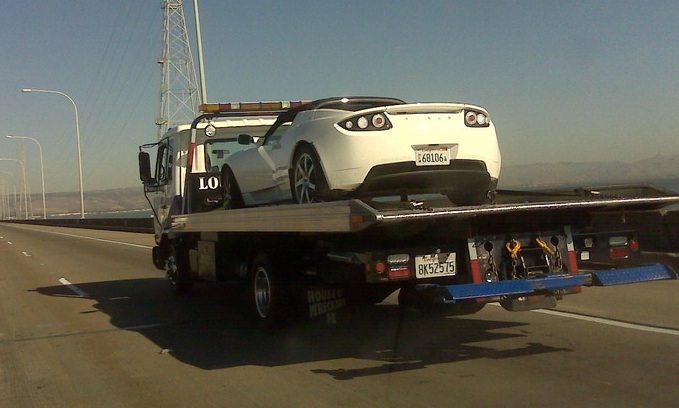
Inoperable Tesla Roadster being towed on a flatbed.Let’s face it: This hasn’t been a very good year for environmental and clean energy initiatives. First it was the Solyndra debacle — a saga that appears to be never-ending.

Next were the reports of “global warmists” getting caught fabricating documents in an attempt to deflect attention away from the steadily mounting data that’s making global warming no longer the “consensus view” in the scientific community.

And now we have a damning report about Tesla Motors’ vaunted Roadster electric vehicles, the darling of the clean car crowd.

It turns out that most of the Roadster models sold into the market suffer from severe design flaws that can essentially destroy the value of the car. If the vehicle’s battery becomes totally discharged, the car becomes completely immobile; the vehicle won’t start, and it can’t even be pushed down the street.

The only remedy for hapless Roadster owners? Tesla will cheerfully replace the battery system … for a cool $40,000. And the owners will have to pay the entire bill, too, because Tesla’s warranty policy does not cover car damage due to battery failure.

That is correct: For those who purchase a Roadster, when it comes to battery-related repairs there’s no warranty … no insurance available from outside carriers … and no payment plan.

[To be fair, Tesla does offer a $12,000 “battery replacement program” for cars whose batteries are more than seven years old. Of course, that figure doesn’t begin to cover the ~$32,000 battery replacement cost plus ~$8,000 in labor charges.]

Some auto industry wags have started to call the Roadster by another name – the “Brickster.” That’s because when the car is immobilized due to the death of the battery, it becomes completely inoperable — basically thousands of pounds of dead weight.

Owners who face the misfortune of a full battery discharge will come to find out that conventional towing won’t work because the car’s wheels won’t even turn. Instead, they’ll have to figure out a way to lift the entire vehicle onto a flatbed truck for towing and repair … in the process spending additional hundreds (or thousands) of dollars in towing fees.

And lest people think that the battery depletion occurs only because of stupidity on owners’ part in forgetting to plug their vehicle in … not so fast. In some instances cars were plugged in but the electrical charge wasn’t strong enough to charge the battery, perhaps because an extension cord was too long.

And considering the hefty ~$109,000 sticker price of a Roadster, it’s disappointing to discover that the vehicle’s battery can become fully discharged in as little as one week’s time. Good luck with that if you find yourself stuck somewhere that’s not in close proximity to an electrical power source.

And for people parking their Roadster at the airport lot during a family vacation … better just hope that the charging mechanism is working properly. Either that, or have someone check up on your vehicle several times during your trip, lest your vacation ends up costing you an additional forty-grand.

The Tesla cautionary tale is yet another example of the disconnect that exists between the promise of clean energy and the practical challenges of turning it into reality.

To begin with, at ~$109,000 a pop, how many consumers can even afford the cost of a Roadster? And how many people who could afford the vehicle will actually plan to sink their hard-earned cash into a product that possesses such fatal design flaws? Even gas pump prices of $7 or $8 per gallon won’t change that dynamic.

Tesla has sold only ~2,500 Roadsters so far. But its aggressive plans call for manufacturing ~25,000 of its new Model S Roadsters by the end of 2013.

The company’s optimistic forecasts are based on the belief that the Model S’s lower price tag of ~$50,000 will attract a new and larger crop of consumers.

But I wonder if that will actually happen. After all, the sticker price remains high … and the “battery bricking” issue will only become more apparent to consumers as more Roadster vehicles end up on the highway.

Time will tell whether the Tesla Roadster’s fortunes will soar to new heights … or sink under its own (dead)weight. Maybe it’s worth making a $40,000 bet on the outcome.

Social Media Communities: Digital Potemkin Villages?

Social media stats riddled with fake accounts and cipher profilesMarketers like to talk about the 90-9-1 rule of web engagement: For every 100 people who are online, one person creates content … 9 people comment on that content … and the remaining 90 may lurk and read, but never participate in any other way.

The more we learn about social media engagement, the more we’re seeing the same phenomenon at work. To wit, studies of social networks like Twitter, Facebook and Google+ are finding far fewer numbers of “real” and “active” users than the gross statistics would suggest.

Alarmingly, these evaluations are finding that as many as half of social media accounts could be fake, or are ones that contain no user profiles.

And if there isn’t a user profile, of what value is a social media account to marketers? After all, it’s the information in these user profiles that provides the data for targeted advertising and marketing campaigns.

Just how extensive is the problem?

Let’s start with Google+, one of the latest entrants into the social media sweepstakes. Kevin Kelly, an industry specialist, published author and former editor of Wired magazine, recently conducted an analysis of the ~560,000 people who have him in their Google+ “circles.”

Reviewing a random sample of these ~560,000 users, he found that the majority of them had not made a single post … had not posted their image … and/or had never made a single comment.

More specifically, here’s what Kelly found:

Only ~30% had ever posted anything
 ~6% were “spammers”
 Fully ~36% were “ghosts” … accounts lacking even a user profile

Evidently, Google+ is taking “ghostwriting” to new heights.

What about Twitter?

Several editors at Popular Mechanics magazine reported recently that only ~25% of their Twitter followers were “real.” About half were identified as fake users or spammers.

Twitter may be tweeting away … but how many people are actually listening and who’s actually engaging?

Who’s gaming the system here? Clearly, there are reasons why people are trying to show higher social media engagement than is actually occurring. Marketing campaigns love to cite metrics where the number of followers and “likes” is high. It’s great for bragging rights … and sometimes financially beneficial, too, when performance goals are met and monetary payouts triggered.

And today there are plenty of ways for people to find services that will jumpstart campaigns by garnering thousands of followers or “likes” … all for a tidy fee, of course.

It would be nice if the social media platforms would step up to the plate and show some transparency in what’s going on. It’s highly likely that these platforms have developed sophisticated ways to pinpoint which of their accounts are real … versus those that are contrived.

But will they be publishing their findings anytime soon? Don’t hold your breath.

Until marketers can get a better handle on the “real facts” behind the elevated engagement numbers being hyped, it’s best to view any such stats with a jaundiced eye.

Here’s a suggestion: Take any stats you might hear about page “likes,” viral video views and the like … and discount them by a massive percentage – say, by 50%. Then, you might be approaching the reality.

Over time, we’ll probably learn more about “authenticity” when it comes to tracking true activity and engagement in the social realm. Marketers would do well to demand it. It’s just not clear how soon it’ll happen.

Until then, keep your antenna up and apply caveats all over the place.

Marketing Measurement: Aiming Really High … Scoring Kinda Low

Marketing ROI - return on investmentThere’s clearly a disconnect in the world of business regarding the theory and practice of ROI measurement for marketing campaigns.

That’s the key takeaway from the 2011 State of Marketing Management Report, based on a survey of 200+ U.S. marketing professionals in the B-to-B and B-to-C realm.

The research was conducted by Ifbyphone, a Chicago-based developer of voice-based marketing automation platforms, with results published in December 2011.

More than 80% of the marketers surveyed report that their executive management expects every campaign to be measured. But fewer than 30% of the respondents believe they can effectively evaluate the ROI of each campaign.

Not surprisingly, e-mail marketing, with its robust reporting capability, is the program that is reportedly most easy to measure for return on investment … whereas public relations programs are most difficult.

Here’s how eight marketing techniques fared in the survey in terms of their ROI measurement “difficulty”:

 E-mail marketing: ~53% of respondents report difficulty measuring ROI
 Direct mail campaigns: ~59% report difficulty
 Online advertising: ~60% report difficulty
 Print advertising campaigns: ~66% report difficulty
 Tradeshow marketing: ~72% report difficulty
 Social media: ~74% report difficulty
 Search engine optimization: ~76% report difficulty
 Public relations: ~82% report difficulty

The survey found some correlation between the types of marketing tools utilized and greater ability to measure ROI. The most popular tools used by the survey respondents included these five:

 Web analytics: ~48% utilize
 e-Mail marketing software analytics: ~47%
 Lead counts from online contact forms: ~38%
 Social media monitoring: ~30%
 Call tracking: ~27%

The study’s bottom-line finding: Marketers have a good deal more work to do to meet senior management expectations for campaign measurement … as well as to meet their own high standards.

Now for the tough part …

Compensatory Damages? Comparing Public and Private Sector Employee Compensation

Public sector worker protests against benefits cutsFor years, it was a truism so well understood it could be etched in stone: A government job was one where the pay wasn’t all that great … but the benefits were wonderful and there was good job security.

The accepted tradeoff was between receiving lower salary compensation in the public sector in exchange for job security and good benefits. Lower reward, perhaps … but also lower risk.

Over the past decade, however, there’s a growing perception that this balance has shifted almost entirely in the direction of public sector workers. And now we have the data to prove it.

A recently released analysis by the Congressional Budget Office reports that federal government employees receive significantly higher total compensation than private sector workers with the same level of education and/or experience.

The CBO analysis found that the average salary for federal workers runs approximately 2% higher than similar jobs in the private sector. So the private sector salary premium seen historically no longer exists.

Benefits are another key factor. And in fact, the value of federal employee benefits now exceeds private sector programs by a whopping 48%. Taken together, total compensation for federal workers exceeds their like counterparts in the private sector by 16%.

That isn’t chump change. With federal employee compensation running $200 billion per year, a 16% premium in compensation represents a beaucoup bucks, actually.

But even with these stark statistics, we continue to hear complaints about the plight of public sector employees. To see how off-tone this sounds, compare the new CBO report with the continuing claims of the federal Office of Personnel Management that federal workers are underpaid by 26% compared to private sector positions.

That contention goes all the way back to the early 1990s, but it’s still quoted as if it’s Gospel truth some 20+ years later.

Really? Which one of these two studies do you believe more?

With the beating that companies in the private sector have had to take in order to remain competitive in a down economy – indeed, even to survive – the notion that federal workers’ average total compensation is lower than comparable private sector jobs doesn’t pass the snicker test.

And what about state and local public sector jobs? The studies may not be as comprehensive, but the evidence looks very much the same. Anecdotally, I know that every time salaries and benefit packages earned by public officials in my state and/or local jurisdictions are published, I hear howls of protest from people who feel that the compensation is way out of line with the rest of the market.

Public employee unions like to talk a lot about fairness. And at the end of the day, it is about fairness: In an economy where business has been battered, unemployment and underemployment continues to be rampant, and many employees who have managed to hold on to their jobs have had to endure big sacrifices in salary cuts, benefit cuts and increased co-pays … for public sector employees to expect the world to stand still for them and them alone seems anything but fair.

Consider the fact that a significant number of local governments – and even some states – are facing huge looming pension payouts and other financial obligations that threaten to bankrupt them. In such an environment, it’s unrealistic for public sector advocacy groups to think they can hold jurisdictions to 25-year-old commitments that were based on actuarial and tax revenue assumptions that are no longer valid.

A couple of maxims are in order: Times change. You can’t get blood out of a turnip. And yes, we can get ourselves out of this situation. But people are going to have to be flexible in their thinking for the effort to succeed.

Wolfgang throws down the gauntlet on SOPA/PIPA and Internet privacy … Would anyone care to pick it up?

Wolfgang NebmaierThe outcry concerning the enforcement provisions included in the pending SOPA (Stop Online Piracy Act) and PIPA (Protect Intellectual Property Act) legislation in Congress has been swift.

… And effective too, evidently, as numerous elected officials have scooted away from the legislation (including some who were once co-sponsors of the legislation.)

Among the more interesting commentary I’ve read from concerned citizens on this topic is a note I received from Wolfgang Nebmaier, an industry colleague who provides business translation services for corporations.

He has is an interesting perspective, I think, considering his background and business activities. Here are some excerpts from what he wrote me:

I am of German descent. This makes the issue of censorship very personal to me. During all times of state terrorism, free speech was not free. Instead, [an elaborate] spy system is established, as was the case with Hitler, and later Stalin, and later … anywhere.

To speak your mind without making sure the walls “have no ears” was potentially fatal. In fact, my father … barely escaped death, but only because he knew the side streets of Munich ‘like the back of his hand’ and was able to ditch his pursuers. He spent the remaining time of the Third Reich hiding – along with his uncle, who had escaped from Dachau – under the snow in a mountain cabin. Believe me, this history is engraved ‘deep in my DNA.’

In all cases of curtailed civil liberties, a perceived external threat is used to justify the big, crude hand of the state appropriating the role of protector …

And make no mistake, we already live in an extremely supervised state. There are more than ample mechanisms in place to monitor and watch people closely. As an example, PayPal, ‘the world’s most-loved way to pay and get paid,’ monitors and analyzes the amounts and subjects of all your money traffic. Recently, this led to a ‘friendly reminder’ to me that I had had too many transactions of a certain amount with a certain title; I was forced to justify all the amounts and the title.

So state censorship is just a law away. The infrastructure is already in place in terms of technology and people.

Every time an “authority” is created, inevitably it wants to prove itself necessary, assert itself and re-enforce its power. It will, sooner or later, be champing at the bit to ‘do its thing.’

Another tidbit: I am a translator and, as such, occasionally canvas job sites. Recently when I looked for translation jobs, there were just a few – except for a plethora of national security-related language analysis jobs. These are Blackwater-type, non-governmental government proxies hired to monitor whatever they are told to monitor – ‘just doing their job.’ The infrastructure of Big Brother watching every click we make is in place, my friend … way in place!

Regardless of what side you take in the SOPA/PIPA debate, the concerns raised by Wolfgang are well worth considering. They’re definitely food for thought for the 21st Century.

Convention centers: Where the laws of supply and demand don’t seem to matter.

McCormick Place, Chicago, IL

For those of us in the business world, it comes as no surprise that conventions and trade shows are in significant decline. While they’re not exactly on life support, we’ve witnessed convention attendance drop pretty significantly over the past decade.

In fact, the decline in the United States has been more than 30% — from 125 million attendees in 2000 to just 86 million in 2010.

It’s not hard to understand why. The “shocks and hard knocks” of the economy have contributed, of course. But in addition to this, the ways people communicate have been changed forever by the online/interactive revolution.

With lean staffing — who has time anymore to take four days away from the office? – plus the ability to congregate easily online in virtual forums and meetings, the need for face-to-face interaction just isn’t the same as it once was.

With such a steep decline in trade show attendance, one wouldn’t expect that investment in new or updated convention centers would be high on the agenda, correct?

Think again. Even as cities and their convention centers are competing for a shrinking pool of convention-goers, they’ve continued on an expansion binge – paid for by hapless taxpayers.

You don’t have to look hard to see example after example of initiatives that make essentially no economic sense, being undertaken by cities in a form of one-upsmanship that is reminiscent of that famous Irving Berlin song, “Anything you can do, I can do better.”

At McCormick Place in Chicago – the convention venue everyone loves to hate – the city has invested heavily in expansions and upgrades in recent years. In 2007, a new $900 million expansion was completed … and today McCormick Center is running at 55% capacity. Swell, fellas.

Closer to where I live, Baltimore City built a brand new, city-owned hotel to the tune of $300 million, thinking it would improve the sagging fortunes of its convention center. Opened in 2008, the hotel has managed to lose money in every successive year – as much as ~$11 million in 2010.

So what is Baltimore’s reaction? It’s now considering putting together a new public-private initiative that will add an arena, yet another convention hotel, plus an additional ~400,000 square feet of convention space. The cost in public money? “Only” about $400 million.

From Boston to Austin and from Columbus to Phoenix, public officials dupe themselves into believing that if only they upgrade or expand their convention facilities, they’ll see robust growth that meets or exceeds optimistic projections of increased hotel bookings and other ancillary economic activity.

Time and again, they’re wrong. And not just because of the economy or changing business practices. When every other city is expanding right along with you, no one is going to attract more than their fair share of any additional business potential that may be out there.

I love what Jeff Jacoby, an op-ed columnist for the Boston Globe, had to say about the newest efforts to expand Boston’s convention center (along with a ~$200 million price tag in new public subsidies), even after a less-than-stellar 2004 improvement initiative fell woefully short of the predicted new convention activity.

“The whole thing is a racket,” Jacoby stated. “Once again, the politicos will expand their empire. Once again, crony capitalism will enrich a handful of wired business operators. And once again, ‘Joe and Jane Taxpayer’ will pay through the nose. How many times must we see this movie before we finally shut it off?”

How many times, indeed.

The 24/7 Work Week

The 24/7 work weekIf you’re thinking that work demands are increasingly encroaching on your life at home … you’re not alone.

According to the U.S. Department of Labor’s Bureau of Labor Statistics in survey results released earlier this summer, more Americans are using their weekends to get more done on the job. The results came from a survey that involved interviews with ~13,200 people over the age of 15.

Non-self-employed persons in office or administrative positions are less likely to be working on weekends. Only 20% of those folks report doing weekend work, compared to ~82% of them working on weekdays either full- or part-time.

But on a typical working day, nearly one in four employed Americans reported that they do at least some of their work at home. Not surprisingly, self-employed people are likely to do so, but those working in business management are more likely to do so as well.

The BLS reports that employed men spend, on average, 8 hours and 9 minutes per day on work or work-related activities. That’s a bit more time than employed women spend on work-related activities (their daily average was 7 hours and 26 minutes).

However, the trajectory appears to be upward for women and downward for men … so it may not be long before any difference between the genders completely disappears.

And for those people who work more than one job … that’s where weekends have lost most of their meaning as a time for R&R, because fully half of the people with multiple jobs find themselves working weekends.

As things evolve, it’s becoming pretty clear that the “Protestant Work Ethic” for which our society is so well known remains pretty robust, 200+ years on.

It reminds me of how a teacher of Russian History explained things to us students in class at Vanderbilt University back in my college years. Speaking of Southern Europe, this professor claimed, “People work to live” … whereas in Northern Europe, “They live to work.”

For some folks, as their working years grind on, they might be thinking that the whole enterprise has become a little sucky. But hopefully, most of us are performing tasks we like or love, so that it doesn’t seem quite so much like “work” … or apply whatever other coping mechanism does the trick!

Hedy Lamarr: A Hollywood Tale where Truth is Stranger than Fiction

Hedy Lamarr in Hollywood DaysWith rare exceptions, the movie stars we encounter do precious little beyond their acting craft that warrants more than just a “gawk factor” response.

Probably the most famous of those exceptions is Ronald Reagan, who also happened to become one of the 20th Century’s most consequential presidents.

But there are others as well. In 2000, I remember reading an obituary of film star Hedy Lamarr, the bombshell beauty active during Hollywood’s “golden age” of the 1940s. There was a passing reference in the obit about Lamarr collaborating on several important inventions, with patents involved also.

I filed this away in my mind as an “interesting factoid” about a woman who otherwise led a pretty typical life of a Hollywood actress – not least her vampy screen name and her six marriages. (Her full name was a real mouthful: Hedwig Eva Maria Kiesler Mandl Markey Loder Stauffer Lee Boies!)

Now we have a new book that’s just been published, and it sheds fascinating light on the “inventive” aspects of Lamarr’s life. As explained in Richard Rhodes’ book, Hedy’s Folly: The Life and Breakthrough Inventions of Hedy Lamarr, the Most Beautiful Woman in the World, it turns out that even as Lamarr was wowing her movie audiences, she was also deeply involved in the invention of the frequency-hopping spread spectrum radio.

“What’s that?” you might ask. It’s technology that harnesses the rapid switching of communications signals among a spread of different frequencies. And it’s the basis for what gives us the functionality of the digital gadgets we use today, from cellphones to GPS units and barcode scanners.

How this came about was due in large part to Lamarr’s background. Instead of being a product of America’s small towns who traveled to California to make it big in the film industry, Hedy was from cosmopolitan Vienna – born into a prosperous family during the waning years of the Austro-Hungarian Empire.

As a girl, Hedy had a natural aptitude for math and science, finding these subjects most interesting of all. But educated in the arts (ballet) and music in accordance with a young girl of her social standing, Hedy then began working with film director Max Reinhardt in Berlin, eventually starring in major roles. A few of these, such as Gustav Machatỷ’s steamy film Ecstacy, tested the limits of censorship, earning her a certain notoriety.

In 1933 – barely 20 years old – she married Friedrich Mandl, a Viennese munitions magnate who became involved with supplying arms to the German government shortly thereafter. Mandl objected to Hedy’s film career – effectively banning her from the industry in favor of being the head of household at Schloss Schwarzenau, the family’s castle-compound.

Mandl also took her to meetings with technicians and business partners, which is where she began to learn about munitions and the technology behind them.

As a well-educated intellectual and individualist – as well as a person with Jewish lineage – Hedy was strongly opposed to what was occurring in Austria politically. The formal Anschluss with Nazi Germany would come about in 1938, but even before then, close collaboration was developing between the two countries.

Hedy would depart Vienna prior to the union of Germany and Austria, but not before doing two things. First, in true pillow-talk form redolent of a Hollywood thriller, she learned as much information from her husband about munitions and weapons as she could. Then she ditched the country for Paris (taking her expensive jewelry with her), and proceeded to divorce him.

It was in Paris that she met Louis B. Mayer, who convinced her to join MGM in Hollywood where he gave her the screen name “Hedy Lamarr.” She would go on to make 20 films during her Hollywood career, the most successful of them being Samson & Delilah.

But it was also in Hollywood that Lamarr became involved with inventions. At a dinner party, she was introduced to George Antheil, the infamous enfant terrible of avant garde classical music in America. One of Antheil’s most notorious and controversial compositions was the Ballet Mécanique, a music score that utilizes a bank of player pianos operating simultaneously.

In conversations, the two discovered their mutual interest in technology … soon realizing that they could pool their knowledge and apply for a patent on a “secret information system.” The patent utilized a piano roll as a device to change between 88 frequencies, thereby making radio-guided torpedoes harder for enemies to detect or jam.

Although the patent was approved in the early 1940s, the idea wouldn’t be implemented until 1962 during the Kennedy Administration’s Cuban blockade.

More importantly for us, the frequency-hopping concept served as the basis for the advent of spread-spectrum communications technology. Lamarr would finally be given public credit for her invention in 1997 in an award bestowed on her by the Electronic Frontier Foundation (co-inventor Antheil had died in 1959).

In later years, Lamarr moved away from Hollywood and essentially shed the limelight, living quietly in Florida where she died in 2000. In accordance with her wishes, her ashes were returned to Austria and scattered in the Vienna Woods, — the storied grounds memorialized in the sweet melodies of Johann Strauss Jr. and Rudolf Sieczyński … but that had also borne silent witness to so much of Europe’s 20th Century turbulence and strife.

It was a fitting ending for a life that was likewise noteworthy – even by Hollywood’s own outré standards!

The Google+ Social Network: Net Plus or Net Minus?

Google Plus, Google+What’s the latest with Google+? The big splash predicted when the new social platform hit the web has been more of a ripple instead.

Underscoring this, recent news reports have suggested that Google basically missed the boat on social media … and that rival Facebook is far too well-established to face anything more than just token competition going forward.

It’s true that many people find the prospects of building and engaging in yet another social media channel a wearying thought, to say the least. There are, after all, only so many hours in the day.

But Google doesn’t want to cede the social media marketplace to Facebook without a fight. That’s understandable, considering the billions of dollars in potential advertising revenues that come from being able to serve ad messages to people who are connected to others who “like” a product or service.

The results charted to date on Facebook confirm that displaying friend “likes” adds an extra measure of credibility to advertising. That’s manifested in a clickthrough rate that’s three times what’s typical for other advertisements on the social platform.

The launch of Google+ this past summer hasn’t resulted in huge user adoption, that much is clear. The Google+ social platform has managed to nab ~40 million users, which isn’t a shabby number in and of itself. But it pales in comparison to the more than 800 million active users on Facebook.

But despite this less-than-stellar performance, we see clues as to where Google is going with its social platform. That’s because Google’s equivalent of the “like” button – the “+1” notation that shows up on Google’s search engine results pages – goes further than simply communicating the news to those in someone’s own Google+ network. Google is also mapping that information through to its Gmail account base.

Google’s Gmail service has hundreds of millions of users, and those who use the site regularly have accumulated dozens or hundreds of contacts. So when a user clicks +1, Google can show that result not just to the user’s social friends on Google+, but also to his or her contacts in Gmail.

[For those who cry “foul” on privacy grounds, Google maintains that clicking the “+1” button is a public action and therefore not subject to privacy considerations.]

The jury’s still out on what the social map will look like in a couple years. There’s little doubt Facebook will still be the biggest guy on the block. The question is, to what extent will Google have taken the 600 pound gorilla down a notch? Stay tuned …