Volunteerism: Is it a Mormon and Midwestern Thing?

Volunteerism in AmericaDuring my adult life I’ve lived in all four regions of the United States. Each of them has its distinct positive aspects (along with a few not-so-positive ones).

Of course, these differences are part of what makes living in America so interesting.

One regional difference I’ve noticed is a greater predilection for volunteerism among people who live in the Midwest and Western regions. 

That anecdotal observation on my part has now been confirmed by the results of a consumer survey conducted in late 2012 by New York-based Scarborough Research.

In broad terms, Scarborough found that approximately 27% of American adults reported having participated in some form of volunteer activities over the previous year.

That percentage breaks down further by demographic age clusters as follows:

  • All Adults: ~27% have volunteered during the past year
  • Baby Boomers (age 45-64): ~34%
  • Gen Xers (age 30-44): ~27%
  • Millennials (age 18-29): ~20%
  • Silent Generation (age 65+): ~18%

Looking more closely at the 27% of respondents who volunteers, the Scarborough research revealed that, while volunteerism is found throughout the United States, certain urban markets have a distinctly larger proportion of their population so involved.

And when you look at the list – and Scarborough studied more than 85 local markets – you’re hard-pressed to find any of them located east of the Mississippi River. Instead, the list is completely skewed towards the Midwest and West:

  • Salt Lake City, UT: ~42% of adults have volunteered during the past 12 months
  • Des Moines, IA: ~34%
  • Minneapolis-St. Paul, MN: ~34%
  • Portland, OR: ~34%
  • Grand Rapids, MI: ~33%
  • San Francisco, CA: ~33%
  • Seattle, WA: ~33%
  • Green Bay, WI: ~32%

Which urban markets are at the bottom of Scarborough’s list? All of them are located in coastal states:

  • Ft. Myers, FL: ~22% of adults have volunteered
  • Las Vegas, NV: ~22%
  • New Orleans, LA: ~22%
  • Bakersfield, CA: ~21%
  • El Paso, TX: ~21%
  • Harlington, TX: ~20%
  • Miami, FL: ~20%
  • Providence, RI: ~20%

Scarborough also found that those who volunteer their time tend to be more generous with their financial support:

  • They are ~84% more likely to have contributed to an arts or cultural organization within the past year
  • ~61% more likely to contribute to an environmental organization
  • ~60% more likely to financially support a social care, welfare or political organization
  • ~57% more likely to have contributed to a religious organization

More details on the Scarborough Research findings, including stats for more than 85 local markets, can be found here.
The (Mostly) Myth of the Multi-Generational Family Business

Multi-generational family businessesThe idea of the family enterprise is practically an article of faith when it comes to American business.

But how much of a reality is it? And do family businesses generally survive from one generation to the next?

To begin with, let’s make clear that there are many family-owned businesses in the United States.  In fact, consulting organization Family Enterprise USA estimates the figure at around 5.5 million entities.

But the average life span of a family business is fewer than 25 years, meaning that only a distinct minority of them remain in the family over time.

The stats are stark. Here’s how they break down by generations:

  • Business passed to the 2nd generation: ~40% of family owned entities
  • Business passed to the 3rd generation: ~13%
  • Business passed to the 4th generation: ~3%

When asked for their opinion, about half of the owners of family businesses stated that they would like to see the business stay in the family when the next generation comes along.

And for larger family businesses (those that employ 20 or more workers), nearly three-fourths would like this to happen.

But wishes and expectations aren’t the same … because only ~23% of these same respondents actually think that a transition to the next generation of family members is “likely” to happen.

At my company, we have some clients – perhaps 15% of our customer base — that are into their 2nd or 3rd generation as family-owned entities. But in my view, it’s highly doubtful that the next generation of family members will end up in charge at most of them.

Groupon’s Slow-Motion Train Wreck

Groupon failure of business modelI’ve blogged before (several times, actually) about the problems with Groupon’s business model and the difficulties it’s encountered since going public.

It seems that the twin whammies of new competitors plus merchants’ increasing unwillingness to take a bath on offering deep-discounted products and services to ultra price-sensitive consumers have been enough to send Groupon’s business into a financial tailspin.

One key takeaway from the Groupon couponing experience: Consumers who are attracted to bottom-of-the-barrel pricing have absolutely no brand loyalty thereafter – unless they’re offered a similarly extreme price discount the next time around.

Understandably, merchants aren’t much interested in marketing practices that boil down to being creative ways to divorce profits from sales.

And now, with yet another quarter of dismal financials just released, Groupon’s board of directors has done the inevitable: separating CEO and founder Andrew Mason from his company.

As the famously quirky Mason, who was once a student of music at Northwestern University, put it in a letter to Groupon employees (which he also released publicly “since it will leak anyway”):

“After four and a half intense and wonderful years as CEO of Groupon, I’ve decided that I’d like to spend more time with my family. Just kidding – I was fired today. If you’re wondering why … you haven’t been paying attention.”

And then Mason goes on to summarize the ugly facts: two quarters of missing the company’s own financial expectations, along with a stock price that’s baely one-fifth of Groupon’s listing price when the company went public ~18 months ago.

Business observer and talk-show personality Jeff Macke has been merciless in his condemnation of Groupon’s recent business performance. He writes:

“In its short, ignominious history as a public company, Groupon crushed the hopes of more true believes than Santa Claus and Jim Jones combined. From its closing level on the day of its IPO in November 2011, GRPN shares have lost more than 80%, driven by accounting scandals, an ill-conceived international expansion and generally poor execution of a not-very-smart business model … What is fresh information is the company’s hideous earnings miss … when it reported a 12-cent loss versus expectations of a 2-cent gain.”

Late moves by the company to staunch the bleeding – such as taking a smaller cut of revenue on daily deals during the latest holiday season in an attempt to attract and keep merchants – haven’t been very successful and haven’t reassured investors.

In late 2012, Andrew Mason was dubbed “Worst CEO of the Year” by CNBC’s Herb Greenberg.  But not every business journalist and analyst has been completely critical of CEO Mason. In an interview with the New York Times, Stifel Nicolaus’ Jordan Rohan remarked: “I view Mason as a visionary idea generator. Few would argue with how impressive the Groupon organization was as it grew.”

But Mr. Rohan went on to report, “However, at some point it became the overgrown toddler of the Internet – operationally clumsy [and] not quite ready to make adult decisions.”

For many of us in the marketing field, peering at Groupon from the outside was like seeing a slow-moving train wreck in the making, so the latest news is pretty much what we expected.

But perhaps the biggest surprise is how similar it all looks to the ill-starred Internet pure-plays of the dotcom bubble a decade ago.

Titanic deck chairs – USPS edition: The Postal Service is getting into the clothing business.

New USPS apparel line "Rain Heat & Snow"The U.S. Postal Service, hemorrhaging red ink all over the place, has finally decided to jettison Saturday mail delivery.

This decision was taken after years of (very public) hand-wringing and amidst dire predictions of public outrage if the trigger was actually pulled on eliminating Saturday delivery.

Yet, once the decision was finally announced, public response was … near silence. It was a total shrug.

[Politicians, take note: This may also turn out to be the public’s reaction to the sequester cuts kicking in — breathless predictions to the contrary aside.]

Of course, we all know the USPS hasn’t been able to catch a break in recent times. As mail volumes continue to slump, the postal service finds itself attempting to spread its fixed and operating costs over a steadily smaller share of mail volume.

According to the USPS’s own figures, there’s been a ~33% decline in catalogs mailed in just the past four years.  First class mailed hasn’t fared much better, decreasing by one-fourth over the past decade.

At worst, the situation is a recipe for complete failure … at best, the USPS will just continue to lurch from one mini-crisis to another. 

So what to do with such dire prospects staring you in the face?

Why not start a clothing line!

That is correct: The USPS has announced plans to launch a new line of apparel and accessory items. It is partnering with Cleveland-based apparel company Wahconah Group to launch the product line, which will be sold under the brand moniker Rain Heat & Snow.

Forget trying to figure out mail delivery practices that will work in the 21st Century. According to the USPS’s corporate licensing manager, Steven Mills, “This agreement will put the Postal Service on the cutting edge of functional fashion!”

By “cutting edge,” Mills is apparently referring to the fact that the new clothing line will incorporate wearable electronics technology to make the items “smart.”

Isaac Crawford, CEO of Wahconah, reports that “the products will build on the rich American history of this iconic brand, creating specialized apparel for consumers, at affordable prices, delivering something new and exciting that retailers can offer their customers.”

Is anyone jumping up and down with excitement yet?

Tellingly, none of the Rain Heat & Snow apparel will be available at post office locations — only at department stores and apparel shops.

I guess it would be rather strange to encounter mannequins and display racks amongst the shipping containers, change-of-address forms and passport applications at your local post office branch.

As much as many people would like this new venture to be a success, I can’t visualize this endeavor causing anything more than a minor blip on an otherwise steady downward trajectory for the postal service.

So, is it back to the drawing board?

Victory of the hayseeds: Meredith Corporation makes a play for Time, Inc.’s magazine titles.

Meredith Corporation logoIf the imminent acquisition of the magazine portfolio of Time, Inc. by publishing giant Meredith Corporation goes through as planned, it will mark a symbolic end to the dominance of New York City in the consumer magazine publishing game.

And for this long run to end at the hands of a family-owned publishing company based in Des Moines, Iowa seems pretty ironic: Manhattan’s fashionable streets vanquished by the cornfields of Iowa!

You have to go back nearly a century to see how things got started. The year 1922 saw the founding of Time magazine in New York City. That same year, out in Iowa, Edwin Thomas Meredith started a publication called Fruit, Garden & Home. That magazine would be renamed Better Homes & Gardens shortly thereafter.

Today, BHG is one of the biggest consumer magazine titles in the United States. It’s a flagship brand among a well-known group of titles published by Meredith Corporation including American Baby, Family Circle, Ladies Home Journal, Parents, Family Fun, Every Day with Rachel Ray and Eating Well.

These publications and others help give Meredith a commanding edge in the important women’s reader demographic. And now, the pending acquisition of the Time media properties – including Fortune, Sports Illustrated and People magazine in addition to Time – gives Meredith important penetration into other readership sectors as well.

Meredith’s recent growth strategies aren’t confined to print alone. It’s also signed licensing agreements with retailers like Wal-Mart for selling home and outdoor products. The company seems intent on generating income from a group of strong, powerful brands that transcends merely print to encompass merchandising and other marketing schemes.

There may be delicious irony in the fact that the “nerve center” for consumer and news publications may soon be migrating from New York City to Des Moines.

“The revenge of the hayseeds,” as it were.

But in another way, perhaps it’s only fitting. It could be argued that New York City is no longer the “intellectual umbilical cord” for news and consumer style trends – and hasn’t been for some time; its monopoly on being the arbiter of such things disappeared years ago.

Besides, Des Moines is probably a lot more representative of the readership of U.S. consumer magazines than Manhattan Island is.

What do analysts think of Meredith’s moves on Time? Keach Hagey, a reporter for The Wall Street Journal, spoke with industry analysts and found that many expect Meredith to make important moves to streamline operations and increase efficiencies. These actions will likely trim ~25% of operating expenses from the merged business.

Hagey goes on to report, “They believe Meredith’s no-nonsense culture and roots in consumer marketing might finally enable the kind of cross-brand advertising buying that Time, Inc.’s titles always seemed ripe for, but only just started to move into.”

If Meredith indeed has a collaborative, team-oriented culture that minimizes office politics, that seems like a better recipe for success in a tough business environment like consumer magazine publishing is today.

Fourteen billion web pages … but you can get from any one to any other in 19 clicks or less.

Opte Project Web Network Map
A visualization of the ~14 billion pages that make up the network of cyberspace. Red lines represent links between web pages in Asia … blue lines for North America … yellow for Latin America … green for Europe, Africa and the Middle East … white for unknown IP addresses.  (Opte Project)

There are an estimated 14 billion+ web pages in existence. But even with this massive number, you can navigate from any single one of those pages to any other in 19 clicks or less.

That’s the finding of Albert-László Barabási, a Hungarian-Romanian physicist and network theorist. He’s constructed a simulated model of the web, and in doing so discovered that of the ~1 trillion web documents in existence (this figure includes every image or other file hosted on every one of the ~14 billion web pages), most are poorly connected.

In other words, they’re linked to just a few other pages or documents.

But the web also has a smallish number of pages associated with search engines, indexes and aggregators that are highly connected and can move from one area of cyberspace to another.

It is these “super-potent” nodes that allow people to navigate from most areas to most others relatively easily.

Physicist Albert-László Barabási
Albert-László Barabási, physicist and network theorist.

Hence Barabási’s “19 clicks or fewer” finding.

He posits that the web mirrors fundamental human experience: the impulse for people to tend to cluster into communities (both real and virtual).

Thus, the pages that make up the web aren’t linked randomly. They’re part of an interconnected organizational structure that includes country, region, subject/topic area and so forth.

That interconnectivity is illustrated nicely in the Opte Project’s “map” of cyberspace. This endeavor, spearheaded by Internet entrepreneur Barrett Lyon, gives us intriguing visualizations of the web and how it is interconnected.

The resulting picture (see above) is impressive, visually arresting … and even a bit scary.

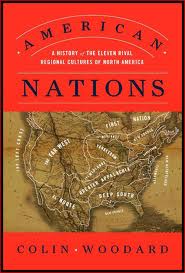
United States … or United Nations? Author Colin Woodard reminds us that “who we are now” is “where we were when.”

"American Nations," a book by Colin Woodard.
In his book “American Nations,” Colin Woodard divides the continent into 11 distinct territories.

It’s tempting to think about the United States as a pretty monolithic country and culture. Certainly, if you listen to the views of Continental Europeans or people from the Middle East, it seems that’s how many around the world view us.

But the reality is far more complex. Speaking as someone who has lived in all four major regions of the U.S. — the Northeast, Midwest, South and West — I’ve experienced first-hand a variety of different regional “quirks.”

And now we have an interesting book that really delves into the phenomenon of America’s distinct regions. In his book American Nations, published in 2011 and now available in paperback, journalist and author Colin Woodard takes us on an interesting regional tour of the continent.

Woodard counts no fewer than eleven “nations within a nation.” And as he defines them, they’re actually spread throughout the United States, Canada and Northern Mexico.

What exactly are these “nations within a nation” and how did they come to be?  They’re the result of early settlers, later migration patterns, and deep-seated cultural affinities that, while somewhat mitigated in recent years, are still surprisingly resilient even after 150 or 200 years.

The one “nation” on Woodard’s map that may characterize what many people think of as “America” is one he calls “Yankeedom.”

“Yankeedom nation” stretches from New England and Upstate New York to the Midwest, encompassing Northern Ohio, Michigan, Wisconsin and Minnesota.

According to Woodard, this region’s character and social culture stem from the utopian communities founded by Puritans and the later immigrants from Scandinavia. In “Yankeedom nation,” intellectual achievement is valued along with an abiding belief in public institutions’ ability to improve and even perfect society.

Understanding these attributes makes it easier to see how the Grange Movement, Robert LaFollette’s Progressive Party and even RomneyCare came into being here rather than in some other part of the United States.

The polar opposite of Yankeedom may well be “Greater Appalachia nation,” a region on Woodard’s map that stretches from Southwestern Pennsylvania west and south to encompass nearly the entire states of West Virginia, Kentucky and Tennessee along with vast swatches of contiguous states.

Also referred to as “The Borderlands,” this “nation” also includes areas we don’t usually associate with Appalachia such as the Ozarks, Oklahoma, Central Texas and even a bit of Eastern New Mexico.

What ties this sprawling “nation” together? The eastern portions of the region were settled not by English planters, merchants or Puritans, but by Scots-Irish immigrants who brought with them a fighting spirit along with a sense of fierce independence and suspicion of central governments.

They and their descendents later migrated to the western regions, bringing their cultural predilections with them. Think of John McCain’s fighting spirit – whose ancestors settled in Mississippi from further east – and you have a flavor of the abiding characteristics of this region.

The great observer of American politics, Michael Barone, has written about Greater Appalachia nation’s antipathy to the social and governmental policies of the current administration in Washington, DC. He notes that even as President Obama has won the White House twice with relative ease, he’s actually fared worse with voters in the Borderlands region when compared to the unsuccessful efforts of John Kerry and Al Gore, losing every county in the states of West Virginia, Arkansas and Oklahoma and carrying precious few anywhere else.

American Nations, by Colin Woodard.Woodard’s book delves into a great deal of rich regional history in order to reveal to us how these and the other “nations” came to be. It’s a fascinating volume that will surely spark some of your own thoughts and perceptions of “America” – in whole and in part.

If you have some personal observations or experiences that illustrate the regional differences in the country, please share them in the comment section below.  As for myself, I’m a person who was born in the “Tidewater nation” and who has relatives in the “Deep South nation.” When attending high school in the Twin Cities (smack in the heart of “Yankeedom nation”), I found it interesting how clueless my otherwise intelligent, knowledgeable and well-traveled schoolmates were about anything to do with the Deep South.

In particular, Mississippi and Alabama were always being mixed up in their minds.

And of the ~50 people who graduated from my high school class, consider these stats: While easily three-fourths of our grads chose to attend college or university out of state … nearly 90% of the class stayed in Woodard’s “Yankeedom nation.”

A coincidence? I think not.

[By the way, I was one of the ~10% who elected to attend college in another “nation,” a decision I never regretted.]

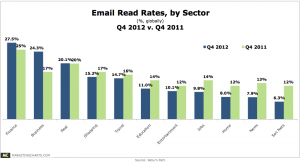
Charting e-mail read rates. (Correction: non-read rates.)

E-Mail Read Rates (Open Rates), Return Path, 4th Quarter 2012One of the great things about e-mail marketing is the ability to track nearly everything about its success (or lack thereof).

A recent Return Path Intelligence Report on e-mail statistics covering the 4th Quarter of 2012 is a case in point. Return Path conducts these studies by monitoring data from thousands of e-mail campaigns that utilize its delivery platforms.

Specifically, the  study tracks the inbox, blocking and filtering rates for more than 400,000 campaigns that use Return Path’s Monitor and Email Client Monitor suites, along with panel data from the company’s Inbox Insight program.

For the 4th study, Return Path reviewed nearly 250 ISPs in North and South America, Europe, Asia and Australia.

And what does its most recent study find? Fewer than one in five e-mails (17%) were opened. And that rate is slightly lower than what was recorded in the 2011 4th Quarter study.

However, some business sectors performed substantially better than the average:

  • Finance sector: ~28% open (read) rate
  • Business sector: ~24%
  • Real estate sector: ~20%

Shopping e-mails fared less well, with a read rate of ~15% (down from ~17% the previous year).

E-mail open rates in the education (~11%) and entertainment (~10%) fields were lower still.

And the worst sectors? News sector e-mails had an average open rate of only ~8%, while social networking e-mails fared even worse at ~6%.

Moreover, both of these bouncing-in-the-basement sectors experienced very significant drop-offs from the previous year, underscoring how they continue to struggle in their efforts to be interesting and relevant to readers.

For those who wish to view additional results and analysis, the Return Path report is available here.  It’s a free download.

Pew Research: Bookworms Going Increasingly Digital

Digital bookworms
Pew finds more readership of e-books, mirroring the healthy increase in tablet computer, smartphone and e-reader sales.

According to the Pew Research Center’s latest survey of American adults (ages 16 and older), ownership of a tablet computer or an e-reader such as a Kindle or Nook has grown substantially in the past year.

According to Pew’s year-over-year findings, ownership grew from ~18% in late 2011 to ~33% by late 2012.

[For those who are counting, tablet ownership increased from ~10% to ~25% of adults, while e-reader ownership rose a little slower, from a similar 10% level to about 19%.]

Based on these findings from Pew, it shouldn’t come as much surprise that e-book readership is also on the rise.

Other results in the Pew survey confirm this: The percent of U.S. adults who read an e-book within the past year is now ~23%, up from ~16% a year earlier.

Conversely, the proportion of printed book readers is declining; Pew finds that ~67% of adults read at least one printed book during the year, which is a drop from ~75% in late 2012 and ~78% in late 2011.

Who are most likely to be reading e-books? According to Pew, they’re the “usual suspects”: better-educated (college or greater); higher-income ($75,000+ annual household income); and folks who are in the 30-49 age range.

No significant differences were discerned in gender or racial segments, although the incidence of e-book readership skews somewhat higher among urban/suburban dwellers compared to those living in rural areas.

And there’s one other type of book platform with some degree of popularity among U.S. adults: ~13% of respondents reported that they had listened to at least one audio book over the course of the year.

Now to a fundamental question: Are we a nation of readers?

The answer to that question depends on your point of view, of course. Some people devour books all the time, while others will do anything they can to avoid reading a single one.

The Pew survey found that book readers tackled an average of 15 books across all “platforms” during the course of the year.

But the median number of books read was just six, leading one to conclude that some people are really, really voracious readers, and they drive the average much higher than the median figure.

Additional findings from the always-interesting Pew research in its invaluable Internet & American Life Project can be found here, for those who are interested in looking through more of the “entrails” …

Power to the people: Online medical diagnosis is here to stay.

Online medical adviceWith the plethora of medical information websites now available, the results of the Pew Research Center’s recent survey on online medical diagnosis behaviors by “Jane and John Q. Public” comes as little surprise.

The research, part of Pew’s Internet & American Life Project, found that ~35% of U.S. adults surveyed reported that they’ve used the web to try to figure out what medical condition they may have … or have done so for a friend or family member.

Pew calls these people “online diagnosers.” Of these, a plurality (~46%) reported that their online research led them to conclude that they needed the attention of a medical professional.

And what about the accuracy of their initial diagnoses? Here’s what the Pew survey revealed:

  • A medical professional confirmed their diagnosis: ~48%
  • A medical professional did not agree … or offered a different opinion about the condition: ~18%
  • The medical professional’s view was inconclusive: ~1%
  • A medical professional or clinician wasn’t visited to get a professional opinion: ~35%

The Pew survey also found that certain sectors of the public more inclined tap online resources for diagnosing a medical condition. These segments include:

  • Women
  • Younger age groups (35 or lower)
  • Those with college or advanced degrees
  • Those part of households earning $75,000+ in annual income

Lest you think that the explosion of websites specializing in health information — including the ever-growing array of hospital websites – are the ones spurring the online activity, the Pew survey clearly finds that the standard search engines are where most of the action is happening:

  • Google, Bing or Yahoo-type search engine sites: ~77%
  • WebMD or other health information-type sites: ~13%
  • Wikipedia: ~2%
  • Facebook or other social-type sites: ~1%

Some hospitals are near-obsessive about their patient satisfaction ratings and achieving high quality scores from third-party ratings firms like Press-Ganey. But the Pew survey finds that a distinct minority of health consumers takes the time and trouble to consult such reporting: Only about one in five survey respondents reported consulting online reviews of pharmaceuticals, medical treatments, physicians, or hospitals.

And practically no one posts online reviews of their own about healthcare services or health providers.

Here’s one final piece of information from the Pew survey: Despite the fact that people who search for health information often do so out of a concern for their own health or the health of a family member, that doesn’t mean that they’re willing to pay for the privilege of accessing the information.

To begin with, only around one-quarter of the Pew respondents reported that they had been asked to pay to access the health-related information they wished to see online.

Their reaction when confronted with such a pay wall? Do everything possible to avoid shelling out any money:

  • ~83% attempted to find the information somewhere else without having to pay
  • ~13% gave up searching entirely
  • Just 2% decided to pay for the information

So even in circumstances as fundamental as those involving health, it would seem that information in cyberspace “wants to be free.”